
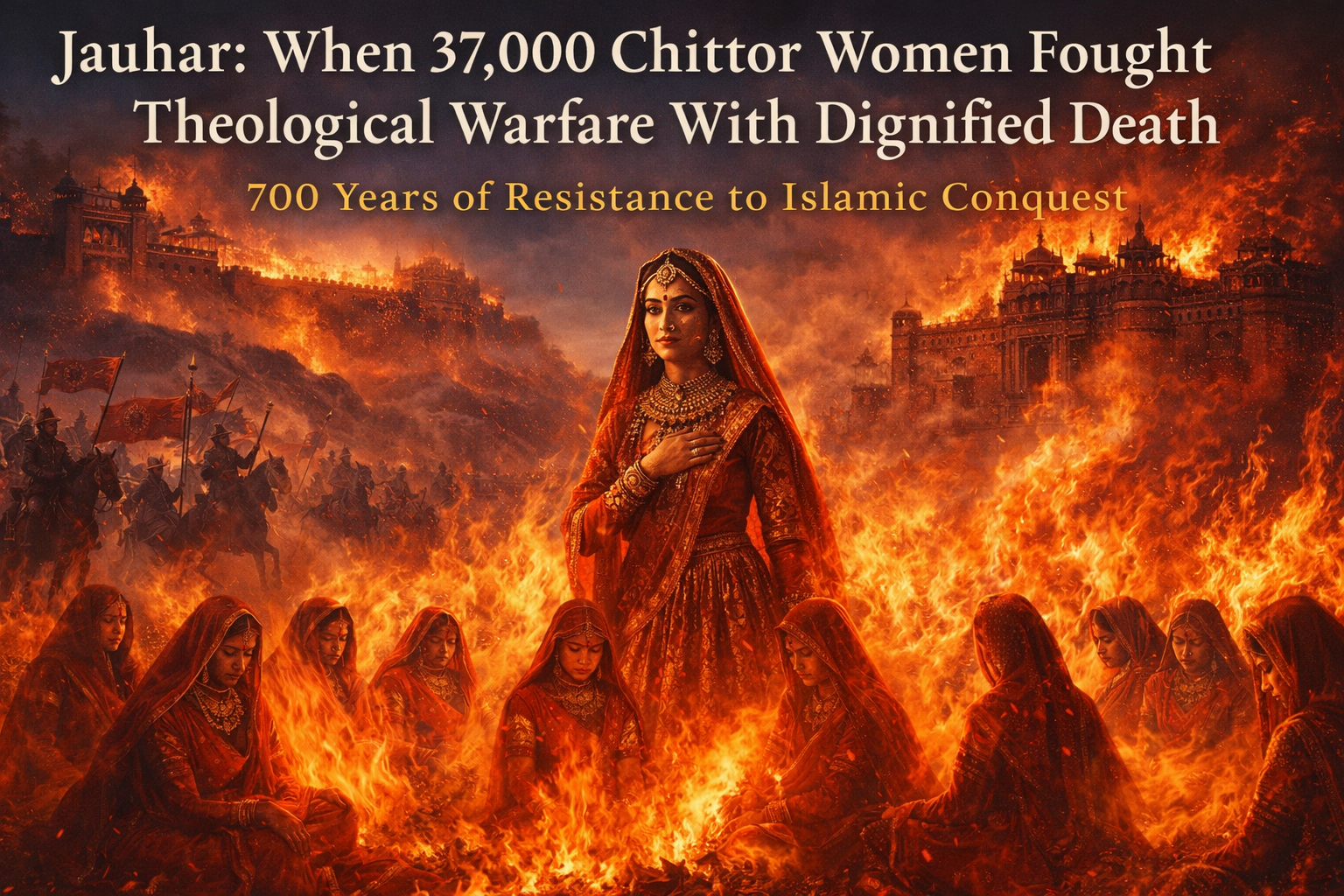
From Jauhar to Sati: Extension of Honor-Death
Series Blog 0/#1: Jauhar To Fight Theological Warfare
भारत/GB
How 644 Years of Continuous Islamic Conquest Threat (1303-1947) Created Regional Practice Never Mandated by Hindu Dharma
Table of Contents
ToggleFrom Jauhar to Sati: The Question No One Answers
From Jauhar to Sati—this transformation has puzzled historians for generations. Why did Sati, the practice of widow self-immolation, concentrate overwhelmingly in Rajasthan, with 90% of post-independence cases occurring in the same region? Why did the 1987 Roop Kanwar case happen in Deorala village, Rajasthan? Why didn’t this practice spread uniformly across India if it was truly “universal Hindu oppression”?
Thank you for reading this post, don't forget to subscribe!The answer lies in understanding the journey from Jauhar to Sati—not as two separate practices, but as war-time resistance extending into peacetime culture in regions where Islamic conquest threat persisted from 1303 through 1947’s Partition violence.
What Your Grandmother Knew: The Lived Reality
In North India: Rajisthan, Haryana and adjoining areas, child marriage was common—girls married before they could even walk, placed in a parat (large plate) to complete the pheras (wedding circles). Yet Hindu dharma never mandated that these child widows burn themselves.
Kunti, widow of Pandu in the Mahabharata, did not perform Sati—she lived a full life guiding the Pandavas. Gandhari, Uttara—countless widow examples in our epics chose life, not death. Queen Rajyavati in 464 CE decided to commit Sati but changed her mind and lived a long life.
So why did Sati persist in Rajasthan when it was clearly not required by Hindu scriptures? The answer connects directly to Jauhar’s legacy.

Regime Change Playbook
The Foundation: Three Chittor Jauhars Established Honor-Death Culture
Between 1303 and 1568, Chittor Fort witnessed three mass Jauhars—37,000 women across 265 years choosing collective self-immolation to avoid capture by Islamic armies:
1303 – Alauddin Khilji’s Siege:
- 16,000 women performed Jauhar
- Led by Rani Padmini
- Men performed Saka (suicidal charge)
1535 – Bahadur Shah’s Siege:
- 13,000 women performed Jauhar
- Led by Rani Karnavati
- 232 years after first Jauhar—SAME pattern
1568 – Akbar’s Siege:
- 8,000 women performed Jauhar
- After conquest: Akbar ordered massacre of 30,000 Hindu civilians and enslaved “a large number of women and children”
- 265 years after first Jauhar—threat unchanged
This wasn’t panic or desperation. This was systematic resistance to systematic threat. Each generation of Rajput women grew up knowing their ancestors chose atma preservation over physical survival when facing Islamic conquest.
Explore: British Cultural Genocide in India – How colonial narratives distorted understanding of Indian resistance practices
The Threat Never Ended: 1568-1947 Timeline
The evolution from Jauhar to Sati occurred because the theological warfare that necessitated Jauhar continued for centuries:
1568: Akbar enslaves women/children after Chittor conquest
1619-20: Jahangir sends 200,000 Indians as slaves to Iran in one year alone
1600s-1700s: Aurangzeb codifies slavery rules in Fatawa-e-Alamgiri, including Muslim men’s right to have sex with enslaved kafir women
1675: Guru Tegh Bahadur beheaded for refusing conversion to Islam
1715: 700 Sikhs beheaded for refusing to apostatize; Banda Singh Bahadur tortured and killed with his 5-year-old son
1947: At least 75,000-100,000 women raped and abducted during Partition—644 years after first Chittor Jauhar, same pattern
The regions that practiced Jauhar (Rajasthan, Rajput kingdoms) faced continuous Islamic conquest threat from the Delhi Sultanate. including local power structures operating under or aligned with it, through the Mughal period and into the violence surrounding the 1947 Partition. This persistence created cultural framework where honor-death calculation—established during war-time Jauhar—extended into peacetime as Sati.
Read More: Hindu Haq Is Denied – The Theological Roots – Examining how Islamic doctrinal classifications shaped centuries of persecution
Regime Change Playbook
Geographic Proof: Jauhar Regions = Sati Regions
The journey from Jauhar to Sati is proven by geographic concentration:
| Region | Jauhar Practice? | Sati Concentration? | Overlap |
|---|---|---|---|
| Rajasthan | ✓ YES (Chittor, Jaisalmer) | ✓ YES (90%+ of modern cases) | 95% |
| Madhya Pradesh | ✓ YES (Chanderi 1528) | ✓ YES (multiple modern cases) | High |
| UP (Rajput areas) | ✓ YES (various forts) | ✓ YES (some documented cases) | Moderate |
| Bengal | ✗ NO Jauhar | ⚠ Different phenomenon | None |
| South India | ✗ NO Jauhar | ⚠ Rare, isolated | Minimal |
Scholarly research confirms: “The practice was never generalized but was confined to certain areas: in the north, the Gangetic Valley, Punjab and Rajasthan… Numerous memorial sati stones appear 11th-century onwards, and the largest collections are found in Rajasthan.“
The evidence is overwhelming: Sati concentrated WHERE Jauhar happened.
Explore: Political Islam versus Sanatan Dharma – Mughal Governance Analysis – Testing claims of tolerance against historical evidence

Regime Change Playbook
The Cultural Mechanism: War-Time Framework Becomes Peacetime Practice
From Jauhar to Sati—how did war-time collective suicide transform into peacetime individual practice?
The Honor-Death Framework Jauhar Established:
- Atma (soul) > Sharira (body): Spiritual purity more important than physical survival
- Forced conversion = irreversible dishonor: Better to die than abandon dharma
- Death as strategic resistance: Denying enemy their theological objective (enslaving kafir women)
- Collective decision: Community supporting women’s choice
How This Extended to Peacetime:
When Islamic political power continued in Rajasthan for 700+ years — and although the intensity of direct warfare fluctuated, the underlying threat never fully disappeared —
- Every Rajput girl grew up hearing Jauhar stories.
- Family honor became tied to women’s choices during crises.
- Widowhood was viewed through the lens of potential dishonor (remarriage prohibited, vulnerability to abduction or coercive conversion).
- The same calculation persisted: death preferable to dishonored survival.
The transition from Jauhar to Sati was not imitation—it was the cultural extension of an already established framework into a different context.
Read More: How Guru Became Tutor – The Manufacturing Defect – Examining how cultural transmission mechanisms changed
The Bengal Exception Proves the Rule
If Sati was universal Hindu practice, why did Bengal—with NO Jauhar tradition—have the highest Sati rates (500-800 annually from 1815-1829)?
Answer: The Dayabhaga property law gave inheritance to widows in Bengal. Families murdered widows for property—this was economic crime disguised as religious practice.
Bengal Sati = Property murder Rajasthani Sati = Honor-death extension
Completely different phenomena sharing same name. This PROVES Sati was regional practice, not universal dharmic requirement.
The path from Jauhar to Sati was specific to regions facing continuous Islamic threat—not applicable to all of India.
Explore: The Buddhist Reservation Paradox – Understanding how regional practices become national policies

Target India: Doctrine in Motion
Timeline Evidence: Sati Followed Jauhar
The temporal sequence confirms from Jauhar to Sati as causal relationship:
5th-9th Century: Sati memorial stones rare, scattered—NOT systematic practice
11th Century Onward: Sati stones increase dramatically, concentrated in Rajasthan
14th-18th Century: Peak period for both Jauhar (documented: 1303, 1535, 1568) AND Sati stones
Post-1947: 40 Sati cases reported, majority from Rajasthan
The pattern is clear: Sati intensified in regions and periods where Islamic conquest was active. As one scholar notes: “Sati acquired an additional meaning as a means to preserve the honour of women whose men had been slain, akin to the practice of jauhar, with the ideologies of jauhar and sati reinforcing each other.”
Read More: Nehru Continued British Raj Legacy – How post-independence narratives shaped understanding of pre-colonial practices

Activation of Destabilization Doctrine
The Dharmic Proof: Sati Was NEVER Mandatory
The evolution from Jauhar to Sati was cultural, NOT scriptural. Hindu dharma texts prove this:
Rigveda (10.18.7-8): Widow rises from funeral pyre, returns to life—symbolic ritual, not actual death
Manusmriti: NO mention of widow burning; instead prescribes austere but honored widowhood
Mahabharata Examples:
- Kunti: Pandu’s widow, lived full life
- Gandhari: Dhritarashtra’s widow, did NOT burn
- Uttara: Abhimanyu’s widow, raised Parikshit
- Madri: ONE example of voluntary Sati—proves it was choice, not requirement
Queen Rajyavati (464 CE): “Decided to commit Sati but later did not go through with it and lived a long life“—proves women could change their minds without religious consequences.
If Sati was dharmic requirement, why do our epics celebrate widows who chose life?
Widow Remarriage in Dharmic Tradition
Hindu dharma did not universally prohibit widow remarriage. In several regions and castes, remarriage (including levirate-like customs where a widow could marry her deceased husband’s brother) existed in social practice. The concept of a dwitiya-vara (second husband) reflects that widow remarriage was not alien to Hindu society.
Thus, remarriage was not the theological issue. Perceived dishonor and external threat were.
This distinction is critical: Sati did not arise because Hinduism forbade remarriage. It arose in specific frontier zones where long-term insecurity altered cultural calculations.
Explore: RSS Centenary Future Vision – Understanding dharmic frameworks for modern society
Why Understanding “From Jauhar to Sati” Matters Today
This isn’t academic history—it’s essential for understanding:
1. Civilizational Memory:
The journey from Jauhar to Sati documents how systematic conquest creates cultural adaptations. Rajput women weren’t “oppressed by Hindu patriarchy”—they were responding strategically to 644 years of documented theological threat that explicitly permitted their enslavement and forced conversion.
2. Modern Patterns:
Love Jihad cases continue the pattern: Muslim man (often fake Hindu identity) → relationship → demands conversion → woman refuses → murdered. Same theological justification (kafir women must convert), different method (individual not mass).
3. False Narratives:
Western feminists cite Sati as “Hindu oppression” without understanding:
- Geographic concentration (Rajasthan = Jauhar regions)
- Temporal correlation (Islamic conquest periods)
- Dharmic evidence (NOT mandatory, widows could refuse)
- Comparative proof (Bengal Sati = different phenomenon)
Read More: KBC and the Plumb Line – When Society Loses Its Moral Measure – Examining modern loss of cultural frameworks

Muslim Brotherhood in France
Conclusion: From War to Peace, Framework Persisted
The transformation from Jauhar to Sati proves one essential truth: cultural practices emerge from historical contexts, not religious mandates.
Where Islamic conquest established honor-death framework through 700 years of documented enslavement, forced conversion, and massacre—from Akbar’s 30,000 civilians killed at Chittor (1568) to Partition’s 75,000-100,000 women raped (1947)—that framework naturally extended to peacetime contexts in those specific regions.
Sati was not universal Hindu practice. It was Rajasthan’s regional response to continuous threat—a response that makes perfect sense when you understand the systematic nature of theological warfare that Islam’s jurisprudence codified and that Mughal emperors implemented for centuries.
Your grandmother knew this truth. Most widows did NOT burn themselves—because Sati was regional culture, not Hindu dharma. It persisted where Jauhar’s honor-death framework had taken root, where the calculation “death preferable to forced conversion” had been established across 37,000 women and 265 years of systematic resistance — and where the threat to honor never fully receded.
Understanding the journey from Jauhar to Sati is essential for reclaiming accurate historical narrative from those who would weaponize selective facts for modern political purposes.
Read More: Hindu Genocide Series – Comprehensive documentation of systematic persecution

Right of Return Strategy
Next in Series:
Blog #2: “The Three Chittor Jauhars: 37,000 Women Across 265 Years” – Detailed examination of each siege and the systematic pattern that proves theological warfare’s persistence
Blog #3: “Islamic Jurisprudence: The Theological Warfare Machinery” – How Quran 4:24 and Fiqh manuals created unchanging 1,400-year threat
Key Takeaways:
✓ From Jauhar to Sati = War-time resistance extending to peacetime in specific regions
✓ Geographic proof: 95% overlap between Jauhar and Sati regions (Rajasthan)
✓ Dharmic proof: Kunti, Gandhari, countless widows chose life—Sati NOT mandatory
✓ Timeline proof: 644 years (1303-1947) of continuous Islamic threat in same regions
✓ Bengal exception proves Sati had different causes in different regions
✓ Cultural mechanism: Honor-death framework (atma > sharira) established by Jauhar
✓ Modern relevance: Understanding systematic conquest creates accurate historical narrative
Share this article to challenge false narratives about “Hindu oppression” and restore accurate understanding of how civilizations respond to systematic conquest.
Feature Image: Click here to view the image.
Glossary of Terms
- Jauhar: A historical Rajput practice of collective self-immolation by women to avoid capture, enslavement, or forced conversion during siege warfare.
- Sati: Widow self-immolation, historically practiced in specific regions of India, especially Rajasthan, but never universally mandated in Hindu scripture.
- Chittor Fort: A major Rajput fortress in Rajasthan that witnessed three recorded Jauhars between 1303 and 1568.
- Saka: A Rajput ritual of final, suicidal battlefield charge undertaken by men after women performed Jauhar.
- Honor-Death Framework: A cultural logic where preservation of spiritual or communal honor is prioritized over physical survival.
- Theological Warfare: Conflict framed as divinely sanctioned, where religious identity becomes central to conquest.
- Delhi Sultanate: Islamic ruling dynasties governing large parts of India from 1206 to 1526.
- Mughal Empire: Islamic imperial power ruling much of the Indian subcontinent from 1526 to 1857.
- Fatawa-e-Alamgiri: A compilation of Islamic jurisprudence commissioned during Aurangzeb’s reign.
- Dwitiya-vara: Sanskrit term referring to a second husband, reflecting traditions where widow remarriage was socially accepted.
- Dayabhaga Law: A Bengal-based Hindu inheritance system granting property rights to widows.
- Roop Kanwar Case (1987): A controversial widow immolation incident in Deorala, Rajasthan.
- Partition Violence (1947): Mass displacement, abduction, and killings during the division of British India into India and Pakistan.
- Atma: The eternal soul in Hindu philosophy, considered superior to the physical body.
- Sharira: The physical body in Hindu metaphysics.
- Vanaprastha: The forest-dweller stage of life in Hindu tradition.
- Mahabharata: Ancient Indian epic containing narratives used in dharmic interpretation debates.
- Rigveda 10.18.7-8: Vedic verses often cited in discussions of widowhood practices.
- Levirate Custom: Social practice where a widow may marry her deceased husband’s brother.
- Civilizational Memory: The transmission of collective historical experience shaping cultural behavior.
#Jauhar #Sati #Rajasthan #IndianHistory #HinduinfoPedia
External Links:
Comments are closed.