

Gandhi’s Prison Address: Aga Khan Palace Was Not Kala Pani (161)
भारत / GB
Part 161: Mahatma Gandhi’s Peace Efforts | Series Index
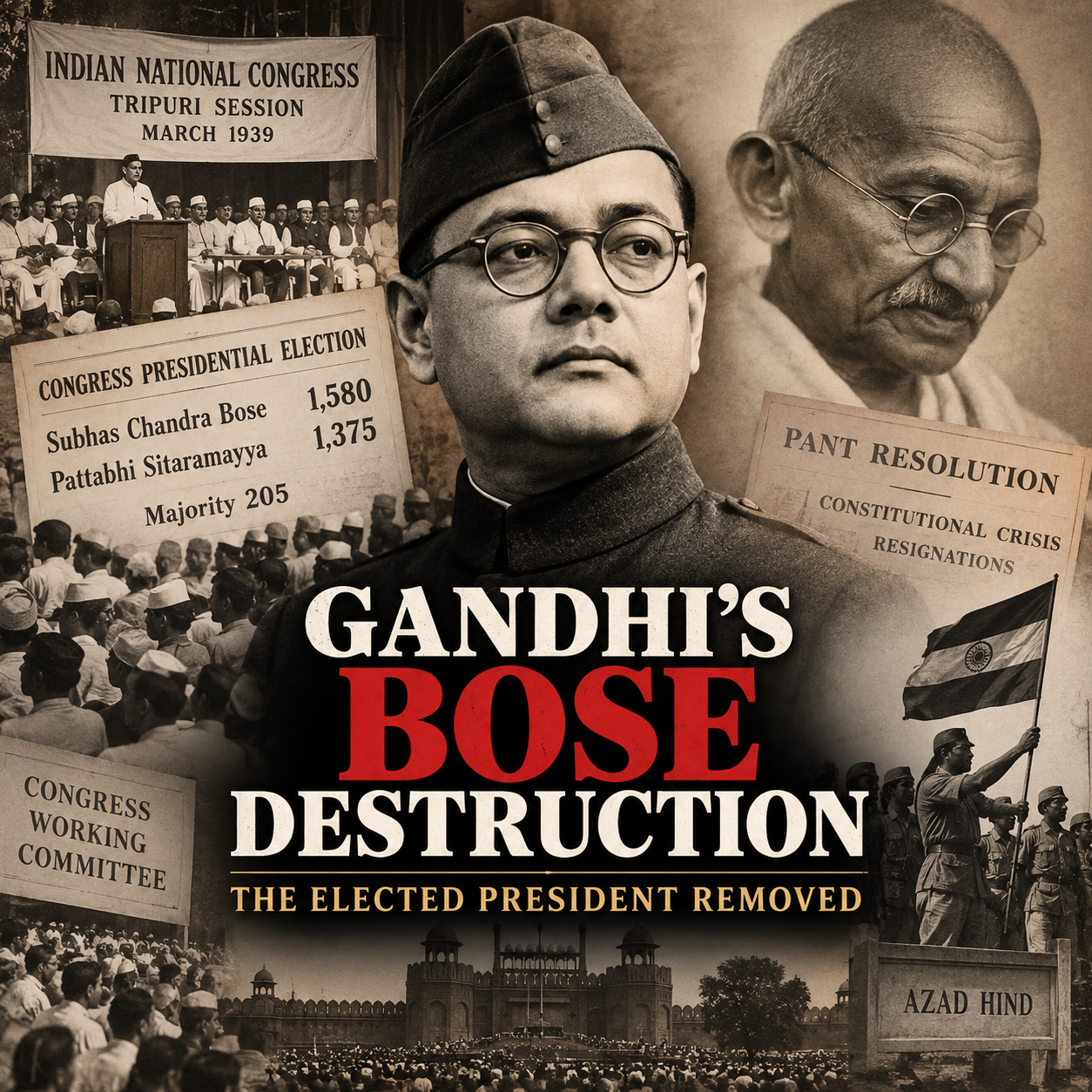
Blog 160 placed the Bose removal before the reader — the elected Congress president rendered ungovernable by the Pant Resolution and Gandhi’s refusal to operate the approval mechanism it created, forced to resign three months after his democratic election. This post, Gandhi’s Prison Address, places a different exhibit before the reader: August 9, 1942, the Quit India arrests — and where Gandhi served his detention.
Thank you for reading this post, don't forget to subscribe!THE HISTORICAL RECORD — THE PATRONAGE & LOGISTICS FILE (Pillar 5 of 7)
The Action Taken: On August 9, 1942, following the Quit India resolution, Gandhi was arrested and interned at Aga Khan Palace, Pune — a palace requisitioned by the British government, staffed with personal attendants, equipped with gardens, and shared with Kasturba Gandhi, Mahadev Desai, and Sarojini Naidu. He remained there until May 6, 1944 — 21 months. The detention was not solitary. It was not punitive in the physical sense. It was administrative internment at a residential palace.
Who Paid the Price: The rank-and-file Quit India participants — arrested, tried, imprisoned in standard colonial jails. For revolutionary nationalists from earlier generations of the independence struggle, the British administration’s instrument was the Cellular Jail, Port Blair — Kala Pani. Between 1932 and 1938, the British government transferred 585 revolutionaries to the Andamans; 100 political prisoners were held there by 1933, when the Cellular Jail hunger strike produced three deaths by forced feeding. The differential in physical conditions between the leader who launched the movement and those who absorbed its consequences was structural, not incidental.
The Alternative Bypassed: No alternative was available to Gandhi regarding the place of detention — the British chose Aga Khan Palace. The exhibit is not about Gandhi’s choice of prison. It is about the differential that the documented record places before the reader: the same British administration that interned the movement’s leader in a palace interned its fighters in conditions the Cellular Jail’s own documentation records as punitive. The question the prosecution places is not whether Gandhi chose his conditions but whether the insulation those conditions provided — from physical cost, from the consequences borne by those who acted on his call — constitutes a structural exhibit in the series’ documented pattern.
Why This Matters: The prosecution’s pattern across seven arcs documents a consistent differential: Gandhi launched, the rank-and-file absorbed the costs, Gandhi’s personal exposure was structurally insulated from the consequences his decisions produced. Aga Khan Palace is the physical embodiment of that differential at its most visible: a palace versus Kala Pani, the same colonial administration, opposite ends of the British penal spectrum.
The Documented Detention — August 9, 1942
Gandhi’s Prison Address places the documented record of the August 9, 1942 arrest before the reader.
The Quit India resolution was passed by the All India Congress Committee on August 8, 1942. Gandhi’s call: “Do or Die.” The British response was immediate. On August 9, Gandhi, the entire Congress Working Committee, and thousands of activists were arrested across India.
Gandhi was taken to Aga Khan Palace, Pune. The palace — built in 1892 by Sultan Muhammad Shah Aga Khan III — had been requisitioned by the British government. It was not a prison. It was a residential palace with grounds, gardens, and accommodation for Gandhi’s personal staff and companions.
The record of Gandhi’s companions at Aga Khan Palace is placed before the reader: Kasturba Gandhi (his wife), Mahadev Desai (his personal secretary, who died there on August 15, 1942, six days into the detention), Sarojini Naidu, and personal attendants. The British government provided medical care. Gandhi undertook a 21-day fast within the palace in February 1943 — a fast the British administration monitored with medical supervision and which the palace’s facilities made survivable in a way that no Cellular Jail cell would have permitted.
Gandhi was released on May 6, 1944 — on grounds of health, after 21 months. He had not been tried. He had not been convicted. He had been administratively interned.
The Cellular Jail — The Other End of the Spectrum
Gandhi’s Prison Address places the Cellular Jail record alongside the Aga Khan Palace record.
The Cellular Jail, Port Blair — Kala Pani — was the British administration’s instrument of punitive detention for those it classified as dangerous revolutionaries. Its documented regime: solitary confinement in individual cells designed to prevent communication between prisoners; hard labour (oil pressing, coir processing); physical punishment for non-compliance; denial of family visits; dietary restriction. The Andaman Islands’ isolation made the detention effectively permanent for those sent there.
Vinayak Damodar Savarkar was transported to the Cellular Jail in 1911 and held until 1921 — ten years of the documented Kala Pani regime. Barindra Kumar Ghose, Ullaskar Datta, and other revolutionary nationalists served sentences under the same documented conditions.
The Cellular Jail’s political-prisoner phase did not end with Savarkar’s departure. In 1932 — two years after Gandhi’s Salt March — the British Government specifically transferred 100 convicted revolutionaries to the Andamans. The first batch arrived on August 15, 1932. By 1933, approximately 100 political prisoners were incarcerated in the Cellular Jail simultaneously. The Union Government stated in Parliament in 2025 that 585 revolutionaries were jailed in Cellular Jail during 1909–1938. The 1933 hunger strike — during which Mahavir Singh died on May 17, Mohan Kishore Namadas on May 26, and Mohit Moitra on May 28, all by forced feeding — constitutes the documented record of what the Cellular Jail’s penal regime produced in the same period Gandhi was held at Yerwada Prison under medical supervision.
The prosecution places the differential before the reader without editorialising: the same British colonial administration that interned Gandhi at Aga Khan Palace in 1942 had interned revolutionary nationalists at the Cellular Jail under conditions its own documentation records as punitive. The Salt March of 1930 and the Cellular Jail political-prisoner phase of 1932–1938 are not historically disconnected — they are the same broad Civil Disobedience era, the same colonial administration, opposite ends of the British penal spectrum. Gandhi at Yerwada then Aga Khan Palace. The revolutionaries at Kala Pani.
The Imperial Calculus — Analysis of the Differential
Gandhi’s Prison Address places the documented administrative logic before the reader.
The defence will argue that the British interned Gandhi in a palace because he chose non-violence — that the penal differential was a response to method, not a political calculation. The prosecution places the alternative explanation on the record.
Savarkar’s act — inspiring an armed cell responsible for the Nasik Collector’s assassination — was crushable. One cell, finite blowback, no mass mobilization behind him. The British transported him to Kala Pani and kept him there for ten years without administrative risk and he was let go only after pleading for pardon.
Gandhi’s mass authority was a different category of problem. Viceroy Linlithgow’s secret dispatches to the War Cabinet in 1942, documented in the Transfer of Power volumes, record the explicit calculation: Gandhi and the Working Committee were to be interned under the Defence of India Rules in secure, non-penal estates — Aga Khan Palace and Ahmednagar Fort — specifically to insulate the administration from the uncontrollable consequences that would follow if Gandhi died in a standard provincial prison. The British could not risk making Gandhi a martyr in a Cellular Jail cell. His mass authority made brutalizing him administratively unacceptable.
The prosecution places the question this calculation raises directly before the reader: if Gandhi’s mass authority made the British administration modify its own standard penal procedures to accommodate him — to give him a palace while revolutionaries took Kala Pani — what did that mass authority extract from the British in enforceable concessions for the constituencies that generated it?
The documented answer across seven arcs: the Irwin Pact delivered zero of the eleven demands in full (Blog 17). The Quit India movement collapsed within weeks of Gandhi’s arrest because no second-tier leadership structure existed to sustain it without him (Blog 147). The mass authority that protected Gandhi from Kala Pani did not protect the 60,000 satyagrahis of 1930, the 172 Chauri Chaura defendants, or the revolutionaries dying in Kala Pani from 1932 to 1938 while Gandhi fasted, negotiated, and was released on grounds of health.
The insulation ran one way.
The Structural Pattern — Insulation Documented Across the Series
Gandhi’s Prison Address places the Aga Khan Palace detention alongside the series’ documented insulation pattern.
Blog 4 placed the South Africa record before the reader: Gandhi’s personal conditions across the 1913 Great March period — when Tamil miners absorbed baton charges and arrests — were those of a barrister with standing, not those of the workers who formed the march’s body. The differential between the movement’s leader and its rank-and-file was structural from the series’ first arc (Blog 3).
Blog 5 placed the Champaran record before the reader: Gandhi’s detention at Champaran in 1917 was brief, legally contested, and ended in his release without trial. The indigo workers whose conditions produced the movement remained in the field.
Blog 147 placed the Aga Khan Palace detention’s immediate context before the reader: the Quit India movement was launched at the moment of maximum British vulnerability in World War II, then collapsed within weeks of Gandhi’s arrest because no second-tier leadership structure existed to sustain it without him. The rank-and-file who responded to “Do or Die” absorbed the consequences of a movement that had no mechanism to operate after its leader was removed from the field.
The prosecution places the cumulative record before the reader. At each arc: Gandhi launched. Gandhi’s personal insulation from physical consequence was structurally greater than that of those who acted on his call. At the terminal arc — Quit India, August 1942 — the insulation took its most visible documented form: a palace with gardens, medical supervision, and companions, while those who carried out “Do or Die” faced standard colonial detention or, for the revolutionaries of the broader independence struggle, Kala Pani.
The Prosecution’s Position
Gandhi’s Prison Address places three questions before the reader.
- Does the documented differential between Aga Khan Palace and the Cellular Jail — both products of the same British colonial administration, both applied to Indian nationalists across the same Civil Disobedience era, the former to the movement’s leader and the latter to those the administration classified as revolutionaries — constitute an exhibit the reader places alongside the series’ documented pattern of differential cost absorption across seven arcs?
- Does the imperial calculus — the documented War Cabinet calculation that Gandhi could not be subjected to standard penal conditions because his mass authority made that administratively unacceptable — constitute an exhibit the reader places alongside the series’ record: mass authority that protected the leader from Kala Pani extracted no equivalent protection for the constituencies that generated it?
- Does the cumulative record — South Africa (Blog 4), Champaran (Blog 5), the Irwin Pact (Blog 17), Bardoli (Blog 30), and Aga Khan Palace — constitute a documented pattern of insulation the prosecution is entitled to place before the reader as a structural exhibit, not an accusation about Gandhi’s personal courage, but a record of the differential between the costs he called others to absorb and the conditions under which he absorbed his own?
The series does not answer. Gandhi’s Prison Address places the palace, the Cellular Jail, the differential, the imperial calculus, and the documented insulation pattern before the reader. The reader will examine what the address established — and complete the sentence.
Invitation To Defence
The floor belongs to the defense. We now invite them to present their exhibits and challenge the narrative established by the prosecution.
August 9, 1942: Gandhi arrested, interned at Aga Khan Palace — gardens, companions, medical supervision, 21 months. The same British administration: Cellular Jail, Port Blair — 585 revolutionaries transported 1909–1938, three dead by forced feeding in 1933, solitary confinement, hard labour, Kala Pani. Same era, same administration, opposite ends of the penal spectrum. The War Cabinet’s own dispatches record why: his mass authority made the standard penal procedure administratively unacceptable. The insulation ran one way. The prosecution places the differential before the reader. The reader will complete the sentence.
Feature Image: Click here to view the image.
Videos
Glossary of Terms
- Gandhi’s Prison Address: The title and central framing of Blog 161, examining Gandhi’s detention at Aga Khan Palace in 1942 and contrasting it with the harsher conditions faced by revolutionaries in Cellular Jail.
- Aga Khan Palace: A residential palace in Pune where Gandhi was interned by the British from August 1942 to May 1944, with gardens, companions, staff, and medical supervision.
- Kala Pani: The historical term for the Cellular Jail and the severe penal detention system in the Andaman Islands used by the British against revolutionary nationalists.
- Cellular Jail: The British prison at Port Blair, Andaman Islands, known for solitary confinement, hard labour, physical punishment, restricted family contact, and harsh conditions imposed on political prisoners.
- Administrative Internment: Detention imposed by government order without the ordinary process of criminal trial and conviction. Gandhi’s detention at Aga Khan Palace is described in the blog in these terms.
- Non-Penal Internment: A form of detention distinguished from ordinary punitive imprisonment. The blog uses this phrase for the type of secure detention arranged for Gandhi in 1942.
- Differential: The unequal conditions between Gandhi’s detention and the conditions experienced by rank-and-file participants and revolutionary prisoners. The blog treats this differential as a structural exhibit.
- Mass Authority: The political influence Gandhi possessed through his ability to mobilize large numbers of people. The blog argues that this influence affected how the British administration handled his detention.
- Imperial Calculus: The blog’s term for the strategic calculation attributed to the British administration when deciding how Gandhi should be detained, particularly because of the consequences of his possible death in prison.
- War Cabinet Dispatch: A communication sent within the British wartime governmental system. The blog refers to Viceroy Linlithgow’s dispatches to the War Cabinet concerning Gandhi’s detention.
- Transfer of Power: The documentary series containing British governmental records used in the blog to examine administrative and political decisions concerning India during the transfer-of-power period.
- Patronage & Logistics File: Pillar Five of the series’ evidentiary framework, focusing on the material arrangements, institutional support, detention conditions, and administrative facilities surrounding Gandhi.
- Rank-and-File: The ordinary participants and activists who formed the body of the movements led by Gandhi and who, according to the blog, absorbed many of the physical and legal consequences.
- Insulation: The blog’s analytical term for the separation between Gandhi’s personal circumstances and the physical consequences experienced by people who acted on his political calls.
- Second-Tier Leadership Structure: The organizational leadership layer below the principal leader. Blog 147 uses its absence to explain why the Quit India movement collapsed rapidly after Gandhi’s arrest.
#Gandhi #India #FreedomMovement #QuitIndia #AgaKhanPalace #KalaPani #CellularJail #Congress #History #HinduinfoPedia
Gandhi’s Peace Efforts: The Questions Before the Mahatma (0)