
Gandhi’s train to Nowhere: The Pietermaritzburg Moment and Its Limits (3)
भारत / GB
Part 3: Mahatma Gandhi’s Peace Efforts | Series Index
The Night on the Platform: What Actually Happened
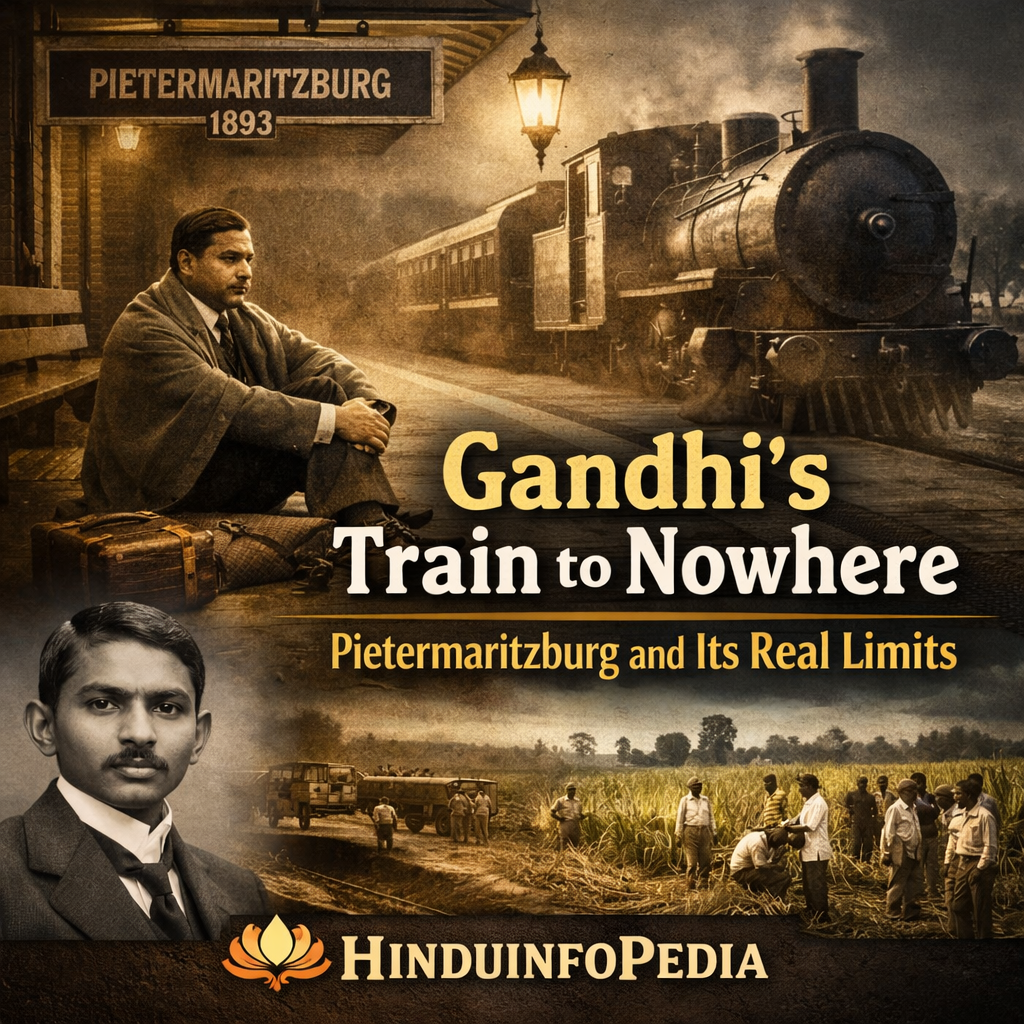
Gandhi’s train to Nowhere began on the evening of 7 June 1893 at Pietermaritzburg station. Gandhi had boarded at Durban in a first-class compartment — he had a valid ticket, he was a barrister in western dress, and he was travelling on legal business for the firm of Dada Abdulla and Co. At Pietermaritzburg a white passenger objected to sharing the carriage with an Indian. A railway official ordered Gandhi to move to the van compartment. He refused. A constable was summoned. Gandhi was removed from the train and his luggage was thrown onto the platform.
Thank you for reading this post, don't forget to subscribe!He spent the night in the waiting room. It was winter in the Natal Midlands — cold, unfamiliar, far from anything he had planned. He had a choice that night that most men in his position would have resolved quickly: take the next available transport back to Durban, complete the legal brief, and book passage home to India. He chose to stay and fight.
That decision deserves its credit. It was not inevitable. It was not comfortable. And without it, none of what followed would have existed.
Gandhi’s train to Nowhere is where the story the world knows begins. It is also, on careful reading, where the story the world does not know begins — in the same waiting room, in the same cold, on the same night.
The Action Taken: Gandhi codified Satyagraha as an individual spiritual command, asserting personal authority to launch, direct, and halt mass strikes and border marches without committee voting oversight.
Who Paid the Price: Striking coal miners and plantation families at Newcastle (1913) who absorbed police baton charges, mine-compound internments, and heavy fines.
The Alternative Bypassed: Standard democratic trade-union procedures where striking workers vote collectively on starting, escalating, or ending industrial strikes.
Why This Matters: The operational prototype of the command principle: mass followers provided physical leverage on the streets, while a single leader retained unilateral authority over when resistance was applied or suspended.
First Class to Everywhere — Except the Platform
The Precise Shape of the Outrage
Gandhi had a first-class ticket. He was travelling on merchant business. He was a barrister — Inner Temple qualified, English-educated, dressed in the clothes of his profession. The racial insult that ejected him from that carriage was real. So was the specific form his outrage took: the outrage of a man who believed, correctly by colonial convention, that he was entitled to be there.
This is not a criticism. It is the most important fact about what the night at Pietermaritzburg produced. The radicalisation that followed was anti-racist in its impulse — but it was not anti-colonial in its conclusion.
The question Gandhi resolved in that waiting room was not “should Indians be free from British rule?” It was “should Indians of my standing be treated as equals within British rule?”
The distinction is not a small one. It shaped every institution he built for the next twenty years. It was his choice to pursue the latter option instead of the former. This choice is critical to our analysis.
Where the Train Did Not Go
Gandhi’s train to Nowhere did not travel toward the Tamil indentured labourer in the Natal sugarcane fields who had no first-class ticket, no legal qualification, no colonial standing, and no expectation of being heard by any petition body. The Gandhi anti-colonialism limits were visible from this first night — the train did not travel toward the African population below both groups in the colonial hierarchy, and it did not travel toward a challenge to the colonial framework itself. That destination would come, if it came at all, much later, much more partially, and under very different pressures.
What Gandhi’s train to Nowhere produced was a reformer: a man who would spend two decades arguing that Indians of his class deserved the same civic rights as Europeans of equivalent standing — equality within the colonial structure, not its dismantling.
In this sense, the NIC was the mirror image of the early Indian National Congress: a body of gentlemen seeking to find their rightful place at the colonial table, rather than a movement seeking to overturn the table entirely. The train Gandhi boarded in 1893 was, for a long time, on the exact same track as the one laid in Bombay in 1885.
The Writing He Left Behind
Gandhi’s own publications from his South Africa years are the most precise record of where his train was heading.
In an 1896 pamphlet circulated across India, he described Indians as belonging to a civilisation superior to that of Africans. In a 1904 letter to the Johannesburg Medical Officer of Health, he protested the housing of Indian workers alongside Africans — accepting the logic of racial separation while objecting only to its application.
Both statements are in the Collected Works. Both are a discomfort in the standard hagiography of Gandhi’s South Africa years.
Gandhi later revised some of these positions. That revision is on the record and deserves acknowledgment. What it does not change is what the original statements reveal: a political consciousness bounded entirely by the world of the Passenger Indian merchant community and its patron-client politics, not yet troubled by the communities below it in the colonial order.

The Template the Train Established
Gandhi’s train to Nowhere established the Gandhi class framework in its clearest form: a genuine personal experience of injustice, a courageous individual response, and a radicalisation precisely bounded by the class and patron-client politics within which the response was mounted.
It was not the radicalism of a socialist revolutionary, but the stubbornness of a Victorian gentleman demanding his due.
The cold platform was real. The resolve was real. The boundary was also real — and it travelled with him to every subsequent campaign.
When the same template was carried back to India in 1915, applied at Champaran, invoked at Jallianwala Bagh, and tested against Partition — the boundary did not disappear. It scaled.
Part 4 takes up the Boer War: the same man who resolved on that Pietermaritzburg platform to fight colonial racism will, six years later, recruit Indians for the British Army and apply for a military campaign medal. The martyrs who chose different paths were already choosing them.
Series Index
Feature Image: Click here to view the image.
Video
Glossary of Terms
- Inner Temple: One of the four Inns of Court in London with the exclusive right to call barristers to the English bar. Gandhi was admitted to Inner Temple in 1888 and called to the bar in June 1891. Membership conferred formal colonial professional accreditation recognised across British India.
- NIC (Natal Indian Congress): The political organisation founded by Gandhi in Durban in May 1894 to represent the interests of Indians in the British colony of Natal. Modelled on the Indian National Congress. Financed primarily by Gujarati Muslim and Hindu merchant families. Its founding petition focused on the colonial franchise that the Passenger Indian merchant class held but Tamil indentured labourers did not.
- INC (Indian National Congress): The principal political organisation of the Indian independence movement, founded in Bombay in 1885 by Allan Octavian Hume. Initially a moderate constitutional body petitioning for greater Indian representation within British rule. Gandhi joined on his return to India in 1915 and transformed it from an elite debating society into a mass movement.
- Dada Abdulla and Co.: The Gujarati Muslim trading firm based in Natal, South Africa, owned by Dada Abdulla. Brought Gandhi to Natal in 1893 to handle a commercial legal dispute with a cousin. One of the larger Passenger Indian merchant firms in Natal. Its network provided Gandhi his initial base of contacts, clients, and political supporters in South Africa.
- Passenger Indians: The colonial legal classification used in Natal to designate Indians who had arrived voluntarily and paid their own passage — primarily Gujarati Muslim and Hindu merchants. Distinguished in colonial law from Indentured Indians who had arrived under labour contracts. The Passenger Indian community formed the funding base and primary constituency of the Natal Indian Congress.
- Indentured Labour: The system under which Indians — primarily from Bihar, eastern UP, and Tamil Nadu — were contracted to work on British colonial plantations in South Africa, Fiji, Mauritius, the Caribbean, and other territories from 1838 to 1917. Contracts bound labourers for five years under conditions documented as equivalent to slavery. The indentured Indian community in Natal formed a distinct and lower social stratum from the Gujarati merchant class Gandhi primarily represented.
- Patron-Client Framework: The structure of obligation and reciprocity in which a wealthy or powerful patron funds or sponsors an individual in exchange for future service, loyalty, or political representation of patron interests. Applied in this series to examine Gandhi’s relationship with the Gujarati merchant community that funded his legal training and early political career.
- Gandhi Class Framework: The analytical concept applied in this series to describe Gandhi’s consistent pattern of principled advocacy for those already organised within existing power structures, combined with symbolic invocation of the most vulnerable — without giving them structural representation. Established in the NIC period and repeated at continental scale in India after 1915.
- Pietermaritzburg Incident (7 June 1893): The event in which Gandhi, travelling first-class from Durban on legal business for Dada Abdulla and Co., was ejected from his railway carriage at Pietermaritzburg station by a constable after a white passenger objected to sharing the compartment. Gandhi refused to move to the van carriage and spent the night on the platform in the waiting room. Widely cited as the founding moment of Gandhi’s political consciousness — and examined in this series for the precise boundaries that consciousness established from the outset.
- Pietermaritzburg: City in the Natal Midlands, now the capital of KwaZulu-Natal province, South Africa. Approximately eighty kilometres inland from Durban. The site of the June 1893 railway incident that is conventionally described as the origin of Gandhi’s political consciousness. Gandhi later established the Gandhi-Luthuli Documentation Centre in the city.
- Anti-Colonialism: The political position seeking the dismantling of colonial rule and the assertion of the colonised population’s right to self-governance independent of the colonial power. Distinguished in this series from reformism — Gandhi’s actual position during the South Africa years — which sought equality of treatment within the colonial framework rather than its abolition.
- Reformism: The political approach seeking to improve conditions within an existing power structure rather than dismantle it. Gandhi’s South Africa programme — equal civic rights for Passenger Indians within the British colonial framework — is characterised in this series as reformist rather than anti-colonial. The distinction is not a moral criticism but an analytical description of what the NIC’s programme aimed to achieve.
- Hagiography: Biography that presents its subject uncritically, suppressing contradictions, failures, or morally complex elements in favour of a reverential narrative. Applied in this series to the standard accounts of Gandhi that treat the Pietermaritzburg incident as the birth of a fully formed liberator, rather than examining what the incident actually produced — a reformer bounded by class and patron-client politics.
- Boer War (1899–1902): The war between the British Empire and the two Boer republics — the South African Republic (Transvaal) and the Orange Free State — fought over control of southern Africa, particularly following the discovery of gold in the Witwatersrand. Gandhi organised and led the Indian Ambulance Corps in support of the British military effort, for which he was awarded the War Medal. Examined in Blog 4 as the clearest demonstration of the limits of the Pietermaritzburg radicalisation — a man who had resolved to fight racial inequality within the British system then served that system in its colonial war.
- Natal Midlands: The inland plateau region of the former British colony of Natal, south of the Drakensberg escarpment. Pietermaritzburg is its principal city. The region’s midwinter temperatures — cold by South African standards — are part of the account Gandhi gave of his night on the Pietermaritzburg station platform in June 1893.
- Racial Separation (Colonial): The formal and informal systems by which British colonial administration in southern Africa maintained distinct legal categories and physical separation between European, Indian, African, and Coloured populations. Gandhi’s 1904 letter to the Johannesburg Medical Officer of Health — protesting the housing of Indian workers alongside Africans — accepted the logic of racial separation while objecting only to its specific application to Indians.
#GandhiTrainToNowhere #PietermaritzburgIncident #GandhiAntiColonialismLimits #GandhiReformism #GandhiRacialHierarchy #MahatmaGandhiSeries #GandhiPeaceEfforts #GandhiSouthAfricaYears #ColonialIndia #PatronClientPolitics #GandhiClassFramework #IndenturedLabour #NatalIndianCongress #IndianIndependence #HinduinfopediaGandhi #Gandhi #Satyagraha #Hagiography #AntiColonialism #GandhiHistory
Related Blogs
Previous Blogs of The Series
- https://hinduinfopedia.in/gandhis-peace-efforts-the-man-before-the-mahatma-1/
https://hinduinfopedia.in/?p=25527 - https://hinduinfopedia.in/gandhis-south-africa-years-inner-temple-to-nic-who-paid-the-fare2/
https://hinduinfopedia.in/?p=25633
Previous Blogs on Mahatma Gandhi
- https://hinduinfopedia.in/martyrs-of-indian-independence-and-gandhis-influence/
- https://hinduinfopedia.in/rowlatt-act-and-gandhi/
- https://hinduinfopedia.in/gandhis-post-independence-actions-and-legacy/
- https://hinduinfopedia.in/gandhis-personal-ideologies-and-methodologies/
- https://hinduinfopedia.in/communal-relations-in-indian-history-gandhis-legacy/
- https://hinduinfopedia.in/ideological-divides-and-gandhis-leadership/
- https://hinduinfopedia.in/gandhis-post-independence-actions-and-legacy/
- https://hinduinfopedia.in/gandhi-revisited-a-critical-legacy/
- https://hinduinfopedia.in/indira-gandhis-actions-the-competition-terminator/
- https://hinduinfopedia.in/nonviolent-policy-and-making-of-gandhi-in-south-africa/
- https://hinduinfopedia.org/ambedkars-buddhist-political-move-divergence-from-gandhi-on-caste-issues/
- https://hinduinfopedia.org/mahatma-gandhi-and-nonviolence/
- https://hinduinfopedia.org/mahatma-gandhi-and-his-principles-analyzed/
- https://hinduinfopedia.org/subhash-chandra-bose-contrasting-strategies-with-gandhi/
- https://hinduinfopedia.in/on-this-day-5-march-2024-tuesday/
- https://hinduinfopedia.in/akshardham-temple-terror-attack-2002/
- https://hinduinfopedia.in/nathuram-godse-murderer-patriot-or-fractured-youth/
- https://hinduinfopedia.in/remembering-indian-freedom-struggle-of-february-5/
- https://hinduinfopedia.org/indias-freedom-struggle-and-quit-india-movement-ii/
- https://hinduinfopedia.org/indian-freedom-fighters-legacy-of-gopal-krishna-gokhale/
Follow us:
- English YouTube: https://www.youtube.com/@Hinduofficialstation
- Hindi YouTube: https://www.youtube.com/@HinduinfopediaIn
- X: https://x.com/HinduInfopedia
- Instagram: https://www.instagram.com/hinduinfopedia/
- Facebook: https://www.facebook.com/Hinduinfopediaofficial
- Threads: https://www.threads.com/@hinduinfopedia