
Gandhi’s Dyer Response: Asymmetry Among Gandhi’s Statements, Actions and Documented Evidence(150)
भारत / GB
Part 150: Mahatma Gandhi’s Peace Efforts | Series Index
Blog 149 placed the documented record of April 13 1919 before the reader — 490 documented names, Dyer’s documented “moral effect” testimony, the Hunter Commission’s documented censure. This post, Gandhi’s Dyer Response, places Gandhi’s documented response to that record before the reader — and places it alongside the documented response to Chauri Chaura three years later
Thank you for reading this post, don't forget to subscribe!The Action Taken: At the Tripuri session, Gandhi’s loyalists passed the Pant Resolution, which directed the newly elected President Bose to appoint his Working Committee strictly in accordance with Gandhi’s personal wishes.
Who Paid the Price: Subhas Chandra Bose and the democratic authority of the elected presidency, which was stripped of its constitutional executive prerogative.
The Alternative Bypassed: Permitting the democratically elected president to appoint his own cabinet in accordance with the Congress constitution.
Why This Matters: An extra-constitutional maneuver: party procedures were subordinated to personal moral fiat, stripping an elected leader of the constitutional power to appoint his own team.
The Documented Response
Gandhi’s Dyer Response places Gandhi’s documented reaction to Jallianwala Bagh before the reader precisely.
Gandhi was in Bombay when the Amritsar massacre occurred on April 13 1919. The documented news reached him. His documented initial response — placed in his autobiography and in Young India — was one of documented restraint. Gandhi wrote that he felt the British were not yet ready to be condemned wholesale, that the fault lay in the system and not entirely in the individuals who administered it.
His documented public response to Jallianwala Bagh: Gandhi called for a documented inquiry. He cooperated with the documented Congress inquiry into the Punjab atrocities — the Congress produced a documented report. He documented the events as a “frightful” action. He participated in the documented political response that demanded accountability.
The Hunter Commission was appointed in October 1919. The Congress ran a parallel documented inquiry into the Punjab atrocities — Gandhi led that inquiry, not the Hunter Commission proceedings. Gandhi’s documented appearances before official bodies in this period concerned the Rowlatt Satyagraha and the Gujarat riots, not Punjab evidence before Hunter. The Hunter Commission produced its documented report in 1920. Dyer was censured for “an error of judgment” — established in Blog 149 of this series.
What Gandhi Did Not Do
Gandhi’s Dyer Response places what Gandhi did not do alongside what he did — both from the documented record.
Gandhi did not suspend the independence movement over Jallianwala Bagh. He did not call Jallianwala Bagh a Himalayan miscalculation of his own. He did not issue a national suspension of political activity citing the documented deaths of 490 documented civilians as evidence that the movement had failed its moral test.
He continued. The Rowlatt Satyagraha — launched in March 1919, which had produced the documented violence that Dyer used as the documented pretext for his April 13 actions — was suspended on April 18 1919 by Gandhi. Gandhi’s documented self-assessment: Himalayan miscalculation — established in Blog 134 of this series. The documented reason for the suspension: the documented crowd violence that preceded April 13 in Amritsar and elsewhere. Gandhi suspended the Satyagraha over documented crowd violence — not over Dyer’s documented firing on 490 documented civilians.
The Documented Asymmetry — Placed Before the Reader
Gandhi’s Dyer Response places the documented asymmetry before the reader. The prosecution places two documented events side by side:
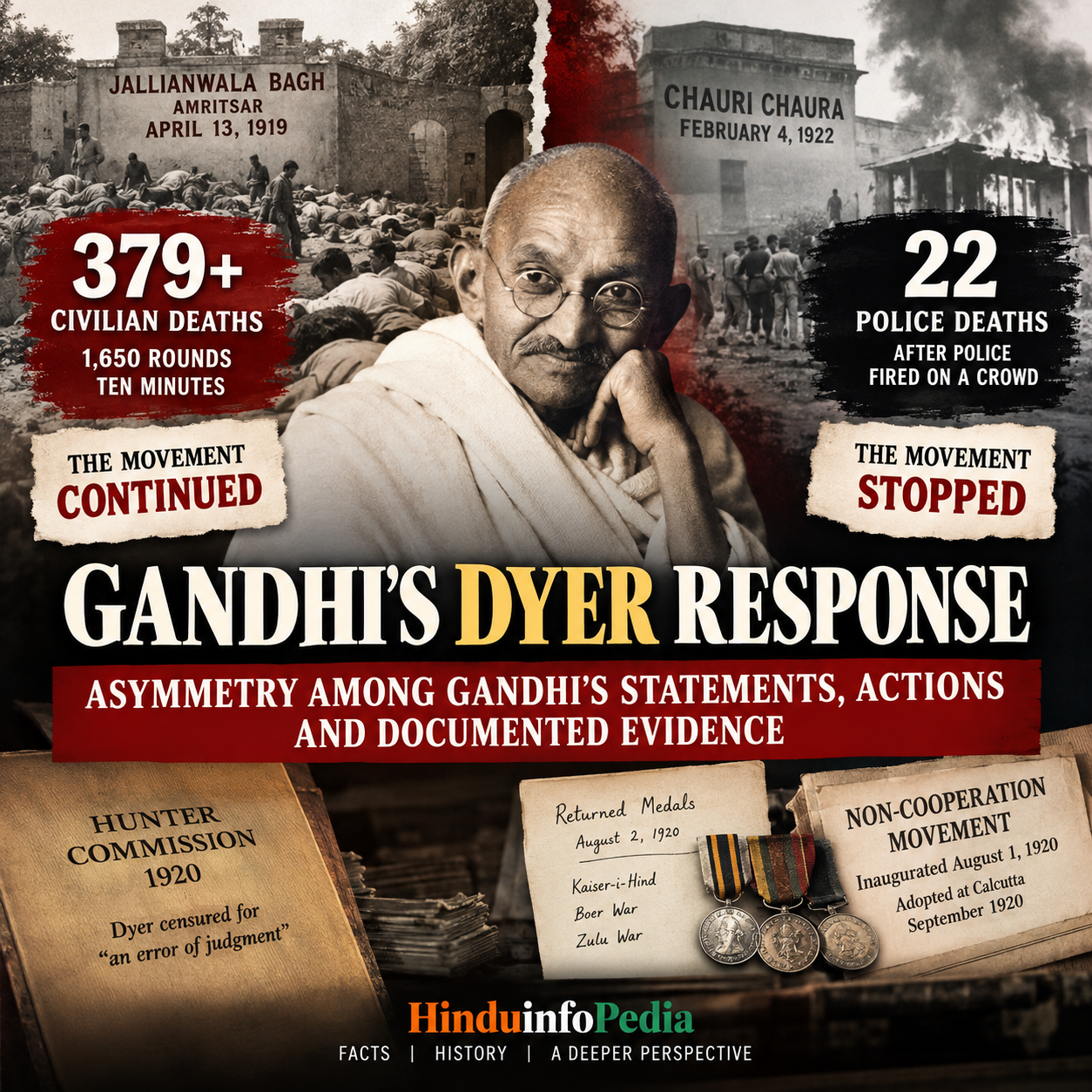
April 13 1919 — Jallianwala Bagh: Brigadier General Dyer. Documented troops. 1,650 rounds. Ten minutes. 379 officially recorded dead — with Indian enumerations placing the figure higher, including the 490 documented names compiled in Blog 149 of this series. Documented unarmed civilians — pilgrims, residents, protesters — who had not left a documented enclosed space. Gandhi’s documented response: continued the documented inquiry process. Documented the events as “frightful.” Participated in the documented political accountability process. Gandhi did suspend the Rowlatt Satyagraha on April 18 1919 — five days after Jallianwala Bagh. His documented stated reason was crowd violence at Nadiad and Ahmedabad that had occurred before April 13 — not the documented 490 civilian deaths of April 13 itself. The documented suspension was attributed to pre-massacre crowd violence. The documented massacre was not Gandhi’s documented stated reason for the suspension.
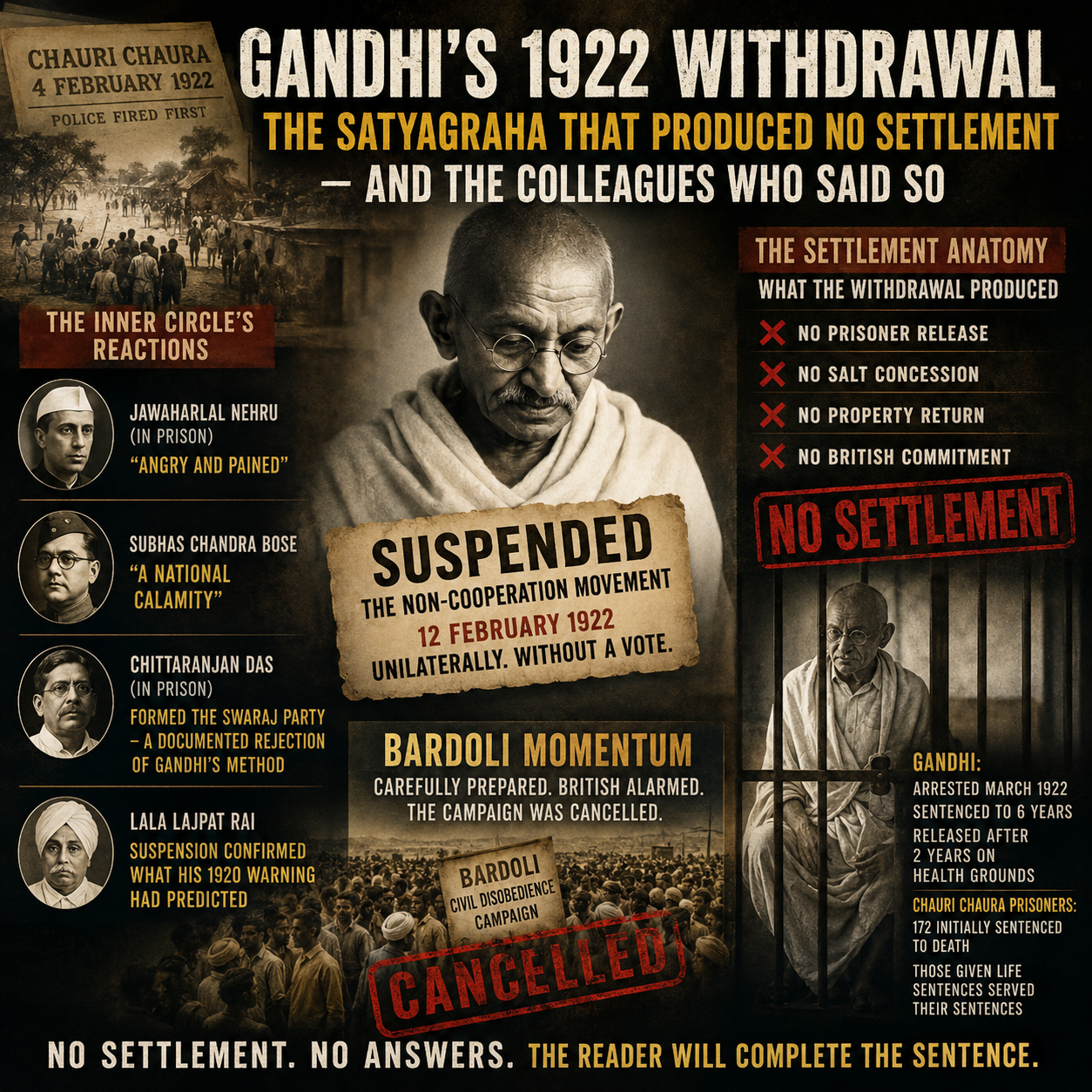
February 4 1922 — Chauri Chaura: Documented crowd retaliated after police fired on protesters. 22 documented policemen killed. Gandhi’s documented response: suspended the entire Non-Cooperation Movement — the largest documented civilian uprising in colonial history — within eight days. Documented action: Bardoli Resolution — the nation declared morally unready for non-violent discipline. No settlement. No concession. British relief documented.
The prosecution places the two documented responses before the reader without characterisation — and asks the reader to examine what the documented asymmetry establishes.
379 officially recorded civilian deaths — with Indian enumerations higher — at the hands of a documented military commander acting on a documented “moral effect” strategy: the movement continued.
22 documented police deaths after documented police firing on a crowd: the movement stopped.
The Hunter Commission Outcome and Gandhi’s 1920 Break
The documented Commission outcome — established in Blog 149: Dyer censured for “an error of judgment.” Not prosecuted. Not dismissed with dishonour. Pension received. The documented institutional response to 490 documented names.
Gandhi’s documented response to the Commission’s outcome was the opposite of continued constitutional engagement. The twin documented shocks — the Hunter Commission’s majority finding of “error of judgment” while the House of Lords praised and raised funds for Dyer — destroyed Gandhi’s documented faith in the British constitutional framework. Gandhi declared the British government “satanic” in 1920. He returned three decorations — Kaiser-i-Hind, Boer War, and Zulu War medals — in a letter to Viceroy Chelmsford dated August 2 1920, the day after the Non-Cooperation Movement was inaugurated. His documented primary stated ground was Khilafat; the Punjab wrongs — including the O’Dwyer administration and the House of Lords’ documented defence of Dyer — were listed as confirming the break, not as the primary cause. Both grievances drove the documented break, not Jallianwala Bagh alone. He launched the Non-Cooperation Movement — inaugurated August 1 1920 and formally adopted at the Calcutta special session in September 1920 — explicitly extra-constitutional, designed to paralyse the documented administrative apparatus. The documented Punjab wrongs and the Khilafat betrayal were Gandhi’s documented stated twin drivers of that launch — both grievances — Punjab wrongs and Khilafat betrayal together — constituted the documented breaking point, not Jallianwala Bagh alone.
The Prosecution’s Position
Gandhi’s Dyer Response places three questions before the reader.
- Does the documented asymmetry — Gandhi suspending the entire national movement over 22 documented police deaths at Chauri Chaura while continuing documented political engagement after 490 documented civilian deaths at Jallianwala Bagh — constitute a documented exhibit the reader places alongside the series’ full documented record of Gandhi’s documented decision-making framework?
- Does Gandhi’s documented suspension of the Rowlatt Satyagraha on April 18 1919 — citing documented crowd violence as the documented trigger — placed alongside his documented non-suspension of the movement after the documented Jallianwala Bagh massacre of April 13 1919, establish a documented pattern about whose documented violence triggered Gandhi’s documented suspension mechanism?
- Does the documented Hunter Commission outcome — Dyer censured for “an error of judgment,” not prosecuted, pension received — placed alongside Gandhi’s documented maintained constitutional engagement during the inquiry period — before his documented shift to extra-constitutional Non-Cooperation, inaugurated August 1920 and formalised at Calcutta September 1920, constitute an exhibit the reader places alongside the documented death toll of Blog 149 — officially 379, Indian enumerations higher?
The series does not answer. Gandhi’s Dyer Response places the documented response, the documented non-response, and the documented asymmetry before the reader. The reader will examine what the documented gap between the two responses established — and complete the sentence.
Invitation To Defence
The floor belongs to the defense. We now invite them to present their exhibits and challenge the narrative established by the prosecution.
April 13 1919: officially recorded 379 dead; Indian enumerations higher. Dyer. 1,650 rounds. Ten minutes. Gandhi: continued. February 4 1922: 22 documented police after police fired on a crowd. Gandhi: suspended the entire national movement within eight days. His documented 1922 language included “warning from God,” “crime,” and “mob violence” — the Bardoli Resolution described the nation as morally unready for non-violent discipline. The documented phrase “Himalayan Miscalculation” belongs to 1919 — established in Blog 134 of this series. The prosecution places the two documented responses before the reader. Officially 379 civilian deaths (Indian enumerations higher) — movement continued. 22 police deaths — movement stopped. The reader will complete the sentence.
Feature Image: Click here to view the image.
Videos
Glossary of Terms
- Gandhi’s Dyer Response: जलियांवाला बाग और डायर की कार्रवाई के प्रति गांधी की प्रमाणित प्रतिक्रिया तथा उसके बाद की राजनीतिक प्रतिक्रिया को दर्शाने वाला इस ब्लॉग का प्रमुख phrase।
- Dyer: ब्रिगेडियर जनरल रेजिनाल्ड डायर, जिसने 13 अप्रैल 1919 को जलियांवाला बाग में सैनिकों से गोली चलवाई।
- Hunter Commission: 1919 में गठित आधिकारिक जाँच आयोग, जिसने पंजाब की घटनाओं की जाँच की और डायर की कार्रवाई को “error of judgment” बताया।
- Constitutional Framework: ब्रिटिश शासन की वह संवैधानिक व्यवस्था जिसके भीतर गांधी ने प्रारंभ में राजनीतिक सुधार और सहभागिता का मार्ग अपनाया।
- Extra-Constitutional: संवैधानिक व्यवस्था से बाहर की राजनीतिक कार्रवाई। ब्लॉग में यह शब्द असहयोग आंदोलन की प्रकृति बताता है।
- Non-Cooperation Movement: गांधी द्वारा 1920 में शुरू किया गया आंदोलन, जिसका उद्देश्य ब्रिटिश प्रशासनिक तंत्र से सहयोग समाप्त करना और उसे निष्क्रिय करना था।
- Khilafat: खिलाफत से संबंधित राजनीतिक प्रश्न, जिसे गांधी ने 1920 में असहयोग आंदोलन शुरू करने का प्रमुख stated ground बताया।
- Punjab Wrongs: पंजाब में हुए अन्याय, जिनमें ओ’ड्वायर प्रशासन और डायर के बचाव से संबंधित घटनाएँ शामिल थीं। गांधी ने इन्हें असहयोग के कारणों में शामिल किया।
- House of Lords: ब्रिटिश संसद का उच्च सदन, जिसके कुछ सदस्यों ने डायर की प्रशंसा की और उसके समर्थन में धन जुटाया।
- Rowlatt Satyagraha: 1919 में रॉलेट कानून के विरोध में गांधी द्वारा चलाया गया सत्याग्रह, जिसे गांधी ने 18 अप्रैल 1919 को भीड़ की हिंसा के कारण स्थगित किया।
- Jallianwala Bagh: अमृतसर का वह स्थान जहाँ 13 अप्रैल 1919 को डायर के नेतृत्व में सैनिकों ने भीड़ पर गोलीबारी की। ब्लॉग में 379 आधिकारिक मृतकों और अधिक भारतीय गणनाओं का उल्लेख है।
- Chauri Chaura: 4 फरवरी 1922 की घटना, जिसमें पुलिस की गोलीबारी के बाद भीड़ ने प्रतिकार किया और 22 पुलिसकर्मी मारे गए। इसके बाद गांधी ने असहयोग आंदोलन स्थगित किया।
- Bardoli Resolution: असहयोग आंदोलन स्थगित करने के समय अपनाया गया प्रस्ताव, जिसमें राष्ट्र को अहिंसक अनुशासन के लिए नैतिक रूप से तैयार नहीं माना गया।
- Documented Asymmetry: जलियांवाला बाग और चौराचौरा में हुई हिंसा के बाद गांधी की अलग-अलग प्रतिक्रियाओं के बीच ब्लॉग में प्रस्तुत प्रमाणित अंतर।
- Himalayan Miscalculation: गांधी द्वारा 1919 की अपनी गंभीर राजनीतिक भूल के लिए प्रयुक्त प्रमाणित phrase, जिसे इस श्रृंखला में विशेष विश्लेषण का विषय बनाया गया है।
#Gandhi #Dyer #JallianwalaBagh #ChauriChaura #NonCooperation #Khilafat #Punjab #IndiaHistory #BritishIndia #HunterCommission #HinduinfoPedia
Scan Through The Entire Series at
Gandhi’s Peace Efforts: The Questions Before the Mahatma (0)