
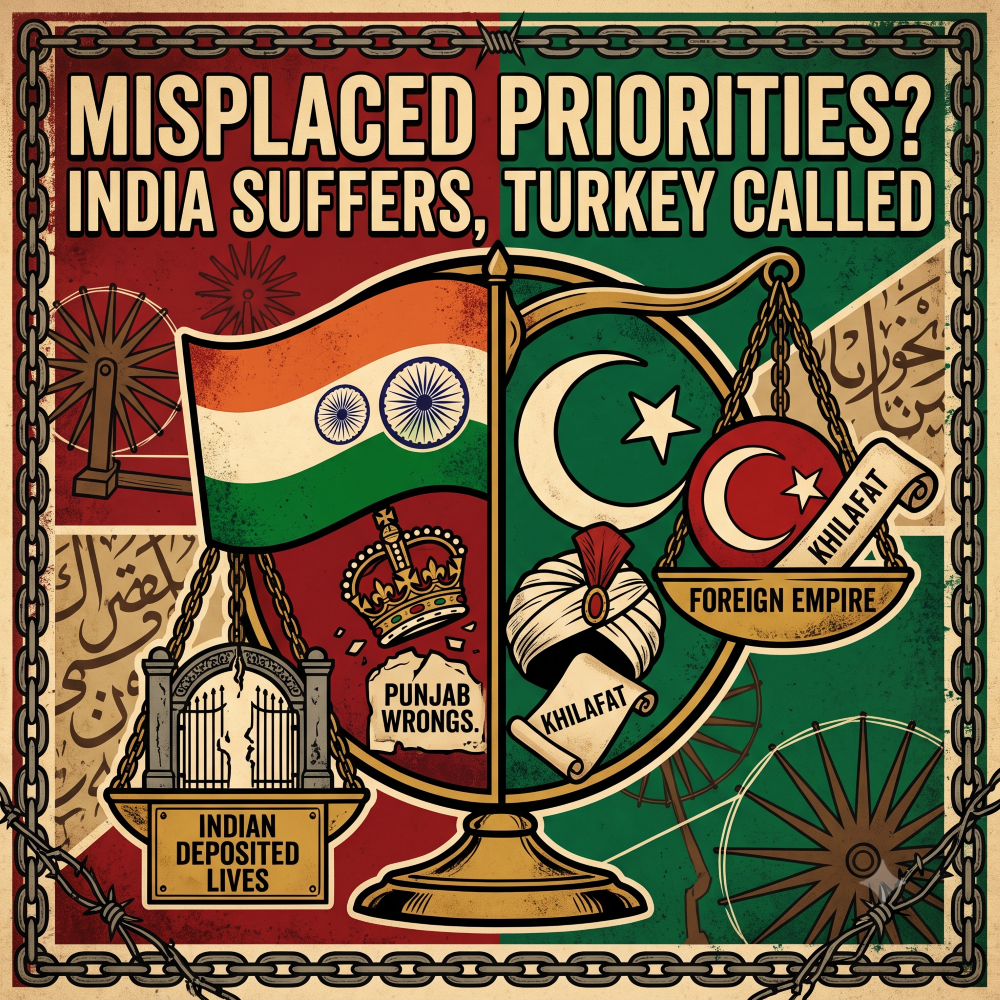
Gandhi’s Misplaced Priority: Khilafat Above Punjab’s Dead and India’s Constitutional Future (114)
भारत / GB
Part 114: Mahatma Gandhi’s Peace Efforts | Series Index
Blogs 107-113 (107, 108, 109, 110, 111, 112, 113) placed the cause inversion before the reader — Gandhi’s own documented words establishing that Khilafat was placed above Swaraj, Ambedkar’s documented verdict, the contemporary witnesses, the experiment’s documented word, and Gandhi’s own 1924 admission of what it produced. “Gandhi’s Misplaced Priority” places the specific documented items Gandhi subordinated to the Khilafat cause — and asks the reader to examine what was placed beneath it.
Thank you for reading this post, don't forget to subscribe!The Action Taken: Gandhi stated in print: “To the Musalmans, Swaraj is secondary to the Khilafat. For me, too, Swaraj is secondary to the moral issue of the Khilafat.”
Who Paid the Price: The priority of Indian national self-determination, which was officially subordinated to a foreign imperial-religious dispute.
The Alternative Bypassed: Prioritizing the unconditional attainment of sovereign Indian independence as the supreme national demand.
Why This Matters: Locked on the printed page: the supreme leader of the independence movement placed the restoration of a foreign theological empire above Indian Swaraj.
Gandhi’s Misplaced Priority: The Documented Statement — February 1920
In February 1920 — seven months before the September Calcutta session, ten months before Nagpur — Gandhi made a documented public announcement: the issues of Punjab wrongs and constitutional advance had been overshadowed by the Khilafat question.
Gandhi’s Misplaced Priority places this documented announcement before the reader as the exhibit. Not the series’ characterisation of Gandhi’s priorities. Gandhi’s own documented public statement of them — before Congress formally adopted the programme, before the September 1920 session, while the Punjab wounds were still raw and the constitutional reform debate was live.
What Was Placed Beneath the Khilafat Question
Gandhi’s Misplaced Priority places the documented record of what Gandhi announced had been overshadowed before the reader in sequence.
Punjab — at least 489 documented victims, youngest being Sohan Lal alias Ram Nath. Jallianwala Bagh, April 13 1919. General Dyer’s documented testimony before the Hunter Commission: he had intended to produce “a sufficient moral effect” on the population of Punjab. He expressed no regret. The Morning Post in Britain raised £26,000 for Dyer in a documented public subscription. The British government failed to condemn the massacre or punish those responsible. Gandhi himself documented in his Great Trial speech (CWMG Vol. 23) that the Punjab horrors — “beginning with the massacre at Jallianwala Bagh and culminating in crawling orders, public floggings and other indescribable humiliations” — had shattered his faith in the British government. And then, in February 1920, Gandhi documented publicly that this same Punjab wound had been overshadowed — by the Khilafat question as the Khilafat gets precedence over Swaraj.
Constitutional advance. The Montagu-Chelmsford Reforms of 1919 — the documented constitutional framework Indians had spent years demanding — were live and contested in February 1920. Gandhi himself had fought at the Amritsar Congress in 1919 for cooperation with these reforms, hoping the British would honour their promises. By February 1920, Gandhi documented that constitutional advance too had been overshadowed by the Khilafat question.
The prosecution places Gandhi’s own documented strategic rationale before the reader alongside the documented announcement. Gandhi’s documented position — stated across his writings of this period — was that Hindu-Muslim unity was a prerequisite for Swaraj, and that standing by the Muslim community in their hour of need over Khilafat would cement that unity permanently. In Gandhi’s documented framework, backing Khilafat was not an alternative to Swaraj but the engine that would make Swaraj possible. The documented outcome of that strategic calculation is placed before the reader across Blogs 109-113 (109, 110, 111, 112, 113) of this series: the riot frequency data, the Jinnah arc, Gandhi’s own 1924 admission that the awakened Mussalmans had proclaimed a kind of Jihad. The reader examines the documented intention alongside the documented outcome and completes the sentence.
What overshadowed both: the territorial restoration of a defeated foreign empire. The Khilafat demands — established in Blog 102 of this series — were the return of Arabia, Syria, Iraq, and Palestine to Ottoman sovereignty, and the preservation of the Sultan-Caliph’s position. A documented foreign territorial dispute. Placed by Gandhi’s own documented announcement above at least 489 documented Indian dead and above the constitutional future of 300 million Indians.
Gandhi’s Misplaced Priority Stated Explicitly — September 1920
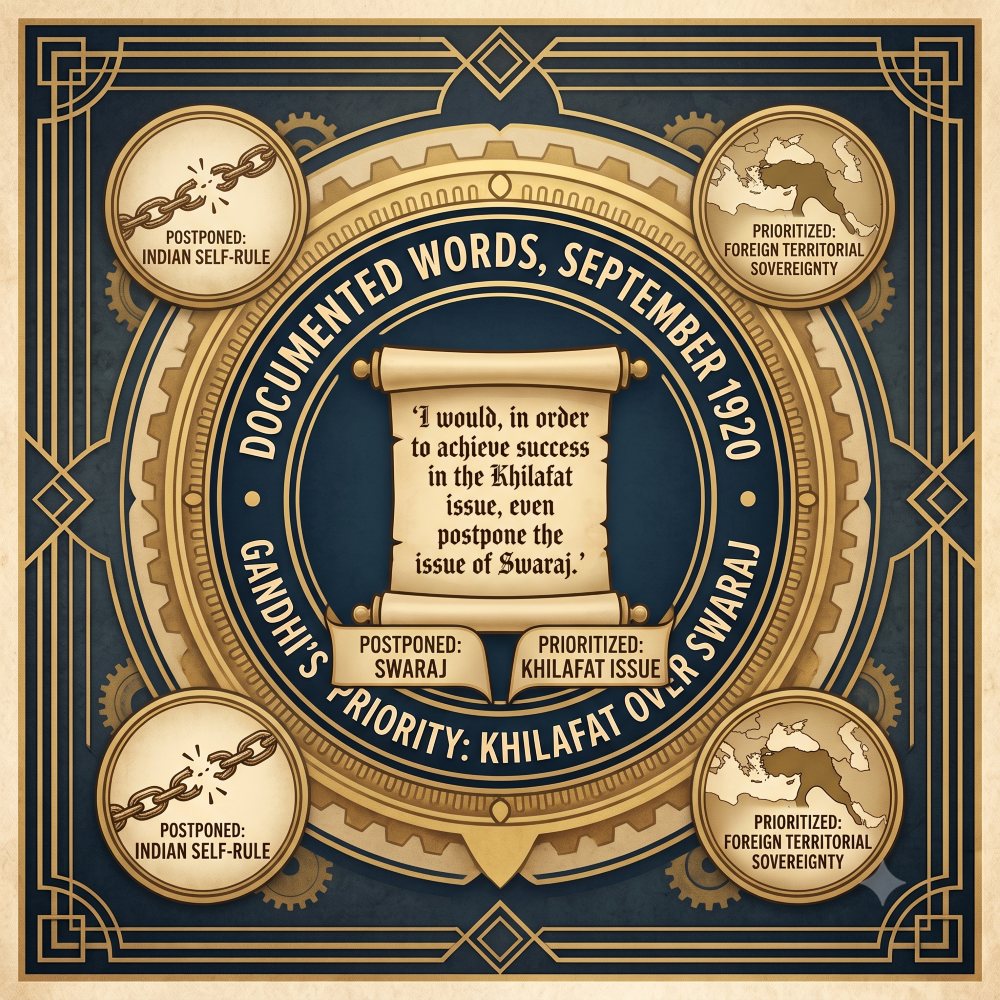
Gandhi’s Misplaced Priority places Gandhi’s own documented words from the September 1920 Calcutta session alongside the February 1920 announcement. Blog 107 has already placed this documented statement before the reader: “I would, in order to achieve success in the Khilafat issue, even postpone the issue of Swaraj.”
The prosecution places both documented statements in sequence. February 1920: Punjab and constitutional advance overshadowed by Khilafat. September 1920: Swaraj itself postponed for Khilafat. The documented priority is stated twice, in Gandhi’s own words, seven months apart.
The Documented Institutional Gandhi Built Around That Priority
Gandhi’s Misplaced Priority places the documented September 1920 Calcutta session resolution before the reader. Three causes were welded together: Khilafat wrongs, Punjab wrongs, and Swaraj. The prosecution places one documented observation alongside this: Punjab’s documented dead and India’s constitutional future were carried into the September 1920 resolution as mobilising fuel — documented grievances used to bring hesitant Congress members on board for a programme Gandhi’s own documented February announcement had already established was primarily about Khilafat.
Bipin Chandra Pal moved an amendment at the Calcutta session — documented in Blog 109. He was defeated. The resolution passed 1,886 to 884. Punjab’s documented 489 dead were carried into the resolution. The constitutional advance Indians had sought was carried into the resolution. The Khilafat question — which Gandhi had documented as overshadowing both — was the primary cause driving the programme.
What Gandhi’s Misplaced Priority Produced
Gandhi’s Misplaced Priority places one further documented contrast before the reader. In August 1921 — while the Non-Cooperation/Khilafat Movement was at its peak — the Moplah rebellion broke out in Malabar. The documented record of that rebellion: killings, forced conversions, temple desecrations, displacement of Hindu families across the Malabar region. Gandhi did not suspend the movement. He did not withdraw from the Khilafat alliance that had produced the documented mobilisation behind the rebellion. He called the Moplahs “brave God-fearing people” acting under a mistaken sense of religion — documented in Young India, December 1921, CWMG Vol. 21.
In February 1922 — when twenty-two policemen were killed by nationalist protesters at Chauri Chaura as a reaction to police attacks on peaceful protesters — Gandhi suspended the entire Non-Cooperation Movement. Unilaterally. Without consultation with Congress, the Working Committee, or the movement’s participants.
The prosecution places this documented contrast before the reader: the Moplah rebellion — documented killings and forced conversions of Hindus — did not produce a movement suspension. Twenty-two policemen killed by nationalist protesters at Chauri Chaura did. The documented priority is placed before the reader in both directions: what Gandhi placed above, and what Gandhi placed below — not in February 1920 alone, but in the documented conduct of the movement throughout 1921 and 1922.
The Prosecution’s Position
Gandhi’s Misplaced Priority places three questions before the reader.
- Did Gandhi’s own documented February 1920 public announcement establish that the Punjab wrongs — at least 489 documented dead at Jallianwala Bagh, crawling orders, public floggings — and constitutional advance had been overshadowed by the Khilafat question, placing a foreign empire’s territorial restoration above documented Indian dead and India’s documented constitutional future?
- Did Gandhi’s own documented September 1920 statement — “I would postpone Swaraj for Khilafat” — confirm seven months later what the February 1920 announcement had already documented: that Khilafat was Gandhi’s documented primary cause?
- Does the documented contrast — the Moplah rebellion of August 1921 producing no movement suspension and a documented “brave God-fearing people” characterisation of the perpetrators, against twenty-two policemen killed at Chauri Chaura in February 1922 producing unilateral movement suspension — belong before the reader alongside Gandhi’s documented February 1920 announcement of his priorities?
The series does not answer. Gandhi’s Misplaced Priority places Gandhi’s own documented February 1920 announcement, his documented September 1920 confirmation, and the documented contrast of what he placed above and below alongside each other. The reader will examine what Gandhi documented as overshadowing Punjab’s dead — and complete the sentence.
Invitation To Defence
The floor belongs to the defense. We now invite them to present their exhibits and challenge the narrative established by the prosecution.
February 1920. Gandhi’s own documented public announcement: Punjab wrongs and constitutional advance had been overshadowed by the Khilafat question. September 1920: “I would postpone Swaraj for Khilafat.” August 1921: Moplah rebellion — documented killings, forced conversions, temple desecrations of Hindus. Movement not suspended. Moplahs: “brave God-fearing people.” February 1922: twenty-two policemen killed at Chauri Chaura by nationalist protesters — movement suspended. The prosecution places what Gandhi placed above, and what Gandhi placed below, before the reader in sequence. The reader will complete the sentence.
Feature Image: Click here to view the image.
Videos
Glossary of Terms
- Khilafat Movement: A political and religious movement launched after the First World War to preserve the authority of the Ottoman Caliph and restore Ottoman territories.
- Punjab Wrongs: The documented British repressive measures in Punjab following 1919, including the Jallianwala Bagh Massacre, martial law, crawling orders, and public floggings.
- Jallianwala Bagh Massacre: The 13 April 1919 shooting at Jallianwala Bagh, Amritsar, where British troops under General Dyer fired on an unarmed gathering.
- Montagu-Chelmsford Reforms: Constitutional reforms introduced under the Government of India Act, 1919, establishing limited provincial self-government through dyarchy.
- Constitutional Advance: The gradual expansion of representative institutions and constitutional self-government in British India.
- Hunter Commission: The official British inquiry established to investigate the Jallianwala Bagh Massacre and related events in Punjab.
- Non-Cooperation Movement: The nationwide movement launched by Gandhi in 1920 encouraging Indians to withdraw cooperation from British institutions.
- Moplah Rebellion: The 1921 uprising in the Malabar region involving large-scale violence, killings, forced conversions, and displacement, occurring during the Khilafat-Non-Cooperation period.
- Chauri Chaura Incident: The February 1922 incident in Gorakhpur where nationalist protesters killed twenty-two policemen, leading Gandhi to suspend the Non-Cooperation Movement.
- Cause Inversion: A term used in this series describing the placement of one political objective above another that had originally been considered more fundamental.
- Misplaced Priority: A key phrase in this blog describing Gandhi’s documented decision to place the Khilafat cause above Punjab grievances, constitutional progress, and ultimately Swaraj.
- Swaraj: Self-rule or self-government for India, regarded as the principal political objective of the Indian National Congress.
- CWMG (Collected Works of Mahatma Gandhi): The official multi-volume collection of Gandhi’s speeches, letters, articles, and writings used as a primary documentary source.
- Young India: Gandhi’s English-language weekly journal in which he published articles explaining his political and social positions.
- Great Trial Speech: Gandhi’s 1922 statement before the court during his sedition trial, later published in the Collected Works of Mahatma Gandhi.
#Gandhi #Khilafat #Swaraj #JallianwalaBagh #Punjab #Congress #History #India #Freedom #NonCooperation #Moplah #ChauriChaura #BritishRaj #Politics #HinduinfoPedia
Gandhi’s Peace Efforts: The Questions Before the Mahatma (0)