
Gandhi’s Sharpening Stone: Did Gandhi’s Method Calibrate the British Weapons? (140)
भारत / GB
Part 140: Mahatma Gandhi’s Peace Efforts | Series Index
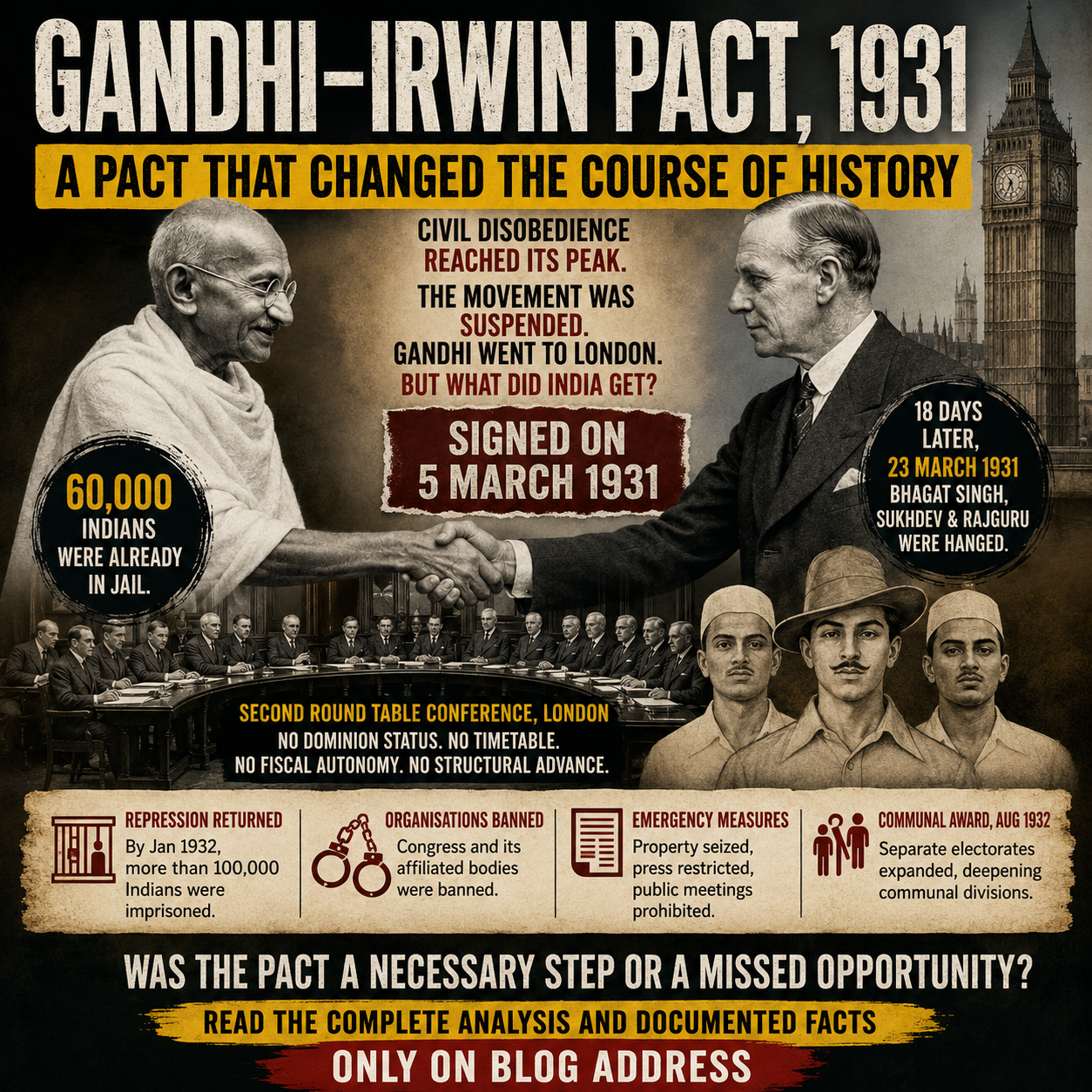
Blog 138 placed the documented balance sheet of the Irwin Pact before the reader — zero constitutional progress, Bhagat Singh eighteen days after the signature. Blog 139 placed the three-step structural mechanism before the reader — how the Pact paralysed the movement’s cadres, re-armed the colonial state, and enabled the pre-emptive strike of January 4 1932. This post places the longer arc before the reader: what each suspension across five documented instances — from South Africa through Civil Disobedience — taught the British colonial administration about Gandhi’s method, and how each lesson sharpened the counter-movement weapon more precisely than the last.
Thank you for reading this post, don't forget to subscribe!The Action Taken: Gandhi formulated the doctrine of “Trusteeship”—preaching that mill owners were moral trustees of the workers’ welfare—discouraging class-based industrial strikes and independent trade unions.
Who Paid the Price: Industrial mill workers in Ahmedabad and Bombay, who were steered away from independent, militant trade-union bargaining.
The Alternative Bypassed: Supporting independent trade unions asserting statutory collective bargaining rights under labor law.
Why This Matters: Ideological protection for donor interests: Trusteeship framed capital-labor conflict as a moral partnership, protecting industrial patrons from class-based labor strikes.
The Documented Learning Arc
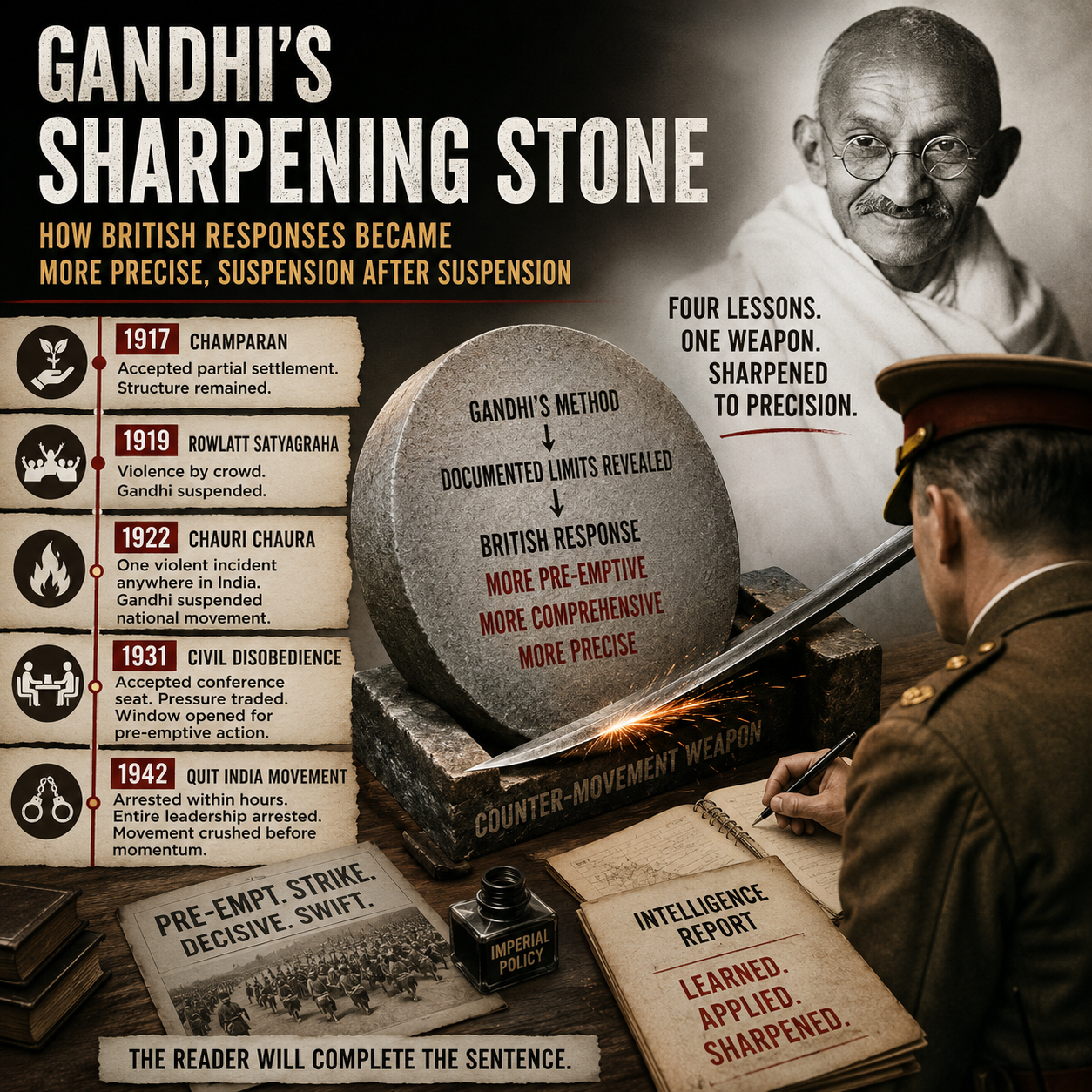
Gandhi’s Sharpening Stone places one documented observation before the reader at the outset. The British colonial administration was not static across the four documented suspensions. It was learning. Each suspension produced specific documented intelligence about where Gandhi’s method had its ceiling, what triggered the suspension, and how to calibrate the suppression response the next time the movement rose.
The prosecution places the four documented lessons before the reader in sequence — not as characterisation of British intent, but as the documented pattern of what each suspension revealed and what the subsequent British response demonstrates the administration had learned.
Lesson 0 — South Africa 1906-1914: The Original Calibration
Gandhi’s Sharpening Stone places the South Africa record before the reader as the documented origin of the calibration — before Champaran, before Rowlatt, before any British administrator in India had observed Gandhi’s method directly.
Gandhi launched the Satyagraha against the Asiatic Registration Act (the Black Act) in 1907. Seven years of documented resistance followed — registration certificate burnings, mass non-compliance, repeated imprisonments. The documented settlement: the Smuts-Gandhi Agreement of 1914. Its documented terms: recognition of Indian marriages and the abolition of the three-pound tax on indentured labourers. Gandhi accepted the agreement and returned to India.
What the structural framework of racial classification, immigration restrictions, and land ownership restrictions for Indians in South Africa produced after the settlement: it remained intact. The documented partial concessions were delivered. The documented structural discrimination continued.
General Smuts’s documented private reaction to Gandhi’s departure — “The saint has left our shores — I sincerely hope for ever” — placed alongside his documented assessment of the settlement reveals a precise calibration: Gandhi’s method had a documented ceiling. Seven years of organised resistance produced partial documented concessions on specific grievances. The structural framework survived. Gandhi accepted the settlement and called it sufficient.
Any British administrator in India who had studied the South Africa record before 1917 had already observed the pattern: Gandhi’s method produces documented partial delivery, accepts settlement short of structural change, and returns the movement’s participants to ordinary life. The ceiling was documented before Gandhi set foot in India.
The prosecution places this documented South Africa calibration before the reader as Lesson 0 — the original sharpening, from which every subsequent Indian lesson refined an instrument already established across seven years in South Africa.
Lesson 1 — Champaran 1917: The Partial Settlement Ceiling
Gandhi’s Sharpening Stone places the Champaran lesson before the reader. Gandhi arrived in April 1917 with 10,000 farmers, rigorous documentation, and a demand for the abolition of the tinkathia system and return of illegal exactions. The documented settlement: partial. The plantation system’s structural framework remained intact. Gandhi accepted the partial settlement and returned to national prominence.
What the British administration learned: Gandhi’s method operates within the colonial legal framework. He will not reject a documented partial concession in favour of holding out for structural change. The ceiling on his demands is not structural — it is negotiable. Weapon calibration: offer documented partial delivery, preserve structural framework, Gandhi accepts and calls it victory.
Lesson 2 — Rowlatt Satyagraha 1919: The Self-Suspension Trigger
Gandhi’s Sharpening Stone places the Rowlatt lesson before the reader. Gandhi called a mass civil disobedience campaign. Violence broke out — across Gujarat and Punjab. Jallianwala Bagh followed. Gandhi suspended the Satyagraha on April 18 1919. His documented self-assessment: “Himalayan miscalculation.”
What the British administration learned: Gandhi’s mass mobilisation has a documented ceiling — the point at which crowd violence breaks out triggers Gandhi’s own suspension. The colonial administration does not need to crush the movement. It needs only to wait for or provoke documented crowd violence. Gandhi will crush the movement himself. The weapon calibration: crowd violence — however caused, including by police firing — produces documented Gandhi self-suspension.
Lesson 3 — Non-Cooperation 1922: The Single Incident Weapon
Gandhi’s Sharpening Stone places the Chauri Chaura lesson before the reader — the most precise documented calibration of the three.
By November 1921, the Non-Cooperation Movement had produced documented British alarm at the highest level. The weapon was at maximum pressure. Then February 4 1922: police fired on a crowd at Chauri Chaura. The crowd retaliated. 22 policemen died. Eight days later Gandhi suspended the entire national movement.
What the British administration learned — and what colonial correspondence from the period documents: a single incident of crowd violence anywhere in India, regardless of the movement’s overall momentum and regardless of what provoked the incident, was sufficient to produce Gandhi’s unilateral national suspension. The Bardoli lesson was specific and documented: the movement’s ceiling was not a military ceiling — it was Gandhi’s own documented moral threshold. One Chauri Chaura anywhere in India and the national movement stopped.
Weapon calibration: produce or await one incident of crowd violence = national movement suspended by Gandhi himself.
Lesson 4 — Civil Disobedience 1931: The Conference Weapon
The fourth documented lesson — Gandhi will trade peak structural pressure for a diplomatic conference seat — is placed before the reader in full in Blog 139 (Gandhi’s Structural Trap) of this series. The three-step operational mechanism: cadres paralysed, state re-armed during the nine-month truce window, pre-emptive strike on January 4 1932 before any movement momentum could reform.
Weapon calibration: conference offer = leverage surrendered + pre-emptive suppression window.
The 1942 Proof — Weapon at Full Sharpness
Gandhi’s Sharpening Stone places the 1942 documented proof before the reader. By August 1942, the British colonial administration had absorbed four documented lessons across twenty-five years. The weapon was fully sharpened.
When Gandhi launched the Quit India Movement on August 8 1942, the British administration moved within hours. Gandhi was arrested on August 9 1942 — before the movement had produced any mass momentum. The entire Congress Working Committee was arrested simultaneously. All Congress-affiliated bodies were banned. The movement was decapitated before it could form.
The documented outcome: the Quit India Movement was suppressed more comprehensively and more rapidly than any previous movement — not because the British had more force than in 1922 or 1931, but because four documented suspensions had taught them exactly where Gandhi’s method required to be struck, and exactly how to strike it before Gandhi’s own documented mechanism could operate.
The Prosecution’s Position
Gandhi’s Sharpening Stone places three questions before the reader.
- Do the four documented suspensions — Champaran 1917, Rowlatt 1919, Non-Cooperation 1922, Civil Disobedience 1931 — each show the British colonial administration learning a specific documented lesson about Gandhi’s method: the partial settlement ceiling, the self-suspension trigger, the single incident weapon, and the conference trade?
- Does the documented British response to each resumed or subsequent movement — more pre-emptive, more comprehensive, more precisely targeted each time — constitute documented evidence that the administration was applying the lessons each suspension had taught?
- Does the documented 1942 proof — Gandhi arrested within hours, entire Congress leadership arrested simultaneously, movement suppressed before mass momentum could form — placed alongside the four documented lessons, constitute an exhibit the reader places alongside Gandhi’s documented role as the movement’s unilateral decision-maker across all four suspensions?
The series does not answer. The five documented lessons — South Africa through 1931 — and their documented application are placed before the reader. The reader will examine what the calibration of the British counter-movement weapon across four suspensions established — and complete the sentence.
Invitation To Defence
The floor belongs to the defense. We now invite them to present their exhibits and challenge the narrative established by the prosecution.
1917: offer partial delivery — Gandhi accepts. 1919: produce crowd violence — Gandhi self-suspends. 1922: one incident anywhere — national movement stopped by Gandhi himself. 1931: offer a conference seat — leverage surrendered, pre-emptive suppression window opened. 1942: move within hours, arrest entire leadership before momentum forms. Four documented lessons. One documented weapon. Sharpened across four suspensions to precision. The prosecution places the documented learning arc before the reader. The reader will complete the sentence.
Feature Image: Click here to view the image.
Videos
Glossary of Terms
1. Gandhi’s Sharpening Stone: The blog’s central metaphor for the documented process through which successive suspensions of Gandhi’s movements revealed vulnerabilities that enabled the British counter-movement response to become progressively more precise.
2. Counter-Movement Weapon: The blog’s term for the British colonial administration’s methods of responding to, containing, and suppressing mass movements led by Gandhi.
3. Documented Learning Arc: The series framework tracing what each documented suspension revealed about Gandhi’s method and how subsequent British responses reflected those lessons.
4. Calibration: The process of adjusting a response more precisely based on lessons learned from earlier experience.
5. Self-Suspension Trigger: The condition identified in the blog under which crowd violence could lead Gandhi himself to suspend a mass movement.
6. Single Incident Weapon: The blog’s phrase for the documented vulnerability in which one incident of crowd violence could lead to suspension of the entire national movement.
7. Conference Weapon: The blog’s phrase for the use of a conference offer as a mechanism through which peak political pressure could be exchanged for negotiations, creating an opportunity for British pre-emptive suppression.
8. Partial Settlement Ceiling: The documented limit in Gandhi’s method whereby partial concessions could be accepted without achieving structural change.
9. Civil Disobedience: A form of organized non-compliance with laws or governmental authority used by Gandhi as a mass political movement.
10. Non-Cooperation Movement: Gandhi’s nationwide movement beginning in 1920 that sought to withdraw cooperation from British colonial institutions.
11. Rowlatt Satyagraha: Gandhi’s 1919 campaign against the Rowlatt legislation, followed by suspension after violence occurred.
12. Quit India Movement: The mass movement launched by Gandhi and the Congress in August 1942 demanding an end to British rule in India.
13. Pre-emptive Suppression: Suppression undertaken before a movement can regain momentum or organize itself into an effective mass challenge.
14. Smuts-Gandhi Agreement: The 1914 settlement between General Jan Smuts and Gandhi in South Africa that included recognition of Indian marriages and abolition of the three-pound tax on indentured labourers.
15. Black Act: The commonly used name for the Asiatic Registration Act against which Gandhi launched Satyagraha in South Africa.
#Gandhi #India #BritishRaj #IndianHistory #FreedomMovement #Satyagraha #CivilDisobedience #QuitIndia #Congress #HinduinfoPedia
Scan Through The Entire Series at
Refer to Various Arks Referred to in the Blog