
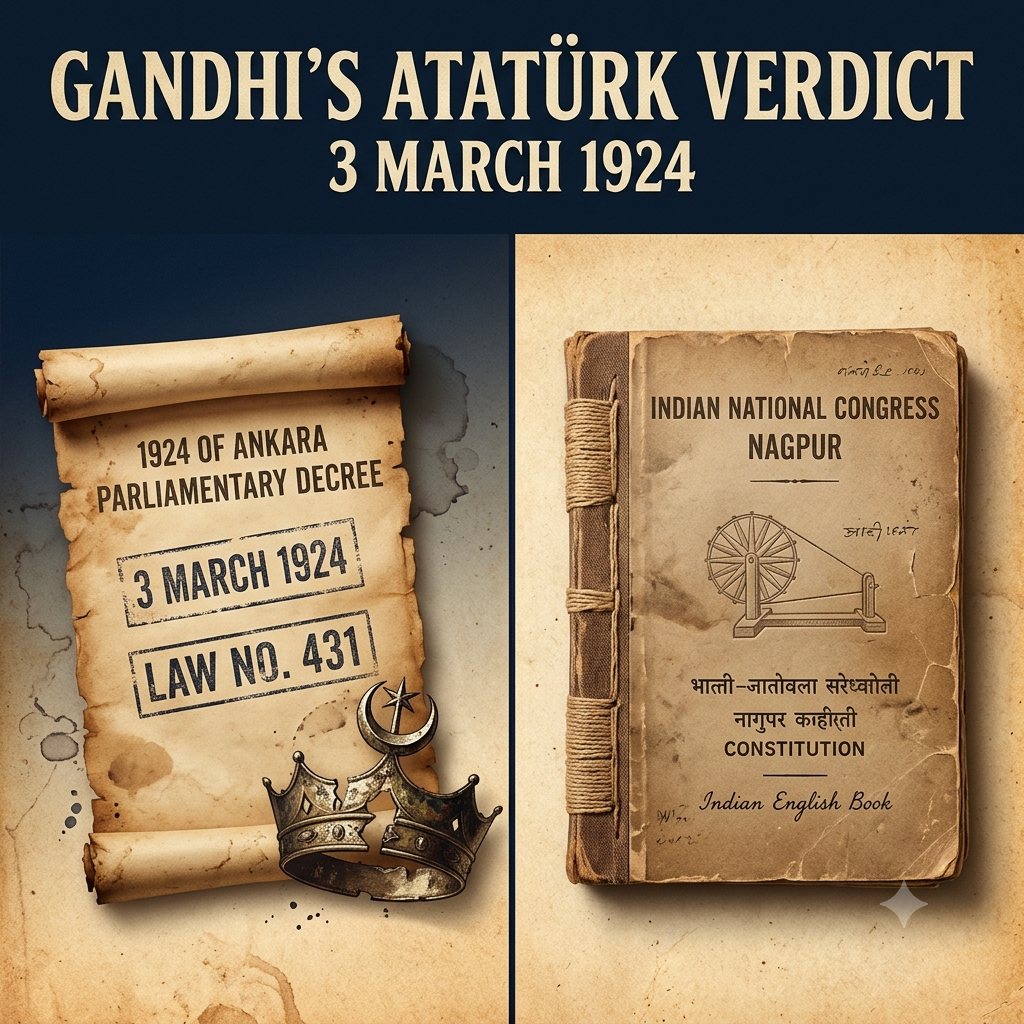
Gandhi’s Atatürk Verdict: Caliphate Abolition Attributable to India’s Khilafat Movement (209)
भारत / GB
Part 209: Mahatma Gandhi’s Peace Efforts | Series Index
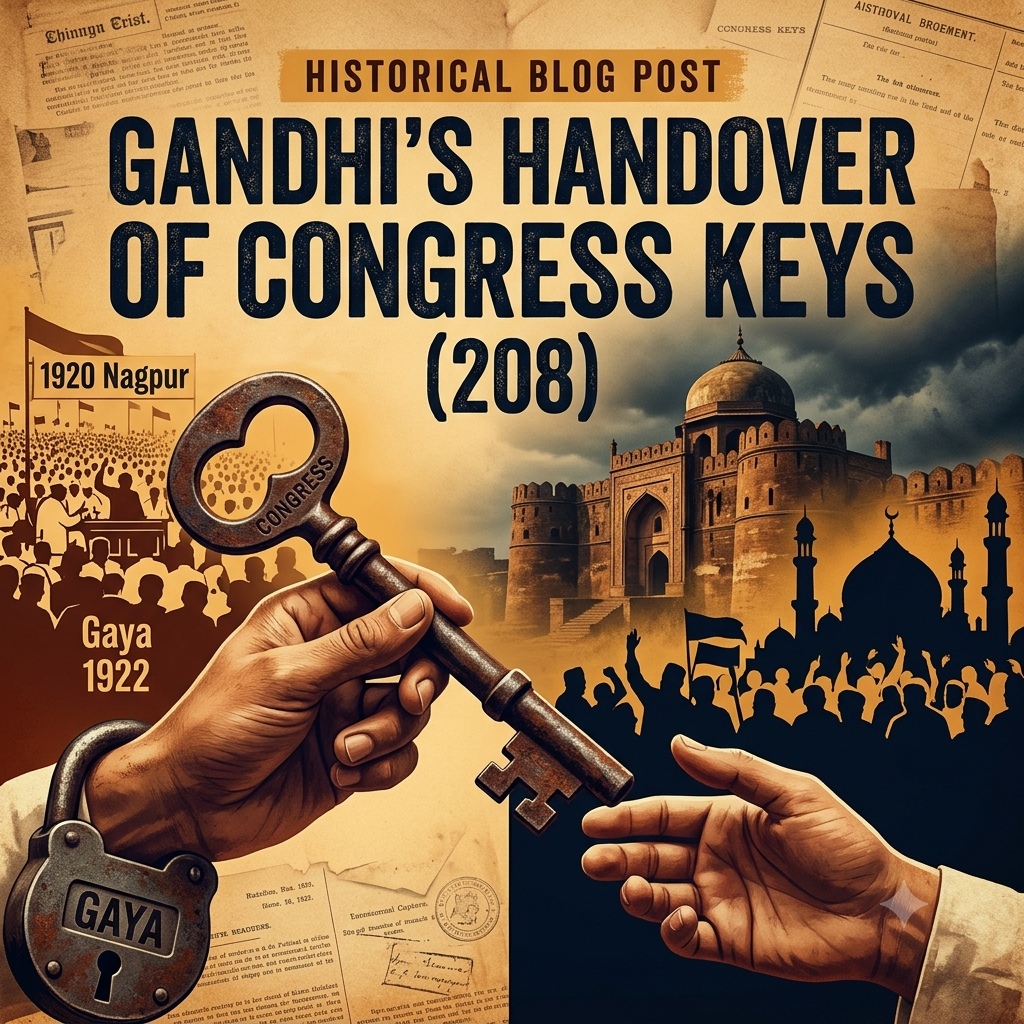
Blog 208 documented Gandhi’s handover of Congress keys — the December 1920 Nagpur Constitution that embedded a Khilafat-ulama voting bloc inside Congress and defeated the sitting Congress president at Gaya in December 1922 even while Gandhi sat in Yerwada Prison. This blog traces that machine back to its birth at the Amritsar Congress of December 1919 and forward to its terminus on 3 March 1924, when the Turkish Grand National Assembly abolished the Ottoman Caliphate by legislative decree — extinguishing in Ankara the very institution for which Gandhi had reorganised Congress, committed the Tilak Swaraj Fund, and sent thirty thousand Indians to prison.
THE ARITHMETIC OF THE VERDICT
The Action Taken: At the Amritsar Congress of December 1919, Gandhi met the Ali Brothers — Mohammad Ali and Shaukat Ali — fresh from colonial detention, and committed the Indian National Congress to defending the Ottoman Caliphate. Over the next year, he placed the Caliphate above Swaraj in the Non-Cooperation preamble and embedded Khilafat networks inside Congress’s new Nagpur Constitution. On 3 March 1924, the Turkish Grand National Assembly abolished that Caliphate by legislative decree — not under British compulsion, but by deliberate Turkish nationalist choice.
Who Paid the Price: Tens of thousands of students who abandoned schools, lawyers who surrendered practices, citizens who donated over ₹1.2 crore to the Tilak Swaraj Fund, the thirty thousand volunteers imprisoned when Gandhi halted the agitation at Bardoli in February 1922, and the 890 delegates voted down at Gaya by the Khilafat-ulama machine Gandhi had installed.
Why This Matters: Gandhi’s Atatürk verdict is the name the prosecution assigns to this event. Built on the premise that the Caliphate faced existential British destruction, the Indian Khilafat movement was rendered false in retrospect when Atatürk’s own parliament abolished the office — leaving behind an embedded sectarian machine inside Congress long after its foreign cause ceased to exist.
The Founding Alliance: Amritsar, December 1919
At the Amritsar Congress of December 1919, Gandhi met Mohammad Ali and Shaukat Ali immediately after their release from colonial detention, where they had been held without trial for opposing British wartime policy.
The meeting occurred at a moment when Gandhi’s own political standing was faltering. His abrupt suspension of the April 1919 Rowlatt Satyagraha, his condemnation of popular retaliation during the Punjab crackdown and the Jallianwala Bagh massacre, and his initial push at Amritsar to cooperate with the Montagu–Chelmsford Reforms had eroded his support among nationalists and revolutionaries alike, leaving him searching for a decisive lever to rejuvenate his authority.
Gandhi grasped the structural opportunity. The Rowlatt Satyagraha had shown that mass agitation needed a mobilising vehicle beyond the professional Congress class. Simultaneously, the Allied occupation of Ottoman territories, the impending dismemberment of the Ottoman Empire at the 1919 Paris Peace Conference — breaking British Prime Minister Lloyd George’s wartime pledges — and brewing pan-Islamic upheavals in Egypt had ignited anger among Indian Muslims over the fate of the Caliphate. By synchronising the Congress plenary session with the Khilafat Committee session in Amritsar — a co-location model that soon became a permanent feature — Gandhi executed a deliberate strategy to harness the Ali Brothers’ mosque-and-madrasa network across the subcontinent.
In exchange, Gandhi committed the Indian National Congress to defending the Ottoman Caliphate — a foreign religious institution over which Congress held no command authority. By Calcutta in September 1920 and Nagpur in December 1920, Gandhi had placed the Caliphate first in the Non-Cooperation resolution preamble, ahead of Punjab wrongs and Swaraj, while the ulama’s Muttafiqa Fatwa placed the agitation under a theological mandate Gandhi could neither direct nor modify. As Blog 208 documented, the Nagpur Constitution embedded Khilafat infrastructure across every tier of Congress.
The Caliphate Gandhi Defended
To understand Gandhi’s Atatürk verdict, the history of the office he and the Indian National Congress had pledged to defend must be separated into two distinct stages. From 1517 onward, the Ottoman ruler had held both the temporal title of Sultan and the spiritual title of Caliph of Sunni Islam. That dual office remained intact under Sultan Mehmed VI when the Ottoman Empire signed the Armistice of Mudros in October 1918 — the post-war crisis that ignited the Indian Khilafat movement in 1919 on the premise that British and Allied policy endangered the Sultan-Caliph’s survival, the very institution Gandhi then bound Congress to protect through Non-Cooperation.
By late 1922, however, that same institution had already been transformed by Turkey’s own nationalists, while in India the Khilafat Movement had fractured the population along religious lines. After the Bardoli resolution of February 1922 suspended the Non-Cooperation Movement, Gandhi was arrested in March and imprisoned in Yerwada Jail. While he remained in prison, Mustafa Kemal’s Grand National Assembly abolished the Ottoman Sultanate on 1 November 1922, deposed Mehmed VI, and formally separated the temporal monarchy from the religious Caliphate. The Assembly then elected Abdülmecid II as Caliph on 18–19 November 1922, confining the office to a purely ceremonial role stripped of political power while sovereignty was consolidated in Ankara. These developments left Indian Khilafatists stranded between a suspended agitation at home and a diminished Caliphate that Turkey’s nationalists had themselves reduced to a powerless religious symbol — an office that would be abolished altogether in March 1924.
The Caliphate Gandhi Defended
To understand Gandhi’s Atatürk verdict, the history of the office he and the Indian National Congress had pledged to defend must be separated into two distinct stages. From 1517 onward the Ottoman ruler had held both the temporal title of Sultan and the spiritual title of Caliph of Sunni Islam. That dual office remained intact under Sultan Mehmed VI when the Ottoman Empire signed the Armistice of Mudros in October 1918. It was the subsequent Allied occupation of Constantinople and the threatened partition of Ottoman territories at the Paris Peace Conference that ignited the Indian Khilafat movement in 1919, built on the premise that British and Allied policy endangered the survival of the Sultan-Caliph—the very institution Gandhi then bound the Congress to protect through Non-Cooperation.
3 March 1924: The Ankara Resolution
The 1922 separation had already reduced the Caliphate to a powerless ceremonial office; on 3 March 1924 the Turkish Grand National Assembly completed what November 1922 had begun. By legislative decree (Law No. 431), the Assembly abolished the Caliphate entirely, deposed Abdülmecid II, and expelled the Ottoman dynasty from Turkish territory. This was not a concession to British compulsion, but an affirmative act by Atatürk’s government—directly prompted by Indian Khilafatist interference in Turkish domestic affairs, notably the public appeal from Aga Khan III and Syed Ameer Ali demanding the preservation of the Caliph’s status, which Ankara treated as intolerable foreign meddling and used to declare the Caliphate incompatible with a modern secular republic.
Abdülmecid II departed Istanbul on 4 March 1924. No major Muslim state recognised a successor, and Egypt’s May 1926 Cairo Caliphate conference produced neither agreement nor restoration. The pan-Islamic architecture on which Gandhi had built the Congress-Khilafat alliance had no institutional roof left standing.
The timing is a fixed coordinate of Gandhi’s Atatürk verdict. Released from Yerwada Prison on 5 February 1924—twenty-six days before the Ankara resolution—Gandhi re-entered Indian politics to find the alliance’s foreign anchor removed before he had completed a single public appearance. Between the February 1922 suspension and the March 1924 abolition, thirty thousand Indians had languished in colonial prisons and the Swaraj Party had entered councils under a vacated programme, without a single Non-Cooperation objective secured.
The Indian Khilafat Committee: The Indian Khilafat Committee: Islamisation of Politics
From 1919 to 1922, the All-India Khilafat Committee operated far beyond a political protest group: it institutionalised pan-Islamic militancy on Indian soil — complete with provincial branches, a drilled volunteer corps, fatwa authority, and a treasury fed by public collections and Tilak Swaraj Fund allocations — all governed by the Muttafiqa Fatwa outside Congress jurisdiction.
Those three years provided the operational testing ground for the scriptural verses chanted at Nagpur, most devastatingly deployed in the full-fledged testing of Quranic Verse 9:5 during the 1921 Malabar rebellion. It was later tested across thirty to forty communal riots during the same period. When the 3 March 1924 Ankara resolution removed the Ottoman Caliphate, the clerical infrastructure, drilled volunteer corps, and militant networks forged during 1919–1922 did not collapse or dissolve; having proved their effectiveness on the ground, they redirected seamlessly into permanent communal mobilisation, Tanzim, and Tabligh across India.
The Ali Brothers: Political Collapse
For Mohammad Ali and Shaukat Ali, Gandhi’s publicly celebrated partners since Amritsar 1919 and the only beneficiaries of his May 1921 Simla immunity deal with Viceroy Reading, political standing had rested on two pillars: proximity to Gandhi and defence of the Caliphate.
Gandhi’s Atatürk verdict knocked away the second pillar entirely, leaving the Ali Brothers without a cause. The first pillar, however, stood firm through the institutional mechanism Gandhi had created at the Calcutta and Nagpur sessions in 1920. Though he was never aligned with Congress on the principles that Congress pursued, Mohammad Ali drifted steadily further away from Congress toward explicitly communal Muslim politics; upon dying in London in January 1931, he was buried in Jerusalem, refusing interment in British-ruled India. Shaukat Ali’s post-1924 career similarly reflected a leadership whose cause had been abolished by its own national constituency.
Gandhi’s Response: Young India and the Verdict
When Gandhi resumed editing Young India in April 1924, he registered the abolition as an internal Muslim question while refusing to confront what it meant for the 1920–22 Congress programme. Ankara’s parliamentary vote proved the Caliphate had never been threatened primarily by British policy; Atatürk, not Britain, had extinguished it.
Yet Gandhi never published the accounting that Gandhi’s Atatürk verdict demanded: on what basis had Congress subordinated Swaraj, committed its organisational machinery, and spent public funds to defend a foreign clerical institution whose own sovereign nation declared it unnecessary? Above all, he offered no reckoning for the devastating price Hindus paid for his experiment in Hindu-Muslim unity — enduring the Malabar massacres, forced conversions, temple desecrations, and thirty to forty communal riots unleashed by a foreign religious cause thrust upon Congress and the Indian public.
What the Verdict Closes
The 3 March 1924 resolution closed the Congress-Khilafat alliance with a stark balance sheet: the Caliphate abolished by Ankara; Non-Cooperation abandoned at Bardoli two years earlier; thirty thousand volunteers imprisoned without a single concession won; millions deprived of their properties and jobs for participating in the movement; the Tilak Swaraj Fund spent without public audit; and Congress permanently restructured to embed a clerical-Khilafat voting apparatus.
Gandhi’s Atatürk verdict was literal, not metaphorical: Ankara judged the Caliphate unnecessary and abolished it. Students, donors, and thirty thousand prisoners received no accounting of what their sacrifice had served. While the foreign cause vanished, the domestic machine built inside Congress — the Nagpur Constitution, embedded blocs, and fatwa-enforcing concurrent sessions — outlasted it by decades. What Gandhi had entangled at Amritsar in 1919 could not be disentangled by Ankara in 1924.
Modern Parallel
The structural consequences of that bargain did not end in March 1924; Indians continue to pay through the nose for it even today. When political leadership binds a domestic party to an extra-territorial religious cause, the stated foreign objective may vanish while the organisational infrastructure built in its service becomes permanent — available for redirection toward ends never disclosed to the public that funded and staffed it.
The very clerical body Gandhi empowered and legitimised during that alliance, Jamiat Ulema-e-Hind, continues to provide legal defence to individuals accused in terror cases, while major political leaders in contemporary India still pursue the same divisive appeasement template. That 1920 institutional compact culminated directly in India’s 1947 Partition and the deaths of millions of Hindus — whose descendants continue to face the wrath of institutionalised extremism in Bangladesh, Pakistan, and within India itself.

Invitation To Defence
The December 1919 Amritsar alliance, the 3 March 1924 Turkish Grand National Assembly abolition decree, the collapse of the All-India Khilafat Committee, and the Ali Brothers’ post-1924 trajectory are all in the record. The defence is invited to identify any primary source showing that the Khilafat movement responded primarily to British policy rather than to the Turkish nationalist forces that abolished the office, or to produce the accounting — never published in Young India — of what Indian sacrifices achieved for the institution in whose name they were demanded.
At Amritsar in December 1919, Gandhi committed the Indian National Congress to defending the Ottoman Caliphate. On 3 March 1924, the Turkish Grand National Assembly abolished that Caliphate on its own sovereign authority. What Gandhi had placed at the head of Congress’s programme, subordinating Swaraj and restructuring the party’s constitution, was declared unnecessary by Turkey itself. Gandhi’s Atatürk verdict was delivered by Atatürk — and the sectarian machine built inside Congress in its service remained.
Feature Image: Click here to view the image.
Videos
Glossary of Terms
1. Gandhi’s Atatürk Verdict: A distinctive phrase coined in this blog to describe the political outcome of Gandhi’s commitment to defending the Ottoman Caliphate, which Turkey’s own nationalist leadership subsequently abolished on 3 March 1924.
2. Ottoman Caliphate: The religious institution headed by the Ottoman ruler, who traditionally held the spiritual title of Caliph of Sunni Islam alongside the temporal title of Sultan.
3. Khilafat Movement: An Indian political and religious movement launched after the First World War to defend the Ottoman Caliphate against its anticipated dismantling by Britain and the Allied Powers.
4. Sultan-Caliph: The combined temporal and spiritual authority exercised by the Ottoman ruler, encompassing the political position of Sultan and the religious position of Caliph.
5. Non-Cooperation Movement: The political agitation led by Mahatma Gandhi beginning in 1920, involving the withdrawal from British institutions, educational establishments, courts and other structures, with the Khilafat cause placed prominently alongside Swaraj.
6. Nagpur Constitution: The revised Indian National Congress constitution adopted in December 1920, which embedded Khilafat organisational networks and their influence within the party’s organisational and voting structures.
7. Muttafiqa Fatwa: A collective religious decree issued by the ulama that placed the Khilafat agitation under a theological mandate, operating independently of Congress’s command authority.
8. All-India Khilafat Committee: The organisation established to coordinate the Indian Khilafat Movement through provincial branches, religious leadership, volunteer organisations, public collections and political mobilisation.
9. Pan-Islamic Militancy: A form of political and religious mobilisation seeking to advance a wider Islamic political cause across national boundaries, which the blog associates with the Khilafat organisational infrastructure in India.
10. Tilak Swaraj Fund: A public fundraising initiative established in the name of Bal Gangadhar Tilak to finance the national movement, which received contributions exceeding ₹1.2 crore and was also committed to the Congress-Khilafat political programme.
11. Grand National Assembly: Turkey’s sovereign legislative institution under Mustafa Kemal’s nationalist leadership, which abolished the Ottoman Sultanate in 1922 and the Caliphate in 1924.
12. Ankara Resolution: The legislative action of 3 March 1924, enacted through Law No. 431, by which the Turkish Grand National Assembly abolished the Caliphate, deposed Abdülmecid II and expelled the Ottoman dynasty from Turkish territory.
13. Tanzim and Tabligh: Two forms of religious organisational activity. Tanzim refers to organisation and mobilisation, while Tabligh refers to religious propagation and communication. The blog identifies these as subsequent directions of the Khilafat-era organisational networks.
14. Co-Located Sessions: The organisational arrangement in which Congress plenary sessions and Khilafat Committee sessions were held alongside each other, facilitating coordination between the two organisations and their respective political networks.
15. Clerical-Khilafat Voting Apparatus: A distinctive description of the voting mechanism embedded within Congress through the Khilafat-ulama network, which the blog identifies as instrumental in influencing internal party elections, including the December 1922 Gaya session.
#Gandhi #Ataturk #Khilafat #Caliphate #IndianHistory #Congress #Swaraj #OttomanEmpire #History #PoliticalHistory #NonCooperation #Amritsar #Ankara #HinduinfoPedia
Scan Through The Entire Series at