
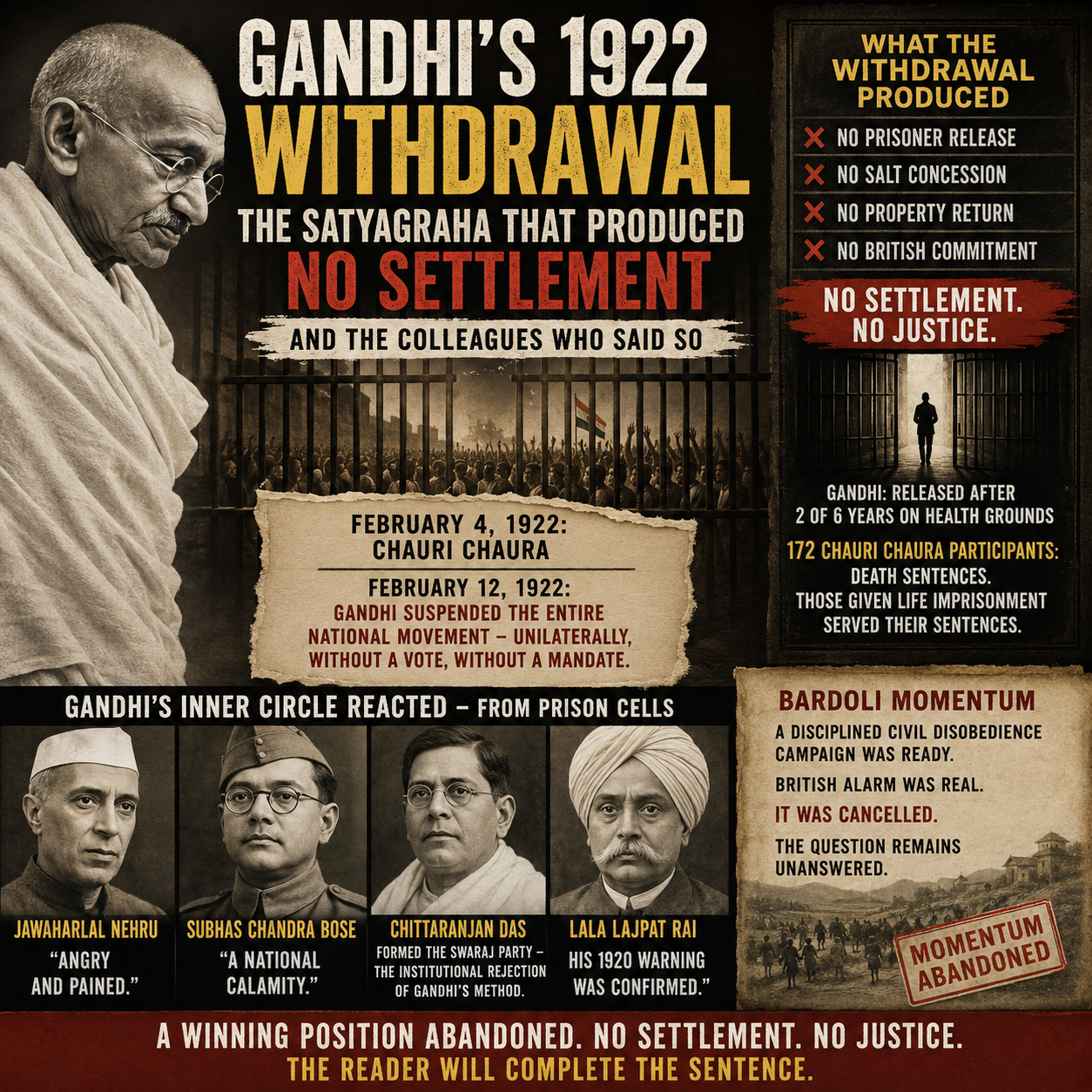
Gandhi’s 1922 Withdrawal: The Satyagraha That Produced No Settlement — and the Colleagues Who Said So (131)
भारत / GB
Part 131: Mahatma Gandhi’s Peace Efforts | Series Index
Blog 130 placed the February 4 1922 events at Chauri Chaura and Gandhi’s unilateral suspension of the Non-Cooperation Movement before the reader. This post, “Gandhi’s 1922 Withdrawal” places the documented reactions of Gandhi’s own inner circle alongside the documented settlement anatomy — what the withdrawal produced for India, and what it produced for Gandhi.
Thank you for reading this post, don't forget to subscribe!The Action Taken: Following the Bardoli resolution suspending Non-Cooperation, the official Congress legal defense panel stopped organizing the defense of the Chauri Chaura peasant defendants.
Who Paid the Price: The peasant defendants, who were left without institutional funding or legal assistance during their initial capital murder trials.
The Alternative Bypassed: Maintaining an institutional, well-funded legal defense panel for participants arrested during movement demonstrations.
Why This Matters: Documents the complete operational abandonment: once an agitation was terminated for moral failure, the participants were left to face colonial capital courts alone.
The Inner Circle’s Documented Reactions
Gandhi’s 1922 Withdrawal places the documented reactions of Gandhi’s closest colleagues before the reader first. These were not outside critics. These were the men who had built the Non-Cooperation Movement alongside Gandhi — men who had gone to prison for it, men who had sacrificed legal careers and political standing for it.
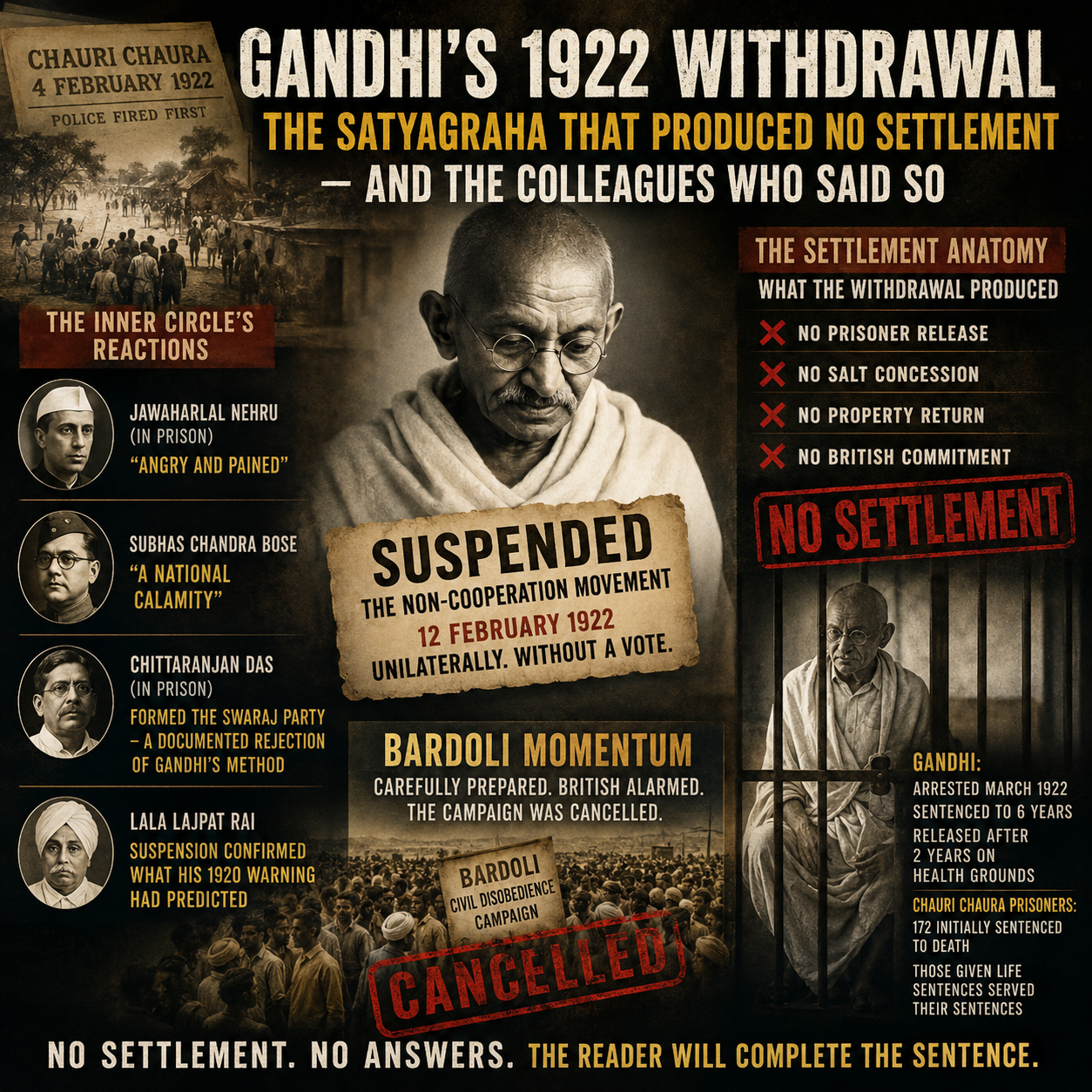
Jawaharlal Nehru — in prison: Nehru heard of the suspension through prison walls. His documented reaction, placed on record in his autobiography: he was “angry” and “pained.” He had been preparing for the next phase of the movement. The suspension reached him as a fait accompli — Gandhi’s unilateral decision delivered to the movement’s participants as an announcement, not a consultation.
Subhas Chandra Bose — documented: Called the suspension “a national calamity.” His documented position: the movement had reached its highest documented momentum, the British administration was by contemporary accounts genuinely shaken, and Gandhi had unilaterally surrendered the strongest hand India had held. Bose documented his conviction that the suspension was not a tactical retreat but an abandonment of a winning position.
Chittaranjan Das — documented: Was in prison when the suspension was announced. His documented disillusionment was profound. Das and Motilal Nehru subsequently formed the Swaraj Party — specifically to pursue constitutional politics inside the legislatures — a documented institutional response to Gandhi’s decision to redirect the movement toward the constructive programme. The Swaraj Party was not formed in opposition to the independence movement. It was formed as a documented rejection of Gandhi’s unilateral authority to determine the movement’s method.
Lala Lajpat Rai — documented: Had placed his documented warning before the Calcutta 1920 session against the Khilafat alliance. The suspension confirmed what his documented position had predicted: Gandhi’s method of unilateral moral authority over the movement was structurally incompatible with democratic accountability to its participants.
The prosecution places these reactions before the reader with one observation: the shock and anger were documented by Gandhi’s own colleagues — not by British officials, not by the movement’s opponents, but by the men who had built the movement and who were inside British prisons for doing so when they learned, from prison, that it had been suspended.
The Settlement Anatomy — What the Withdrawal Produced
Gandhi’s 1922 Withdrawal places the documented settlement anatomy before the reader. The Non-Cooperation Movement produced no settlement.
The Irwin Pact of 1931 — established in Blogs 17-20 of this series — had at least produced a documented transaction: Gandhi’s signature, the release of political prisoners, a suspension of civil disobedience, India’s attendance at the Round Table Conference. Not one demand was met in full, but the documented exchange had a structure — both sides gave something verifiable.
The 1922 withdrawal produced no equivalent. No prisoner release clause. No salt concession. No property return for those whose property had been seized during the movement. No documented British commitment of any kind. Gandhi simply stopped.
Gandhi was arrested in March 1922. He was tried and sentenced to six years’ imprisonment. He served two years before being released on health grounds in February 1924.
Gandhi’s 1922 Withdrawal places the documented asymmetry before the reader: Gandhi served two of his six years before being released on health grounds. The 172 participants who had faced death sentences at Chauri Chaura — of whom Malaviya saved 153, as established in Blog 130 — had no equivalent documented health ground available to them. Those who received life imprisonment sentences served their sentences.
The Bardoli Momentum — What Was Abandoned
Gandhi’s 1922 Withdrawal places the documented context of what was cancelled before the reader. The Bardoli civil disobedience campaign had been carefully prepared. Gandhi had personally selected Bardoli, Gujarat, as the site for a disciplined, controlled demonstration of non-violent resistance that would test the movement’s capacity to operate at scale without descending into the violence Gandhi feared.
The British administration’s documented response to the approaching Bardoli campaign — by contemporary accounts — was one of genuine alarm. The movement, by February 1922, had sixty thousand Indians through its jails, had disrupted the documented economic functioning of the colonial apparatus, and had produced, in the words of the Viceroy’s own correspondence, a level of mass participation the administration had not anticipated.
The Bardoli campaign was cancelled. The British alarm — documented in contemporary official correspondence — was not tested. The question of whether that tested alarm would have produced a documented settlement of substance was not answered.
Gandhi’s 1922 Withdrawal does not assert that the Bardoli campaign would have succeeded. It places the documented momentum, the documented British alarm, and the documented cancellation before the reader — and asks the reader to examine what the unilateral suspension left unanswered.
The Prosecution’s Position
Gandhi’s 1922 Withdrawal places three questions before the reader.
- Did the documented reactions of Nehru (angry and pained, in prison), Bose (“national calamity”), Das (formed the Swaraj Party as a documented institutional rejection of Gandhi’s method), and Lajpat Rai (confirmed what his 1920 warning had predicted) — all from inside the movement’s own inner circle — establish that the unilateral suspension was recognised by Gandhi’s closest colleagues as an abandonment of a winning position without their consultation or consent?
- Did the 1922 withdrawal produce no documented settlement — no prisoner release, no salt concession, no property return, no British commitment of any kind — establishing that the satyagraha that had placed sixty thousand Indians in jail and produced documented British alarm produced, at its suspension, nothing for those who had participated in it?
- Does the documented asymmetry — Gandhi released after two of six years on health grounds, 172 Chauri Chaura participants initially sentenced to death, those who received life imprisonment serving their sentences — constitute an exhibit the reader places alongside Gandhi’s documented unilateral authority over the movement he suspended?
The series does not answer. Gandhi’s 1922 Withdrawal places the inner circle reactions, the settlement anatomy, and the Bardoli momentum before the reader in sequence. The reader will examine what the movement’s own colleagues documented — and complete the sentence.
Invitation To Defence
The floor belongs to the defense. We now invite them to present their exhibits and challenge the narrative established by the prosecution.
Nehru: angry and pained, in prison. Bose: national calamity. Das: formed the Swaraj Party — the documented institutional rejection. Lajpat Rai: confirmed. No prisoner release. No salt concession. No property return. No British commitment. Gandhi: arrested March 1922, sentenced six years, released two years later on health grounds. The movement participants: served their sentences. Bardoli cancelled. British alarm not tested. The prosecution places the inner circle’s documented reactions and the withdrawal’s documented anatomy before the reader. The reader will complete the sentence.
Feature Image: Click here to view the image.
Videos
Glossary of Terms
- Non-Cooperation Movement: A nationwide movement launched by Gandhi in nineteen hundred twenty to withdraw Indian cooperation from British institutions through peaceful non-cooperation.
- Chauri Chaura Incident: The four February nineteen hundred twenty-two event in which a violent clash led to the deaths of policemen, prompting Gandhi to suspend the Non-Cooperation Movement.
- Gandhi’s 1922 Withdrawal: The unilateral suspension of the Non-Cooperation Movement by Gandhi after the Chauri Chaura incident, forming the central subject of this blog.
- Bardoli Campaign: The planned civil disobedience campaign intended to expand the Non-Cooperation Movement through disciplined non-violent resistance before it was cancelled.
- Civil Disobedience: A method of political protest involving deliberate but non-violent violation of selected laws to challenge governmental authority.
- Satyagraha: Gandhi’s doctrine of non-violent resistance based on truth and moral persuasion rather than physical force.
- Swaraj Party: A political party established by Chittaranjan Das and Motilal Nehru to pursue constitutional politics within legislative institutions after the movement’s suspension.
- Irwin Pact: The nineteen hundred thirty-one agreement between Gandhi and the British Government that exchanged suspension of civil disobedience for limited political concessions.
- Round Table Conference: A series of constitutional conferences held in London to discuss India’s constitutional future with representatives from British India and princely states.
- Constructive Programme: Gandhi’s programme emphasizing social reform, village industries, education and self-reliance instead of direct political agitation.
- Documented Settlement Anatomy: A key phrase in this series describing the measurable terms, concessions and outcomes produced by a political settlement for evaluating its effectiveness.
- Documented British Alarm: A key phrase referring to official British correspondence recording concern over the scale and momentum of the Non-Cooperation Movement before its suspension.
- Documented Asymmetry: A key phrase describing the contrast between Gandhi’s early release on health grounds and the continued imprisonment or harsher punishment of many movement participants.
- Winning Position: A key phrase used by Subhas Chandra Bose to describe the movement’s perceived strategic advantage before Gandhi suspended it.
- Unilateral Suspension: A key phrase describing Gandhi’s decision to suspend the movement without consulting or obtaining approval from its principal colleagues or participants.
#Gandhi #NonCooperation #ChauriChaura #FreedomMovement #IndianHistory #Satyagraha #Congress #Bardoli #Nehru #SubhasBose #Swaraj #HinduinfoPedia
Gandhi’s Peace Efforts: The Questions Before the Mahatma (0)