
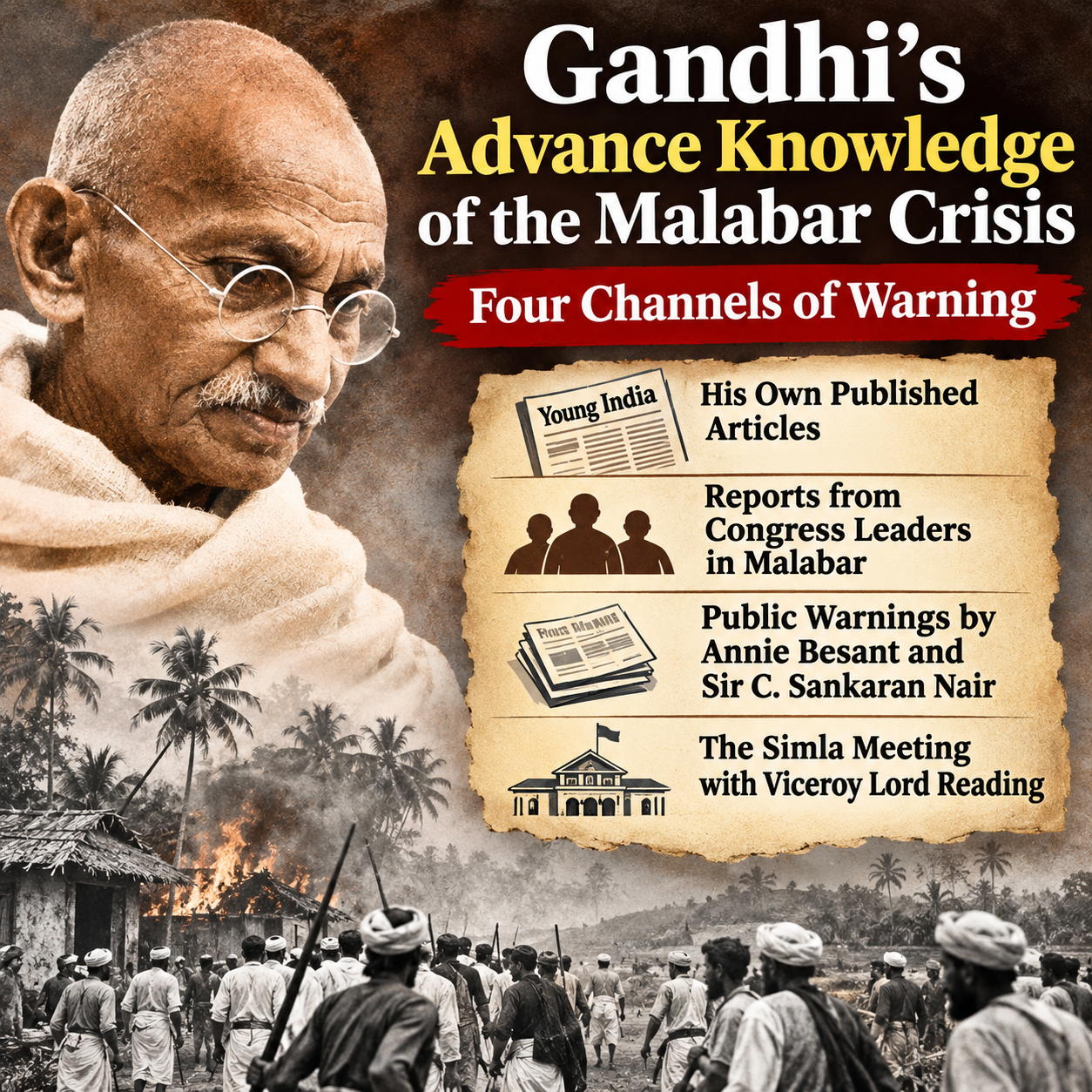
Gandhi’s Live Bomb Knowledge — Malabar: Three Channels, No Secret Dossier Required (195)
भारत / GB
Part 195: Mahatma Gandhi’s Peace Efforts | Series Index
The previous two blogs documented the Simla transaction in full: the unminuted summit at 7,000 feet, Lord Reading’s police shorthand transcripts of the Ali brothers’ incitement to armed jihad, the ultimatum, Gandhi’s concession, and the 30 May 1921 retraction whose drafting ensured both parties could claim what they needed. The Simla channel is the most direct single proof that Gandhi’s live bomb knowledge — Malabar was contemporaneous and acknowledged. This blog places the three remaining independent channels before the reader: each one sufficient on its own to foreclose the standard defence, none of them dependent on the Simla record.
Thank you for reading this post, don't forget to subscribe!GANDHI’S SIMLA CHAMBER — THE KNOWLEDGE RECORD ACROSS THREE REMAINING CHANNELS
The Pattern: The standard defence argues that Gandhi was not shown the secret Madras CID dossiers and therefore could not have known what was building in Malabar. The Simla arc (Blogs 193–194) demolished that defence through the most direct channel available: the Viceroy’s personal confrontation with verbatim transcripts and Gandhi’s own brokered retraction. This blog places three further channels before the reader — channels that do not depend on Simla, on CID files, or on any private communication. Gandhi’s live bomb knowledge — Malabar arrived through his own published words, through his own Congress apparatus on the ground, and through the national press. The defence has four independent lines to defeat. This blog presents three of them.
The Lethal Exhibit: K.P. Kesava Menon and K. Madhavan Nair — Gandhi’s own Congress officers in Malabar — documented that local Moplah congregations told Congress workers directly in 1921 that violence in defence of the Caliphate was sanctioned by the Quran and was not covered by Gandhi’s prohibition. This divergence was known to the Congress provincial hierarchy that reported to the AICC. Gandhi’s live bomb knowledge — Malabar included the specific information that the apparatus he had built was operating on theological premises that explicitly overrode his own stated doctrine. That information came from his own men.
Why it matters: The three channels in this blog are qualitatively different from the Simla channel. Simla was a private bilateral confrontation — the defence can argue Gandhi misunderstood its gravity, was deceived by Reading, or could not independently verify the transcripts. The three channels here are all public, documented, and independently verifiable: his own published words in Young India, his own Congress officers’ field reports, and former Congress Presidents writing in the national press. No secret file. No private meeting. No single-source reliance. Gandhi’s live bomb knowledge — Malabar is established without Simla. Simla merely adds the capstone.
Channel One: Gandhi’s Own Published Words (February–March 1921)
The Section 144 orders District Magistrate E.F. Thomas imposed in Ernad and Walluvanad in February 1921 were not filed in a confidential dossier. They were public statutory instruments issued in named taluks because the district administration believed an armed uprising was a credible near-term risk. Gandhi commented on them in Young India within days.
His 23 February 1921 article praised the arrested leaders — Yakub Hasan, K. Madhavan Nair, U. Gopala Menon, and P. Moideen Koya — for courting jail in defiance of the prohibition. His 9 March 1921 article, The Meaning of the Moplah, dismissed the district administration’s powder-keg characterisation as imperialist panic designed to sabotage Hindu-Muslim unity and praised the Moplah community for restrained endurance under official provocation.
Gandhi’s live bomb knowledge — Malabar therefore begins with his own published words. The state’s alarm was not confidential. Gandhi’s receipt of it and his chosen interpretation are documented in his own hand, in CWMG, in the Young India archive. A man who writes two articles in Young India responding to emergency public safety orders in specific taluks has received the state’s warning. His response framed the warning as bad-faith alarmism, convincing the public that the British were merely manufacturing communal divisions. The first channel is not inference. It is text.
Channel Two: The Congress Ground Reports (February–July 1921)
Gandhi’s own Congress apparatus in Malabar was generating and transmitting warnings about conditions in Ernad and Walluvanad throughout the first half of 1921. These warnings did not remain at the district level.
K.P. Kesava Menon, Secretary of the Malabar District Congress Committee, documented in his memoir Kazhinja Kaalam that local Congress leaders operating in the interior of the district had discovered, by early 1921, that secret arms collections were underway, that war knives — vaals — were being manufactured, and that Friday sermons at the Ponnani mosque and affiliated pulpits were being used by the tangal preachers to frame resistance to the British and their Hindu landlord allies as a religious obligation. K. Madhavan Nair’s Malabar Kalapam, written contemporaneously in the 1920s, records the same discoveries.
What Kesava Menon and Madhavan Nair also documented was the ideological divergence they encountered when they attempted to preach Ahimsa in the interior taluks. Local Moplah congregations and tangal preachers told them directly that while non-violence was the Mahatma’s policy, violence in defence of the Caliphate was sanctioned by the Quran and was not covered by Gandhi’s prohibition. This divergence — the apparatus Gandhi had built operating on theological premises that explicitly overrode his own stated doctrine — was known to the Congress provincial hierarchy that reported to the AICC. Gandhi’s live bomb knowledge — Malabar included the specific information that the Moplah community in the coastal taluks did not consider non-violence binding when the Caliphate was at stake. That information came from his own officers in the field.
Channel Three: The Public Press (March–July 1921)
The warnings reaching Gandhi were not confined to official channels or internal party reports. They were published in the national press by figures whose authority within the Indian public sphere was unquestioned.
Annie Besant wrote throughout the spring of 1921 in New India — a Madras-based paper with national reach — warning directly that introducing the Khilafat agitation into Malabar would awaken communal tendencies among the Moplah community that Gandhi’s doctrine of Ahimsa was completely powerless to control. Besant was not an outsider to Indian political life: she had presided over the Indian National Congress in 1917. Her warnings were addressed to Gandhi by name and were published in a paper he read.
Sir C. Sankaran Nair — former President of the Indian National Congress and former member of the Viceroy’s Executive Council — made the same argument in contemporaneous writings later formalised in Gandhi and Anarchy (1922). Sankaran Nair documented that every person with practical knowledge of Malabar district administration knew that religious excitement introduced into Ernad invariably ended in blood, forced conversions, and agrarian massacre. He stated explicitly that Gandhi had been warned by men who knew the district.
The public press channel adds a third independent layer to Gandhi’s live bomb knowledge — Malabar: the danger was not merely official, not merely internal to the Congress apparatus, but publicly and prominently stated by former senior Congress figures in publications Gandhi’s circle read and to which Gandhi’s circle responded. These warnings were on the record before August 1921. They remain on the record now.
The historical record establishes that Gandhi set aside the warnings delivered at Simla by Viceroy Lord Reading in May 1921 — whether through political miscalculation or tactical design. In either case, the material consequence was identical: the civilian population of Malabar was left exposed to an ideological storm that the national leadership refused to halt. What followed in August 1921 was not unforeseeable. It was foreseen — by Besant, by Sankaran Nair, by Gandhi’s own Congress officers in the field, and, through the Simla confrontation, by Gandhi himself.
The Closed Defence
Taken together with the Simla arc documented in Blogs 193–194, four independent channels establish the knowledge record. The standard defence — Gandhi was not shown the secret Madras CID dossiers and therefore could not have known — is foreclosed on four separate grounds, each sufficient on its own.
Channel One requires no classified file: Gandhi wrote the response himself. His Young India articles did not merely dismiss the state’s warning — they actively reframed what was visible. Gandhi saw the Ali brothers’ calls for Khilafat resistance, saw the Moplah community’s response in Ernad and Walluvanad, and then published his interpretation: not incitement, but righteous endurance under official provocation. He was not arguing from ignorance. He was arguing from observation and reaching the opposite conclusion to every official and independent witness who saw the same events. The charge is not that Gandhi failed to notice the incitement. The charge is that he noticed it, named it differently, and left the apparatus running.
Channel Two requires no Viceroy, no police transcript, no imperial confrontation: Gandhi’s own Congress officers in the field reported the arms, the weapons collections, and the theological override of his doctrine directly into the provincial hierarchy.
Channel Three requires no internal document of any kind: Besant and Sankaran Nair published their warnings in the national press. The Simla channel, documented in full in Blogs 193–194, adds the fourth: the Viceroy placed verbatim transcripts before Gandhi in private, Gandhi conceded their force, Gandhi brokered the retraction, and then Gandhi left the Malabar apparatus untouched.
Gandhi’s live bomb knowledge — Malabar is not a matter of probability or inference. It is a matter of documented receipt across four independent sources: his own Young India, his own Congress apparatus, the national press, and the Viceroy of India. The defence requires the reader to believe that Gandhi read none of his own articles, received no reports from his own officers, read no national newspaper, and remembered nothing of what the Viceroy had placed before him in Simla. The next blog documents what the machine he left running produced.
Invitation To Defence
Young India 23 February 1921 — Gandhi’s own response to Section 144 in Ernad. Young India 9 March 1921 — Gandhi’s own dismissal of the powder-keg warning. Kesava Menon and Madhavan Nair ground reports — Gandhi’s own Congress apparatus. Besant in New India and Sankaran Nair in Gandhi and Anarchy — the national press, addressed to Gandhi by name. And Simla — documented in Blogs 193–194. Gandhi’s live bomb knowledge — Malabar stands on four independent documented channels. We invite the defence to place before the reader which channel Gandhi did not receive.
Feature Image: Click here to view the image.
Videos
Glossary of Terms
1. Gandhi’s Live Bomb Knowledge — Malabar: A distinctive phrase used in this series to describe Gandhi’s alleged prior awareness of the escalating danger in Malabar through multiple information channels before the violence of August 1921.
2. Four Channels of Information: The four independent sources examined in the article: Gandhi’s own published writings, reports from Congress officers in Malabar, public warnings by senior political figures, and the Simla meeting with Viceroy Lord Reading.
3. Section 144: A provision of Indian criminal procedure law that empowers authorities to prohibit assemblies and impose restrictions to prevent disturbances or threats to public order.
4. Young India: A newspaper published under Mahatma Gandhi’s editorship through which he communicated his political views, including his responses to developments in Malabar in February and March 1921.
5. Powder-Keg: A metaphor describing a situation of extreme tension in which a small incident could trigger widespread violence or an uprising.
6. Moplah: A historical term referring to the Muslim community of the Malabar region of Kerala, particularly in the context of the 1921 uprising.
7. Khilafat Agitation: A political and religious movement in India that sought to defend the position of the Ottoman Caliph following the First World War.
8. Caliphate: An institution of Islamic political and religious leadership headed by a Caliph, whose position became the central concern of the Khilafat Movement.
9. Ahimsa: The principle of non-violence, central to Gandhi’s political philosophy and methods of mass mobilisation.
10. Tangal Preachers: Religious preachers associated with the Tangal leadership in Malabar who, according to the accounts cited, presented resistance against British rule and Hindu landlords as a religious obligation.
11. Ernad: A taluk in the Malabar district of the Madras Presidency where the administration imposed Section 144 in February 1921 amid fears of an armed uprising.
12. Walluvanad: A taluk in the Malabar region that experienced rising tensions and was among the areas placed under restrictive public-order measures in 1921.
13. AICC (All India Congress Committee): The principal national-level organisational body of the Indian National Congress to which provincial Congress leadership reported.
14. CID (Criminal Investigation Department): A specialised police intelligence and investigative department. The Madras CID maintained records concerning political and security developments in Malabar.
15. Simla Confrontation: The May 1921 meeting between Mahatma Gandhi and Viceroy Lord Reading in which the Viceroy presented transcripts of the Ali brothers’ speeches concerning armed resistance.
#Gandhi #Malabar #IndianHistory #Khilafat #Congress #AnnieBesant #FreedomMovement #History #HinduinfoPedia
Gandhi’s Live Bomb Knowledge — Malabar: Three Channels, No Secret Dossier Required (195)
Scan Through The Entire Series at