
Gandhi’s Recurring Settlement: The Comparative Ledger — Of Gandhi’s Movements (147)
भारत / GB
Part 147: Mahatma Gandhi’s Peace Efforts | Series Index
The DAM ARC ( The 1922 Suspension Analysis-Blogs 136-140 and The Settlement Arithmetic) placed the documented pattern of assembled reservoirs and held dams before the reader across ten blogs. This post places one final exhibit before the reader: the two largest movements of the independence era — Non-Cooperation 1920-22 and Civil Disobedience 1930-31 — placed side by side across six documented columns. The prosecution does not characterise. It places the ledger before the reader.
Thank you for reading this post, don't forget to subscribe!The Action Taken: Gandhi was released from prison early on medical grounds twice (serving less than two years of a six-year sentence in 1924, and released from Aga Khan Palace in May 1944).
Who Paid the Price: Revolutionary prisoners and ordinary freedom fighters who were denied medical parole and served full hard-labor sentences until death or completion.
The Alternative Bypassed: Refusing medical discharge unless all political prisoners suffering health breakdowns were granted identical early release.
Why This Matters: The health exemption pattern: the colonial state recognized that his death in custody would cause immense civil unrest, releasing him early while ordinary satyagrahis served full terms.
The Comparative Ledger
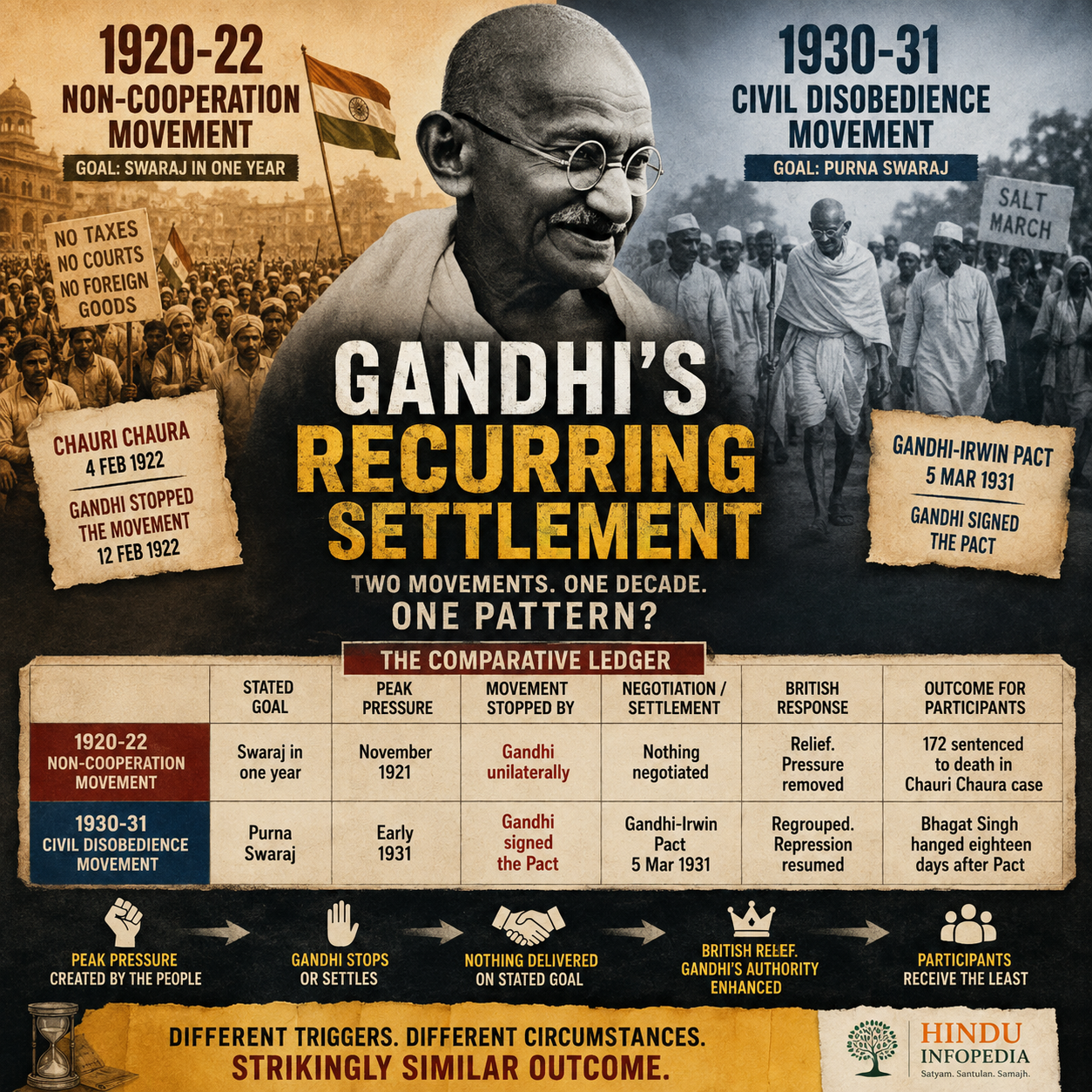
Gandhi’s Recurring Settlement places the two documented movements before the reader in six parallel columns. The reader examines what the documented ledger establishes across the decade between 1922 and 1931. The reader examines what the ledger establishes.
| Column | Non-Cooperation 1920-1922 | Civil Disobedience 1930-1931 |
|---|---|---|
| Stated Goal | Swaraj within one year. Documented: Gandhi’s documented public commitment at the Calcutta special session September 1920. | Purna Swaraj — complete independence. Documented: Congress Lahore session December 1929, Gandhi’s documented Salt March launch March 1930. |
| Peak Pressure Achieved | November 1921 — documented British alarm at its highest recorded point. Viceroy Reading’s documented despatches to Montagu recorded the movement threatening basic operation of government authority. Documented mass arrests across urban and rural centres — thousands jailed, courts overwhelmed, administrative machinery documented as paralysed. | Early 1931 — 60,000 jailed, provinces losing administrative control, customs revenues documented as collapsing, the strongest documented hand assembled. British administration on the documented defensive. |
| Trigger for Suspension | Chauri Chaura, February 4 1922 — police fired on protesters, crowd retaliated, 22 policemen killed. Gandhi’s documented self-assessment: Himalayan miscalculation. The documented institutional context — established in Blog 141 of this series — places the question of whether the incident was purely movement-related or rooted in documented historical friction between the British administration and the agrarian community before the reader alongside the trigger. | Gandhi-Irwin negotiations, March 1931 — Gandhi offered a seat at the Second Round Table Conference, London. Gandhi’s documented acceptance: the Gandhi-Irwin Pact, March 5 1931. |
| Who Suspended It | Gandhi — unilaterally. Bardoli Resolution February 12 1922. Without a vote of the Congress membership. Over the documented objections of Nehru, Bose, Das, and Lajpat Rai. | Gandhi — as sole negotiating plenipotentiary with Viceroy Irwin. The Viceroy had released the entire Congress Working Committee in January 1931 specifically so Gandhi could consult them. Gandhi met with the CWC daily at Dr. M.A. Ansari’s residence in Old Delhi — Nehru, Patel, Azad, and Naidu all participated. On paper: the CWC deliberated and ratified each clause. In practice: Gandhi had negotiated directly with Irwin as Congress’s sole counterpart. Whatever Gandhi settled across that table was a documented fait accompli before it reached the CWC. To reject the terms, the CWC would have had to repudiate Gandhi’s personal authority and collapse the negotiations — returning 60,000 participants to jail with no agreement. Nehru documented his discomfort with the Pact. He also documented his non-rejection of it. The gap between Nehru’s documented discomfort and his documented non-rejection is placed before the reader: the CWC’s functional power to overrule Gandhi’s negotiated settlement was, in practice, structurally constrained by the documented architecture of his unchallengeable authority. The ratification was institutional. The decision was Gandhi’s. |
| What Was Negotiated | Nothing. No prisoner release. No salt concession. No property return. No documented British commitment of any kind. The movement stopped. British relief followed. Gandhi arrested March 10 1922. | A seat at the Second Round Table Conference, London. The conference produced zero constitutional progress — no dominion status, no timeline for independence, no fiscal autonomy. Gandhi returned to Bombay December 28 1931 empty-handed. Within one week — January 4 1932 — Viceroy Willingdon promulgated the Emergency Powers Ordinances. Gandhi and Sardar Patel were arrested in the early hours. Congress was banned overnight, bank accounts seized, over 100,000 jailed within weeks before any movement momentum could reform. The British used the nine-month conference window to prepare what they deployed the moment Gandhi landed. Bhagat Singh hanged eighteen days after the Pact was signed. |
| Who Received Benefit | British administration: documented relief. Gandhi’s authority: established as largest after suspension than before it — Blog 144 of this series. Movement participants: 172 Chauri Chaura defendants sentenced to death, Malaviya saving 153 in a private capacity. | British administration: Willingdon’s documented Special Powers Ordinances drafted during the nine-month conference window, 100,000 jailed when movement resumed January 1932, Congress banned overnight. Gandhi: sailed to London as Congress’s sole representative, named Time’s Man of the Year January 1931. Movement participants: nothing delivered in full. |
What the Ledger Establishes
Gandhi’s Recurring Settlement places the six-column ledger before the reader and asks the reader to examine what the documented pattern across two movements and a decade establishes.
Gandhi’s Recurring Settlement places the pattern before the reader: both movements stopped at documented peak leverage. Both were stopped by Gandhi’s documented unilateral decision — without a vote, without a mandate, over documented objections in 1922, without consultation in 1931. Both left the documented structural extraction framework intact — the colonial apparatus continued, the documented economic drain continued, the documented legal framework continued. Both produced documented British relief. Both enhanced Gandhi’s documented authority — established in Blog 144 of this series. And both produced documented organisational fracture: the 1922 suspension drove documented revolutionary groups — including Bhagat Singh’s Hindustan Socialist Republican Association — to work independently outside Gandhi’s non-violent framework, concluding that the Gandhian method would not deliver freedom. The 1931 Pact produced documented splits within Congress itself — the documented formation of the Congress Socialist Party, the documented Swaraj Party’s earlier emergence after 1922, and the documented departure of multiple documented revolutionary streams that concluded the negotiated settlement framework had been exhausted. The documented independence movement after each suspension was documented as more fragmented than before it.
The participants who provided the documented mass — 60,000 in 1922, 60,000 in 1931 — received the documented outcomes placed in the final row of the ledger.
The Prosecution’s Position
Gandhi’s Recurring Settlement places three questions before the reader — drawn from the six documented columns above.
- Do the two documented movements — Non-Cooperation 1920-22 and Civil Disobedience 1930-31 — placed side by side across six documented columns, establish a documented pattern across a decade: stated goal not delivered, peak pressure stopped unilaterally, nothing negotiated or nothing delivered, British relief documented, Gandhi’s authority enhanced, participants receiving least?
- Does the documented trigger difference — Chauri Chaura (crowd violence) in 1922 and a conference seat offer in 1931 — placed alongside the identical documented outcome structure, constitute an exhibit the reader places alongside Blog 140’s documented calibration: by 1931 the British had learned that Gandhi would trade peak leverage for diplomatic process, having already learned in 1922 that Gandhi would stop the movement himself at peak pressure?
- Does the documented decade between the two movements — 1922 to 1931 — in which the documented British apparatus sharpened its documented calibration of Gandhi’s method across three documented lessons (Blog 140), constitute an exhibit the reader places alongside the identical documented outcome structure of the second movement?
The series does not answer. Gandhi’s Recurring Settlement places the comparative ledger — six documented columns, two movements, one decade — before the reader. The reader will examine what the two documented movements placed side by side established — and complete the sentence.
Invitation To Defence
The floor belongs to the defense. We now invite them to present their exhibits and challenge the narrative established by the prosecution.
Non-Cooperation 1922: Swaraj stated. Peak pressure November 1921. Chauri Chaura triggered suspension. Gandhi alone suspended it. Nothing negotiated. British relief. Gandhi’s authority enlarged. 172 sentenced to death. Civil Disobedience 1931: Purna Swaraj stated. Peak pressure early 1931. Conference seat offered. Gandhi alone signed. Nothing delivered. British regrouped. Gandhi sailed to London. Bhagat Singh hanged eighteen days after the signature. The prosecution places the two documented ledgers side by side. The reader will complete the sentence.
Feature Image: Click here to view the image.
Videos
Glossary of Terms
- Gandhi’s Recurring Settlement: The recurring pattern examined in this series in which Gandhi stopped major movements at documented peak pressure and entered or accepted a settlement without securing the stated political objective.
- Comparative Ledger: The six-column comparison placing Non-Cooperation 1920-22 and Civil Disobedience 1930-31 side by side to examine their documented goals, pressure, suspension, negotiation, benefits, and outcomes.
- DAM ARC: The series framework covering the documented pattern of assembled reservoirs of political pressure and the points at which those pressures were held, released, or stopped.
- Non-Cooperation Movement: The 1920-22 movement associated with Gandhi’s stated objective of achieving Swaraj within one year through non-cooperation with British rule.
- Civil Disobedience Movement: The 1930-31 movement associated with the demand for Purna Swaraj and the Salt March, followed by negotiations between Gandhi and the British administration.
- Peak Pressure: The point at which a movement had assembled its strongest documented political, administrative, economic, or mass pressure against the British administration.
- Unilateral Suspension: The stopping of a movement through Gandhi’s own decision rather than through a broad membership vote or an independently established movement mandate.
- Gandhi-Irwin Pact: The March 5, 1931 agreement under which Gandhi accepted participation in the Second Round Table Conference in London in return for specified concessions and arrangements.
- Second Round Table Conference: The London constitutional conference in which Gandhi participated as Congress’s sole representative after the Gandhi-Irwin Pact.
- Negotiating Plenipotentiary: A representative possessing authority to negotiate and settle terms on behalf of the organisation represented; the term is used in the blog to describe Gandhi’s position in negotiations with Viceroy Irwin.
- British Relief: The documented advantage obtained by the British administration when a movement was stopped at peak pressure without achieving its stated objective.
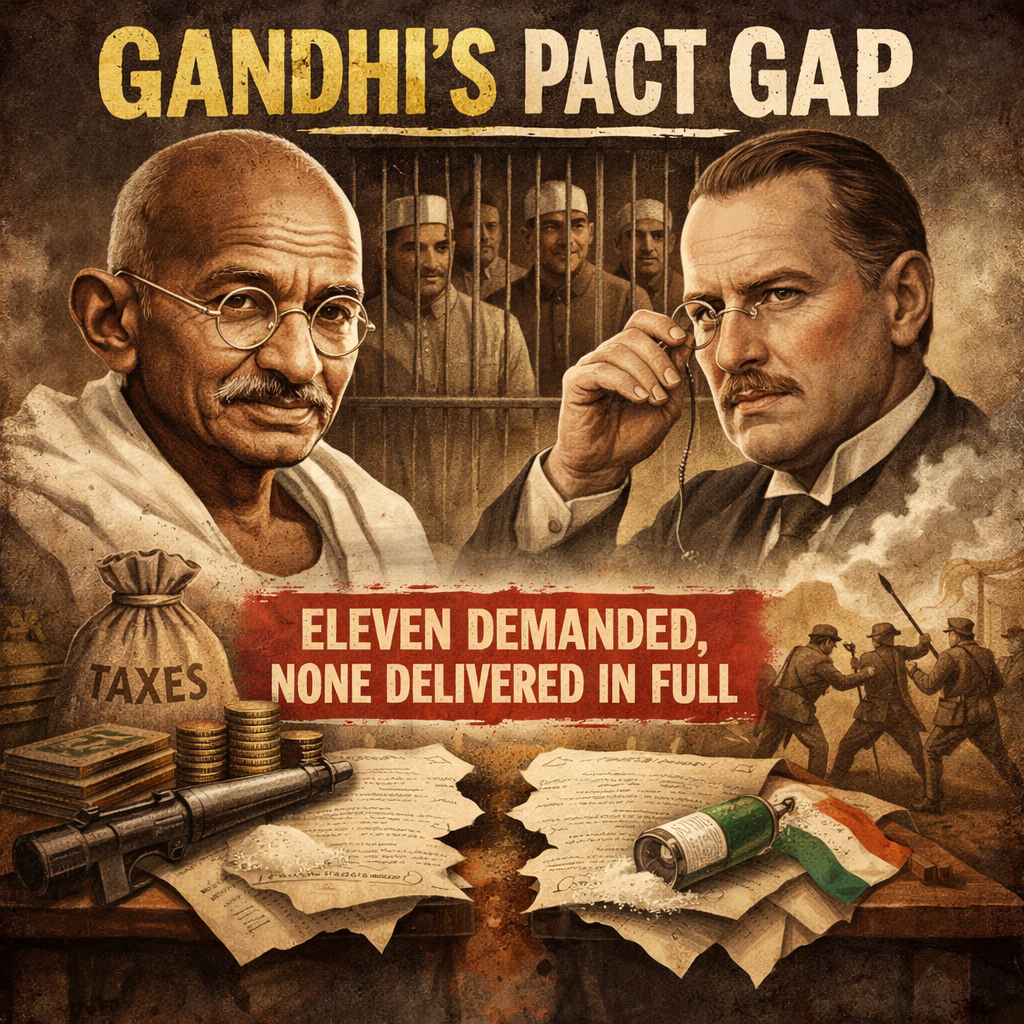
- Gandhi’s Pact Gap: The documented gap between demands made by the movement and what was actually secured or delivered through the resulting settlement.
- Congress Working Committee (CWC): The principal executive body of the Indian National Congress that deliberated on and formally ratified the terms negotiated by Gandhi in 1931.
- Hindustan Socialist Republican Association (HSRA): The revolutionary organisation associated with Bhagat Singh and other revolutionaries that operated outside Gandhi’s non-violent framework after the 1922 suspension.
- Invitation to Defence: The series device in which the prosecution places its documented evidence before the reader and invites the defence to present exhibits that challenge the prosecution’s narrative.
#Gandhi #India #Freedom #Swaraj #Congress #History #Independence #BritishRule #NonCooperation #CivilDisobedience #GandhiIrwinPact #HinduinfoPedia
Gandhi’s Peace Efforts: The Questions Before the Mahatma (0)