
Gandhi’s Moplah Verdict: Gandhi’s Words — Chosen And Not Chosen (117)
भारत / GB
Part 117: Mahatma Gandhi’s Peace Efforts | Series Index
Blog 116 placed what the Khilafat experiment destroyed before the reader across three documented arcs. This post places Gandhi’s documented conduct during the Moplah rebellion itself — August to December 1921 — before the reader. What he said. What he did not say. What he did not fast for. What he did not call satyagraha for. The gap between his documented statements and the documented violence is placed before the reader as the exhibit.
Thank you for reading this post, don't forget to subscribe!The Action Taken: When the Caliphate was abolished, the massive religious mobilization and volunteer infrastructure built in India between 1920 and 1922 was left without an external goal, redirecting its zeal inward.
Who Paid the Price: Peaceful civilian populations across north and central India, who bore the brunt of a decade of intense domestic communal riots.
The Alternative Bypassed: Systematically dismantling the sectarian volunteer corps and prohibiting faith-based political marching.
Why This Matters: Direct mechanical causation: cadres mobilized around intense religious emotion did not disperse when the Caliphate fell; their mobilized energy was redirected into domestic communal confrontations.
What Happened — The Documented Record
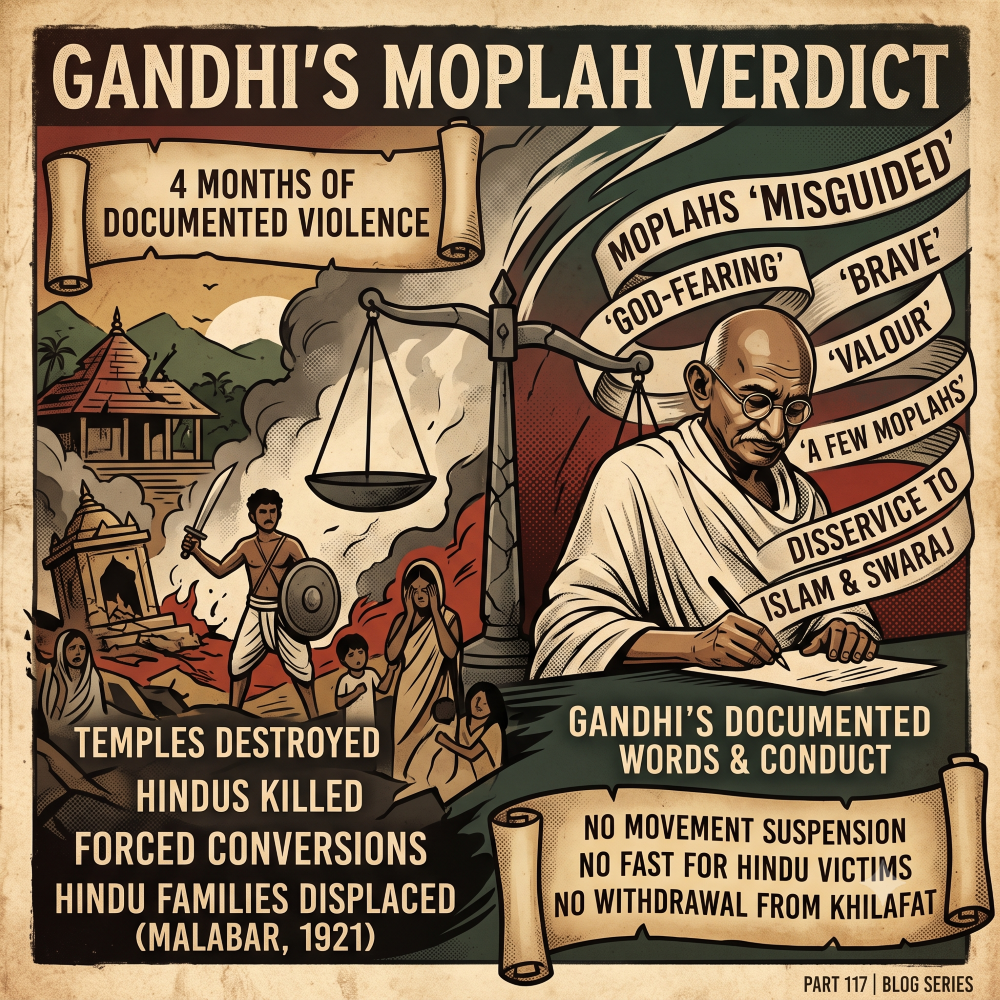
Gandhi’s Moplah Verdict places the documented record of the Moplah rebellion before the reader. The rebellion commenced August 20 1921 in Malabar, Kerala. Variankunnathu Kunjahammad Haji proclaimed himself the Khalifa and declared two tehsils Khilafat Kingdoms. What followed is documented across primary sources including the Malabar District Gazetteer, the Hitchcock Report, Annie Besant’s documented eyewitness-proximate account from Madras, and Ambedkar’s documented verdict in Pakistan or the Partition of India.
The documented record: temples destroyed, Hindus killed, women dishonoured, forced conversions documented across the Malabar region, Hindu families displaced. The rebellion lasted four months. It was produced directly within the communal landscape the Khilafat alliance had charged with religious mobilisation — established across Blogs 102-116 of this series.
Gandhi’s Moplah Verdict places one documented observation before the reader: the Moplah rebellion occurred while the Non-Cooperation/Khilafat Movement was at its documented peak, with Gandhi as its documented leader.
What Gandhi Said — The Documented Statements
Gandhi’s Moplah Verdict places Gandhi’s own documented statements during the rebellion before the reader in sequence. All citations from CWMG Vol. 24.
September 8 1921, Young India, CWMG Vol. 24, p. 189:
“We must not betray any mental or secret approval of the Moplahs. We must see clearly, that it would be dishonourable for us to show any approval of the violence… The misguided Moplahs have therefore rendered a distinct disservice to the sacred cause of Islam and Swaraj.”
Gandhi documented the Moplahs as “misguided” — not as perpetrators of documented violence against Hindu civilians. The documented framing: a disservice to Islam and Swaraj, not to the Hindus killed, converted, and displaced.
September 15 1921, speech at Madras, CWMG Vol. 24, p. 190:
“My heart goes out to those men who have been so much afflicted in Malabar. They are God-fearing… Their bravery must be transformed into purest gold. I feel sure, that once they realise the necessity of non-violence for the defence of the faith for which they have hitherto taken life, they will follow it without flinching.”
The prosecution places this documented statement before the reader precisely. Gandhi’s documented heart went out — to the Moplahs. Not to the Hindu victims of the documented killings, forced conversions, and temple desecrations. The documented Moplahs were “God-fearing.” Their documented bravery needed to be “transformed into purest gold.” The documented Hindu victims are not named in this documented statement.
September 15 1921, Madras Mail interview, CWMG Vol. 24, p. 238:
“I don’t despair for the simple reason that no sane Muslim approves of what a few Moplahs have done.”
Gandhi’s documented characterisation of the rebellion: a few Moplahs, not approved by sane Muslims. The documented record of the rebellion — four months, multiple tehsils declared Khilafat Kingdoms, documented organised violence — is placed alongside Gandhi’s documented “a few Moplahs” characterisation.
CWMG Vol. 24, p. 294:
Gandhi wrote of “Moplah valour” to be harnessed “for purposes of peace and God.”
The prosecution places one documented word before the reader: valour. Gandhi’s documented word for the conduct of men whose documented actions included killings, forced conversions, and temple desecrations of Hindu civilians in Malabar.
What Gandhi Did Not Say — The Documented Gap
Gandhi’s Moplah Verdict places the documented gap before the reader alongside the documented statements.
Gandhi did not issue a documented condemnation of the Moplah violence as violence against Hindus. He documented the rebellion as a disservice to Islam and Swaraj. He documented the Moplahs as God-fearing and brave. He documented their conduct as the product of a mistaken sense of religion. He did not document the Hindu victims’ experience in the same terms he used for the perpetrators.
Gandhi did not suspend the Non-Cooperation/Khilafat Movement during the Moplah rebellion — established in Blog 114. He suspended the movement five months later, in February 1922, when twenty-two policemen were killed by nationalist protesters at Chauri Chaura. The documented rebellion that produced four months of documented violence against Hindu civilians did not produce a documented movement suspension.
Gandhi did not withdraw from the Khilafat alliance that had produced the documented religious mobilisation behind the rebellion. His documented September 15 1921 Madras Mail interview placed his reasoning on record: “I don’t despair for the simple reason that no sane Muslim approves of what a few Moplahs have done.”
What Gandhi Did Not Fast For — The Documented Contrast
Gandhi’s Moplah Verdict places the documented record of Gandhi’s fasts before the reader alongside what he did not fast for during the Moplah rebellion.
Gandhi fasted in September 1924 — after the Kohat riots, in which Hindus were the documented victims — for Hindu-Muslim unity. He fasted in 1932 — the Poona Pact fast — to prevent separate electorates for Dalits. He fasted in January 1948 — to compel the Indian government to release Rs 55 crore to Pakistan during the Kashmir war.
Gandhi did not fast during the Moplah rebellion of August-December 1921. He did not fast for the documented Hindu victims of four months of documented violence. He did not call satyagraha for the documented Hindu families displaced, converted, and killed in Malabar.
The prosecution places the documented pattern before the reader: what Gandhi fasted for, and what Gandhi did not fast for, are both on the documented record.
The Prosecution’s Position
Gandhi’s Moplah Verdict places three questions before the reader.
- Did Gandhi’s own documented statements during the Moplah rebellion — “God-fearing,” “brave,” “valour,” “a few Moplahs,” “misguided” — constitute the documented language Gandhi used for the perpetrators of four months of documented violence against Hindu civilians in Malabar, and does that documented language belong before the reader alongside the documented record of the rebellion itself?
- Did Gandhi’s documented conduct during the rebellion — no movement suspension, no documented condemnation of violence against Hindus in the language he used for Chauri Chaura five months later, no withdrawal from the Khilafat alliance — constitute Gandhi’s Moplah Verdict as a documented exhibit distinct from what he said?
- Does the documented pattern — Gandhi fasted for Hindu-Muslim unity in 1924, for Dalit electorates in 1932, for Pakistan’s Rs 55 crore in 1948, but not for the documented Hindu victims of four months of documented violence in Malabar in 1921 — belong before the reader alongside what Gandhi’s documented fasts establish about his documented priorities?
The series does not answer. Gandhi’s Moplah Verdict places what Gandhi said, what Gandhi did not say, and what Gandhi did not fast for before the reader from the same documented period. The reader will examine the documented language Gandhi used for the perpetrators and the documented silence Gandhi maintained toward the victims — and complete the sentence.
Invitation To Defence
The floor belongs to the defense. We now invite them to present their exhibits and challenge the narrative established by the prosecution.
August-December 1921, Malabar. Four months. Temples destroyed. Documented killings, forced conversions, Hindu families displaced. Gandhi’s documented words for the perpetrators: “God-fearing.” “Brave.” “Valour.” “A few Moplahs.” “Misguided — a disservice to Islam and Swaraj.” No movement suspension. No documented condemnation of violence against Hindus in the language used five months later for Chauri Chaura. No fast. The prosecution places what Gandhi said and what Gandhi did not say alongside each other. The reader will complete the sentence.
Feature Image: Click here to view the image.
Videos
Glossary of Terms
- Moplah Rebellion: The 1921 uprising in the Malabar region, examined in this blog through documented historical records and Gandhi’s public statements.
- Malabar: A historical region of present-day Kerala where the Moplah Rebellion took place between August and December 1921.
- Variankunnathu Kunjahammad Haji: Leader of the Moplah Rebellion who proclaimed himself Khalifa and declared parts of Malabar as Khilafat Kingdoms.
- Khalifa: The religious and political head of the Islamic Caliphate, a title claimed by Variankunnathu Kunjahammad Haji during the rebellion.
- Khilafat Kingdoms: The territories in Malabar declared under Khalifa rule during the Moplah Rebellion.
- Non-Cooperation–Khilafat Movement: The political alliance led by Gandhi combining the Non-Cooperation Movement with the Khilafat Movement between 1920 and 1922.
- CWMG (Collected Works of Mahatma Gandhi): The official multi-volume compilation of Gandhi’s speeches, writings, letters and statements, cited extensively in this blog.
- Young India: Gandhi’s English weekly journal in which many of his political statements were published.
- Madras Mail Interview: Gandhi’s interview published on 15 September 1921, cited as documentary evidence regarding his response to the Moplah Rebellion.
- Malabar District Gazetteer: An official historical reference documenting the geography, administration and major events of the Malabar district, including the Moplah Rebellion.
- Hitchcock Report: A contemporary administrative report documenting events and violence during the Moplah Rebellion.
- Chauri Chaura Incident: The February 1922 incident in which nationalist protesters killed twenty-two policemen, leading Gandhi to suspend the Non-Cooperation Movement.
- Gandhi’s Moplah Verdict: A key phrase coined in this series referring to Gandhi’s documented statements, actions and omissions regarding the Moplah Rebellion.
- Documented Gap: A key phrase used in this series describing the contrast between documented historical events and Gandhi’s recorded public statements and actions.
- Documented Record: A key phrase referring to the collection of primary historical sources, official reports and authenticated documents examined throughout this series.
#Gandhi #Moplah #MoplahRebellion #Khilafat #Malabar #History #India #Congress #FreedomMovement #HinduinfoPedia
Gandhi’s Peace Efforts: The Questions Before the Mahatma (0)