
Gandhi’s Unreported Results: After 1920, the Method Continued — But Never as an Experiment (126)
भारत / GB
Part 126: Mahatma Gandhi’s Peace Efforts | Series Index
Blog 125 placed the scientific standard before the reader — what an experimenter is obligated to do when results contradict the hypothesis — and Gandhi’s documented 1924 response: hearts not pure enough, not because the cause was wrong. This post places the specific mechanism that followed before the reader: after 1920, Gandhi continued the same method but never again named it as an experiment — structurally removing the obligation to examine and report what it produced.
Thank you for reading this post, don't forget to subscribe!The Action Taken: Gandhi actively intervened against the formation of Hindu community self-defense corps, stating that carrying defensive sticks (lathis) or drilling signified moral weakness and prevented true national Swaraj.
Who Paid the Price: Vulnerable urban communities, which remained unorganized and physically defenseless against street violence.
The Alternative Bypassed: Permitting lawful, organized neighborhood defense watches to deter aggressive street rioting.
Why This Matters: Confirms the demobilization doctrine: the leadership actively intervened to dismantle local defensive preparedness while unable to guarantee state or police protection.
The Word That Created the Obligation
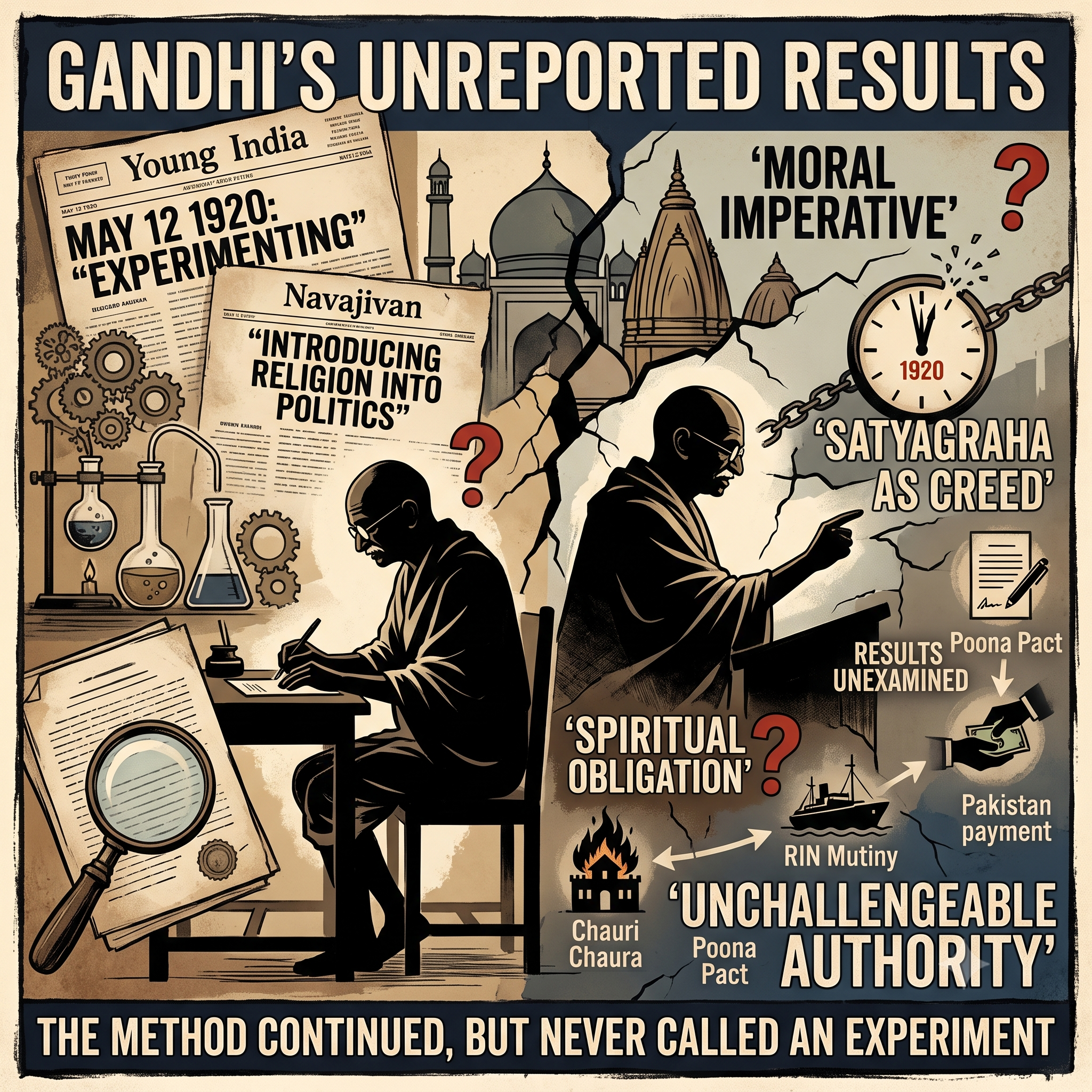
Gandhi’s Unreported Results places one documented fact before the reader at the outset. In Young India, May 12 1920, Gandhi wrote: “I have been experimenting with myself and my friends by introducing religion into politics.”
The word “experimenting” placed the method inside a framework that acknowledges uncertainty — the outcome is not known, the results will be observed, the method is subject to what the results reveal. An experiment has an obligation attached to it: report the results, examine the hypothesis against them, revise if the hypothesis cannot account for what happened.
After May 12 1920, Gandhi did not use the word “experimenting” again to describe his method.
What the Method Was Called Instead
Gandhi’s Unreported Results places the vocabulary Gandhi used for the same method after 1920 before the reader. The method — religious mobilisation, moral coercion, unchallengeable personal authority over decisions affecting millions — continued across Gandhi’s documented career. The name changed.
After 1920 it was called a moral imperative. A principled position. A spiritual obligation. Non-violence as a creed, not a strategy. Satyagraha as truth-force, not a method subject to examination.
The prosecution places one observation alongside this vocabulary shift: a moral imperative cannot produce results that require examination. A spiritual obligation does not generate data points. Truth-force is not subject to revision based on outcomes. By renaming the method after 1920, the obligation to report results was structurally removed — not by evasion, but by the vocabulary of the framing itself.
Four Instances — The Method Continued, the Results Unreported
Gandhi’s Unreported Results places four instances before the reader where the same method produced results that were not placed before the reader as results of a method subject to examination.
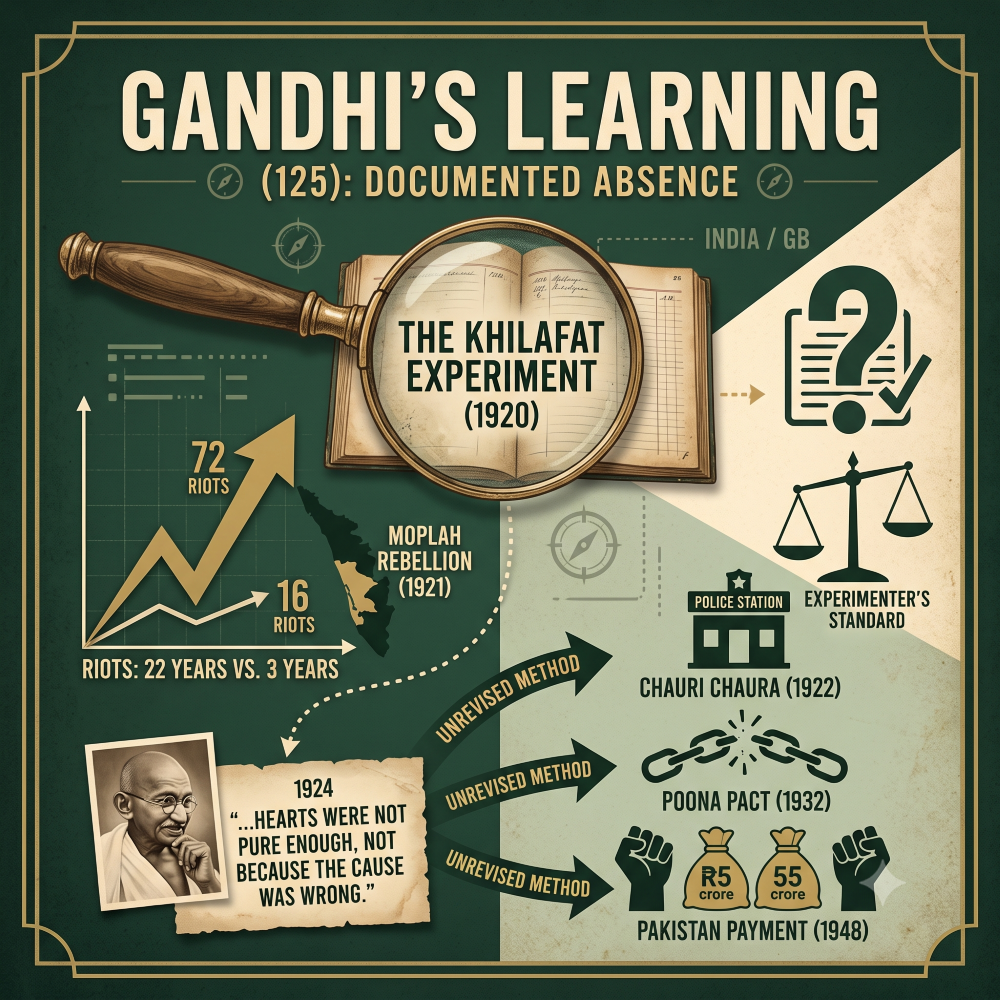
Chauri Chaura, February 1922. The method: mass religious mobilisation, moral authority as the movement’s engine, Gandhi’s unchallengeable decision-making as the movement’s governance. The result: crowd violence that Gandhi used to suspend the entire Non-Cooperation Movement unilaterally. The framing Gandhi placed before the reader: not a result of the method, but a failure of the crowd’s readiness for non-violence. The method was not named. The result was presented as a character failure in the participants — the Himalayan Blunder, already established in Blog 111. The experiment of introducing religion into politics had produced Chauri Chaura. That connection was not placed before the reader as a result requiring examination.
Poona Pact, 1932. The method: personal fast unto death as political coercion applied to a constitutional question. The result: Ambedkar’s capitulation, the surrender of separate electorates the British had granted the Dalit community. The framing Gandhi placed before the reader: a moral victory for Hindu unity, a principled stand against the division of Hindu society. The method was not named as a method subject to examination. Whether fasting unto death to override a documented democratic preference constituted a legitimate instrument of political persuasion was not placed before the reader as a question the results could answer.
Royal Indian Navy Mutiny, 1946. The method: non-violence as an absolute principle applied to a moment of documented armed indigenous resistance. The result: the mutiny was condemned, defused, and the British military apparatus was preserved intact for the incoming independence government. The framing Gandhi placed before the reader: a principled position on non-violence, the mutiny an “unholy combination.” Whether the method of non-violence produced independence or preserved the structures independence was supposed to dismantle — that question was not placed before the reader as a result requiring examination.
Pakistan payment fast, January 1948. The method: personal fast unto death as political coercion applied to national financial and military policy. The result: Patel’s documented decision to freeze Rs 55 crore in payment to Pakistan — during a documented military conflict over Kashmir — was reversed by Gandhi’s fast. Pakistan received the payment. Gandhi was assassinated twelve days later; Nathuram Godse’s documented stated reasons included this specific act. The framing Gandhi placed before the reader: a moral imperative for communal justice, a principled stand against national dishonesty. The method was not named as a method subject to examination. The results were not reported.
What “Unreported” Means
Gandhi’s Unreported Results places one precise observation before the reader. The results of the Khilafat experiment were placed before the reader in part — by Gandhi himself, in Young India 1924, where he acknowledged that “the awakened Mussalmans have proclaimed a kind of Jihad against us Hindus.” But those results were not placed before the reader as the results of the method he had named “experimenting” in 1920. They were placed before the reader as consequences of insufficient purity of heart — a spiritual failing in the participants, not a result of a method that could be examined and revised.
Each subsequent instance followed the same pattern: the result was named as something other than a result of the method. Chauri Chaura was mass unreadiness. The Poona Pact was a moral victory. The Navy Mutiny was an unprincipled act. The Pakistan payment was communal justice. None was placed before the reader as a result of “experimenting” — because after May 12 1920, the word “experimenting” was never used again.
The Prosecution’s Position
Gandhi’s Unreported Results places three questions before the reader.
- Did Gandhi’s use of the word “experimenting” in May 1920 place his method inside a framework that acknowledges uncertainty and creates an obligation to report results — and did Gandhi never again use that word after May 1920 to describe the same method that continued across his documented career?
- Did the vocabulary Gandhi used for the same method after 1920 — moral imperative, principled position, spiritual obligation, truth-force — structurally remove the obligation to examine and report results, since a moral imperative cannot produce data and a spiritual obligation is not subject to revision based on outcomes?
- Do the four instances placed before the reader — Chauri Chaura 1922, Poona Pact 1932, Royal Indian Navy Mutiny 1946, Pakistan payment fast 1948 — each show the same method producing results that were framed as something other than results of the method, so that the obligation to examine the method against its outcomes was never engaged?
The series does not answer. Gandhi’s Unreported Results places the single documented use of the word “experimenting,” the vocabulary shift that followed, and the four instances of unreported results before the reader in sequence. The reader will examine what the renaming of the method produced — and complete the sentence.
Invitation To Defence
The floor belongs to the defense. We now invite them to present their exhibits and challenge the narrative established by the prosecution.
May 12 1920: “experimenting.” After May 12 1920: moral imperative, principled position, spiritual obligation, truth-force. The method: unchanged. The vocabulary: changed. Chauri Chaura — mass unreadiness, not the method. Poona Pact — moral victory, not the method. Navy Mutiny — unprincipled act, not the method. Pakistan payment — communal justice, not the method. The obligation to report results requires first that the method be named as a method subject to results. The prosecution places the single use of “experimenting” and its four unreported successors before the reader. The reader will complete the sentence.
Feature Image: Click here to view the image.
Videos
Glossary of Terms
- Experimenting: Gandhi’s documented description in Young India (12 May 1920) for introducing religion into politics as an experiment, implying that results should be observed and evaluated.
- Unreported Results: A key concept in this blog series referring to outcomes of Gandhi’s political methods that, according to the prosecution, were not subsequently examined or presented as results of the original “experiment.”
- Young India: The English weekly journal edited by Mahatma Gandhi in which many of his political ideas, statements, and reflections were published.
- Khilafat Experiment: The series’ term for Gandhi’s support of the Khilafat Movement, presented as his declared experiment of combining religion with politics.
- Moral Imperative: A term Gandhi later used to justify political action as an ethical obligation rather than as a method open to evaluation through results.
- Truth-force (Satyagraha): Gandhi’s doctrine of non-violent resistance based on adherence to truth, presented as a moral principle rather than an experimentally tested political method.
- Chauri Chaura Incident: The 1922 violent clash in which protesters killed policemen, leading Gandhi to suspend the Non-Cooperation Movement.
- Poona Pact: The 1932 agreement between Mahatma Gandhi and Dr. B. R. Ambedkar that replaced separate electorates for the Depressed Classes with reserved seats in joint electorates.
- Royal Indian Navy Mutiny: The 1946 naval uprising by Indian ratings against British rule, which Gandhi publicly criticized as inconsistent with his principle of non-violence.
- Pakistan Payment Fast: Gandhi’s January 1948 fast that preceded the release of ₹55 crore to Pakistan after the Government of India had initially withheld the payment during the Kashmir conflict.
- Hypothesis Revision: The scientific principle requiring modification of an original proposition when evidence contradicts it; a central analytical concept in this blog series.
- Religious Mobilisation: The organized use of religious identity, beliefs, or symbolism to influence political participation and public action.
- Personal Moral Authority: Gandhi’s influence derived from personal ethical stature, allowing him to shape major political decisions beyond formal constitutional processes.
- Spiritual Obligation: A religious or ethical duty presented as binding regardless of practical political outcomes, according to the terminology examined in this article.
- Vocabulary Shift: The series’ term describing Gandhi’s transition from calling his political method an “experiment” to describing it through expressions such as moral imperative, spiritual obligation, and truth-force.
#Gandhi #MahatmaGandhi #History #IndianHistory #Khilafat #Satyagraha #NonViolence #PoonaPact #Pakistan #Politics #FreedomMovement #HinduinfoPedia
Gandhi’s Peace Efforts: The Questions Before the Mahatma (0)
Refer to Various Arks Referred to in the Blog