
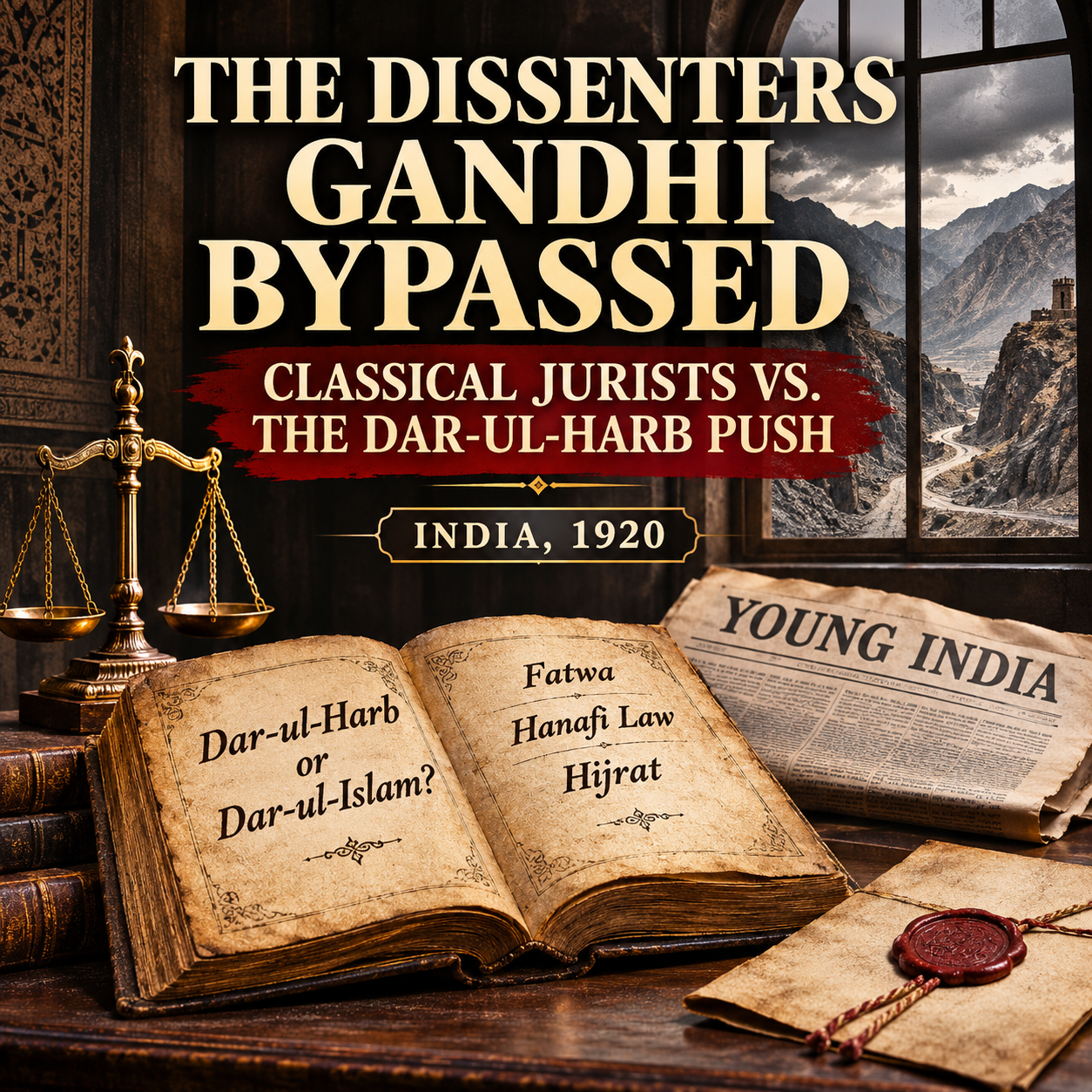
The Dissenters Gandhi Bypassed: Classical Jurists Vs Gandhi’s Dar-ul-Harb Push (216)
भारत / GB
Part 216: Mahatma Gandhi’s Peace Efforts | Series Index
Blog 215 documented the three-tier transmission machine through which Gandhi’s summer 1920 Young India endorsements passed through a politicized distortion of classical Dar-ul-Harb terminology — stripped of its classical safeguards — and were amplified at the Nagpur Congress dais into the Hijrat disaster of August 1920. This instalment documents the counter-record that machine suppressed: the classical Hanafi jurists, constitutional Muslim leaders, and nationalist reformers who opposed the 1920 agitation on legal, theological, and political grounds — and whose warnings Gandhi declined to amplify.
Thank you for reading this post, don't forget to subscribe!THE DISSENT RECORD: WHAT WAS AVAILABLE AND SUPPRESSED
The Action Taken: In 1920, as the Jamiat Ulama-i-Hind’s fatwa declared British India Dar-ul-Harb and the Ali Brothers’ mosque-circuit tours mobilised frontier Muslim populations toward the Afghan passes, an authoritative body of counter-rulings and political warnings was simultaneously on the record. Maulana Ahmed Raza Khan of Bareilly — the foremost Barelvi jurisprudential authority of the period — issued formal fatwas ruling that the classical Hanafi conditions for Dar-ul-Harb were not met in British India and that the Hijrat call was therefore invalid on its own legal terms. Muhammad Ali Jinnah warned at the Nagpur Congress session (December 1920) that mixing clerical dogma with mass agitation would produce consequences Congress could not control. Annie Besant and other nationalist voices documented the same trajectory. Gandhi amplified none of them.
Who Paid the Price: The Muslim families of Sindh, Punjab, and the North-West Frontier who sold property at distress prices and trekked to the Afghan border on the strength of a fatwa that the most authoritative counter-voice within their own legal tradition had already ruled invalid — a ruling that never reached them through the same mosque circuits that had carried the agitation’s call.
Why This Matters: The existence of authoritative dissent in 1920 — from within classical Hanafi jurisprudence, from within the constitutional Muslim political leadership, and from within the Congress itself — means the agitation was not an inevitable religious consensus that Gandhi had no alternative to supporting. It was a political choice. The counter-voices existed. Gandhi chose his allies from the other side of that divide.
Ahmed Raza Khan of Bareilly and the Dar-ul-Islam Ruling
Maulana Ahmed Raza Khan (1856–1921) — the founder of the Barelvi tradition and the foremost Hanafi jurisprudential authority of his era in the Indian subcontinent — issued two formal fatwas in 1919–1920 directly contradicting the Jamiat Ulama-i-Hind’s Dar-ul-Harb declaration: Tadbir-e-Falah o Najat o Islah (Measures for Welfare, Salvation and Reform) and Al-Mahajjat al-Mu’taminah fi Ayat al-Qur’an. His ruling rested on established classical Hanafi criteria: British India was not Dar-ul-Harb because Muslim religious practice was free — the five pillars were performed without legal restriction, waqf properties were administered under Muslim governance, personal law was adjudicated in Sharia courts, and mosques operated under their own authority. Under classical Hanafi jurisprudence, territory where Muslim religious obligations could be freely discharged remained Dar-ul-Islam or Dar al-Aman regardless of who held political power; Ahmed Raza Khan’s ruling placed India unambiguously in this category. The Hijrat call was therefore not a valid religious obligation but a politically manufactured one — issued in service of the Khilafat campaign, not in fidelity to classical legal standards.
Ahmed Raza Khan also ruled against the Congress-Khilafat alliance on a separate ground: the Ottoman Sultan’s claim to be Caliph of all Sunni Muslims globally was itself contestable under classical Hanafi jurisprudence, which required Caliphs to be of Qurayshi lineage — a criterion the Ottoman dynasty did not meet. The Dar-ul-Harb fatwa and the mass agitation it supported were therefore doubly invalid: wrong about India’s legal status and grounded in a Caliphate claim that classical law did not recognise. This was the counter-authority available to Gandhi in 1920 — and the jurists Gandhi bypassed when he chose instead to endorse the Ali Brothers’ platform.
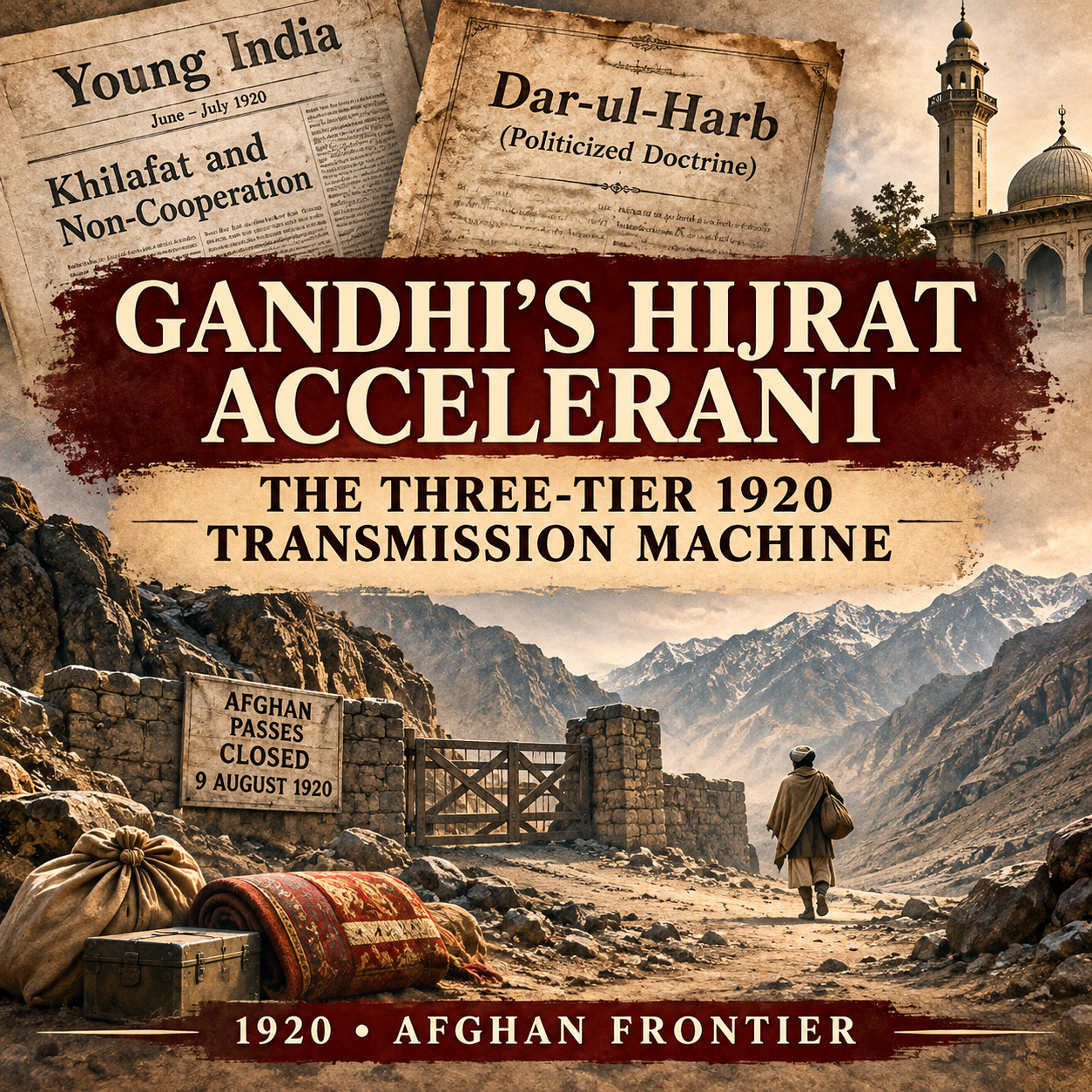
The Classical Hanafi Safeguards Subverted in 1920
Classical Hanafi jurisprudence — the legal tradition both the Deobandi and Barelvi schools nominally inherited — contained three doctrines that together made the 1920 Dar-ul-Harb declaration untenable on its own terms. First, Dar al-Aman (Abode of Security): a territory where non-Muslim rulers guaranteed the security and religious freedom of Muslim subjects was classified as a protected zone, not a war-zone, under classical Hanafi law. Second, mu’amalat (civic and commercial relations): classical Hanafi jurists permitted — and in many conditions required — normal commercial and civic relations with non-Muslims in a territory of coexistence, explicitly rejecting the severing of economic ties as a religious obligation. Third, the Ottoman Caliphate claim: mainstream Hanafi legal opinion had for centuries held the Qurayshi lineage requirement in abeyance as a practical concession to political reality, but several senior scholars — including Ahmed Raza Khan — held it as a live criterion that the Ottoman Sultan did not satisfy.
All three doctrines were available to clerics in 1920 and were invoked by dissenting scholars against the Jamiat fatwa. The 1920 agitation doctrine stripped each of them from the operative framework — grafting pan-Islamic political grievance and romantic Ottoman loyalism onto the classical vocabulary of Dar-ul-Harb and Hijrat while discarding the legal tests those concepts required. The dissenting scholars who identified this subversion in real time are the jurists Gandhi bypassed when he chose to treat the Ali Brothers’ agitation platform as the voice of Indian Muslim religious opinion.
Karamat Ali Jaunpuri’s Precedent and Mainstream Clerical Caution
The 1920 dissent drew on a nineteenth-century Hanafi precedent that was already established in Indian jurisprudential literature. Maulana Karamat Ali Jaunpuri (1800–1873) — a Sufi scholar and jurist of the Qadiri tradition trained in classical Hanafi law — had issued rulings in the 1860s specifically addressing the question of British India’s legal classification. Karamat Ali held that India under British administration, where Muslim religious practice remained free, was Dar al-Islam rather than Dar-ul-Harb; Hijrat was therefore not a valid obligation, and mass exodus would constitute unnecessary destruction of Muslim families and communities rather than a religious duty. His rulings were well known in Indian clerical circles and were cited by several scholars opposing the 1920 Jamiat fatwa as the established mainstream Hanafi position on exactly the question the agitators were distorting.
The existence of this nineteenth-century precedent — not a marginal view but the recorded mainstream legal position on British Indian governance — meant that the 1920 Jamiat fatwa was departing from established Hanafi jurisprudential consensus, not applying it. The scholars who cited Karamat Ali’s precedent against the fatwa were arguing from the centre of their legal tradition. They are part of the documented record of the jurists Gandhi bypassed: authoritative voices within classical Hanafi jurisprudence, citing established precedent, whose counter-ruling never received mention in Young India.
Muhammad Ali Jinnah and the Constitutionalist Warning at Nagpur (December 1920)
Muhammad Ali Jinnah — then the foremost constitutional Muslim politician in India, an Ismaili Khoja lawyer and former Congress–League bridge-builder — attended the Nagpur Congress session of December 1920 and took the floor to oppose Gandhi’s Non-Cooperation programme on explicit grounds: mixing mass agitation with clerical religious authority would create forces that neither Gandhi nor Congress would be able to control or direct once unleashed, and would permanently damage the constitutional Muslim political leadership that had been building a civic, rights-based framework alongside Congress since the Lucknow Pact of 1916. Jinnah was heckled off the platform and subsequently withdrew from the Congress entirely.
Jinnah’s Nagpur warning was not a minor parliamentary objection. It was the direct prediction — from within the Congress session, from the most prominent Muslim constitutionalist in India — of the precise institutional consequence that followed: the Khilafat apparatus outlived the Caliphate, the clerical networks continued operating on domestic targets, and moderate constitutional Muslim leadership was progressively displaced by the agitational framework Gandhi had empowered. Jinnah’s departure from Congress is part of the documented record of the jurists Gandhi bypassed — extended to the constitutional political leadership Gandhi chose not to amplify when he had the platform to do so.
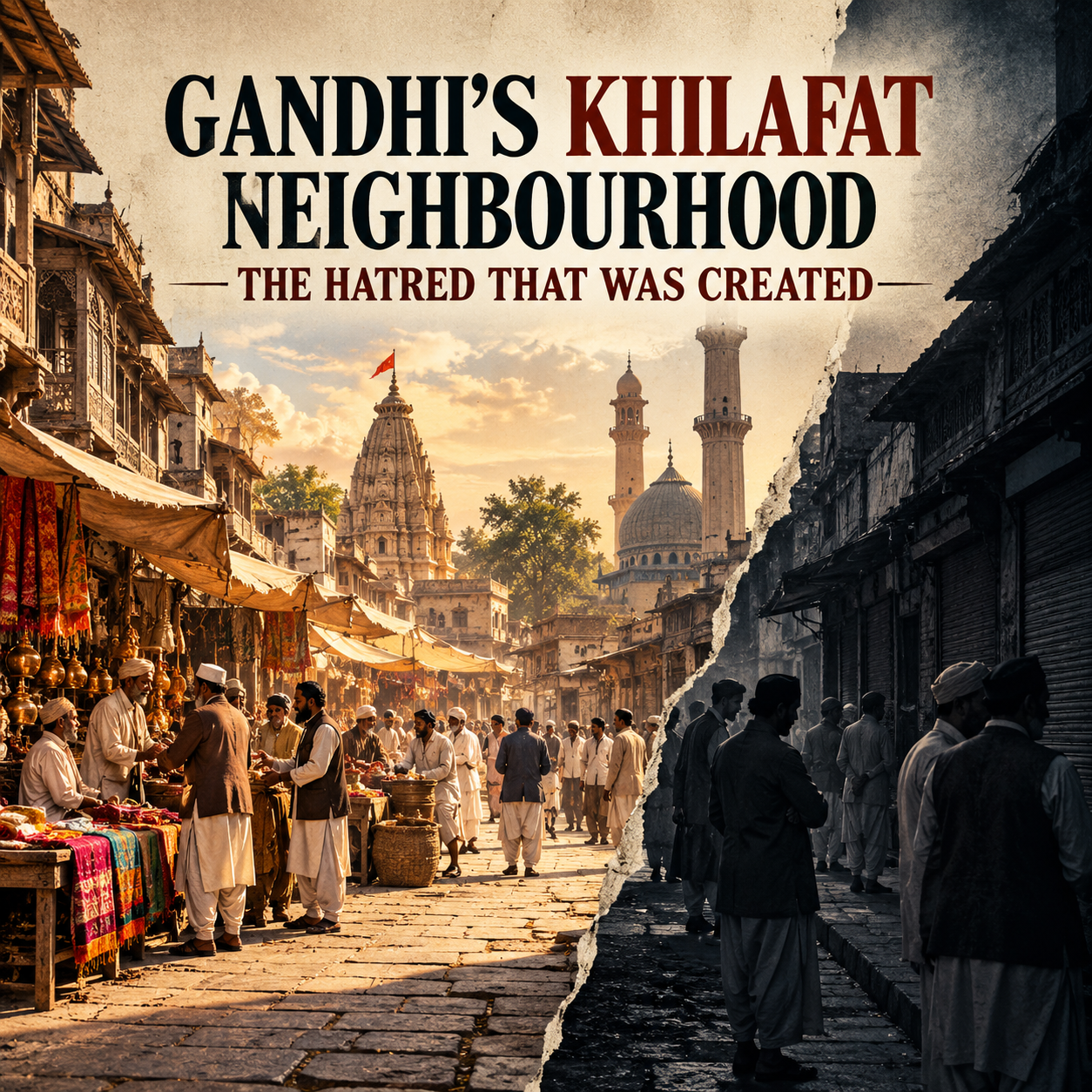
The Human Cost Predicted and Ignored (August 1920)
The dissenting scholars and constitutionalists of 1920 did not merely argue the theological case in the abstract. Ahmed Raza Khan and several supporting scholars explicitly warned — in terms that entered the contemporaneous clerical correspondence record — that the practical consequence of the Dar-ul-Harb fatwa and the Hijrat call would fall disproportionately on poor peasants, artisans, and small merchants who would sell their homes and agricultural holdings at ruinous distress prices while the fatwa-issuing clerics and political leaders remained safely in India. The scholars who had the authority to issue counter-fatwas had the influence to reach the same mosque circuits the agitation was using — they were not marginal figures. Annie Besant documented the same trajectory from the Congress political side, warning in The Future of Indian Politics that the Khilafat alliance was building a religious-political force that secular constitutional politics could not contain.
The warning was fulfilled on 9 August 1920, when Afghanistan sealed the Khyber and Kurram passes and the families who had already sold their property were stranded at the border without shelter or means of return. The jurists Gandhi bypassed had predicted this exact outcome — not in retrospect but in contemporaneous documents — and their prediction was available to Gandhi in the same months that Young India was publishing endorsements of the Khilafat cause. The Besant warning is cited and sourced in B.R. Ambedkar, Pakistan or the Partition of India, pp. 274–275, referencing Besant’s The Future of Indian Politics, pp. 301–305.
Gandhi’s Choice of Allies
The documented record of Gandhi’s Young India output between June and December 1920 shows a consistent pattern: the Ali Brothers, the Jamiat Ulama-i-Hind, and the Mutafiqa Fatwa circle — the clerical network that had issued the Dar-ul-Harb declaration — appear repeatedly as Gandhi’s endorsed partners, their statements quoted approvingly, their platforms shared. Ahmed Raza Khan of Bareilly does not appear in Young India during this period. Karamat Ali Jaunpuri’s jurisprudential precedent is not cited. The Barelvi counter-ruling on Dar al-Aman does not appear. Jinnah’s Nagpur floor dissent is not addressed. Besant’s warnings receive no engagement. The Young India record is a record of one side of an internal Islamic legal and political debate — the agitation side — presented to English-language readers as though no authoritative counter-position existed within Indian Muslim thought.
This is the documented core of the jurists Gandhi bypassed as a historical phenomenon: not the absence of counter-authority, but Gandhi’s consistent, months-long choice to endorse the agitators’ platform while giving no space in Young India to the classical scholars, the jurisprudential precedent, or the constitutional Muslim political leadership that opposed it on legal, theological, and political grounds that were on the record and available to him in real time.
Modern Parallel
The suppression of classical Islamic legal restraint by politically motivated clerical agitation — and the sidelining of constitutionalist Muslim political leadership by mass religious mobilisation — recurred across the region in later decades. The classical Hanafi and Sufi scholarly traditions that opposed the Taliban’s doctrine in Afghanistan and Pakistan’s Northwest Frontier in the 1990s and 2000s occupied the same structural position as Ahmed Raza Khan’s counter-rulings in 1920: authoritative, grounded in classical jurisprudence, and systematically marginalised by the agitators’ control of mosque circuits, madrasa networks, and street mobilisation capacity. The pattern of choosing agitators over jurists, and of treating one side of an internal Islamic legal debate as the whole of Muslim opinion, did not originate in 1920 — but 1920 is where the Indian record of that pattern begins.
Invitation To Defence
Ahmed Raza Khan’s fatwas (Tadbir-e-Falah o Najat o Islah and Al-Mahajjat al-Mu’taminah), Karamat Ali Jaunpuri’s nineteenth-century rulings on British India’s legal classification, Jinnah’s Nagpur December 1920 floor dissent, and Besant’s contemporaneous warnings are all established primary documents. The Young India archive for June–December 1920 is likewise established. The defence is invited to identify any Young India article between June and December 1920 in which Gandhi cited, engaged with, or gave platform to Ahmed Raza Khan’s counter-ruling, Karamat Ali Jaunpuri’s established Hanafi precedent, or Jinnah’s constitutional objection — or any statement by Gandhi acknowledging that the Dar-ul-Harb declaration he was endorsing was contested within classical Hanafi jurisprudence.
Between June and December 1920, an authoritative body of classical Hanafi dissent, constitutional Muslim political warning, and nationalist caution was on the record. Ahmed Raza Khan of Bareilly had ruled the Dar-ul-Harb fatwa invalid on its own legal terms. Karamat Ali Jaunpuri’s nineteenth-century precedent was available. Jinnah had been heckled off the Nagpur platform for predicting the precise institutional collapse that followed. Annie Besant had documented the trajectory in print. None of it appeared in Young India. The families who sold their homes and trekked to the Afghan passes acted on a fatwa that the jurists Gandhi bypassed had already ruled invalid — and found the passes sealed on 9 August 1920.
Feature Image: Click here to view the image.
Videos
Glossary of Terms
1. Dar-ul-Harb: A classical Islamic legal term meaning an abode of war. The 1920 Jamiat Ulama-i-Hind fatwa applied this classification to British India, a position challenged by several classical Hanafi jurists.
2. Dar-ul-Islam: A classical Islamic legal classification for territory where Muslims can freely practise their religious obligations. Ahmed Raza Khan considered British India to fall within this category.
3. Dar al-Aman: An abode of security under classical Hanafi jurisprudence, referring to territory where non-Muslim rulers guarantee the safety and religious freedom of Muslim inhabitants.
4. Hijrat: Migration undertaken for religious reasons. In 1920, the term was used to encourage Indian Muslims to migrate to Afghanistan following the declaration that British India was Dar-ul-Harb.
5. Hanafi Jurisprudence: One of the four major Sunni schools of Islamic jurisprudence. Its classical legal principles formed the foundation of the opposition to the 1920 Dar-ul-Harb declaration.
6. Fatwa: A formal religious-legal opinion issued by a qualified Islamic scholar on a question of religious law. The competing fatwas of 1920 became central to the dispute over Hijrat.
7. Ahmed Raza Khan: The founder of the Barelvi tradition and a prominent Hanafi scholar from Bareilly who issued formal rulings opposing the classification of British India as Dar-ul-Harb.
8. Karamat Ali Jaunpuri: A nineteenth-century Hanafi jurist and Sufi scholar who maintained that British India was Dar-ul-Islam and that migration from the country was not a religious obligation.
9. Barelvi Tradition: A Sunni Islamic religious tradition founded by Ahmed Raza Khan, known for its emphasis on traditional Hanafi jurisprudence and Sufi practices.
10. Deobandi School: A Sunni Islamic scholarly movement originating in Deoband, India, which follows the Hanafi school of jurisprudence.
11. Mu’amalat: Classical Islamic legal provisions governing civil, commercial and social transactions, including relationships and economic dealings between Muslims and non-Muslims.
12. Khilafat Movement: A political and religious movement launched by Indian Muslims after the First World War to defend the Ottoman Caliphate. Gandhi supported its alliance with the Indian National Congress.
13. Qurayshi Lineage: Descent from the Quraysh tribe of Arabia, traditionally regarded in classical Sunni jurisprudence as a qualification for the Caliphate. Ahmed Raza Khan invoked this requirement to question the Ottoman Sultan’s claim.
14. Non-Cooperation Movement: A political movement launched under Gandhi’s leadership in 1920 to oppose British rule through the withdrawal of cooperation from colonial institutions.
15. Constitutionalist Muslim Leadership: Muslim political leadership that favoured constitutional methods, civic rights and political negotiation rather than mass mobilisation based on religious authority. Muhammad Ali Jinnah represented this political approach.
#Gandhi #IndianHistory #Khilafat #Hijrat #DarulHarb #Hanafi #Jinnah #AhmedRazaKhan #BritishIndia #IslamicHistory #HinduinfoPedia
Scan Through The Entire Series at