
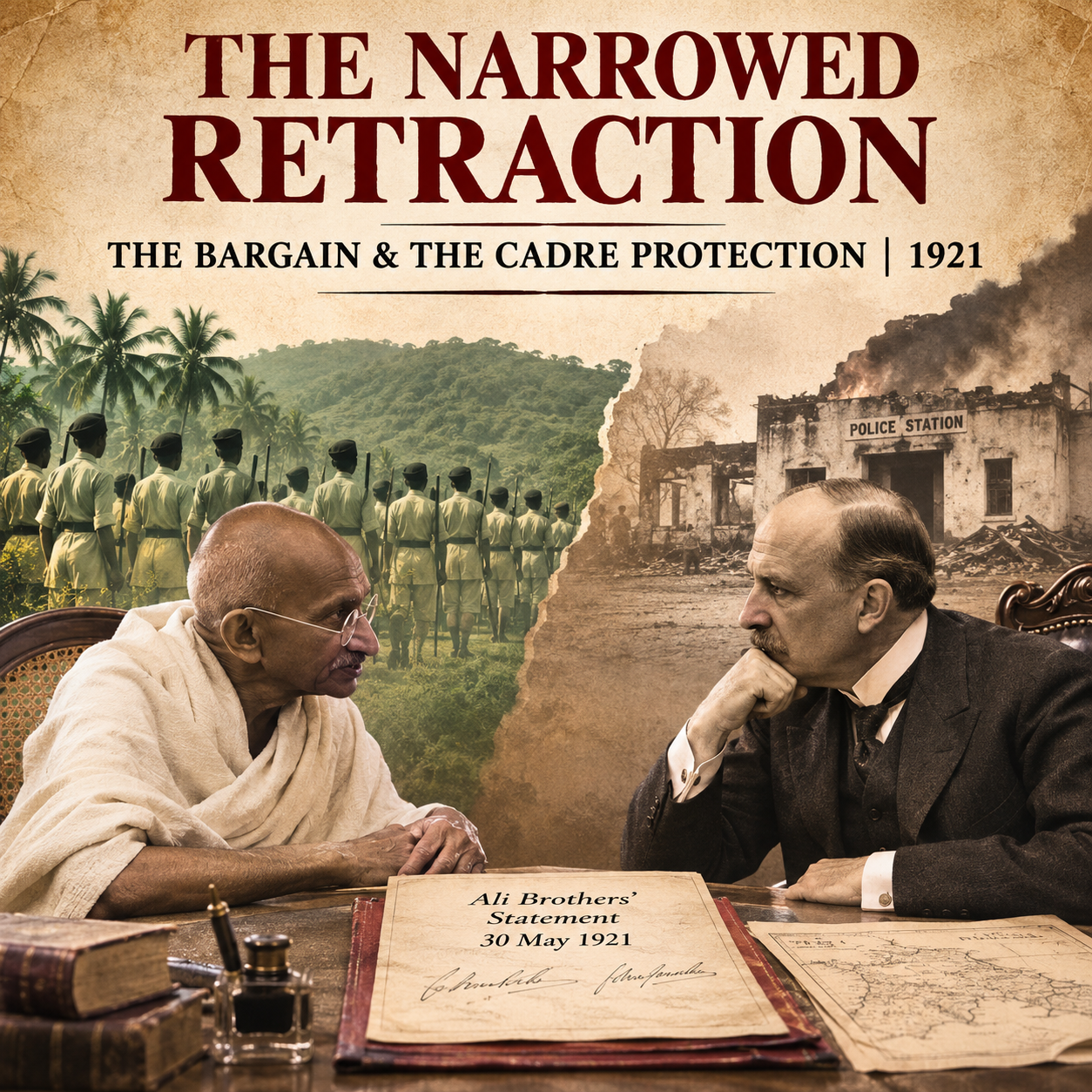
Gandhi’s Narrowed Retraction: The Bargain and the Cadre Protection (194)
भारत / GB
Part 194: Mahatma Gandhi’s Peace Efforts | Series Index
The previous blog documented Gandhi’s Simla Chamber — the six bilateral interviews at Viceregal Lodge in which Lord Reading placed before Gandhi CID records of the Ali brothers’ calls for armed jihad, issued an ultimatum, and recorded Gandhi’s concession that the passages were accurate and the statements dangerous. Gandhi left Simla having agreed to broker a public retraction. This blog documents what that retraction contained, what it deliberately excluded, and what the asymmetry between Malabar and Chauri Chaura proves about what Gandhi had actually guaranteed.
Thank you for reading this post, don't forget to subscribe!THE RETRACTION — ANATOMY OF AN ESCAPE HATCH
The document: Gandhi’s narrowed retraction — the Ali brothers’ signed statement of 30 May 1921 — acknowledged that certain of their statements had a tendency, in their opinion, to incite to violence. The phrase is not incidental. It preserved both the state’s demand for a public statement and the Ali brothers’ claim that the statements had not, in fact, incited to violence. Reading boasted of a psychological victory. The Ali brothers resumed their speeches within weeks.
What it left untouched: The retraction covered the Ali brothers’ public statements. It did not cover the Malabar Khilafat Volunteer Corps, the tangal preachers at Ponnani, or the arms reported in Ernad and Walluvanad. No order issued — from Gandhi, the AICC, or the KPCC — to demobilise, stand down, or surrender. Gandhi’s narrowed retraction closed the Simla transaction. The Malabar apparatus kept drilling.
The proof: The movement survived over 2,500 deaths in the Malabar conflagration from August 1921 onward without being called off. It did not survive the killing of 22 constables at Chauri Chaura in February 1922. The difference between those two triggers is the record of what Gandhi’s guarantee to Reading actually covered.
From Simla to Bombay
Gandhi left Simla having accepted Reading’s ultimatum: secure from the Ali brothers a public statement covering the specific passages that had been placed before him, or watch them prosecuted on the basis of their own words. He was not travelling to Bombay to inform the Ali brothers of the state’s concern. He was going to deliver an ultimatum he had already accepted himself.
The Reading Papers record the Simla interviews across mid-May. The Ali brothers’ signed statement is dated 30 May. Gandhi was therefore in transit or in direct negotiation for approximately ten days. During this period he published nothing in Young India about the Simla encounter. The statement emerged on 30 May. His Young India articles of 1 June and 8 June followed it.
The Anatomy of ‘In Their Opinion’
The Ali brothers’ signed statement of 30 May 1921 acknowledged that the passages in their recent speeches were of a character which, in their opinion, had a tendency to incite to violence, and that they regretted any statements of theirs that could be so interpreted.
The phrase “in their opinion” is the escape hatch. It converted an unconditional acknowledgement into a qualified procedural concession. The Ali brothers did not concede that their statements had incited any person to any act of violence. They did not concede intent. They conceded only that statements of this type tended, in their own assessment, toward incitement. The concession was real enough for the Government to claim compliance. It was narrow enough for the Ali brothers to deny moral responsibility for anything that followed.
Reading wrote to Montagu that the statement was “as good as I had reason to expect” — a formulation that signals awareness of the settlement’s limits. The purpose was to prevent prosecution, not to demobilise the Khilafat apparatus. Gandhi’s narrowed retraction achieved the purpose for which it was drafted.
The Quid Pro Quo
In exchange for the Ali brothers’ signed statement, the Government of India suspended its prosecution under the sedition provisions of the Indian Penal Code.
What Gandhi received: The charges the CID transcripts had made available to the state were placed in abeyance. Prosecution was suspended — the British arrested the Ali brothers four months later at the Karachi Trial in September 1921, after the Karachi Khilafat Conference passed Resolution 6 inciting sepoy defection and after the Malabar explosion had shifted administrative calculations. What the May retraction bought was not permanent immunity, but a four-month window in which both parties held their positions.
What Gandhi gave: Reading believed Gandhi would now exercise restraint over his Khilafat allies because he had seen what the Government held.
Two questions follow directly from this exchange, and the rest of this blog is the answer to both.
Was this the reason why the Non-Cooperation Movement was called off when it was at its very peak?
Was what Gandhi gave an unwritten but infallible commitment to stop resistance when violence against the British state erupted?
What Reading did not achieve was restraint over the Ali brothers’ immediate conduct. They resumed radical public addresses within weeks. The signed statement had changed only what they were prepared to say under prosecution pressure. Gandhi’s narrowed retraction satisfied the visible transaction. The deeper commitment — whose proof is in February 1922, not June 1921 — held without a single written word requiring it to hold.
The Untouched Cadres
The 30 May signed statement covered the Ali brothers’ public speeches. It did not cover the Malabar Khilafat Volunteer Corps, which continued drilling in Ernad and Walluvanad through June and July 1921. It did not cover the tangal preachers at Ponnani, who continued to deliver Friday sermons framing resistance to the British administration and Hindu landowners as a religious obligation. It did not cover the arms the Malabar Collector’s March 1921 intelligence summary had identified by location.
No order issued from Gandhi, the AICC, or the KPCC (Kerala Provincial Congress Committee) directing demobilisation, suspension of sermons, or surrender of arms. The Malabar apparatus continued operating without modification through the summer. The 1896 Manjeri outbreak — in which approximately 99 insurgents were killed and which Winterbotham’s inquiry had made the standard administrative reference point — had been the worst disturbance the district had seen in the 19th century.
By June 1921, District Magistrate E. F. Thomas was warning the Madras Government that the situation had already surpassed that benchmark: unlike every previous outbreak, which had been localised and uncoordinated, the Khilafat organisation had given the district something categorically different, no longer “an isolated fanatical rush as in former days, but a widespread armed rising.” Gandhi’s narrowed retraction closed the transaction with the Viceroy. It left the district apparatus running.
The British wanted to rule in peace — even if one community was killing the other, societal disturbance only served their policy of divide and rule. Gandhi wanted the Khilafat cause displayed in full frame. Both parties showed no operational concern for the Hindus at risk of losing their lives in Malabar, as that did not fit either cause. Was this the reason why Malabar was not discussed at Simla?
The Volunteer Corps units in Ernad and Walluvanad wore green armbands. They drilled in formation. They received organisational guidance from the Khilafat apparatus Gandhi had endorsed at Nagpur in December 1920. Gandhi’s narrowed retraction — precise, limited, and operationally silent on the district level — was the last document between Simla and 20 August 1921.
The Silence on Malabar: Oversight or Agreement?
No surviving account of the Simla sessions establishes that Malabar was discussed. By May 1921, the district had appeared in Madras Government fortnightly intelligence reports for two consecutive months. The Tirurangadi reports of April 1921 had reached the provincial administration. The Malabar Collector’s March summary had identified the Volunteer Corps by name. Reading, across six sessions, chose not to place that record before Gandhi. Gandhi, negotiating a settlement whose scope he was defining, chose not to raise it.
Both parties chose the same silence, simultaneously, about the one district where the conditions for mass violence were most advanced. A settlement negotiated by Gandhi, covering precisely what the state had raised and nothing else, leaving untouched precisely what the state’s own intelligence and Gandhi’s public knowledge had been tracking since March 1921 — this is either the most consequential oversight in the history of Indian nationalism, or it is not an oversight.
What each party gained from the silence is in what followed. The British gained the communal fracture they required: Hindus and Muslims, briefly united under Non-Cooperation, were separated by the Malabar uprising more decisively than any administrative measure could have achieved — ultimately leading to the partition of India. A divided subcontinent is a governable subcontinent. Gandhi gained the continuation of the Khilafat alliance on terms he could manage. The Malabar uprising, when it came, was the Khilafat movement’s local expression — and Gandhi could, and did, distance himself from it. The consequences fell on the Hindus of Malabar, who had no seat at Simla and no voice in a settlement whose scope Gandhi had negotiated.
The Proof in What Followed
The standard of proof for a tacit understanding is consistent conduct across multiple inflection points that is inexplicable on any other hypothesis.
First inflection point: Gandhi delivers the retraction; the Ali brothers escape prosecution — freeing Gandhi to pursue the seeming Khilafat cause in full frame.
Second inflection point: through June and July 1921 the Ali brothers resumed radical public speeches, climaxing at the Karachi Khilafat Conference in July with direct appeals to Muslim soldiers to desert the British Indian Army. When the Malabar rising erupted in late August, Khilafat leaders openly lauded the rebels as religious martyrs. The May retraction had served its purpose: it secured the cadres the summer they needed to arm and organize.
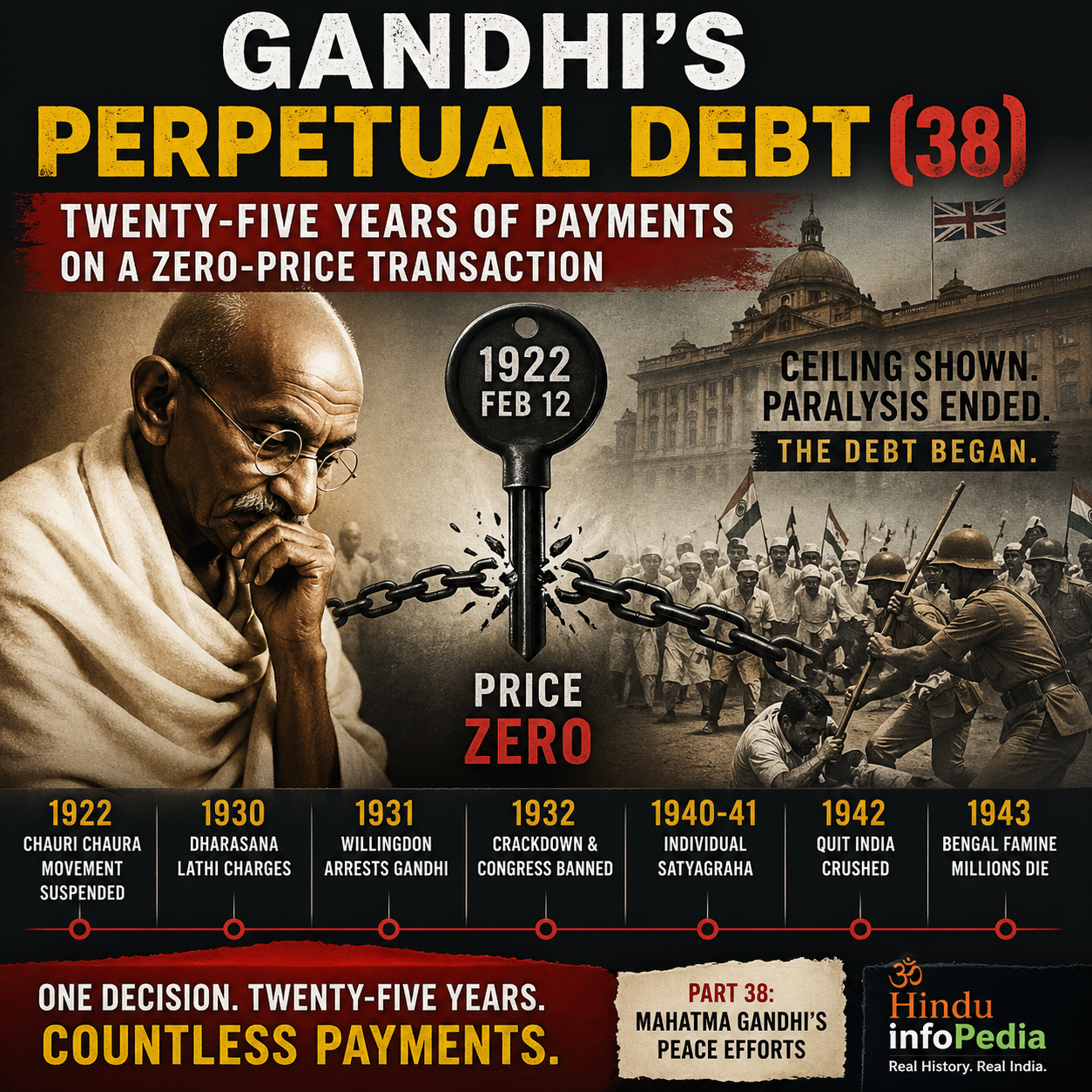
Third inflection point: 4 February 1922, Chauri Chaura, United Provinces. A crowd attacked and burned a police chowki, killing 22 constables — a reaction to police firing on Non-Cooperation demonstrators. Gandhi announced the suspension of the Non-Cooperation Movement within days, citing the violence as proof that India was not ready for civil disobedience — in spite of extreme criticism from all quarters of Congress. The movement that had brought millions onto the streets, survived mass arrests, and continued uninterrupted through the slaughter in Malabar five months earlier was called off because 22 state agents were killed in a single district.
The consequences fell on those who had followed Gandhi’s call. Thousands faced prosecution. At Chauri Chaura, 172 participants were sentenced to death by the Sessions Court; it was the personal legal intervention of Pandit Madan Mohan Malaviya before the High Court — not Gandhi, who had already repudiated the accused in Young India as moral apostates — that commuted 153 of those sentences. The local administration used the unilateral suspension and ensuing demoralization to crush nationalist resistance across districts. Those who had staked their livelihoods and freedom on the movement were abandoned at the moment the guarantee Gandhi had given Reading required the movement to stop.
From August 1921 onward, the Malabar uprising claimed over 2,500 lives and saw thousands forcibly converted. Gandhi minimized the atrocities in Young India, described the perpetrators as “god-fearing,” and continued Non-Cooperation. The movement ran for another six months. Then 22 constables died at Chauri Chaura and it stopped within days.
The asymmetry was acceptable to both parties. It was acceptable to the British because their governance remained intact — societal violence between communities did not threaten the administration. It was acceptable to Gandhi because disturbing the asymmetry would have disturbed the seeming Khilafat cause he was running. The word “seeming” is precise: the real Khilafat — armed resistance against the British — was exactly what Gandhi had promised Reading he would not permit. What Gandhi ran was a Khilafat in appearance, contained within the boundary of his guarantee.
Reading did not need to issue a fresh ultimatum after Chauri Chaura. Gandhi called off the movement before any ultimatum was necessary. Gandhi policed the boundary that mattered to the British. The British protected the alliance that mattered to Gandhi. The communities between those two calculations — the Hindus of Malabar, the promise of Hindu-Muslim unity — were not parties to the arrangement whose silence had determined their fate.
Invitation To Defence
The 30 May 1921 signed statement is a matter of public record. Reading’s dispatches are in the Reading Papers, India Office Records. The absence of any instruction to the Malabar Volunteer Corps between 30 May and 20 August 1921 is in the negative space of every relevant archive. Gandhi’s Young India of 16 February 1922 carries the suspension announcement. We invite the defence to explain three things: the choice of “in their opinion”; the absence of any demobilisation instruction to the Malabar Volunteer Corps after 30 May; and why over 2,500 deaths in Malabar did not trigger the movement’s suspension while 22 constable deaths at Chauri Chaura did.
30 May 1921: the Ali brothers sign. “In their opinion” preserves what the retraction was designed to preserve. Reading writes to Montagu: satisfactory. No instruction issues to the Malabar Volunteer Corps. The cadres drill. August arrives. Over 2,500 die in Malabar — the movement continues. 4 February 1922: 22 constables die at Chauri Chaura — the movement stops. The difference between those two triggers is the record of what Gandhi’s guarantee covered.
Feature Image: Click here to view the image.
Videos
Glossary of Terms
1. Narrowed Retraction: A deliberately limited public withdrawal or clarification of earlier statements, restricted to specific speeches without addressing the wider activities of the organisation associated with them.
2. Escape Hatch: A qualifying phrase or carefully worded expression that allows a person to avoid accepting full legal or moral responsibility. In this blog, it refers to the phrase “in their opinion.”
3. Quid Pro Quo: A reciprocal exchange in which one party provides something in return for a concession or benefit from another. Here, it describes the Ali brothers’ signed statement in exchange for suspension of prosecution.
4. Khilafat Volunteer Corps: An organised volunteer formation associated with the Khilafat movement in Malabar, whose activities included military-style drills in Ernad and Walluvanad.
5. Tangal: A religious title used for Muslim religious leaders in Kerala, particularly those associated with the traditional religious leadership of the Malabar region.
6. Ernad and Walluvanad: Administrative regions of Malabar in present-day Kerala that feature prominently in the account of the 1921 uprising and the activities of Khilafat volunteers.
7. Sedition: An offence involving conduct or expression considered by the state to incite disaffection or opposition against its authority. The blog refers to prosecution under the sedition provisions of the Indian Penal Code.
8. CID (Criminal Investigation Department): A specialised police investigative department responsible for collecting intelligence and investigating criminal and politically sensitive activities. Its records concerning the Ali brothers formed part of the evidence presented to Gandhi.
9. AICC (All India Congress Committee): The central organisational body of the Indian National Congress, responsible for coordinating its political activities and organisational decisions.
10. KPCC (Kerala Provincial Congress Committee): The provincial Congress organisation referred to in the blog in connection with the absence of instructions to demobilise the Malabar volunteer cadres.
11. Tacit Understanding: An implicit or unspoken agreement between parties, inferred from their conduct rather than established through an explicitly written commitment. The blog uses this concept to examine Gandhi’s understanding with Lord Reading.
12. Demobilisation: The process of disbanding or withdrawing organised personnel from active operations, including the termination of military-style activities.
13. Manjeri Outbreak of 1896: An earlier disturbance in the Malabar region, in which approximately ninety-nine insurgents were killed. The blog identifies it as an important historical reference point for subsequent administrative assessments.
14. Chauri Chaura Incident: The February nineteen twenty-two incident in the United Provinces in which a police station was attacked and burned, resulting in the deaths of twenty-two constables. Gandhi subsequently suspended the Non-Cooperation Movement.
15. Seeming Khilafat: A distinctive analytical expression used in this blog to distinguish the publicly presented Khilafat cause under Gandhi’s leadership from the armed anti-British resistance associated with the original Khilafat agitation.
#Gandhi #Khilafat #Malabar #ChauriChaura #NonCooperation #BritishIndia #AliBrothers #Simla #IndianHistory #HinduinfoPedia
Scan Through The Entire Series at