
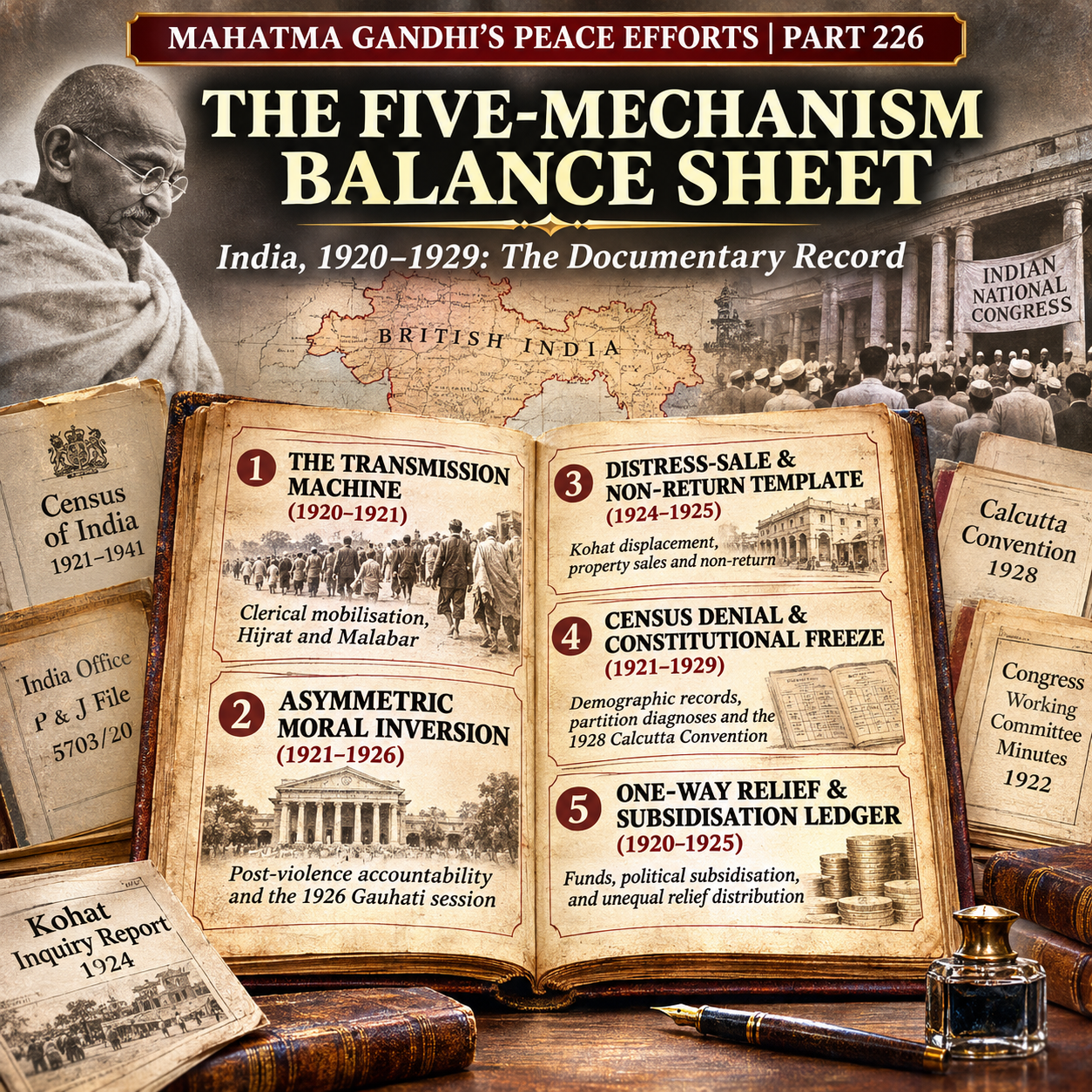
Gandhi’s Partition Blueprint Complete: The Five-Mechanism Balance Sheet (226)
भारत / GB
Part 226: Mahatma Gandhi’s Peace Efforts (1920–1929 Replication Wave & Financial Audit Synthesis) | Series Index
Blog 225 documented the primary financial and relief ledger across 1920–1925 — contrasting dedicated Khilafat and Hijrat committee relief at Peshawar’s Namak Mandi Sarai and Congress’s institutional subsidisation of the Khilafat alliance against zero restitution for Malabar’s forcibly converted Hindus and Kohat’s 3,500 displaced refugees. This closing synthesis of the 1920–1929 evidentiary arc (Blogs 211–226) consolidates the five interlocking mechanisms of Gandhi’s Partition blueprint proven from primary records between the December 1920 Nagpur session and the December 1928 Calcutta Convention — establishing the complete operational baseline before Blog 227 examines the 1930s escalation. The 1924 demographic rehearsal is in Blog 223; the Census and settlement funnel is in Blog 224.
1920–1929 CLOSING BALANCE SHEET: FIVE MECHANISMS PROVEN
The Action Taken: Between December 1920 (Nagpur) and March 1929 (Jinnah’s 14 Points), five distinct operational mechanisms locked India onto the trajectory toward 1947: (1) a three-tier clerical and political transmission machine that bypassed classical jurists and ignited the 1920 Hijrat and 1921 Malabar outbreaks; (2) asymmetric moral inversion after riots and assassinations, culminating in Gandhi’s December 1926 Gauhati absolution of Swami Shraddhanand’s killer; (3) the 1924 Kohat distress-sale and non-return template; (4) the freezing of Census demographic warnings and British/Indian partition diagnoses while rejecting every constitutional compromise from ~30 demands down to just 3 amendments at Calcutta in December 1928; and (5) a one-way financial and relief ledger that subsidised political mobilisation while denying Hindu victim rehabilitation as “communal.”
Who Paid the Price: Hindus across Malabar, Kohat, NWFP, Punjab, and Bengal — and the entire Indian electorate — kept inside an artificial unity narrative while their demographic security, ancestral properties, donor funds, and constitutional bargaining windows were systematically liquidated eighteen years before August 1947.
Why This Matters: Partition in 1947 was not an accidental breakdown at the eleventh hour. Every structural component of the 1947 catastrophe was built, tested, and verified in primary records between 1920 and 1929.
1. Mechanisms 1 & 2: The Transmission Machine and Asymmetric Moral Inversion (1920–1926)
The first phase of this 1920s audit (Blogs 211–222) traced how theological separatism was injected into mainstream Indian politics and shielded from accountability whenever violence erupted:
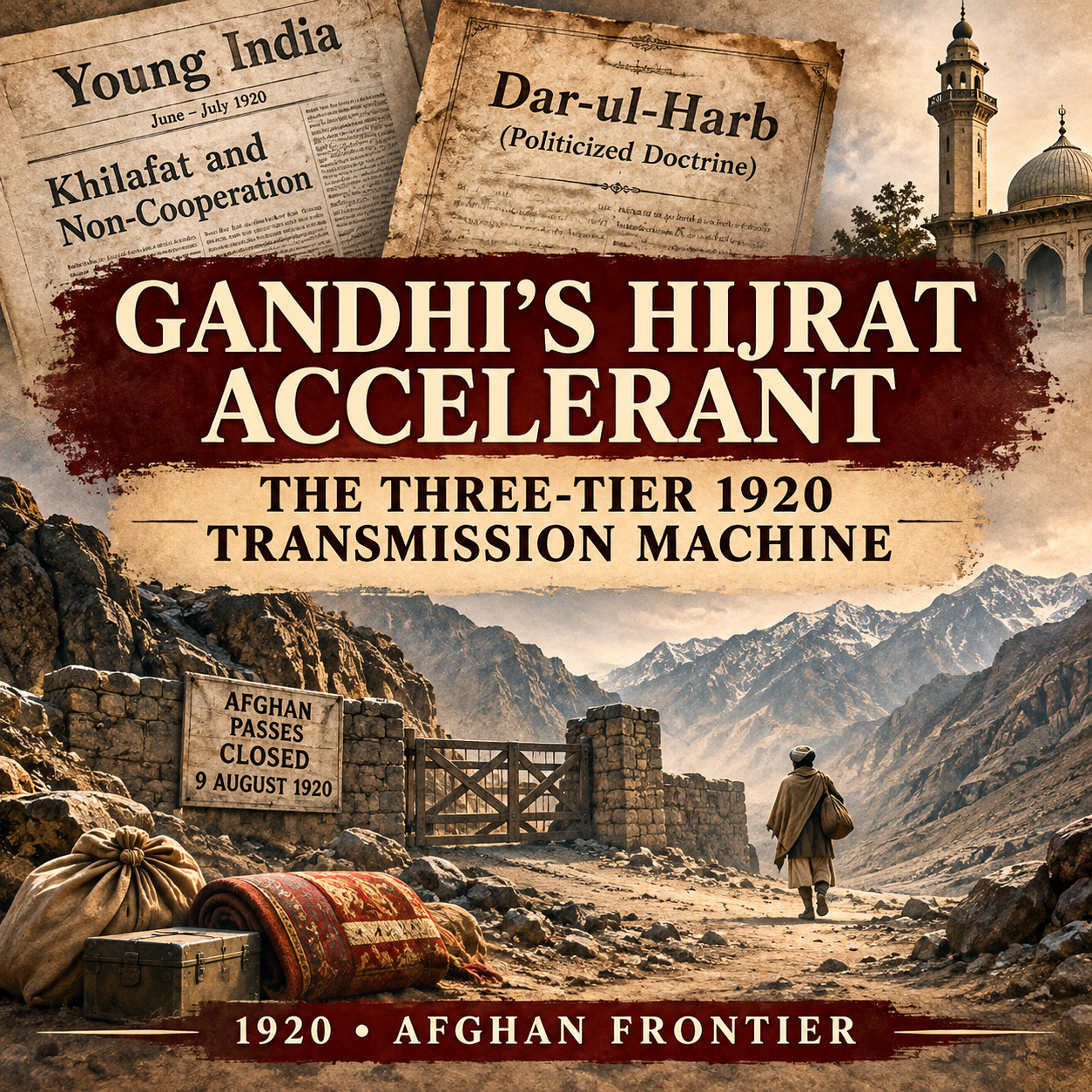
- Bypassing Dissenters and Classical Jurists (Blogs 215–218): At Nagpur in December 1920, Gandhi sidelined constitutionalists like Muhammad Ali Jinnah and Annie Besant while elevating Maulana Hasrat Mohani and clerical Khilafat leaders — overriding classical Islamic jurists who ruled British India was Dar-ul-Aman (not Dar-ul-Harb) and turning his July–August 1920 Frontier and Sindh tours into an accelerant for the disastrous Hijrat exodus.
- Six-Year Causal Chain to Assassination and Moral Absolution (Blogs 220–222): When post-Khilafat street violence detonated across Malabar (1921), Multan (1922), Saharanpur (1923), and Kohat (1924), Gandhi blamed Arya Samaj reformers and Hindu press defenders rather than the clerical perpetrators — a pattern that isolated Swami Shraddhanand after his 1923 Shuddhi rescue mission, culminated in his December 1926 murder in Delhi, and ended with Gandhi calling the assassin “Brother Abdul Rashid” at the Gauhati Congress session.
Together, clerical mobilisation and post-violence moral inversion created permanent street impunity — forming the psychological foundation of Gandhi’s Partition blueprint.
2. Mechanisms 3 & 4: The 1924 Distress Rehearsal and Constitutional Freeze (1921–1929)
The demographic and constitutional exhibits (Blogs 223–224) moved from street violence to hard demographic, real-estate, and constitutional records:
| Mechanism | Primary Documentary Record | Operational Impact Before 1947 |
|---|---|---|
| 1. Three-Tier Transmission Machine (1920–1921) | India Office P&J File 5703/20; December 1920 Nagpur Congress records | Legitimised parallel religious sovereignty and eliminated constitutional moderates. |
| 2. Asymmetric Moral Inversion (1921–1926) | CWMG Vol. 32 (December 1926 Gauhati speech); Shraddhanand correspondence | Absolved assassins while stigmatising Hindu self-defence and reclamation as “provocation.” |
| 3. Distress-Sale & Non-Return Template (1924–1925) | 1924 Kohat Inquiry Report (Rs. 9 lakh loss, 473 properties); CWMG Vol. 26 (Feb 1925) | Blocked displaced refugees from returning without local Muslim invitation, forcing distress property liquidation. |
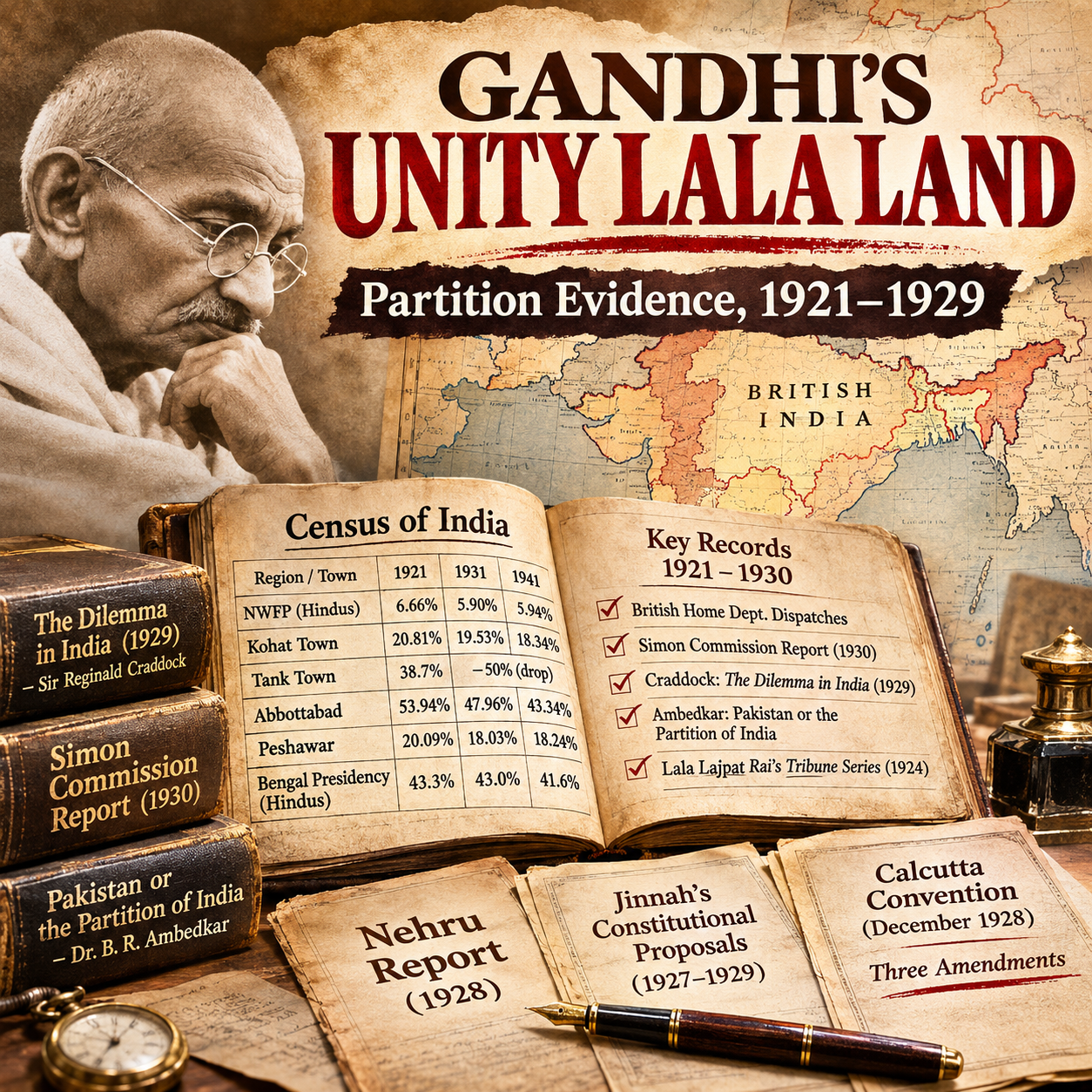
| 4. Census Denial & Settlement Rejection (1921–1929) | Census of India (1921, 1931, 1941); Simon Commission (1930); Lajpat Rai (1924); Calcutta Convention (Dec 1928) | Hid NWFP/Kohat/Tank Hindu population drops while voting down every compromise from ~30 demands to 14 points to just 3 Calcutta amendments. |
| 5. One-Way Relief & Subsidisation Ledger (1920–1925) | Ambedkar, What Congress and Gandhi Have Done to the Untouchables (Ch. X); 1922 CWC minutes | Used Hindu-donated crores to subsidise the political alliance (with Rs. 80L–1 Cr un-audited) while denying Malabar & Kohat victim relief as “communal.” |
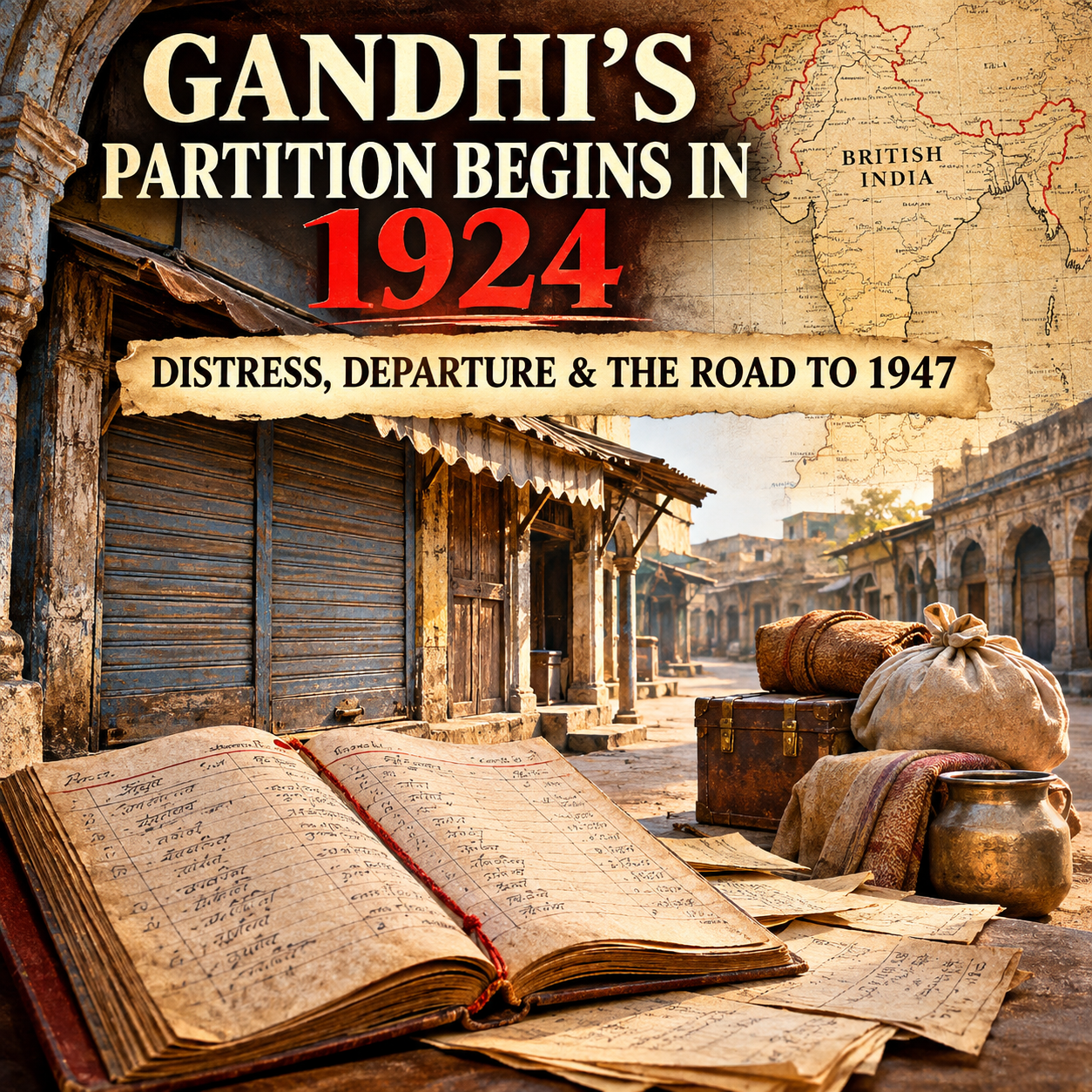
From the five-step Kohat displacement sequence in 1924 (Blog 223) to the 1921–1941 Census tables and December 1928 Calcutta rejection (Blog 224), hard official statistics prove that Gandhi’s Partition blueprint froze public awareness of demographic contraction while slamming shut every constitutional exit.
3. Mechanism 5: The One-Way Financial and Relief Ledger (1920–1925)
The financial audit layer (Blog 225) demonstrated how money reinforced every political and demographic asymmetry — converting capital collected primarily from Hindu donors into operational fuel deployed by Gandhi and Khilafat leaders against Hindu interests:
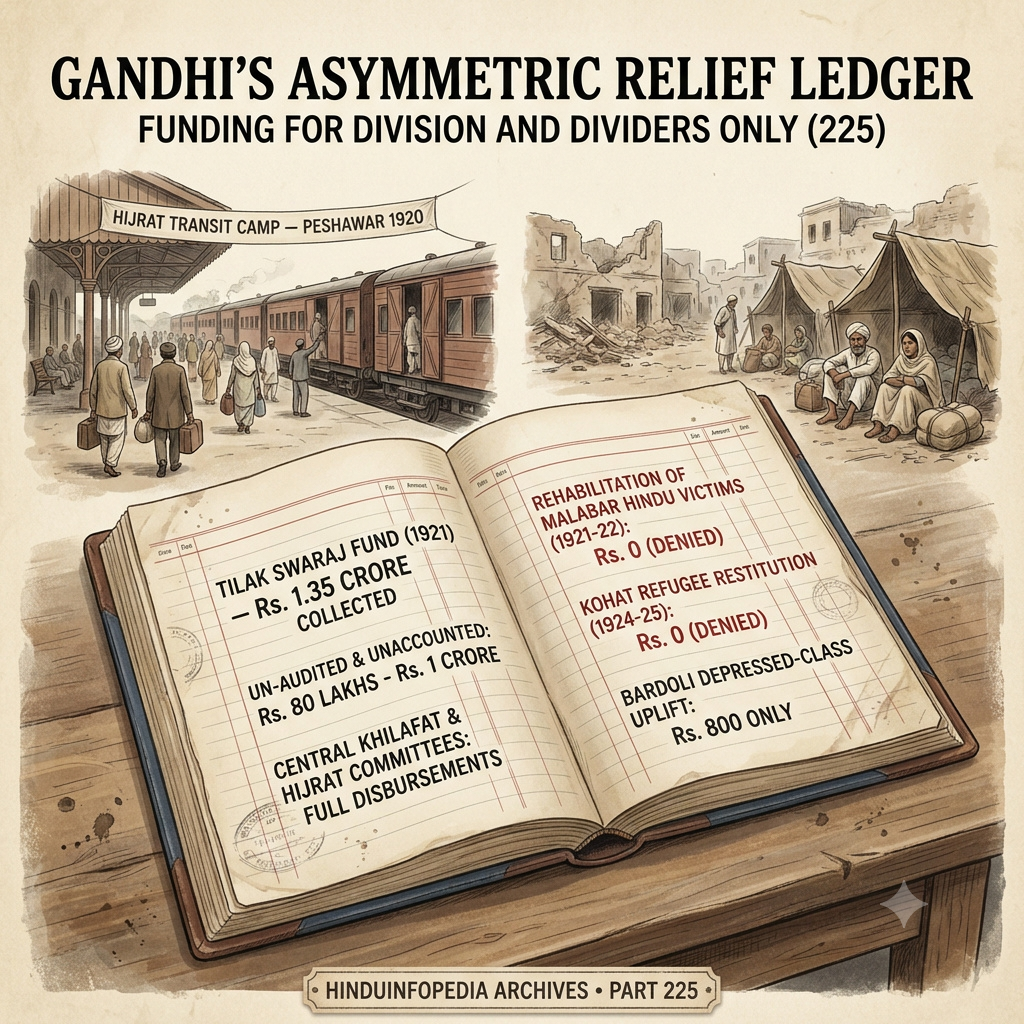
- Funding for Agitation Participants, Refusal for Hindu Victims: Dedicated Khilafat and Hijrat committees funded transit camps, rations, and hospital care at Peshawar’s Namak Mandi Sarai in 1920, while Hindu-donated Tilak Swaraj Fund collections (Rs. 1.35 crores, with Rs. 80 lakhs to Rs. 1 crore un-audited per Dr. B.R. Ambedkar) provided the institutional and political subsidisation of the Congress–Khilafat alliance — turning money raised predominantly from Hindus into the political and organisational machinery used against them by Gandhi and his Khilafat partners.
- Blocking Malabar and Kohat Restitution as “Communal”: When Swami Shraddhanand sought Congress funds in 1922 to reclaim forcibly converted Malabar Hindus or uplift depressed classes (receiving just Rs. 800 out of Rs. 43,000 sanctioned), Congress refused Hindu victim rehabilitation as sectarian — and left Kohat’s 3,500 evacuees in 1924–1925 with zero restitution.
The consolidated balance-sheet synthesis of these financial ledgers is reserved for the 300-series analysis, where every rupee collected from Hindus and denied to Hindu victims across the entire movement will be tallied — completing the evidentiary record of Gandhi’s Partition blueprint at the event level.
4. Closing the 1920–1929 Ledger and Entering the 1930s: From Rehearsal to Structural Lock-In
With this Blog, the 1920–1929 evidentiary record (Blogs 211–226) stands complete. The 1920–1929 decade was not a missed opportunity for composite nationalism; it was a ten-year laboratory in which every tool later deployed in 1946–1947 was tested in miniature:
- Proven in the 1920s: Clerical veto power over constitutional moderates, asymmetric blame after street violence, non-return edicts converting temporary flight into permanent demographic clearing, refusal of minority-protection compromises at Calcutta (December 1928), and one-way institutional funding.
- What Follows in the 1930s Arc (Blog 227 Onward): Having forged the five-part operational template in the 1920s, Congress leadership carried the exact same doctrinal reflexes into the 1930s — from the Round Table Conferences and the 1932 Communal Award to the 1937 provincial ministries and the road to the 1940 Lahore Resolution.
Every subsequent crisis after 1929 operated along the tracks already laid down by Gandhi’s Partition blueprint.
Modern Parallel
The enduring danger of Gandhi’s Partition blueprint is that its five mechanisms operate as a repeatable political system whenever institutional leadership prioritizes ideological optics over empirical reality. When demographic shifts documented in official Census records are dismissed as taboo, when street intimidation is met with moral equivalence rather than legal enforcement, when displaced victims are denied restitution in the name of “communal harmony,” and when public funds subsidise political mobilisation while neglecting affected citizens, territorial and civic fragmentation becomes mathematical certainty.
Closing the 1920–1929 evidentiary ledger across Blogs 211–226 leaves the historical record established on primary documents alone: Census volumes (1921–1941), India Office dispatches, British parliamentary reports, Congress Working Committee minutes, Dr. B.R. Ambedkar’s audits, Lala Lajpat Rai’s 1924 warnings, and the December 1928 Calcutta proceedings all confirm that Gandhi’s Partition blueprint was fully assembled eighteen years before August 1947.
Invitation To Defence
The five primary archival pillars consolidated across Blogs 211–226 — India Office File P&J 5703/20 (1920 Hijrat), the 1924 Kohat Inquiry Report and CWMG Vol. 26 (February 1925 non-return statement), CWMG Vol. 32 (December 1926 Gauhati speech), the Census of India (1921, 1931, 1941) alongside the December 1928 Calcutta Convention records, and Dr. B.R. Ambedkar’s Chapter X Tilak Swaraj Fund audit — are all verifiable primary sources. The defence is invited to identify which of these five documented mechanisms did not operate between 1920 and 1929, or to produce any primary record showing Congress dismantled them before 1947.
Between December 1920 and March 1929, five interlocking mechanisms — clerical mobilisation, moral inversion after assassinations, distress-sale displacement without return, Census denial alongside the rejection of every compromise from ~30 demands down to 3 Calcutta amendments, and one-way relief funding — locked in Gandhi’s Partition blueprint eighteen years before 1947.
Feature Image: Click here to view the image.
Videos
Glossary of Terms
1. Five-Mechanism Balance Sheet: A consolidated analytical framework identifying five interconnected political, demographic, constitutional, and financial mechanisms examined in India’s history between 1920 and 1929.
2. Three-Tier Transmission Machine: A term used in the series to describe the interaction of clerical leadership, Khilafat committees, and Gandhi’s political mobilisation in transmitting religious and political ideas into mass movements.
3. Clerical Mobilisation: The organisation and mobilisation of people through religious leadership and clerical networks for political or collective action.
4. Dar-ul-Aman: An Islamic jurisprudential classification referring to a territory where Muslims can practise their religion under conditions of security and protection.
5. Dar-ul-Harb: A traditional Islamic jurisprudential classification historically associated with territories outside the recognised domain of Islamic political authority. Its interpretation has varied among jurists.
6. Asymmetric Moral Inversion: A phrase coined in the series to describe what the author identifies as an unequal application of moral accountability following political violence, including the treatment of perpetrators and those defending or protecting affected communities.
7. Distress-Sale and Non-Return Template: The proposed framework describing how displacement, property sales under economic pressure, and conditions restricting refugees’ return operated in the Kohat episode of 1924–1925.
8. Census Denial and Constitutional Freeze: A series-specific expression describing the alleged suppression or neglect of demographic warnings alongside the rejection of constitutional compromise proposals during the 1920s.
9. One-Way Relief and Subsidisation Ledger: The financial framework used in the blog to examine the contrast between funding political mobilisation and providing relief or rehabilitation to victims of communal violence and displacement.
10. Hijrat Movement: The 1920 movement in which groups of Indian Muslims migrated towards Afghanistan, influenced by religious and political appeals concerning British India.
11. Khilafat Movement: An Indian political and religious movement, particularly active between 1919 and 1924, seeking to protect the position of the Ottoman Caliph following the First World War.
12. Distress Sale: The sale of property under severe economic or social pressure, often at a substantially reduced price because the owner cannot reasonably retain or market the property under normal conditions.
13. NWFP (North-West Frontier Province): The former British Indian province situated along the north-western frontier, corresponding broadly to present-day Khyber Pakhtunkhwa in Pakistan.
14. CWMG (Collected Works of Mahatma Gandhi): The documentary collection of Gandhi’s writings, speeches, correspondence, and other historical records, cited in the blog as evidence for examining his statements and political positions.
15. CWC (Congress Working Committee): The principal executive committee of the Indian National Congress, responsible for important organisational and political decisions.
#Gandhi #Partition #IndianHistory #BritishIndia #Khilafat #Malabar #Kohat #Congress #Census #HinduHistory #HinduinfoPedia
Scan Through The Entire Series at
Refer to Various Arks Referred to in the Blog