
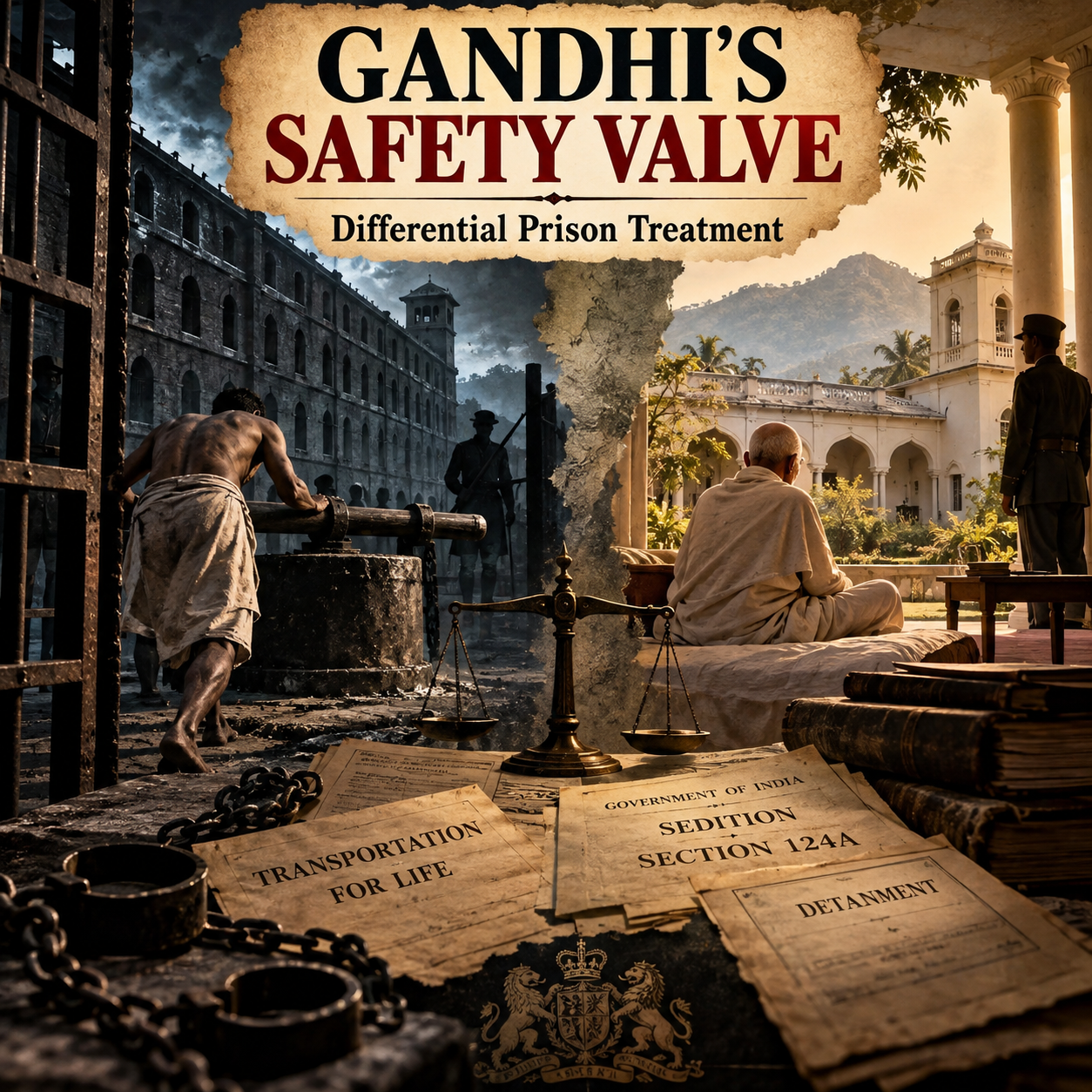
Gandhi’s Safety Valve: The Imperial Calculus Different Parameters for Jail (163)
भारत / GB
Part 163: Mahatma Gandhi’s Peace Efforts | Series Index
Blog 162 placed before the reader the economics of Gandhi’s austerity — the Birla, Bajaj, and Sarabhai financial networks that underwrote the Mahātmā’s infrastructure while six identified constituencies absorbed the movement’s residual costs. Blog 161 placed before the reader the Aga Khan Palace detention: a non-penal residential estate with gardens, companions, and medical supervision, documented as the deliberate British administrative choice when Gandhi was arrested in August 1942. This post, Gandhi’s Safety Valve, places before the reader the question that follows directly from those two exhibits: why did the same British administration that transported Vinayak Damodar Savarkar for 50 years sentence Gandhi to 6 years and release him in 2 on health grounds — for a campaign that brought the administration to documented fiscal near-collapse?
Thank you for reading this post, don't forget to subscribe!The Two Sentences
Gandhi’s Causation Engine places the two sentencing decisions before the reader as a single exhibit.
Vinayak Damodar Savarkar was tried in 1910 by the Bombay Special Tribunal for abetment of the assassination of A.M.T. Jackson, Collector of Nasik, and for conspiracy to wage war against the King — under Sections 121 and 302/109 of the Indian Penal Code, offences carrying execution or life transportation. He received two consecutive life terms of transportation — 50 years — to the Cellular Jail at Port Blair. He served approximately ten years under the documented penal conditions of that institution: solitary confinement, hard labour, denial of family visits, oil pressing by hand. He was transferred to Ratnagiri in 1921 under house arrest conditions after submitting mercy petitions.
Mohandas Karamchand Gandhi was tried in 1922 by the Ahmedabad Sessions Court on a charge of sedition under Section 124A of the Indian Penal Code — for three articles published in Young India. He received a six-year sentence. He was released in February 1924, approximately two years into the sentence, on grounds of health following an appendectomy. The presiding judge, C.N. Broomfield, placed on record at sentencing that Gandhi was “in a different category from any person tried under Section 124A” and that if the government found it possible to reduce the period and release him, no one would be better pleased than the court.
One administration. Two different statutory frameworks, applied to two different categories of offence. Two sentences that were not equivalent — and the prosecution places the question of why before the reader.
What Each Man Had Done
The prosecution places the predicate offences before the reader — not to rank their moral weight, but to establish what the British administration was calibrating against.
Savarkar’s conviction rested on his connection to the India House in London — the militant nationalist network that provided the pistol used in the Jackson assassination and distributed seditious literature. The conviction was for abetment and conspiracy under sections carrying capital or life punishment. The 50-year consecutive sentence reflected the administration’s determination to remove from the political field a man connected to an armed cell whose operational model — targeted assassination of colonial officials — represented a threat the administration classified as requiring permanent neutralisation.
Gandhi’s conviction rested on three Young India articles — “Tampering with Loyalty,” “The Puzzle and Its Solution,” and “Shaking the Manes” — that the prosecution argued brought the government established by law into hatred and contempt. Section 124A carried a maximum of transportation for life, but established judicial precedent from the 1908 Tilak sedition trial had set the practical ceiling for press-based sedition at six years. Broomfield’s sentence sat at that ceiling. The campaign that preceded those articles had brought the administration to a documented near-collapse: the Non-Cooperation Movement of 1920–1922 produced a documented revenue crisis, mass resignation from government employment, collapse of court attendance, and internal British correspondence acknowledging that continuation would make governance impossible (Blog 29). Gandhi had then suspended the movement himself at Bardoli on February 12, 1922 — twelve days before his arrest. The movement that had been the actual administrative threat was already over before the sentencing took place (Blog 130).
The prosecution places this before the reader as an exhibit: Gandhi was sentenced after the movement he led had already been unilaterally suspended by the man who led it. The statutory ceiling constrained the sentence. What the administration chose to do within and below that ceiling — and what it chose to do after — is the exhibit the prosecution places before the reader.
The Imperial Calculus
Gandhi’s Causation Engine places the documented administrative reasoning before the reader — not inference, but the British administration’s own recorded logic.
Viceroy Linlithgow’s War Cabinet dispatch of August 1942, placed on record in the Transfer of Power series, Volume II, documents the reasoning behind Gandhi’s internment at Aga Khan Palace rather than a standard penal institution (Blog 161). The explicit concern: if Gandhi died or was seriously harmed in standard detention, the mass authority he commanded would convert his death into a mobilisation trigger the administration could not contain. The non-penal estate was a risk-management decision about what Gandhi’s body represented to 350 million people, not a concession to his moral stature.
The same logic, read backward, explains 1922. A six-year sentence with early release on health grounds for the man who had just suspended the movement that threatened British governance: administratively rational. Gandhi alive and available as a negotiating partner was more useful than Gandhi dying in prison. Gandhi’s mass authority — the same authority that made standard detention a risk-management problem in 1942 — made his continued availability a governance asset in 1922.
Savarkar’s network had no equivalent mass authority. It had operational capability: a documented capacity to produce armed attacks on colonial officials. Against that, the administration’s calculus was different. The armed cell was crushable. Its political consequence — blowback, martyrdom — was finite and manageable. Its continued operation, if left unchecked, was not.
The prosecution places the imperial calculus before the reader in its documented form: Savarkar was a threat the administration classified as eliminable. Gandhi was a resource the administration classified as governable.
What Gandhi Said About Savarkar
Gandhi’s Causation Engine places one additional exhibit before the reader, documented in Blog 24 of this series.
On May 26, 1920 — as Gandhi was preparing to launch the Non-Cooperation Movement — he published an article in Young India arguing for Savarkar’s release from the Cellular Jail. The argument Gandhi chose was not that Savarkar had been unjustly convicted or that the sentence was disproportionate to the offence. The argument Gandhi chose was that the Savarkar brothers “do not desire independence from the British connection” — that they were constitutionalists, not revolutionaries, and that the sentence was therefore excessive given their actual political position.
The prosecution places before the reader the framing Gandhi selected: to argue for Savarkar’s release by arguing that Savarkar presented no fundamental revolutionary threat to the British connection.
Blog 24 places that article within its analysis of Gandhi’s operating method — the accommodation mechanism by which potential opposition was integrated into Gandhi’s framework on his terms. The prosecution places it here within a different frame: the argument Gandhi chose, whatever its intent, was structurally identical to the argument a British administrator would have accepted — that the imprisoned man was not actually dangerous. The prosecution notes the convergence and places it before the reader without editorial conclusion.
The Safety Valve Defined
A safety valve in a pressure system serves two simultaneous functions. It releases accumulated pressure at the point of maximum accumulation, preventing rupture. And it keeps that pressure within the system — controlled, directed, and ultimately available to the administrator of the system rather than to the force the pressure represents.
Gandhi’s documented operational pattern — mass mobilization at peak administrative vulnerability, unilateral suspension without enforceable concession extracted, movement authority returned to the leader rather than institutionalised in the rank-and-file — produced outcomes consistent with the safety valve function. The Non-Cooperation Movement reached documented peak pressure in November 1921 (Blog 29). Gandhi suspended it in February 1922 before the administration broke (Blog 130). The Salt March reached documented fiscal impact in April–May 1930 (Blog 9). Gandhi signed the Irwin Pact in March 1931, delivering zero of eleven demands in full (Blog 20). The Quit India Movement of August 1942 produced documented administrative disruption across six weeks. Gandhi was arrested on the first day and administratively insulated from the movement’s costs for 21 months (Blog 161).
In each instance, the pressure was released. In each instance, the administration survived. In each instance, the rank-and-file who had generated the pressure absorbed the residual costs — imprisonment, lathi charges, the documented deaths catalogued across Blogs 33, 35, and 41. In each instance, Gandhi remained available for the next arc.
The prosecution does not claim that Gandhi was a British agent. The prosecution does not claim that Gandhi’s moral convictions were manufactured. The prosecution places before the reader a more precise claim: that the British administration’s documented sentencing decisions — Savarkar 50 years, Gandhi 6 years with early release — reflect a documented administrative calculus about which form of nationalist mobilisation was eliminable and which was governable. And that the form of nationalist mobilisation Gandhi led was, in the British administration’s documented judgment, the governable form.
Three Counter-Strikes the Defence Will File
The prosecution anticipates the defence and places its responses on record before the floor is opened.
Counter-Strike One: The Statutory Boundary (The IPC Wall)
Defence argument: “The prosecution confuses administrative favoritism with statutory compulsion. Judge Broomfield could not have sentenced Gandhi to transportation for life under Section 124A without violating the Tilak precedent. Savarkar was convicted under Sections 121 and 302/109 — capital offences carrying execution or life transportation. The differential was written into the law books in 1860, decades before either man entered politics.”
The prosecution acknowledges the statutory frame and does not dispute it. The defence is correct that the two men were charged under different sections carrying different maximum penalties. The prosecution’s exhibit is not the statutory ceiling — it is the administrative conduct within and below that ceiling.
Three facts the statutory argument cannot account for: first, Section 124A permitted transportation for life — the Tilak precedent established a practical ceiling, not a hard statutory one, and the administration chose not to press for the maximum. Second, Gandhi’s early release after two years was not a judicial outcome — it was an executive decision by the government, taken on medical grounds at a moment when the movement was already suspended and Gandhi had begun urging Indians to contest elections. The statutory frame ended at sentencing. What followed was administrative discretion, and that discretion is the prosecution’s exhibit. Third, the Linlithgow dispatch of 1942 — the administration’s own documented reasoning for the Aga Khan Palace decision — is not a statutory document. It is an explicit statement of governance calculus. The prosecution places that calculus before the reader alongside the early release of 1924 and asks what consistency the two decisions share.
The statutory wall explains the sentencing differential. It does not explain the early release. It does not explain the non-penal estate. It does not explain the Broomfield statement that the court hoped the government would find it possible to reduce the sentence further. The prosecution places all four exhibits before the reader.
Counter-Strike Two: The 1942 Physical Impossibility
Defence argument: “By August 1942, Japan had occupied the Andaman Islands. The Cellular Jail was physically unavailable. Furthermore, Gandhi was detained under Rule 26 of the Defence of India Rules — the exact same wartime preventive detention applied to over 60,000 ordinary Congress cadres and the entire Working Committee.”
The prosecution places two responses on record.
First, on the Andaman occupation: the Japanese did occupy the Andamans in March 1942, making Port Blair unavailable. The prosecution does not claim that the administration was choosing between Aga Khan Palace and the Cellular Jail in August 1942. The prosecution claims that the administration chose Aga Khan Palace over the available alternatives — Ahmedabad Central Prison, Yerwada Jail (where Gandhi had previously been held and where Ambedkar’s Working Committee was meeting that same year), or any standard colonial penal institution then operational. The Linlithgow dispatch documents the reasoning for that choice, and the reasoning is mass authority, not logistics. The prosecution places the documented reasoning before the reader, not a counterfactual about Port Blair.
Second, on Rule 26 and parity with the Working Committee: the prosecution has placed the full detention differential on record in Blog 161. The Working Committee was interned at Ahmednagar Fort — a functioning military garrison under active wartime security, not a residential estate with gardens, personal attendants, and private correspondence access. The co-application of the same preventive detention rule to Gandhi and to the Congress rank-and-file does not establish equivalence of conditions. The prosecution places the documented conditions before the reader, not the legal instrument used to authorize them.
The prosecution’s structural claim is not that Gandhi was uniquely detained. It is that the documented conditions of Gandhi’s detention, and the documented reasoning behind those conditions, are consistent with an administration that understood Gandhi’s value alive and contained — and acted on that understanding.
Counter-Strike Three: Martyrdom Cost vs. Safety Valve Intent
Defence argument: “Linlithgow’s fear of Gandhi dying in detention and sparking uncontrollable insurrection does not mean the state viewed that prisoner as a partner or a safety valve. It simply proves the state understood the catastrophic military cost of creating a supreme martyr in wartime.”
The prosecution accepts this argument as a restatement of the prosecution’s own exhibit — and places before the reader what it does not resolve.
The defence is correct that fear of martyrdom is not the same as intent to manage a resource. A state can fear a prisoner’s death without viewing that prisoner as a tool. The prosecution does not rest its case on the 1942 internment alone. The prosecution rests its case on the pattern: seven arcs across four decades in which mass pressure was generated, peaked, and was released without a structural rupture to British governance — and in which Gandhi’s availability at the start of each subsequent arc was preserved by administrative decisions consistent with the martyrdom-cost calculus the defence has now conceded.
The prosecution asks the defence to account for 1924. Gandhi’s early release was not a wartime decision. There was no Japanese occupation. There was no military emergency. There was a man who had just suspended the movement that threatened British governance, whose movement’s rank-and-file were absorbing prosecution costs, and whom the presiding judge had placed on record as deserving of reduced sentence. The government released him. The prosecution places that decision — outside of any martyrdom-cost wartime frame — before the reader alongside the 1942 internment and asks what administrative logic connects them.
The martyrdom-cost argument is the prosecution’s exhibit, not a rebuttal of it. The defence has named the mechanism. The prosecution asks the reader to assess what seven iterations of that mechanism, across four decades, established about the administration’s relationship to the force it was managing.
The Prosecution’s Position
Gandhi’s Causation Engine places two questions before the reader.
- Does the documented differential between Savarkar’s 50-year consecutive transportation sentence and Gandhi’s 6-year sedition sentence — delivered by the same British colonial administration within twelve years of each other, for forms of anti-colonial activity the administration classified under different statutory frameworks — constitute an exhibit the reader places alongside the narrative of Gandhi as the principal threat the British administration sought to suppress?
- Does the documented British administrative reasoning for Gandhi’s Aga Khan Palace internment in 1942 — that Gandhi’s mass authority made standard detention a governance risk requiring a risk-management solution, in the administration’s own recorded words — constitute a document the reader places alongside the seven-arc record of what Gandhi’s mass authority produced, and for whom?
The series does not answer. Gandhi’s Causation Engine places the two sentences, the one administration, the three counter-strikes and their prosecution responses, the documented calculus, and the documented operational outcomes across seven arcs before the reader. The reader will assess what the imperial arithmetic establishes — and complete the sentence.
Invitation To Defence
The floor belongs to the defense. We now invite them to present their exhibits and challenge the narrative established by the prosecution.
One British colonial administration. Two statutory frameworks. Savarkar: 50-year consecutive transportation for abetment of an armed assassination — Cellular Jail, hard labour, solitary confinement, oil pressing by hand — under sections carrying execution or life. Gandhi: 6-year sedition sentence for three newspaper articles under Section 124A — released in 2 years on health grounds by executive decision, the presiding judge having placed on record his hope that the government would reduce the sentence further. The administration’s documented reasoning for 1942: Gandhi’s mass authority made standard detention a governance risk. The prosecution has absorbed the three counter-strikes the defence will file — the statutory wall, the Andaman occupation, the martyrdom cost — and placed its responses on record. The reader will assess what one administration’s documented calculus, across seven arcs and four decades, establishes about which form of nationalist mobilisation it classified as eliminable — and which it classified as governable.
Feature Image: Click here to view the image.
Videos
Glossary of Terms
- Gandhi’s Safety Valve: The central analytical phrase of the blog, describing the prosecution’s argument that Gandhi’s mass mobilisation generated pressure but was repeatedly suspended before a structural rupture, allowing British governance to survive while Gandhi remained available for subsequent political mobilisation.
- Imperial Calculus: The blog’s term for the documented administrative reasoning used by the British government to assess Gandhi and Savarkar differently according to the perceived political and administrative consequences of their continued imprisonment or release.
- Causation Engine: The analytical framework developed in the series to connect documented political actions, administrative responses, mobilisation, suspension, patronage, costs, and subsequent outcomes across multiple historical arcs.
- Statutory Framework: The specific legal provisions under which an individual was prosecuted and sentenced, including the different provisions applied to Savarkar and Gandhi.
- IPC — Indian Penal Code: The Indian Penal Code under which Savarkar and Gandhi were prosecuted under different statutory provisions, including Sections 121, 302/109 and 124A.
- Section 124A: The Indian Penal Code provision under which Gandhi was convicted for sedition based on three articles published in Young India, carrying a maximum penalty that included transportation for life.
- Transportation for Life: A severe colonial punishment involving removal of a convicted person to a penal settlement, historically associated with imprisonment in places such as the Cellular Jail in the Andamans.
- Tilak Precedent: The judicial precedent from the 1908 Tilak sedition case that the blog identifies as establishing a practical sentencing boundary for press-based sedition cases.
- Administrative Discretion: The authority exercised by the executive administration after sentencing, including decisions concerning detention conditions, early release, and the location and character of imprisonment.
- Non-Penal Estate: A detention location that was not a conventional penal institution. In the blog, the term refers specifically to the Aga Khan Palace arrangement used for Gandhi in 1942.
- Mass Authority: The political authority derived from a leader’s ability to mobilise a large population. The blog uses the term to explain why Gandhi’s continued availability carried a different administrative significance from that of Savarkar.
- Martyrdom Cost: The political and administrative consequences the British government anticipated if Gandhi died in detention, particularly the possibility that his death could trigger mobilisation or unrest beyond administrative control.
- Safety Valve Function: The two-part function used in the blog’s analogy: releasing accumulated political pressure before rupture while keeping that pressure within a system where it remains controllable.
- Counter-Strikes: The blog’s term for the three principal defence arguments anticipated by the prosecution: the statutory boundary, the physical unavailability of the Cellular Jail in 1942, and the distinction between martyrdom cost and safety-valve intent.
- Eliminable and Governable: The blog’s paired terms for the administrative classification it attributes to the British response: a threat considered capable of being permanently suppressed, versus a political force considered capable of being contained and managed within the governing system.
#Gandhi #Savarkar #IndianHistory #BritishIndia #FreedomMovement #Satyagraha #Sedition #CellularJail #QuitIndia #HinduinfoPedia
Gandhi’s Peace Efforts: The Questions Before the Mahatma (0)