
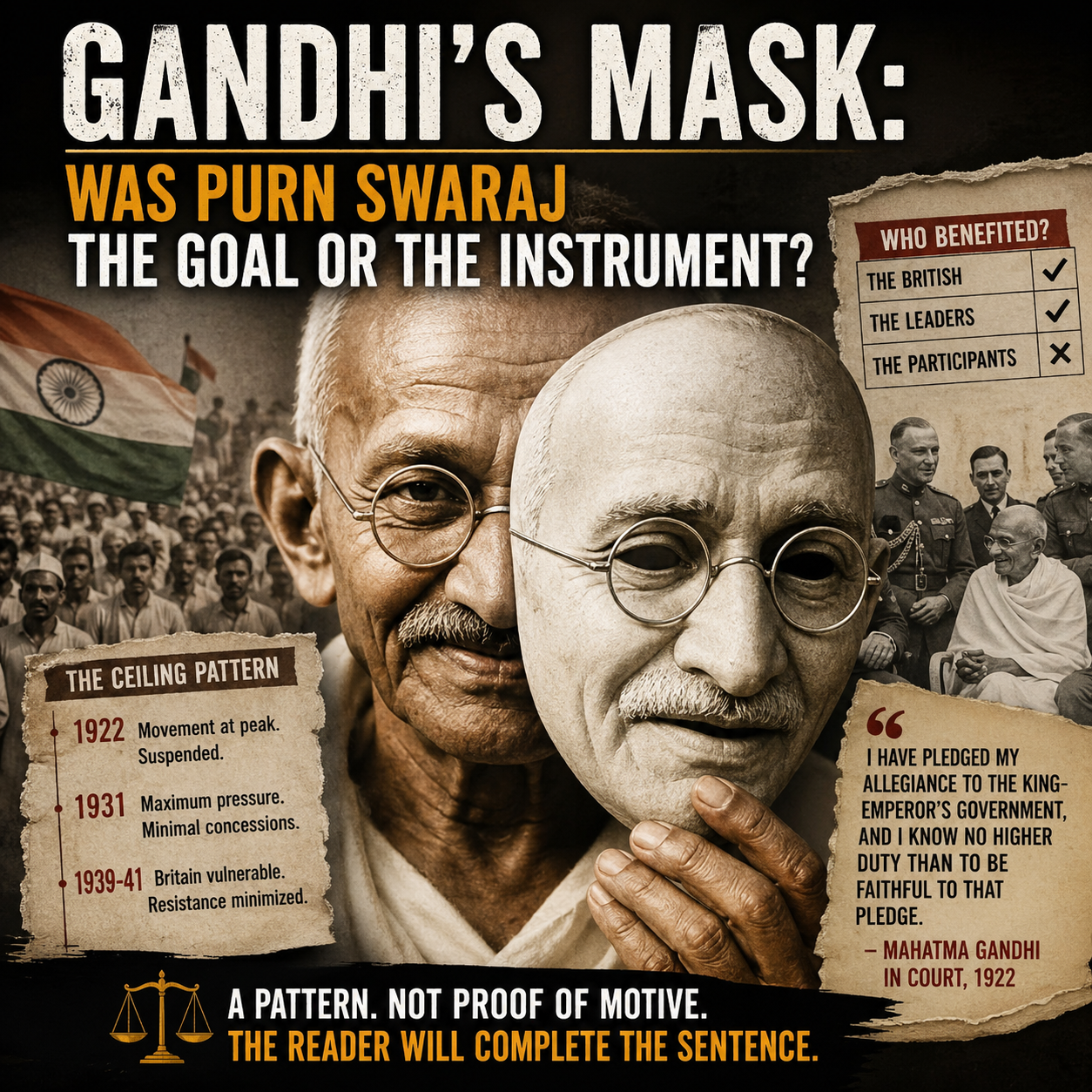
Gandhi’s Mask: Was Purn Swaraj the Goal or the Instrument? (40)
भारत / GB
Part 40: Mahatma Gandhi’s Peace Efforts | Series Index
The Suspension Arc has documented eleven specific consequences of Gandhi’s consistent choices — the signal, the counterfactual, the licence, the torch, the ledger, the accounting, the unled crowd, the forgotten lawyer, the perpetual debt, the cost beyond 1947, and the 1942 proof. This post does not add a twelfth consequence. It steps back and asks the question that sits underneath all eleven: if the principle consistently produced outcomes that served the adversary and cost the movement’s participants everything — what was the principle actually for?
Thank you for reading this post, don't forget to subscribe!The Question the Series Has Been Carrying
Gandhi’s Mask is the series’ most carefully handled post. It operates at the edge of what documented evidence can establish — not in the realm of fact, where this series has operated across forty blogs, but in the realm of pattern. Pattern is not proof of motive. But pattern, stated precisely and placed before the reader without assertion, is the most honest instrument available to a prosecution that cannot read a man’s mind.
The question Gandhi’s Mask asks is not whether Gandhi was dishonest. It is whether the claim that purn swaraj — complete self-rule — was Gandhi’s genuine goal is consistent with the documented record of what Gandhi did every time he had the leverage to advance it.
Three pillars. Each documented. Each placed before the reader without verdict.
Pillar One — The Ceiling Pattern
The ceiling pattern across three acts begins with arithmetic. Blog 33 documented three moments — 1922, 1931, 1939 to 1941 — in which Gandhi’s movement reached maximum pressure and Gandhi dissolved or minimised it without extracting maximum concession.
A man who genuinely sought purn swaraj — complete independence, the dissolution of British authority over India — would use maximum leverage to extract maximum concession. That is the logic of negotiation. Every negotiator with a strong hand plays it.
Gandhi had a strong hand three times. Each time he folded.
1922 — the movement at peak pressure, the British with no clean answer, Lord Reading’s dispatches at documented alarm. Gandhi suspended without extracting a single British commitment. The ceiling was self-enforced, on moral grounds, before the British were forced to act.
1931 — sixty thousand in jail, the strongest hand any Indian leader had held. Gandhi signed the Irwin Pact and abandoned eight of eleven demands. The salt tax — the movement’s symbolic centrepiece — remained intact in practice. The machine remained intact. Bhagat Singh was hanged eighteen days later.
1939 to 1941 — Britain standing alone after Dunkirk, the Indian Army the largest available Allied force. Maximum British vulnerability. Gandhi’s response: Individual Satyagraha — minimum resistance by design. The moment passed. The war ended. The leverage was surrendered at the point of its greatest value.
The ceiling pattern across three acts: maximum pressure, minimum extraction, consistent surrender at the strategic peak.
A man pursuing purn swaraj would explain this pattern. Gandhi’s defenders have not explained it. They have explained each individual act — Chauri Chaura was genuine, the pact was the best available terms, the war situation was complicated. But they have not explained why all three acts, in three different contexts, across twenty years, produced the same outcome: maximum leverage surrendered without concession, let alone, maximum concession.
Pillar Two — The Jallianwala Asymmetry
Blog 34 placed this before the reader in full. This post restates it in the context of the mask question.
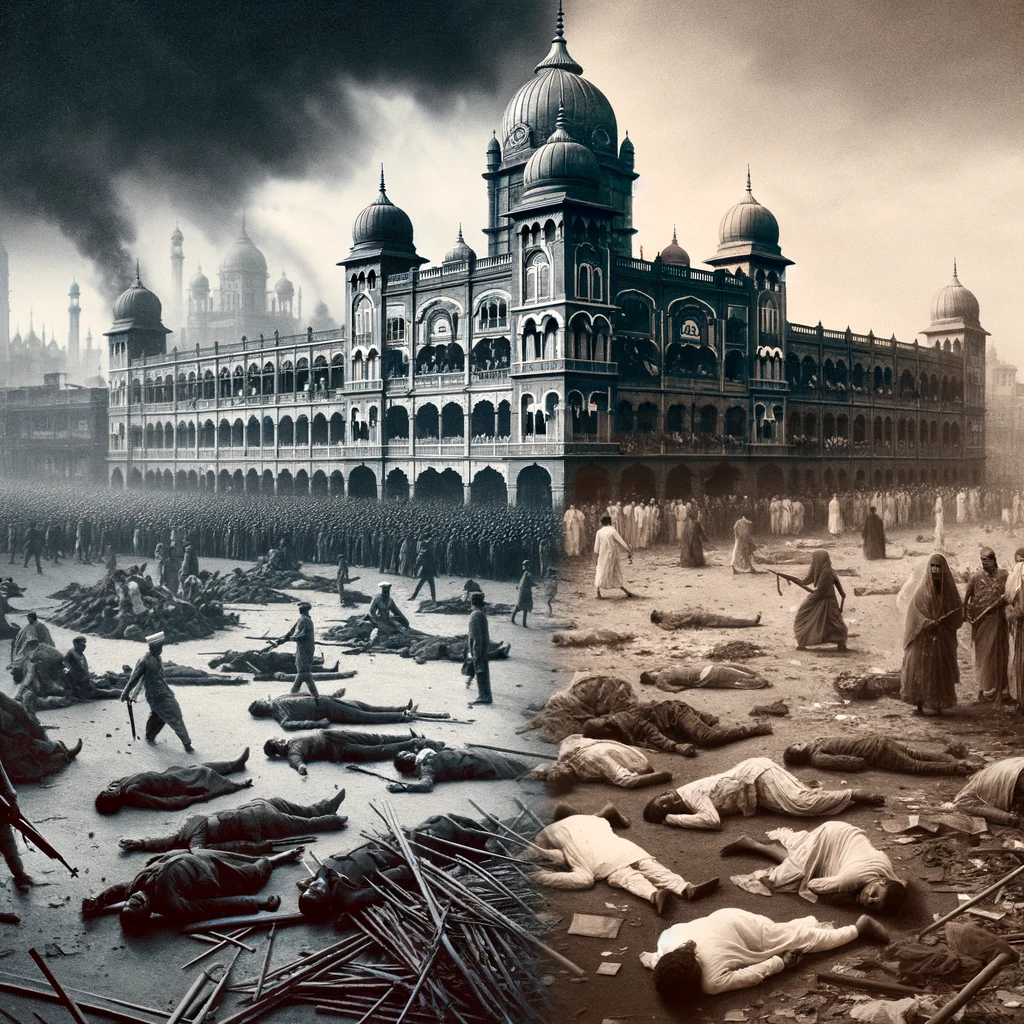
April 13, 1919. British troops enclosed thousands of unarmed Indians inside Jallianwala Bagh on Baisakhi — a walled garden, exits blocked — and opened fire. The documented names of at least 489 victims have been established — among them Hassan Mohammad of Gujranwala, nine years old, student, and Sohan Lal of Amritsar, nine years old, student. The British colonial government acknowledged 379. The Indian National Congress investigation estimated approximately 1,000.
Gandhi did not fast. He did not stop the movement. He used the massacre as the moral foundation for everything that followed — the anger it generated was the fuel for Non-Cooperation.
February 5, 1922. A crowd at Chauri Chaura attacked a police station. Twenty-two policemen died. Gandhi suspended the entire Non-Cooperation Movement seven days later, citing those twenty-two deaths.
November 1921. Traders and Congress supporters clashed in Bombay. Gandhi fasted for five days.
The asymmetry: British troops killing hundreds of unarmed Indians at Baisakhi — no fast, movement continued and fuelled. Indians clashing with Indians in a commercial district — five-day fast. Indians killing policemen at Chauri Chaura — entire movement dissolved.
Gandhi’s Mask asks one question about this asymmetry: what determined when Gandhi’s principle of non-violence activated?
The documented answer is consistent across all three events: the principle activated against Indian violence, specifically against the form of Indian violence that threatened British control and therefore threatened the negotiating framework within which Gandhi operated. British violence against Indians — even mass violence, even enclosed unarmed civilians on Baisakhi — did not activate the principle. It activated the movement.
The series does not characterise this asymmetry. It places it next to the mask question and asks the reader to read both simultaneously.
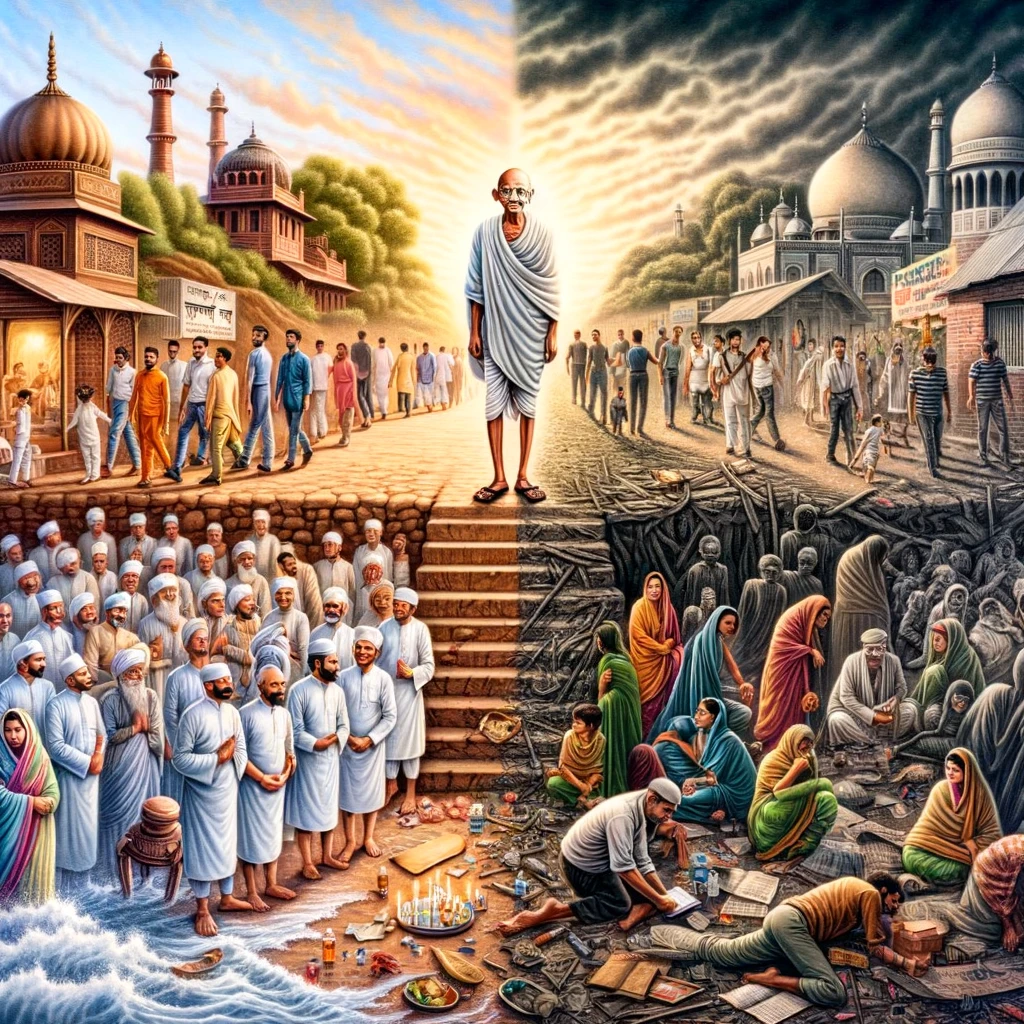
Pillar Three — The Beneficiary Consistency
The third pillar of Gandhi’s Mask is the beneficiary column — applied not to individual acts but to the pattern across Gandhi’s entire career.
Blog 10 documented the four satyagrahas in detail. This post extracts the beneficiary column across all four.
Champaran 1917 — Gandhi’s first major Indian campaign. The tinkathia system — forced indigo cultivation — was abolished. A genuine victory for the Champaran peasants. But the settlement delivered 25 percent refund of what the peasants had paid, not 50 percent. Gandhi accepted the partial settlement and declared victory. The peasants received relief. Gandhi received the political launch that made him the dominant figure in Indian nationalism. The British and the zamindars received a settlement that preserved the plantation system’s structural framework.
Non-Cooperation 1920 to 1922 — zero concession extracted. Thirty thousand in jail to nothing. Gandhi received enhanced unilateral authority — demonstrated above the institution’s capacity to refuse. The British received the answer to the question that had been constraining their conduct for seventeen months.
Irwin Pact 1931 — none of eleven demands fulfilled to reasonable extent. The extraction machine remained intact. Gandhi received the status of negotiating partner to the Viceroy — the recognition that the independence movement had a legitimate interlocutor and he received a royal reception at London . The British received a settlement that not only preserved but strengthened their administrative infrastructure at the moment of maximum pressure.
Individual Satyagraha 1940 to 1941 — minimum resistance at maximum British vulnerability. Gandhi received moral credit for opposing the war without destabilising the British war effort. The British received India’s continued participation in the war without having to make a single structural concession on independence.
Four acts. Four beneficiary columns.
Each time: Gandhi’s authority grew or was preserved. Each time: the movement’s participants received partial results or nothing. Each time: the British administrative framework remained intact.
The mask question is not whether Gandhi was dishonest. It is whether a man pursuing purn swaraj — complete dissolution of British authority — would produce this beneficiary pattern four times across twenty-five years. The pattern is consistent. The claim it sits underneath is not.
What the Series Does Not Claim
The three pillars do not claim Gandhi was a British agent. It does not claim his commitment to non-violence was fabricated. It does not claim he consciously served British interests.
It claims the pattern is visible, documented, and inconsistent with the stated goal.
A man can pursue a goal sincerely and fail to achieve it. That is not what the mask question is about. The mask question is about a specific form of consistent failure — one in which the stated goal is never advanced at the moment of maximum leverage, in which the adversary consistently benefits, in which the man holding the principle consistently gains authority while the people paying for the principle consistently gain nothing.
That pattern, across four acts, across twenty-five years, is either the most consistent political failure in the history of the independence movement — or it is something else. Gandhi’s Mask does not name the something else. It places the three pillars before the reader. The reader will complete the sentence.
The Guilty Plea — The Fourth Pillar
There is a fourth data point Gandhi’s Mask carries — one that sits outside the three pillars but belongs in any honest account of the mask question.
On March 18, 1922, Gandhi stood before Judge Broomfield in a British colonial court. He was charged with sedition under Section 124A of the Indian Penal Code — a British colonial law. He pleaded guilty.
He did not challenge the court’s jurisdiction. He did not refuse to recognise the proceedings as illegitimate — which is what a man who genuinely held that British authority over India had no legitimacy would have done.
Bal Gangadhar Tilak had mounted a jurisdictional challenge. Bhagat Singh in 1930 used his trial as a platform to deny the court’s right to try him. Gandhi pleaded guilty and used his submission as moral theatre — inflict on me the severest penalty — but the act itself was recognition of the colonial court’s authority to penalise him.
A man who pleads guilty to sedition in a colonial court is saying: this court has the right to judge me. That is not the position of a man who holds that British authority over India is illegitimate. It is the position of a man who operates within the British legal framework while publicly opposing it — which is a different position entirely, with different implications for what purn swaraj actually meant to the man who declared it.
The series places this before the reader as a fourth data point. The reader will decide what four consistent data points across twenty-five years constitute.
The Case of the Four Pillars: A Structural Summary
| Pillar | Focus Area | The Documented Pattern | The Strategic Outcome |
| I. The Ceiling Pattern | Strategic Leverage | In 1922, 1931, and 1940, Gandhi dissolved or minimized movements precisely when British vulnerability was at its peak. | Maximum Leverage surrendered for Minimum Extraction. |
| II. The Moral Asymmetry | The Principle of Non-Violence | Massive British violence (Jallianwala Bagh) fueled the movement; Indian violence (Chauri Chaura) was used to terminate it. | The principle activated only against violence that threatened the negotiating framework. |
| III. The Beneficiary Consistency | The Result Ledger | Across four major campaigns (1917–1941), the British administrative machine remained intact while Gandhi’s personal authority grew. | Participants gained partial/no relief; the Adversary gained structural preservation. |
| IV. The Jurisdictional Plea | Legal Legitimacy | Gandhi pleaded guilty in colonial courts (1922), unlike Tilak or Bhagat Singh who challenged the court’s right to judge them. | An implicit recognition of the authority he was publicly claiming to dissolve. |
Three pillars and a guilty plea. The ceiling surrendered at maximum pressure — three times. The principle activated against Indian violence, not British. The beneficiary column reading Gandhi and the British — consistently, across four acts. The guilty plea that recognised the court’s authority while declaring its rule illegitimate. Gandhi’s Mask does not remove the mask. It describes its shape precisely enough that the reader can see what is behind it.
Feature Image: Click here to view the image.
Videos
Glossary of Terms
- Purna Swaraj: Complete self-rule or full independence from British authority, declared as the ultimate political goal of the Indian freedom movement.
- Ceiling Pattern: A recurring pattern identified in the series where maximum political pressure is reached but not fully utilised to extract concessions.
- Maximum Leverage: The highest point of strategic advantage available to a political movement during negotiation or confrontation.
- Minimum Extraction: A situation where limited or no concessions are obtained despite strong negotiating power.
- Jallianwala Bagh Massacre: The 1919 killing of unarmed Indian civilians by British troops in Amritsar, a defining घटना in colonial repression.
- Chauri Chaura Incident: A 1922 घटना where a violent mob killed 22 policemen, leading to the suspension of the Non-Cooperation Movement.
- Non-Cooperation Movement: A nationwide protest (1920–1922) led by Gandhi urging Indians to withdraw cooperation from British institutions.
- Irwin Pact (Gandhi-Irwin Pact): A 1931 agreement between Gandhi and the British Viceroy that ended Civil Disobedience temporarily with limited concessions.
- Individual Satyagraha: A limited protest strategy (1940–41) allowing selected individuals to oppose British war efforts without mass mobilisation.
- Beneficiary Column: A framework used in the series to analyse who gained from political actions—leaders, participants, or ruling authorities.
- Jallianwala Asymmetry: A coined term describing the differing responses to British violence versus Indian violence within the same moral framework.
- Negotiation Logic: The principle that stronger bargaining positions typically aim to secure greater concessions.
- Section 124A (Sedition Law): A colonial-era legal provision used by the British to prosecute dissent against their rule.
- Jurisdictional Challenge: A legal argument rejecting the authority of a court to try a case.
- Mask Question: The central analytical question of the blog examining whether stated goals align with observed outcomes and patterns.
#Gandhi #IndianHistory #FreedomStruggle #Swaraj #BritishRaj #Independence #History #Politics #ColonialIndia #HinduinfoPedia
Gandhi’s Peace Efforts: The Questions Before the Mahatma (0)
Read The Prosecution Exhibits Through Links