
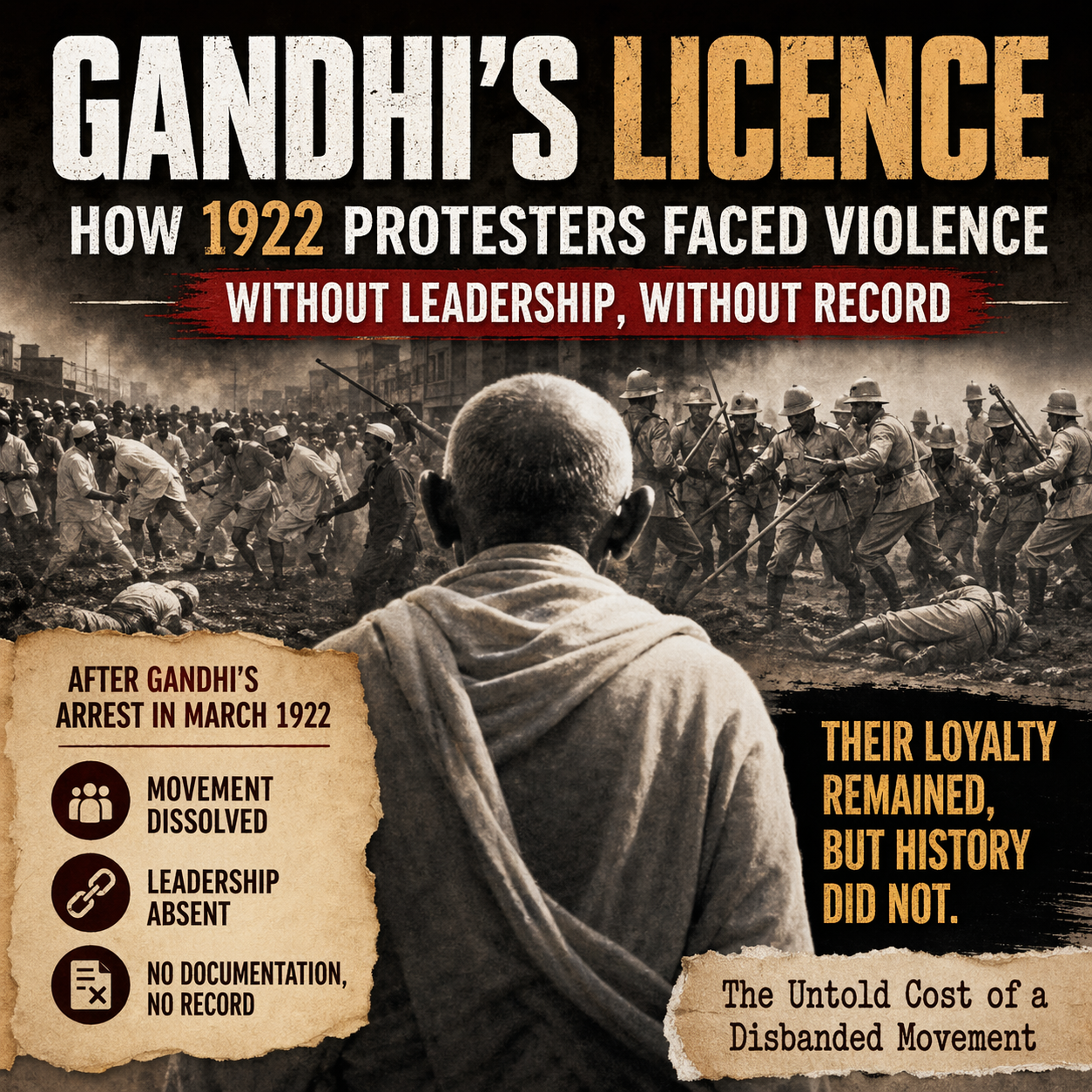
Gandhi’s Arrested Protesters: People Beaten With Gandhi’s Licence (36)
भारत / GB
Part 36: Mahatma Gandhi’s Peace Efforts | Series Index
Blog 35 documented the colonial arithmetic — twenty-two policemen killed, thirty-one Indians killed (through hanging and in custody) by the state in response, one hundred and seventy-two sentenced to death. Blog 30 documented the licence — issued February 12, 1922, the day the British learned Gandhi’s ceiling. This post documents the first people on whom that licence was exercised. They were not Dharasana volunteers in 1930. They were not Quit India marchers in 1942. They were the people who took to the streets in March 1922 to protest Gandhi’s own arrest — and they walked into British force with nothing to protect them.
Thank you for reading this post, don't forget to subscribe!The Action Taken: When crowds spontaneously gathered to protest Gandhi’s arrest in March 1922, they assembled under instructions of complete non-retaliation despite the formal dissolution of Congress volunteer corps.
Who Paid the Price: Unorganized civilian crowds beaten and dispersed by police batons without organizational shelter or legal rescue panels.
The Alternative Bypassed: Maintaining an active, disciplined civil disobedience defense organization to shelter protesters during leadership arrests.
Why This Matters: The first operational exercise of the enforcement dynamic: an unorganized public, instructed not to use physical resistance, was easily controlled by restored colonial police authority.
What the Licence Required to Function
Gandhi’s Arrested Protesters were not the first people the British had beaten since 1857. They were the first people beaten inside a new operational framework — one that Gandhi’s suspension had created twenty-six days before his arrest.
The licence issued on February 12, 1922 required three conditions to function. First: the British needed to know Gandhi’s ceiling — that the movement would stop before becoming ungovernable. Second: the movement needed to be dissolved — so that no organised response could make British force politically costly. Third: the people who still felt loyalty to Gandhi needed to have nowhere to channel that loyalty safely.
By March 10, 1922 — the day Gandhi was arrested — all three conditions were in place. The movement was dissolved. The ceiling was known. The loyalty remained but had no organisational structure to contain it.
They were the human product of that combination. They did not march as part of a movement. They marched because they loved a man who had been taken, and because the instinct to respond to that taking was stronger than the absence of any organisational framework telling them how to respond safely.
The Pattern the British Already Knew
The British administration had seen this pattern before. In April 1919, when rumours spread that Gandhi had been arrested en route to Punjab, Ahmedabad erupted in riots. The city had seen the pattern that personal loyalty to Gandhi, deprived of organisational direction, produced spontaneous and ungovernable eruptions. The British had learned this in 1919.
By March 1922 they had learned something more precise — from the torch Gandhi had lit on February 12. They knew that the organised movement that might have channelled this loyalty, directed it, given it strategic purpose and protected it with discipline — that movement was gone. What remained was raw loyalty without structure. And raw loyalty without structure, in the face of colonial force, produces exactly what it produced in the streets after Gandhi’s arrest: crowds walking into batons with no ceiling of their own, no leader to call them home, no instrument capable of making their suffering a political cost to the administration that was beating them.
In 1919 the British had faced uncertainty about Gandhi’s ceiling and had hesitated. In March 1922 they faced no uncertainty. The licence told them what Gandhi’s arrested protesters could not tell themselves: that there was no movement left to escalate, no satyagraha that would follow, no organised consequence for what the administration did to the people in the streets.
The Specific Character of This Violence
Gandhi’s Arrested Protesters were beaten in a condition unique in the entire independence movement — one that had never existed before February 12, 1922 and would not exist again in quite this form.
They were not protesters against a British policy. They were not participants in a satyagraha. They were not part of a planned civil disobedience campaign with a strategic objective. They were the first exercise of the licence — people whose spontaneous loyalty to one man brought them into the street against an administration that was now operating with the knowledge that no organised response would follow whatever it did to them.
The Dharasana volunteers of 1930 walked forward in organised columns, trained, disciplined, part of a movement that was still functioning. Their suffering was visible, documented by Webb Miller, cabled to newspapers worldwide. The movement was still alive to amplify it.
Those who marched in March 1922 had none of these protections. No training. No columns. No movement to amplify their suffering. No Webb Miller watching. No strategic framework making their pain politically useful. They were crowds — and crowds without organisation absorb colonial force silently, because there is nothing left to carry the record of what was done to them into history.
Why They Are Not in the Record
Gandhi’s Arrested Protesters are not in the standard history of the independence movement for the same reason that crowds without organisation are never in the standard history — because history requires documentation, and documentation requires structure.
The 1930 Salt March has Webb Miller’s dispatch. The Dharasana beating has photographs and congressional records. The Chauri Chaura defendants have trial transcripts. The Jallianwala Bagh dead have the Hunter Commission inquiry and your own site’s documented names.
Gandhi’s Arrested Protesters have none of these. They were beaten in the space between a dissolved movement and a not-yet-reconstituted one — in the administrative gap that the suspension had created. The administration processed their arrests and dispersals without strategic consequence, because there was no movement left to make strategic consequence possible.
They are invisible in the record precisely because the conditions of their suffering made visibility impossible. A crowd without structure cannot produce documentation. A protest without a movement cannot produce a Webb Miller. A loyalty without an organisation cannot produce a Hunter Commission.
A crowd without structure cannot produce documentation. A protest without a movement cannot produce a Webb Miller. A loyalty without an organisation cannot produce a Hunter Commission.
They marched for Gandhi. He was in jail. The movement he had dissolved could not protect them. The licence he had issued told the administration exactly what it could do to them.
The Instrument That Was Available
Gandhi entered Yerwada Jail on March 18, 1922, sentenced to six years. He served two years before release on health grounds.
From inside Yerwada, with his followers in the streets and the 17 (while 6 had died in custody) defendants being processed toward their death sentences, Gandhi had one instrument that required no freedom — the hunger strike. Blog 35 documented that he would use this instrument from the same jail in 1932 for the Communal Award — and Ambedkar would capitulate in six days.
In 1922, the instrument was available. The conditions for its effectiveness were present — Gandhi’s arrest had demonstrated his continued moral authority, the spontaneous protests showed the loyalty was intact, the colonial administration had shown it was sensitive to political cost when that cost was made visible.
Gandhi did not use it. The series does not claim to know why. It records what the instrument could have produced, what the people in the streets needed it to produce, and what the record shows it produced when Gandhi chose to use it in 1932.
The people in the streets were not marching against a British policy. They were marching for Gandhi — for the man whose arrest they were protesting, whose release they were demanding, whose name they were shouting as the lathis fell. Gandhi knew they would march. The pattern of 1919 had already shown him what his arrest produced in the streets. He knew what was happening outside Yerwada as he settled into his two-year residence.
A fast announced from Yerwada in March 1922 — before the beatings consolidated, before the arrests multiplied — would have done one specific thing: it would have called his supporters home. Not toward the British. Not into batons. Home. Gandhi had built a movement on the premise that he could start and stop the water. The fast was the instrument that could have stopped this water — the spontaneous, leaderless, unprotected loyalty flowing into British force on his behalf.
He did not call them home. He read, prayed, and spun.
The people who marched for Gandhi after his arrest were the first people beaten with the licence the suspension had issued. They were also the first demonstration that the licence worked exactly as the British had calculated it would — silently, efficiently, without strategic consequence, against people whose love for one man had brought them into the street without any of the protections that love had once organised around them.
What This Blog Cannot Carry
Gandhi’s Arrested Protesters cannot be named in this post. The standard history does not carry their names — because the conditions of their suffering made naming impossible. There was no inquiry. There was no commission. There was no movement left to compile the record.
This is not a prosecution. It is an acknowledgement of an absence. The people who marched in March 1922 for Gandhi’s release walked into history without leaving names behind. The series records the structural reasons for that invisibility — and names the man whose decision created those structural conditions.
The man who could have made their suffering visible from inside Yerwada — with one instrument he had already demonstrated worked — chose not to use it.
The next post examines the one man who did act for those the suspension left behind — not from jail, not with a fast, but with a legal brief in the Allahabad High Court.
They marched for Gandhi. There was no movement left to march with them. The licence told the administration exactly what it could do — because the man who issued it was in jail, and the instrument that might have made their suffering costly was the one instrument Gandhi did not use. Gandhi’s Arrested Protesters are the first entry in the ledger of the licence. They are also the entry that history lost — because crowds without structure leave no record, and the suspension had taken the structure away.
Feature Image: Click here to view the image.
Videos
Glossary of Terms
#Gandhi #IndianHistory #FreedomStruggle #ColonialIndia #NonCooperation #BritishRule #History #Protest #Independence #HinduinfoPedia
Scan Through The Entire Series at
Gandhi’s Peace Efforts: The Questions Before the Mahatma (0)