
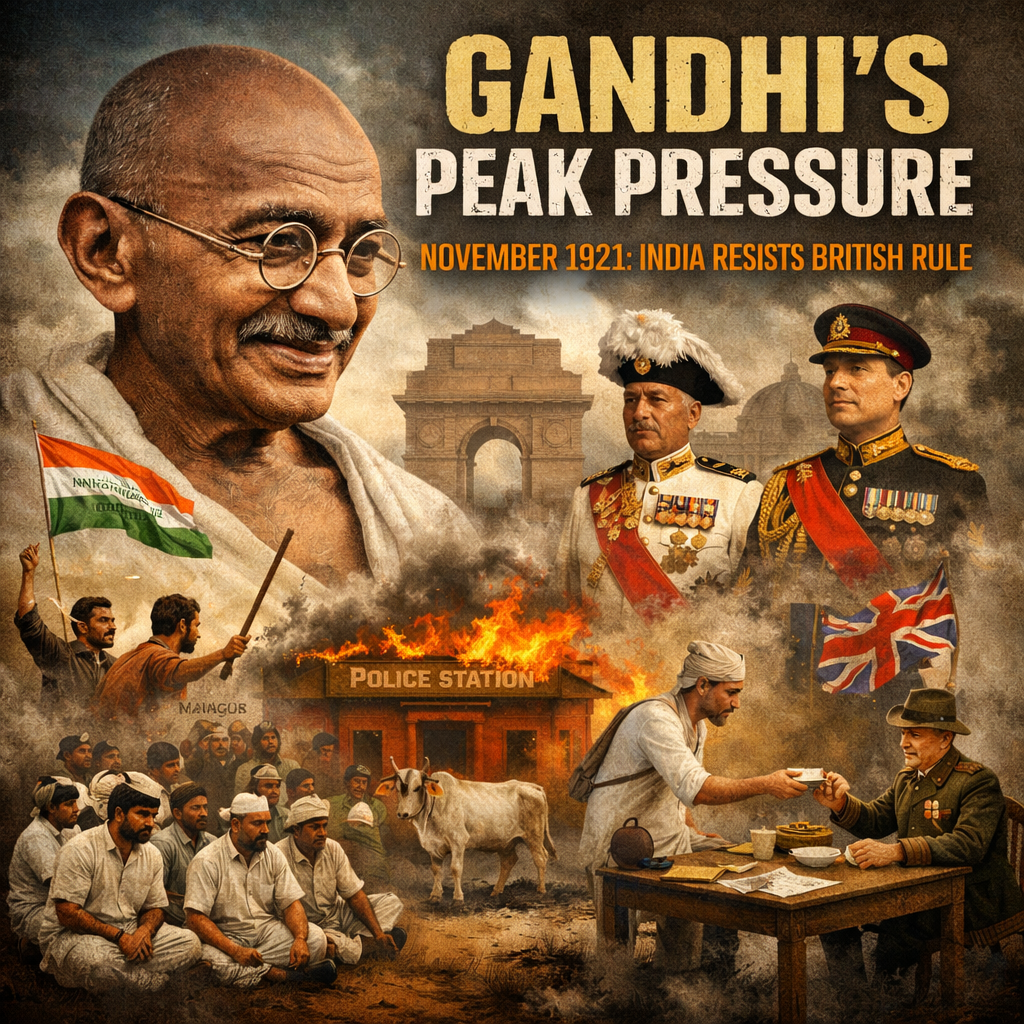
Gandhi’s Peak Pressure: November 1921 — The British Nearly Broke (29)
भारत / GB
Part 29: Mahatma Gandhi’s Peace Efforts | Series Index
The Irwin Pact Arc is complete — seven blogs documenting the pact’s negotiation, its terms, its gaps, its aftermath, and its deterrent value. This post steps back nine years to the moment that made the pact possible: November 1921, when the Non-Cooperation Movement had built the largest civilian pressure the colonial government had faced since 1857, and the British administration was showing documented signs of strain. By November 1921 Gandhi had assembled the largest civilian pressure any Indian leader had ever built against the colonial administration. One man held the key to those floodgates of water storage system. On February 12, 1922, he closed them — without extracting a concession, without consulting the Congress Working Committee, without receiving a single British commitment. What that choice gave the British, and what it cost the people who had built the pressure, is the subject of the next post.
Thank you for reading this post, don't forget to subscribe!The Action Taken: By late 1921, the Non-Cooperation movement brought colonial municipal and administrative operations in multiple provinces near breakdown.
Who Paid the Price: Over 30,000 imprisoned citizens, non-cooperating lawyers, and students who sustained the boycott.
The Alternative Bypassed: Imperial administrative certainty, as provincial authorities reported wavering police and revenue loyalty.
Why This Matters: Documents the peak leverage generated by nationwide mass resistance, establishing the operational baseline against which the sudden February 1922 dissolution must be judged.
The Movement at Maximum Potency
Gandhi’s Peak Pressure is the precise point in the Non-Cooperation Movement’s timeline when the British colonial administration was closest to a position it could not govern its way out of. It is not a claim about what would have happened if the movement had continued. It is a documentation of what had already happened by November 1921 — what the British had lost, what they could not project, and what their own dispatches recorded.
The Non-Cooperation Movement had been launched on August 1, 1920. By November 1921 — fifteen months later — it had produced something the colonial administration had not encountered in the modern period: a simultaneous, multi-provincial collapse of voluntary compliance with British authority across every domain the administration required to function.
Gandhi’s Peak Pressure was not a military threat. It was something the colonial system had no counter-insurgency response to — a population that had collectively decided to stop participating in the mechanisms of its own governance, across courts, schools, councils, cloth markets, and revenue offices simultaneously.
What the British Had Lost by November 1921
Administrative Control — Multiple Provinces
By November 1921, the Non-Cooperation Movement had disrupted administrative functioning across Bengal, the United Provinces, Punjab, and the Central Provinces simultaneously. Congress volunteer organisations had replaced the normal civic infrastructure in several districts — operating dispute resolution outside the British courts, organising local economic activity outside the foreign cloth trade, managing local grievances outside the colonial revenue system.
The British administration’s ability to project authority — to make Indians believe that non-compliance would be detected, prosecuted, and punished — had been visibly compromised. Collectors reported to their superiors that enforcement had become unreliable. When the administration attempted to arrest Congress volunteers, crowds prevented arrests in multiple documented instances. The gap between the administration’s formal authority and its practical capacity to exercise it had widened to a point that senior officials were documenting in internal dispatches.
Revenue Collections — Gujarat
The no-tax campaign in Gujarat had produced the most precise measurement of the movement’s economic pressure. Land revenue — the colonial administration’s primary extraction mechanism, the first line of the £9.2 trillion the series has documented — was not being collected at normal rates in significant portions of Gujarat. Farmers who had participated in the movement were refusing revenue payment as an act of organised non-cooperation.
The colonial administration’s response options were limited. Mass eviction and land seizure — the standard enforcement mechanism for revenue default — required a functioning administrative machinery, an available police force, and a population that would not resist enforcement collectively. By November 1921, all three of these preconditions were in question in multiple districts.
The Prince of Wales Visit — November 1921
The most visible single exhibit of Gandhi’s Peak Pressure was the Prince of Wales visit of November 1921. The Prince arrived in Bombay on November 17. The Congress had called for a boycott. The streets were empty.
The British had invested the royal visit with the full weight of imperial ceremony — the presence of the heir to the throne was designed to project the normalcy and legitimacy of British rule in India. What the visit projected instead was the administration’s inability to produce a population willing to participate in that projection. In many parts of Bombay and other cities, streets were empty and businesses shut — active participation in the hartal, not fear. Where the boycott held, it was visible proof of organised mass non-compliance. Where it broke into riots, it demonstrated something equally alarming to the administration: that the movement had grown to a scale Gandhi himself could not fully control.
Hartals were observed across large parts of Bombay and other cities, with many areas reporting deserted streets and shuttered businesses. In parts of Bombay, however, the boycott turned violent when Congress and Khilafat supporters attacked those who defied the hartal — particularly businesses belonging to communities not aligned with the movement, especially Parsi-owned liquor shops. Gandhi himself strongly condemned the violence and undertook a fast in response. The combination of a largely successful hartal and uncontrolled riots sent a clear message to the colonial administration: the movement had grown beyond the capacity of both the British and Gandhi himself to fully control public conduct. Lord Reading reported to London that the visit had demonstrated the movement’s reach rather than the permanence of the Empire.
Police and Military Hesitation
By late 1921, reports from district officers across several provinces documented signs of strain in enforcement — reluctance in specific confrontations with Congress volunteers, logistical difficulty in processing the volume of arrests the movement was generating, and tension within lower ranks of the Indian police. The hesitation was localised, not systemic, though. The administration retained significant coercive capacity throughout: it arrested thousands, declared volunteer corps illegal, and would demonstrate its full repressive reach after the suspension. But the documented strain was real, and it was alarming to senior leadership precisely because it appeared at a moment when the movement showed no signs of exhausting itself.
The extraction machine ran on compliance — and the administration was watching compliance fray in multiple registers simultaneously. Not collapse. Fray.
What “Nearly Broke” Means
Gandhi’s Peak Pressure does not claim the British would have left India in 1922 if the movement had continued. The claim is more precise than that — and more important.
The colonial administration in November 1921 was facing a situation for which it had no established response. Military suppression of the 1857 Rebellion had been possible because the resistance was armed and geographically concentrated. The Non-Cooperation Movement was neither. You cannot shoot non-compliance. You cannot arrest a population that has collectively withdrawn participation from the administrative system. You cannot prosecute a movement that has made the prosecution machinery itself the object of boycott.
The administration’s senior officials were documenting, in internal communications, that the movement was producing conditions they did not know how to reverse through the instruments available to them. Lord Reading’s dispatches to the Secretary of State for India in late 1921 recorded a deteriorating situation across multiple provinces with no clear path to restoration of normal governance.
“Nearly broke” means: the administration had reached the boundary of its available responses, and the movement had not yet reached the boundary of its capacity. The water was still rising. The dam had not yet been needed.
The Moment Gandhi Held
This is the context for what happened on February 12, 1922. Gandhi suspended the movement unilaterally, without consulting the Congress Working Committee, citing the violence at Chauri Chaura on February 5 in which twenty-two policemen had died when a crowd burned a police station.
The suspension came at the moment this blog has documented. The British administration was facing documented strain across multiple provinces. Revenue collections were failing. Enforcement was hesitating. The Prince of Wales visit had demonstrated the administration’s inability to project imperial normalcy. The movement had been building for fifteen months and had not yet exhausted its capacity.
The suspension was announced. The administration breathed. The dispatches changed in tone. The enforcement machinery was given the time it needed to reconstitute. Gandhi was arrested on March 10, 1922 — three weeks after the suspension — and the administration proceeded from a position of recovered strength.
The eleven demands Gandhi had not yet made — those came nine years later, in January 1930. The movement that nearly broke the British in November 1921 did not produce a single documented concession before it was suspended. The water that had been built over fifteen months was drained by one announcement, on one morning, by one man who held the switch.
The Cost of the Moment
Gandhi’s Peak Pressure is the prosecutor’s necessary exhibit — the documented evidence that the water existed, that it was at maximum height, and that the decision to hold the dam was made from a position of maximum strength rather than from a position of exhaustion.
The series has documented what the suspension produced: Gandhi’s authority grew after the suspension rather than before it — because he had demonstrated that the revolution existed only as long as he permitted it.
The British learned that he held the switch. India learned the same thing. The administration that had been facing documented strain in November 1921 was arresting Gandhi three weeks after the suspension from a position of recovered confidence.
The people who had built the pressure — the thirty thousand in jail, the students without schools, the lawyers without practices, the farmers who had stopped paying revenue — had not been consulted about the suspension.
Their sacrifice had produced Gandhi’s Peak Pressure. The decision about what to do with it was Gandhi’s alone.
The next post examines who those people were — the social composition of the army that built the water, and what happened to one of its officers when he encountered the same conditions the foot soldiers faced every day.
By November 1921, Gandhi had opened the floodgates. Three hundred million people, thirty thousand of them already in jail, the colonial administration losing grip across province after province — this was the water at full force, moving toward the forts. One man had built the reservoir. One man held the key to the floodgates. On February 12, 1922, he turned the key and closed them. Not because the water had exhausted itself. Not because the British had offered terms. He closed them himself — and the forts that the water would have reached stood undamaged. What Gandhi’s Peak Pressure had assembled, Gandhi’s own hand preserved the British from.
Feature Image: Click here to view the image.
Videos
Glossary of Terms
- Non-Cooperation Movement: A nationwide movement launched in nineteen twenty by Mahatma Gandhi urging Indians to withdraw participation from British institutions such as courts, schools, and councils.
- Gandhi’s Peak Pressure: The key phrase describing November nineteen twenty one, when the Non-Cooperation Movement created maximum civilian pressure on British administration without armed conflict.
- Hartal: A collective shutdown of shops, businesses, and public activity as a form of protest and non-participation.
- Chauri Chaura Incident: A violent event on February five, nineteen twenty two, where a crowd killed policemen, leading Gandhi to suspend the movement.
- Lord Reading: The British Viceroy of India during the peak of the Non-Cooperation Movement, who received reports from multiple provinces.
- Edward VIII: The British royal whose visit to Bombay in November nineteen twenty one saw widespread boycott and empty streets.
- Congress Volunteer Corps: Organised groups of Indian National Congress workers who managed local activities outside colonial administrative systems.
- Revenue Resistance: Refusal by farmers, especially in regions like Gujarat, to pay land revenue to the colonial government.
- Colonial Administration: The governing structure established by the British in India, including officials, courts, and enforcement systems.
- Boycott: The act of refusing to engage with institutions, goods, or services as a form of protest.
- Civil Resistance: A method of protest based on non-violent refusal to comply with authority rather than armed confrontation.
- Congress Working Committee: The executive decision-making body of the Indian National Congress during the freedom movement.
#Gandhi #IndianHistory #FreedomStruggle #NonCooperation #BritishIndia #History #India #HinduinfoPedia
Scan Through The Entire Series at
Gandhi’s Peace Efforts: The Questions Before the Mahatma (0)