
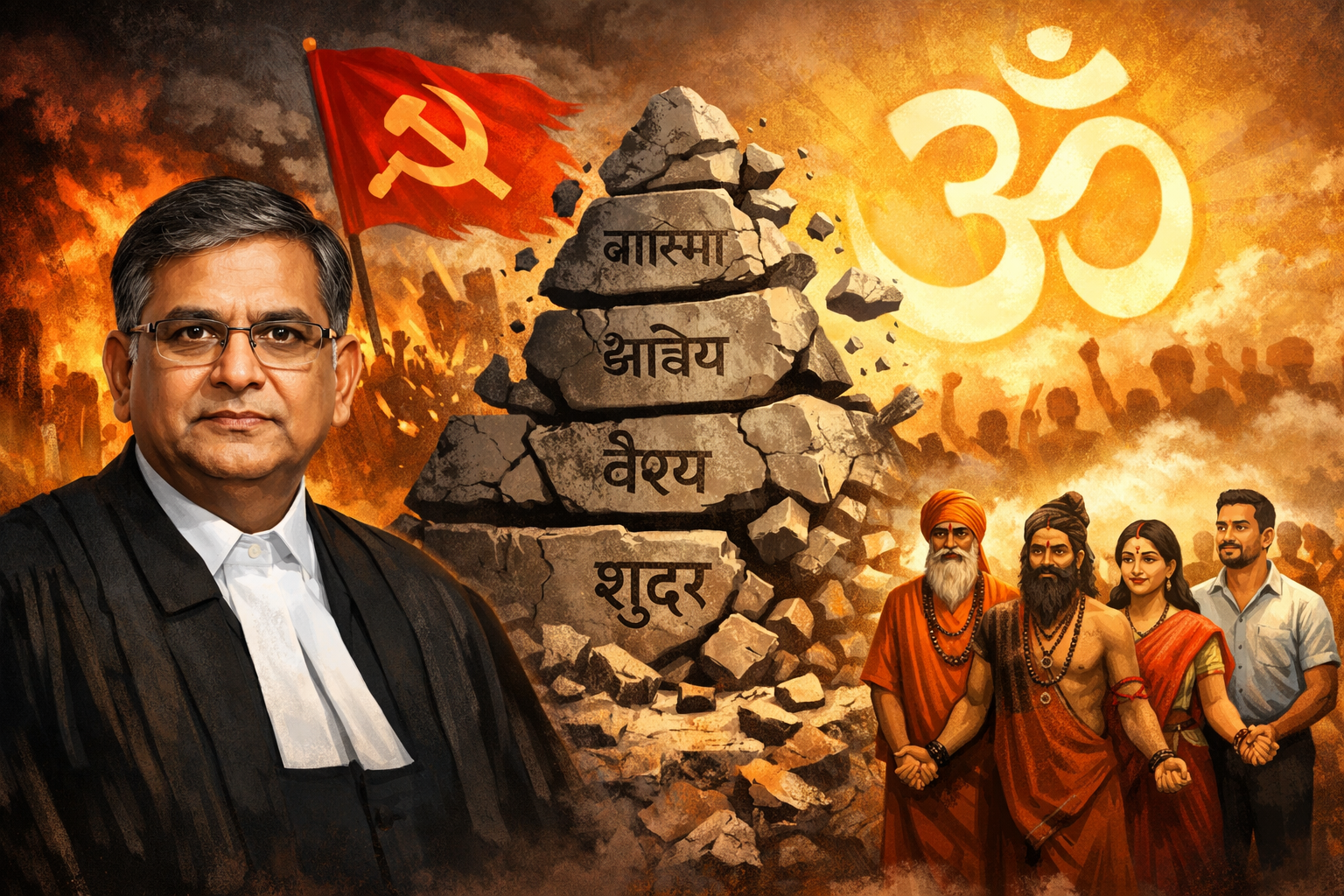
CJI Surya Kant Defends Hindu Unity: When Questioning Caste Division Triggers Leftist Rage
BREAKING NEWS | January 29, 2026
On January 29, 2026, when CJI Surya Kant defends Hindu unity by staying discriminatory UGC regulations that excluded general category students from protection, the leftist establishment responded with immediate condemnation. The Campaign for Judicial Accountability and Reforms attacked his “casteless society” remarks as “insensitive insult”—proving once again that any judicial defense of Hindu interests, even promoting unity over caste division, triggers coordinated backlash.
भारत/GB
What Happened: CJI Stays Discriminatory UGC Regulations
On January 29, 2026, a bench led by Chief Justice of India Surya Kant and Justice Joymalya Bagchi stayed the University Grants Commission (Promotion of Equity in Higher Education Institutions) Regulations, 2026, calling them “vague and capable of misuse.”
Thank you for reading this post, don't forget to subscribe!The Discriminatory Regulations
The UGC 2026 Regulations, notified on January 13, contained a controversial definition in Clause 3(c):
“Caste-based discrimination” means “discrimination only on the basis of caste or tribe against the members of the Scheduled Castes, Scheduled Tribes and Other Backward Classes.”
This definition excluded general category students entirely. Under these regulations:
- ✅ SC/ST/OBC student harassed? Institutional protection available
- ❌ General category student harassed? No protection whatsoever
- ❌ Anti-“upper caste” violence? No remedy under regulations
Petitions documented incidents at JNU where walls were defaced with slogans like:
- “Brahmins Leave the Campus”
- “There Will Be Blood”
- “Brahmin-Baniya Murdabad”
Similar incidents at Ashoka University included slogans like “Brahmin-Baniyawaad Murdabad” during protests.
Under the 2026 Regulations, victims of these attacks would have ZERO institutional protection.
📚 UNDERSTANDING JUDICIAL PATTERNS:
When Courts Fail Hindu Interests:
🔹 Lord Vishnu Mockery: CJI Gavai’s Religious Insensitivity
🔹 Shaheen Bagh: 101-Day Judicial Delay
🔹 When Judges Investigate Themselves
CJI Surya Kant’s Courageous Stand
When CJI Surya Kant defends Hindu unity by staying these discriminatory regulations, he made several powerful observations:
1. “Are We Becoming Regressive?”
“Whatever we have gained in terms of achieving a casteless society, are we now becoming regressive?“
This isn’t abstract philosophy—it’s recognition that dividing Hindu students by caste undermines Hindu civilizational unity. As we documented in our analysis of caste-based fragmentation strategies, external forces exploit internal divisions.
2. “For God’s Sake, Don’t Do This!”
When told the regulations proposed separate hostels for SC/ST students, CJI Surya Kant strongly objected:
“For god’s sake, don’t do this! We all used to stay together…There are inter-caste marriages also.“
This statement—CJI Surya Kant defends Hindu unity by opposing caste-based segregation—echoes dharmic principles of sama-darshana (equal vision) we explored in our Dharma vs Jurisprudence framework.
3. “Vague and Capable of Misuse”
“Prima facie language of the regulations…there is complete vagueness…capable of misuse.“
A counsel presented a hypothetical: A general category fresher resisting ragging from a senior belonging to SC category could face false accusations of caste discrimination. Since SC/ST Act cases don’t allow anticipatory bail, the student could be imprisoned. His career ends “on first day, first month.”
The regulations had no provision to prevent such misuse.
4. “Will Divide Society”
“If we don’t intervene, it will lead to dangerous impacts… It will divide the society and will have grave impacts.“
This recognition—that caste-based institutional mechanisms fragment rather than unite—represents judicial wisdom missing in cases like Shaheen Bagh where the Court enabled division.
📚 CASTE AND DIVISION PATTERNS:
How Internal Fragmentation Serves External Agendas:
🔹 Buddhist Reservation Paradox – Converting for benefits while maintaining anti-Hindu stance
🔹 Religious Demographics in Action – How divisions weaken majority communities
🔹 Civilization Under Siege – Existential threats to fragmented communities
The Immediate Leftist Backlash
Within hours of the January 29 order, the Campaign for Judicial Accountability and Reforms (CJAR) issued a scathing condemnation:
CJAR’s Attack on CJI:
“The Chief Justice’s remarks that the UGC regulations amounted to ‘going backwards’ in the goal of attaining a ‘casteless society’ is an insensitive insult to all Indian citizens who continue to suffer from caste based discrimination and oppression.“
The CJAR statement continued:
“As the head of the judiciary, the Chief Justice cannot feign ignorance of current social realities by iterating a formalistic reading of equality.“
Interpretation: How dare CJI Surya Kant defends Hindu unity by promoting “casteless society”! Doesn’t he know caste division serves leftist politics?
The Pattern Revealed
This immediate condemnation proves what we documented in our judicial accountability series:
ANY judicial defense of Hindu interests triggers coordinated backlash.
Compare responses:
| CJI Action | Response |
|---|---|
| CJI Gavai mocks Lord Vishnu | Mild controversy, no institutional condemnation |
| CJI Surya Kant defends Hindu unity (UGC case) | Immediate CJAR condemnation, calls him “insensitive” |
| Justice Swaminathan protects Hindu festival | 120 MPs file impeachment motion |
| Court blames Nupur Sharma | No criticism, praised by secular lobby |
The message to judges is clear: Mock Hindus = safe. Defend Hindu unity = attacked.
🎯 INSTITUTIONAL PRESSURE PATTERNS:
How Judges Learn to Avoid Pro-Hindu Rulings:
🔹 Institutional Corruption Crisis – Bar Council admits 90% judges corrupt
🔹 Framework for Measuring Failures – Systematic bias documentation
🔹 Abrahamic Alliance Networks – Coordinated pressure on Indian institutions
Why This Matters: Hindu Unity vs Caste Division
The Civilizational Stakes
When CJI Surya Kant defends Hindu unity through his “casteless society” remarks, he’s articulating a fundamental dharmic principle:
Unity (aikya) over Division (bheda)
The Rigveda states:
“संगच्छध्वं संवदध्वं सं वो मनांसि जानताम्”
“Move together, speak in harmony, let your minds be in agreement.” (Rigveda 10.191.2)
This isn’t just poetic idealism—it’s survival strategy. As we documented in our civilization under siege analysis, fragmented communities face systematic elimination.
The Historical Pattern
Medieval Islamic conquests succeeded partly because Hindu kingdoms remained divided by caste and region. British colonial rule deepened these divisions through census categorization and preferential policies.
The 2026 UGC Regulations continue this pattern:
- Institutionalize caste as primary identity
- Create hierarchies of victimhood
- Prevent Hindu students from seeing themselves as one community
- Enable anti-“upper caste” violence without consequence
By staying these regulations, CJI Surya Kant defends Hindu unity against modern institutional mechanisms of fragmentation.
The “General Category” Reality
Who comprises the “general category” excluded from UGC 2026 protection?
- Brahmins (priests, scholars)
- Kshatriyas (warriors, administrators)
- Vaishyas (merchants, farmers)
- Other Forward Castes
These aren’t abstract categories—they’re Hindu communities now denied institutional protection from caste-based harassment.
JNU incidents show this isn’t hypothetical:
- “Brahmins Leave Campus” slogans
- Threats of violence
- Systematic intimidation
Under 2026 Regulations: No remedy. No protection. No institutional support.
📚 DEMOGRAPHIC WARFARE PATTERNS:
How Internal Division Enables External Conquest:
🔹 International Law Under Siege – Global frameworks enabling demographic displacement
🔹 Human Rights Paradox – Universal rights selectively applied
🔹 Fastest Growing Religion – Demographic mathematics of civilizational change
The Rohingya Context: CJI Surya Kant’s Other Battle
This isn’t CJI Surya Kant’s first encounter with leftist rage. On December 2, 2024, when he questioned the legal status of Rohingya illegal immigrants, 44 former judges had to defend him against activist attacks.
Two Questions, Same Pattern:
December 2024: “Who granted Rohingyas refugee status?” (Legal status question)
Response: Secular activists attack him, call remarks “dehumanizing”
January 2026: “Are we regressive to divide students by caste?” (Unity question)
Response: CJAR condemns him, calls remarks “insensitive insult”
The Common Thread:
Both times, CJI Surya Kant asked uncomfortable questions that challenge leftist dogma:
- Rohingyas: Are they legal immigrants? (Challenges open borders narrative)
- UGC: Should we unite or divide by caste? (Challenges identity politics)
Both times, he faced immediate coordinated backlash for simply applying constitutional principles of equality and rule of law.
As documented in our regime change playbook analysis, this coordinated pressure represents sophisticated institutional capture techniques.
What the Order Actually Did
The Supreme Court’s January 29 order:
- Stayed 2026 Regulations entirely – No preferential caste-based mechanisms
- Revived 2012 Regulations – Broader, more inclusive framework
- Issued notice to Centre and UGC – Asked for response by March 19
- Suggested expert committee – To reframe regulations considering “social values”
- Protected general category – Ensured they’re not left without remedy
The Legal Reasoning
Justice Joymalya Bagchi raised crucial point about “principle of non-regression”:
“If 2012 regulations spoke of a more widespread, all-inclusive policy…why should there be a regression in a protective, ameliorative framework?”
In other words: Why NARROW protections when broader framework existed?
The Court recognized that moving from inclusive (2012) to exclusive (2026) framework represented regression, not progress.
When CJI Surya Kant defends Hindu unity by opposing this regression, he’s applying sound constitutional principles—yet faces condemnation for it.
📚 CONSTITUTIONAL PRINCIPLES:
Understanding Equality and Protection:
🔹 Waqf Act Debate – Selective application of constitutional rights
🔹 Judicial Response to Waqf Unrest – Pattern of instant intervention
🔹 Selective Judgment Patterns – Constitutional rights applied differentially
The revived 2012 UGC Regulations
Why General Category Students Needed Protection
The petitions documented specific incidents showing anti-“upper caste” violence is REAL:
JNU December 2022:
- Walls defaced: “Brahmins Leave the Campus”
- Threats: “There Will Be Blood”
- Slogan: “Brahmino Baniya Bhago” (Brahmins-Baniyas Run Away)
Ashoka University March 2024:
- Students recorded raising: “Brahmin-Baniyawaad Murdabad” (Death to Brahmin-Baniya-ism)
The Problem:
Under 2026 Regulations, victims of these attacks have:
- ❌ No grievance mechanism
- ❌ No institutional protection
- ❌ No legal remedy
- ❌ No equal opportunity cell support
But perpetrators (if belonging to SC/ST/OBC) have:
- ✅ Full institutional backing
- ✅ Grievance committees on their side
- ✅ SC/ST Act protection against counter-complaints
This isn’t equality—it’s institutionalized discrimination against general category students.
When CJI Surya Kant defends Hindu unity by stopping this discrimination, he’s protecting constitutional principles, not “regressing.”
The Ragging Question That Exposed Everything
One of the most revealing exchanges occurred when the Court asked about ragging:
CJI: “Why do the Regulations not address ragging? It’s one of the worst issues in educational institutions.”
Counsel: “The Regulations don’t even define ragging. But a fresher resisting ragging from a SC/ST senior could face false caste discrimination complaints. No anticipatory bail. Career destroyed.”
This hypothetical exposed the regulations’ fundamental flaw:
Ragging (actual physical/mental harassment): Not addressed
Caste discrimination (even if false claim): Immediate punishment
The regulations prioritized caste identity over actual student safety—a perversion of institutional purpose.
Why This Is a “Casteless Society” Issue
The leftist attack on CJI’s “casteless society” remark deliberately misrepresents dharmic philosophy.
What “Casteless Society” Means:
NOT: Denying historical caste discrimination
NOT: Ignoring current caste-based disadvantages
NOT: Opposing reasonable affirmative action
YES: Treating all Hindus as ONE civilizational community
YES: Opposing caste-based SEGREGATION (separate hostels)
YES: Ensuring protection for ALL students, not selective by caste
YES: Moving TOWARD unity, not deepening division
As explored in our RSS centenary vision series, the goal isn’t to eliminate diversity but to prevent it from becoming divisive identity politics.
The Dharmic Principle:
वसुधैव कुटुम्बकम् – “The world is one family”
If the WORLD is one family, surely Hindus can see themselves as one community despite internal diversity?
When CJI Surya Kant defends Hindu unity with his “casteless society” remarks, he’s articulating this civilizational vision—which is why it terrifies those who profit from division.
🎯 UNDERSTANDING THE BACKLASH:
Why Hindu Unity Terrifies Certain Groups:
🔹 Islamic Authority Paradox – How unified communities resist external pressure
🔹 Media as Manipulator – False causality matrices maintaining division
🔹 Mathematical Evidence – Why fragmentation enables systematic elimination
What Happens Next
The Court has:
- Issued notice to Centre and UGC – Response required by March 19, 2026
- Kept 2026 Regulations in abeyance – Cannot be implemented until constitutional questions resolved
- Revived 2012 Regulations – Broader, more inclusive framework operates meanwhile
- Suggested expert committee – To reframe regulations with “social values” in mind
The Questions Before the Court:
The bench identified 4-5 constitutional questions:
- Why is “caste-based discrimination” separately defined when general “discrimination” definition exists?
- Why exclude general category from protection mechanisms?
- Why regress from broader 2012 framework to narrow 2026 definition?
- What about ragging, regional discrimination, other forms of harassment?
- Won’t caste-based segregation (separate hostels) divide society?
These questions—when CJI Surya Kant defends Hindu unity by asking them—cut to the heart of identity politics vs constitutional equality.
Lessons for Hindu Community
1. Judicial Courage Is Rare But Exists
CJI Surya Kant’s stance proves that principled judges exist. But the immediate backlash he faces shows WHY such courage is rare—as documented in our institutional corruption analysis, the career incentives favor appeasing secular lobby.
2. Hindu Unity Threatens Power Structures
The violent reaction to “casteless society” remarks reveals what terrifies the establishment: Unified Hindus cannot be manipulated through caste divisions.
As we showed in demographic continuity patterns, fragmented communities lose demographic battles.
3. General Category = Most Hindus
“General category” isn’t abstract—it’s most Hindu communities. Regulations excluding them from protection are anti-Hindu by definition.
4. Speak Up When Judges Do Right
CJI Surya Kant faces condemnation for defending equality. Hindu community must vocally support judges who show courage.
Otherwise, the message is: defending Hindu unity = career suicide.
A Rare Example Worth Celebrating
In a judicial landscape documented in our comprehensive series “When Courts Fail Both Ancient Dharma and Modern Jurisprudence,” CJI Surya Kant’s January 29 stand represents something remarkable:
A judge applying constitutional principles EQUALLY, regardless of community.
When CJI Surya Kant defends Hindu unity by:
- Opposing caste-based segregation
- Protecting general category students
- Promoting “casteless society”
- Staying discriminatory regulations
- Asking uncomfortable questions about ragging and safety
…he demonstrates judicial courage that has become rare in India’s courts.
The immediate leftist backlash—calling his remarks “insensitive insult”—proves he struck the right nerve.
Those who profit from Hindu division fear Hindu unity.
The UGC case will be heard again on March 19, 2026. Until then, the broader 2012 framework applies, ensuring ALL students—regardless of caste—have institutional protection.
That’s not regression. That’s constitutional equality.
And when CJI Surya Kant defends Hindu unity through such equality, he deserves support, not condemnation.
Share this analysis if you believe judges who defend constitutional equality deserve support, not condemnation. Comment below with your thoughts on CJI Surya Kant’s courageous stand.
This breaking news analysis documents a rare example of judicial courage in defending equality and unity. For systematic documentation of judicial failures, read our comprehensive 17-part series “When Courts Fail Both Ancient Dharma and Modern Jurisprudence.”
Feature Image: Click here to view the image.
Glossary of Terms
- Chief Justice of India (CJI) Surya Kant: The Chief Justice of India who led the Supreme Court bench that stayed the UGC Equity Regulations, 2026, citing constitutional concerns and risks of social division.
- UGC Equity Regulations, 2026: Rules notified by the University Grants Commission that narrowly defined caste-based discrimination and excluded general category students from institutional protection.
- General Category Students: Students not classified under Scheduled Castes, Scheduled Tribes, or Other Backward Classes, who were denied protection under the 2026 UGC framework.
- Casteless Society: A civilizational and constitutional concept emphasizing unity beyond caste divisions, not denial of historical discrimination or opposition to affirmative action.
- Institutional Discrimination: Systemic bias embedded in regulations or policies that deny equal protection to specific groups by design.
- Ragging: Physical or psychological harassment of junior students in educational institutions, notably omitted from the scope of the 2026 UGC Regulations.
- SC/ST Act: A special Indian law protecting Scheduled Castes and Tribes, which does not permit anticipatory bail and was highlighted for potential misuse concerns.
- Principle of Non-Regression: A constitutional principle stating that protective legal frameworks should not be weakened once broader safeguards already exist.
- Caste-Based Segregation: The separation of students based on caste identity, including proposals such as separate hostels, criticized for promoting social division.
- Constitutional Equality: A foundational principle of the Indian Constitution guaranteeing equal protection of law to all citizens irrespective of identity.
#CJI #HinduUnity #Caste #UGC #HinduinfoPedia #CJISuryaKantDefendsHinduUnity #UGCRegulations2026 #CastelessSociety #HinduUnity #SupremeCourtIndia #JudicialCourage #ConstitutionalEquality #GeneralCategory #CasteBasedDiscrimination
Related Reading
Judicial Accountability Series
- https://hinduinfopedia.in/shoe-at-supreme-court-symbol-of-indias-judicial-crisis/
- https://hinduinfopedia.in/dharma-vs-jurisprudence-the-framework-for-measuring-judicial-failure/
- https://hinduinfopedia.in/ranchi-court-confrontation-when-lawyers-challenge-judicial-arrogance/
- https://hinduinfopedia.in/public-order-and-protests-supreme-courts-shaheen-bagh-failure/
- https://hinduinfopedia.in/judicial-accountability-crisis-when-judges-investigate-themselves/
- https://hinduinfopedia.in/lord-vishnu-can-repair-himself-when-chief-justice-mocks-hindu-beliefs/
- https://hinduinfopedia.org/buddhist-reservation-paradox-why-buddhists-get-sc-benefits/
- https://hinduinfopedia.org/institutional-corruption-in-indian-judiciary-when-bar-council-admits/ https://hinduinfopedia.in/?p=24660
Other Relevant Analysis:
External References & Citations
Supreme Court Order and Proceedings:
- LiveLaw: SC stays UGC Regulations 2026
- Tribune: Dangerous, can be misused
- LiveLaw: Can divide society, dangerous impact
- Supreme Court Observer: Full proceedings
- LawBeat: Breaking news coverage
- CJAR Condemnation:
6. The Wire: CJAR condemns CJI’s remarks
7. The Wire: SC stays new UGC guidelines - JNU and Campus Incidents:
8. Siasat: Vague and can be misused - Legal Framework:
9. SC/ST Prevention of Atrocities Act
Follow us:
English YouTube: Hinduostation – YouTube
Hindi YouTube: Hinduinfopedia – YouTube
X: https://x.com/HinduInfopedia
Instagram: https://www.instagram.com/hinduinfopedia/
Facebook: https://www.facebook.com/Hinduinfopediaofficial
Threads: https://www.threads.com/@hinduinfopedia