
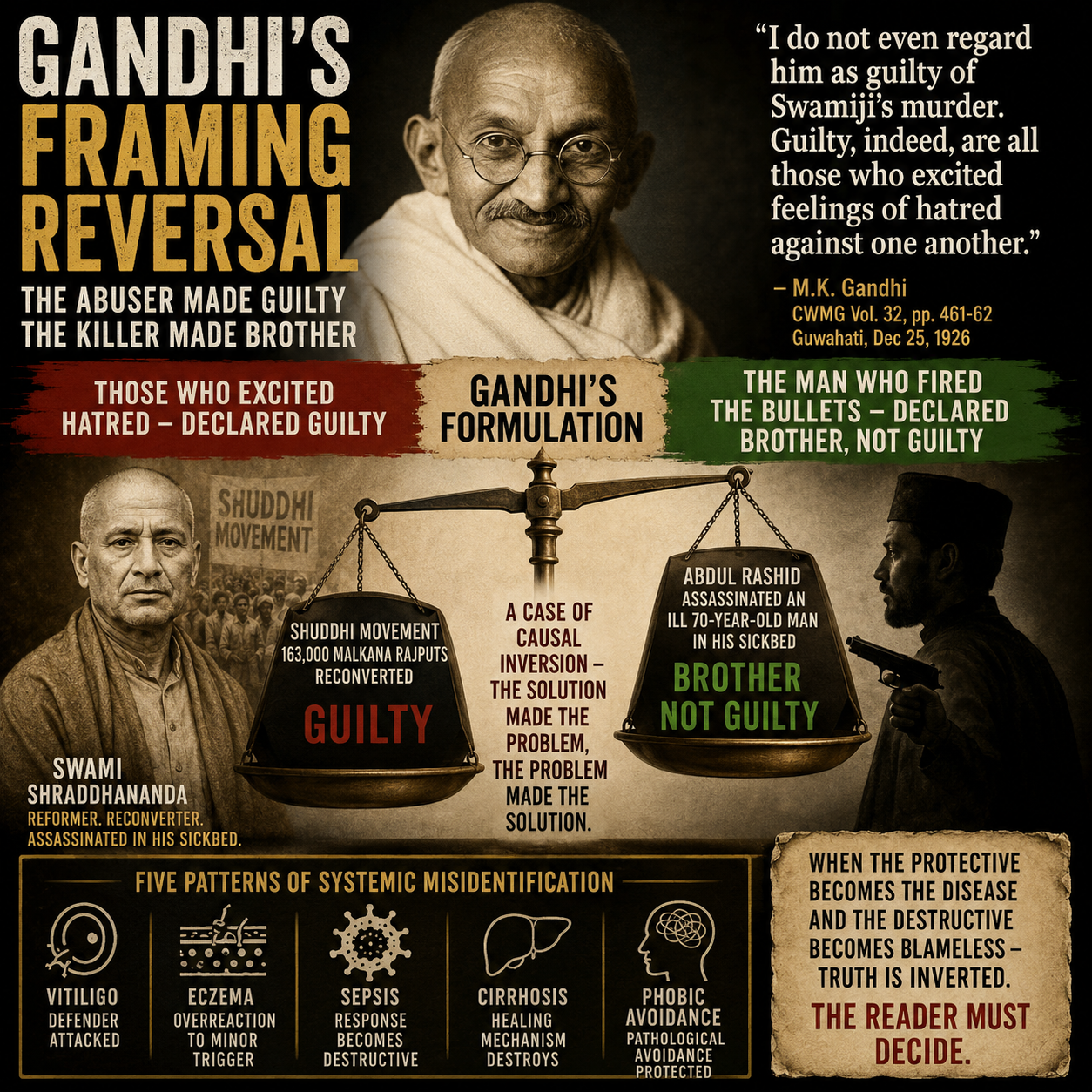
Gandhi’s Framing Reversal: The Abuser Made Guilty — The Killer Made Brother (78)
भारत / GB
Part 78: Mahatma Gandhi’s Peace Efforts | Series Index
Blog 75 documented the apportionment of guilt in Gandhi’s Guwahati formulation. This post places the structural logic of that formulation before the reader — and five patterns from medical science that document the category of error the formulation represents.
Thank you for reading this post, don't forget to subscribe!The Action Taken: Gandhi explicitly warned that organizing Hindu physical fitness akharas and neighborhood defense committees signaled communal distrust and violated the core truth of Ahimsa.
Who Paid the Price: Local civilian populations in communally sensitive districts, who remained unorganized and defenseless during street riots.
The Alternative Bypassed: Supporting community-level neighborhood watch and defensive preparedness to deter street violence.
Why This Matters: Completed the doctrinal demobilization of the target population: having counselled against state police intervention, the leadership actively prohibited organized physical self-defence.
The Documented Formulation
CWMG Vol. 32, pages 461-62. Guwahati Congress session, December 25, 1926:
“Now you will perhaps understand why I have called Abdul Rashid a brother, and I repeat it. I do not even regard him as guilty of Swamiji’s murder. Guilty, indeed, are all those who excited feelings of hatred against one another.”
Gandhi’s Framing Reversal places the structural logic of this formulation before the reader.
Those who excited feelings of hatred — declared guilty.
The man who fired two bullets into a seventy-year-old ill man in his sickbed — declared brother, not guilty.
Shraddhananda’s Shuddhi movement had reconverted 163,000 Malkana Rajputs. Gandhi had written in Young India 1922 that Shraddhananda’s speeches were often provocative. In Gandhi’s documented formulation, the victim’s own documented activity placed him in the guilty column. The killer was placed in the brother column.
Five Autoimmune Patterns — Where the Logic Fails
The prosecution places five patterns from medical science before the reader — not to vindicate the framing reversal but to document the category of error it represents.
Pattern One — Vitiligo:
In vitiligo the immune system attacks the body’s own melanocytes — the protective cells responsible for skin pigment. The melanocytes perform their natural defensive function. The immune system misidentifies them as a threat and destroys them. The protective agent is branded the disease. The destructive agent — the immune strike — is treated as a natural blameless reflex.
Pattern Two — Eczema:
A minor irritant triggers a massive destructive inflammatory response that damages the body’s own tissue. The system ignores the underlying dysfunction. The violent destructive flare is treated as an inevitable blameless reflex. The skin’s natural exposure to the environment is blamed as the inciter.
Pattern Three — Sepsis:
A localised infection triggers a cytokine storm — the immune system attacks its own vital organs. The response loses its defensive purpose and becomes the primary agent of death. A doctor who declares the internal immune reaction not guilty because an external bacteria existed has misdiagnosed the immediate cause of death.
Pattern Four — Cirrhosis:
The liver attempts to heal chronic injury by producing scar tissue. Over time the healing mechanism overtakes the healthy cells and destroys the organ. The remedy becomes the killer. The system continues producing it automatically.
Pattern Five — Phobic avoidance:
A person encounters a challenging stimulus and reacts with a paralyzing panic attack. The system treats the panic as an unchangeable law of nature. The cure — exposure and reality-testing — is treated as an abusive attack. The pathological avoidance is protected. The outside world is blamed for triggering it.
In each pattern the system attacks its own protective elements while excusing the destructive agent. The error is not in the trigger — it is in the system’s response to the trigger.
The Reversal Applied
Gandhi’s Framing Reversal applies this analysis precisely to the documented Guwahati formulation.
Shraddhananda’s Shuddhi work was the body’s protective mechanism — legal, open, documented. Gandhi’s formulation branded it as the guilty incitement. Abdul Rashid — who chose to fire the bullets — was placed in the brother column as a blameless systemic reflex. The protective agent was made the disease. The destructive agent was excused.
This is the category of error the five medical patterns document. Gandhi’s Framing Reversal places the comparison before the reader without assertion. In vitiligo the immune system destroys its own melanocytes. In Gandhi’s formulation the political system destroyed its own reformer’s reputation. In sepsis the immune response becomes the agent of death. In Gandhi’s formulation the political response placed the agent of death in the brother column.
Gandhi’s Framing Reversal does not claim Gandhi consciously designed this error. It places the documented formulation and the five patterns before the reader as a paired exhibit. It places the documented formulation alongside five patterns that document what category of error it represents — and asks the reader to examine both.
The Prosecution’s Position
Gandhi’s Framing Reversal places three questions before the reader — each answerable from the primary source and the five documented patterns.
- Does Gandhi’s documented formulation — guilty are those who excited hatred, the killer is my brother and not guilty — follow the same structural logic as the five autoimmune patterns placed before the reader?
- In Gandhi’s documented formulation, which party performs the protective function and which party performs the destructive act?
- When the reader completes the sentence — according to Gandhi’s own documented words, the real guilty party for Swami Shraddhananda’s murder was… — what name fills the blank?
The series does not answer. The primary source is CWMG Vol. 32. The five autoimmune patterns document the category of error. Ambedkar’s documented assessment from Pakistan or the Partition of India is placed alongside: Gandhi was anxious to preserve Hindu-Muslim unity and did not mind the murder of a few Hindus. The five autoimmune patterns document what that structural preference looks like when it operates as a systemic logic — branding the protective agent as the disease, excusing the destructive agent as a blameless reflex. The reader will examine all and complete the sentence.
Those who abuse — declared guilty. Those who kill the abuser — declared brother and not guilty. Shraddhananda’s documented religious reform work placed in the guilty column. Abdul Rashid’s documented act of shooting an ill seventy-year-old in his sickbed placed in the brother column. The prosecution places the documented formulation and five autoimmune patterns before the reader. The reader will identify what category of error the formulation represents.
Feature Image: Click here to view the image.
Videos
Glossary of Terms
- Gandhi’s Framing Reversal: A term coined in this series to describe Gandhi’s Guwahati formulation, where responsibility is argued to shift from the direct perpetrator of violence to those alleged to have created hostility.
- CWMG (Collected Works of Mahatma Gandhi): The official multi-volume compilation of Mahatma Gandhi’s writings, speeches, letters, and public statements.
- Guwahati Formulation: Gandhi’s statement at the Guwahati Congress session on December 25, 1926, in which he described Abdul Rashid as a brother and stated that those who spread hatred were the real guilty parties.
- Abdul Rashid: The man who assassinated Swami Shraddhananda in December 1926 and whose actions became the focus of Gandhi’s controversial remarks.
- Swami Shraddhananda: Arya Samaj leader, social reformer, and advocate of the Shuddhi movement who was assassinated in Delhi in 1926.
- Shuddhi Movement: A reform movement associated with Arya Samaj aimed at reconverting individuals and communities who had previously left the Hindu fold.
- Malkana Rajputs: A community in northern India that became the focus of major Shuddhi reconversion efforts during the 1920s.
- Causal Inversion: A key phrase in this analysis referring to the reassignment of primary responsibility from the actor committing harm to the person or activity alleged to have provoked it.
- Systemic Misidentification: A concept used in the blog to describe situations where a system incorrectly identifies the source of a problem and directs blame toward the wrong target.
- Vitiligo: An autoimmune condition in which the body’s immune system attacks melanocytes, the cells responsible for skin pigmentation.
- Sepsis: A life-threatening medical condition in which the body’s response to infection becomes dysregulated and damages its own organs and tissues.
- Phobic Avoidance: A psychological pattern in which a person repeatedly avoids a feared stimulus, reinforcing fear and preventing adaptation.
- Autoimmune Pattern: A biological process in which the immune system mistakenly attacks the body’s own cells or tissues instead of genuine threats.
- Young India: A journal edited by Mahatma Gandhi through which he expressed political, social, and religious views during the freedom movement.
- Primary Moral Responsibility: The principal accountability assigned to the individual or entity directly responsible for carrying out a harmful act.
#Gandhi #MahatmaGandhi #History #India #Hindu #AryaSamaj #Shraddhanand #Politics #Partition #Congress #FreedomMovement #Truth #Debate #Analysis #HinduinfoPedia
Gandhi’s Peace Efforts: The Questions Before the Mahatma (0)