Gandhi’s Brave Death Prescription: What He Told Others — What He Did Himself (65)
भारत / GB
Part 65: Mahatma Gandhi’s Peace Efforts | Series Index
Blog 64 documented Gandhi’s admission that he and the Ali Brothers held the authority to stop the Moplah massacre — and chose not to use it. This post examines the sixth statement in Blog 59’s arc — Gandhi’s prescription of brave death to Hindus facing Muslim violence — and documents that this prescription was not a single careless statement. It was a consistent instruction, applied across twenty-six years, to every major episode of Muslim violence against Hindus.
Thank you for reading this post, don't forget to subscribe!The Action Taken: Gandhi formally counseled that Hindus facing sectarian violence should submit to death without physical resistance, declaring that non-retaliation and voluntary martyrdom constituted the only pure Ahimsa.
Who Paid the Price: Vulnerable civilian populations in riot zones, who were stripped of moral sanction to organize armed neighborhood defense or retaliatory deterrence.
The Alternative Bypassed: Recognizing legitimate collective physical self-defense as an inalienable natural and constitutional right.
Why This Matters: The foundational T3 exhibit: unilateral disarmament was prescribed as a spiritual obligation to victim communities, while the leadership preserved its own legal and medical remedies under state detention.
The Prescription — Across Twenty-Six Years
Gandhi’s Brave Death Prescription begins with the documented record — not one statement but a pattern across Gandhi’s full career.
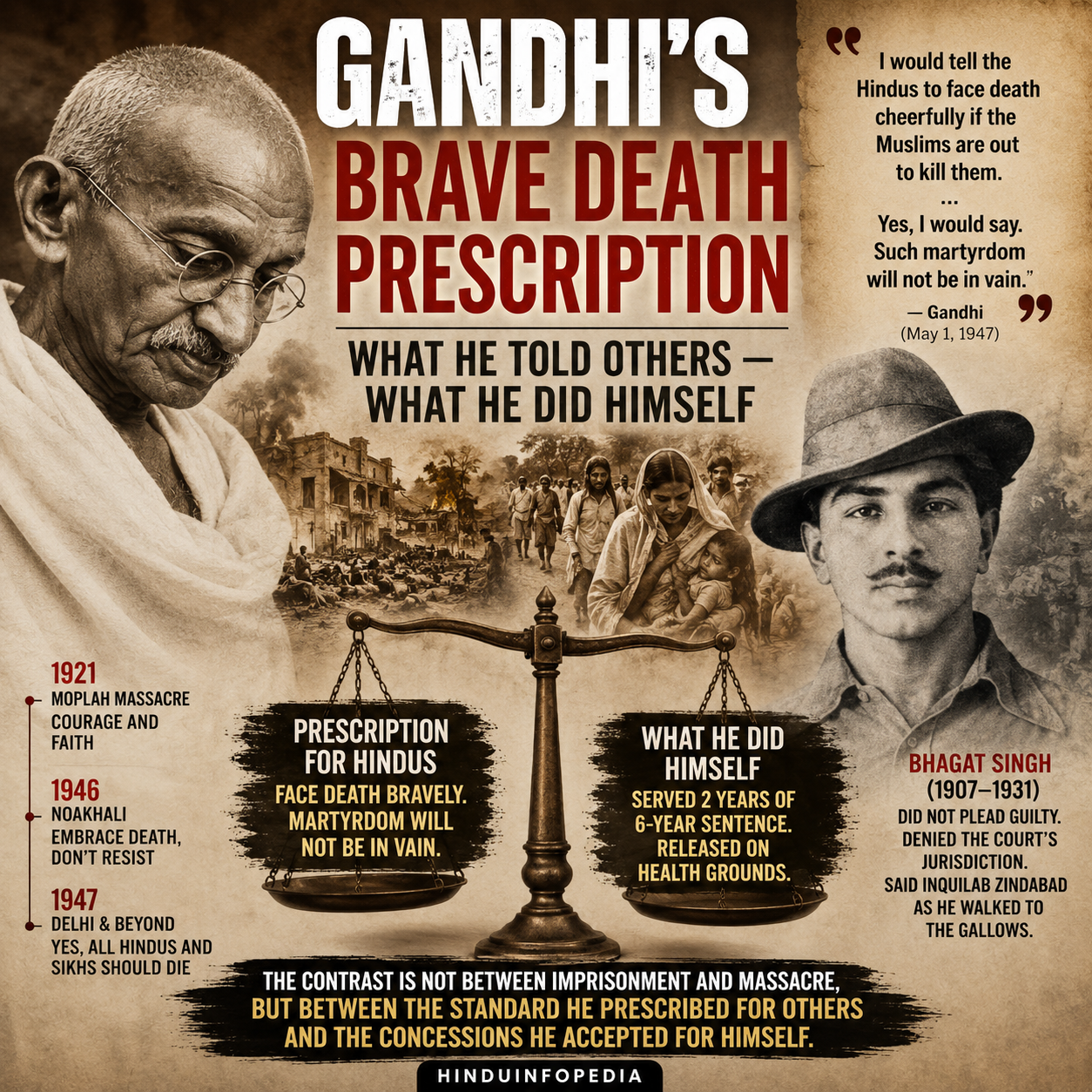
1921 — Moplah massacre: Gandhi told the Hindus of Malabar they must have the courage and the faith to protect their religion in spite of such fanatical eruptions. Documented in Blog 58.
April 6, 1947 — Prayer meeting, New Delhi — CWMG Vol. 94, page 249: “Hindus should not harbour anger in their hearts against Muslims even if the latter wanted to destroy them. Even if the Muslims want to kill us all we should face death bravely. If they established their rule after killing Hindus we would be ushering in a new world by sacrificing our lives. None should fear death.”
May 1, 1947 — Prayer meeting: “I would tell the Hindus to face death cheerfully if the Muslims are out to kill them. I would be a real sinner if after being stabbed I wished in my last moment that my son should seek revenge. I must die without rancour. You may turn round and ask whether all Hindus and all Sikhs should die. Yes, I would say. Such martyrdom will not be in vain.”
On Hindu refugees from Pakistan: Gandhi told Hindu refugees who had fled violence in Pakistan to go back — to return to the geography where the violence had occurred.
On Noakhali 1946: Gandhi told Hindu women facing sexual violence to embrace death rather than resist — documented in contemporaneous accounts of his Noakhali tour.
Gandhi’s Brave Death Prescription is not a single careless quote. It is a documented instruction applied consistently from 1921 to 1947 — to every major episode of Muslim violence against Hindus across twenty-six years of Gandhi’s public career.
The prescription’s evolution is documented precisely. In 1921 at Moplah — courage and faith. In 1947 at Delhi — face death bravely, martyrdom will not be in vain. In May 1947 — all Hindus and Sikhs should die, such martyrdom will not be in vain. The instruction did not moderate as the violence escalated. It intensified. By 1947 — as Partition approached and communal massacres were documented daily — Gandhi’s prescription reached its most explicit form: yes, all Hindus and Sikhs should die.
What Gandhi Did Himself
Gandhi was sentenced to six years imprisonment by Judge Broomfield on March 18, 1922 — documented in Blog 50. He was released unconditionally from Yerwada Prison on February 5, 1924, after an appendicitis operation — having served approximately two years of a six-year sentence.
Before his imprisonment, Gandhi had written in Young India in August 1921: “If only our men and women welcome jails as health resorts, we will cease to worry about the dear ones put in jails.”
And on January 26, 1922 — the same date he told Hindus they were not without blame for the Moplah massacre: “We have today converted the jails into heavens of refuge for liberty-loving men.”
Gandhi prescribed brave acceptance of death to Hindus facing Muslim violence. Gandhi himself served two years of a six-year sentence and was released on health grounds from the colonial authority whose courts he had legitimised through his guilty plea.
The Bhagat Singh Contrast
Gandhi’s Brave Death Prescription requires one documented comparison — placed precisely, without characterisation.
Bhagat Singh was hanged on March 23, 1931. He was twenty-three years old. He did not plead guilty. He denied the court’s jurisdiction. He did not negotiate early release. He did not cite health grounds. He said Inquilab Zindabad as he walked to the gallows.
Gandhi had told Irwin that Bhagat Singh’s execution had no connection with the Irwin Pact negotiation — documented in Blog 51. The pact was signed. Bhagat Singh was hanged eighteen days later.
The prescription Gandhi gave to Hindu victims of Muslim violence — face death bravely, martyrdom will not be in vain — Bhagat Singh lived it. Facing the colonial state whose authority Gandhi had legitimised. Gandhi did not make his execution a condition of the negotiation he was conducting at that moment.
The Prosecution’s Position
Gandhi’s Brave Death Prescription does not claim Gandhi was a coward. His personal courage in documented situations was genuine. It places two documented records before the reader — the prescription he gave consistently to others across twenty-six years, and the conduct of his own documented life.
- Did Gandhi consistently prescribe brave acceptance of death to Hindus facing Muslim violence — across 1921, 1946, and 1947?
- Did Gandhi serve two years of a six-year sentence and accept release on health grounds?
- Did Gandhi tell Hindu women facing sexual violence in Noakhali to embrace death rather than resist?
- Did Gandhi tell Hindu refugees from Pakistan to return to the geography of their persecution?
- Did the same Gandhi make Bhagat Singh’s execution — who faced death without negotiation — no part of his documented negotiation with Irwin?
The series does not answer. The prescription across twenty-six years is documented. Gandhi’s own conduct is documented. The reader will examine both and complete the sentence.
Face death bravely — 1921, Malabar. Face death cheerfully — May 1947. All Hindus and Sikhs should die, such martyrdom will not be in vain — May 1947. Gandhi’s Brave Death Prescription was not one careless statement. It was a consistent instruction across twenty-six years of Muslim violence against Hindus. Gandhi served two years of six and was released on health grounds. Bhagat Singh faced death at twenty-three without negotiation. The prosecution places the prescription and the conduct before the reader. The reader will complete the sentence.
Feature Image: Click here to view the image.
Videos
Glossary of Terms
- Moplah Massacre: The 1921 Malabar violence during the Khilafat–Non-Cooperation period in which thousands of Hindus were reportedly killed, displaced, or forcibly converted by sections of the Moplah Muslim community.
- Malabar: A historical region in present-day Kerala associated with the 1921 Moplah rebellion and communal violence discussed throughout the series.
- Noakhali: A district in present-day Bangladesh where large-scale anti-Hindu violence occurred in 1946 during the final phase of British India.
- CWMG (Collected Works of Mahatma Gandhi): The official multi-volume archival compilation of Gandhi’s speeches, letters, statements, and writings used as a documentary source in the series.
- Yerwada Prison: A British-era prison in Pune where Gandhi was incarcerated after his 1922 sedition conviction.
- Young India: Gandhi’s English-language weekly journal used extensively for publishing his political and ideological views during the freedom movement.
- Irwin Pact: The 1931 agreement between Mahatma Gandhi and Viceroy Lord Irwin that temporarily suspended the Civil Disobedience Movement.
- Bhagat Singh: Indian revolutionary executed by the British in 1931, frequently contrasted in nationalist discourse with Gandhi’s constitutional negotiation approach.
- Ahimsa: The principle of nonviolence central to Gandhi’s philosophy, interpreted by him as moral resistance through suffering rather than retaliatory violence.
- Brave Death Prescription: A phrase coined in this series referring to Gandhi’s repeated advice that Hindus should face communal violence and even death without retaliation.
- Martyrdom Will Not Be in Vain: A recurring Gandhian moral framework suggesting sacrificial suffering could produce future ethical or societal transformation.
- Ali Brothers: Maulana Mohammad Ali and Shaukat Ali, prominent Khilafat leaders allied with Gandhi during the Non-Cooperation Movement.
- Non-Cooperation Movement: Gandhi-led anti-British movement launched in 1920 encouraging boycott of British institutions, courts, schools, and titles.
- Prayer Meeting Statements: Public speeches delivered by Gandhi during communal tensions in 1946–47, many of which are cited in this series regarding nonviolence and communal conflict.
- Prosecution’s Position: A recurring structural phrase in this series indicating that the article presents documented evidence and contradictions for reader evaluation rather than direct moral verdicts.
#Gandhi #MahatmaGandhi #BhagatSingh #Ahimsa #Partition #Noakhali #Moplah #Khilafat #History #India #FreedomStruggle #Hindu #Congress #BritishRaj #HinduinfoPedia
Scan Through The Entire Series
Gandhi’s Peace Efforts: The Questions Before the Mahatma (0)
Read The Prosecution Exhibits Through Links