Gandhi’s Moplah Statements: Six Statements, One Direction (59)
भारत / GB
Part 59: Mahatma Gandhi’s Peace Efforts | Series Index
Blog 58 placed Gandhi’s primary Moplah statements before the reader — the brave God-fearing characterisation of the perpetrators and the courage and faith instruction to the victims. This post documents the full body of Gandhi’s statements on the Moplah massacre. Not one careless quote. Gandhi’s Moplah Statements is a consistent position maintained across six documented statements while the massacre was ongoing. Each statement in this post is documented in full — and each receives dedicated treatment in the five blogs that follow.
Thank you for reading this post, don't forget to subscribe!The Action Taken: Across six major public statements, Gandhi systematically minimized reports of forced conversions, deflecting responsibility onto local unorganized elements to insulate the Khilafat leadership.
Who Paid the Price: The historical accuracy of the casualty record, and the displaced refugees whose testimonies were publicly disputed by their own national leadership.
The Alternative Bypassed: Appointing an independent, credible Congress commission to conduct an objective physical census of forced conversions and property destruction.
Why This Matters: Documents the systematic reframing of mass violence to preserve political alliances, establishing a blueprint repeated across subsequent communal riots.
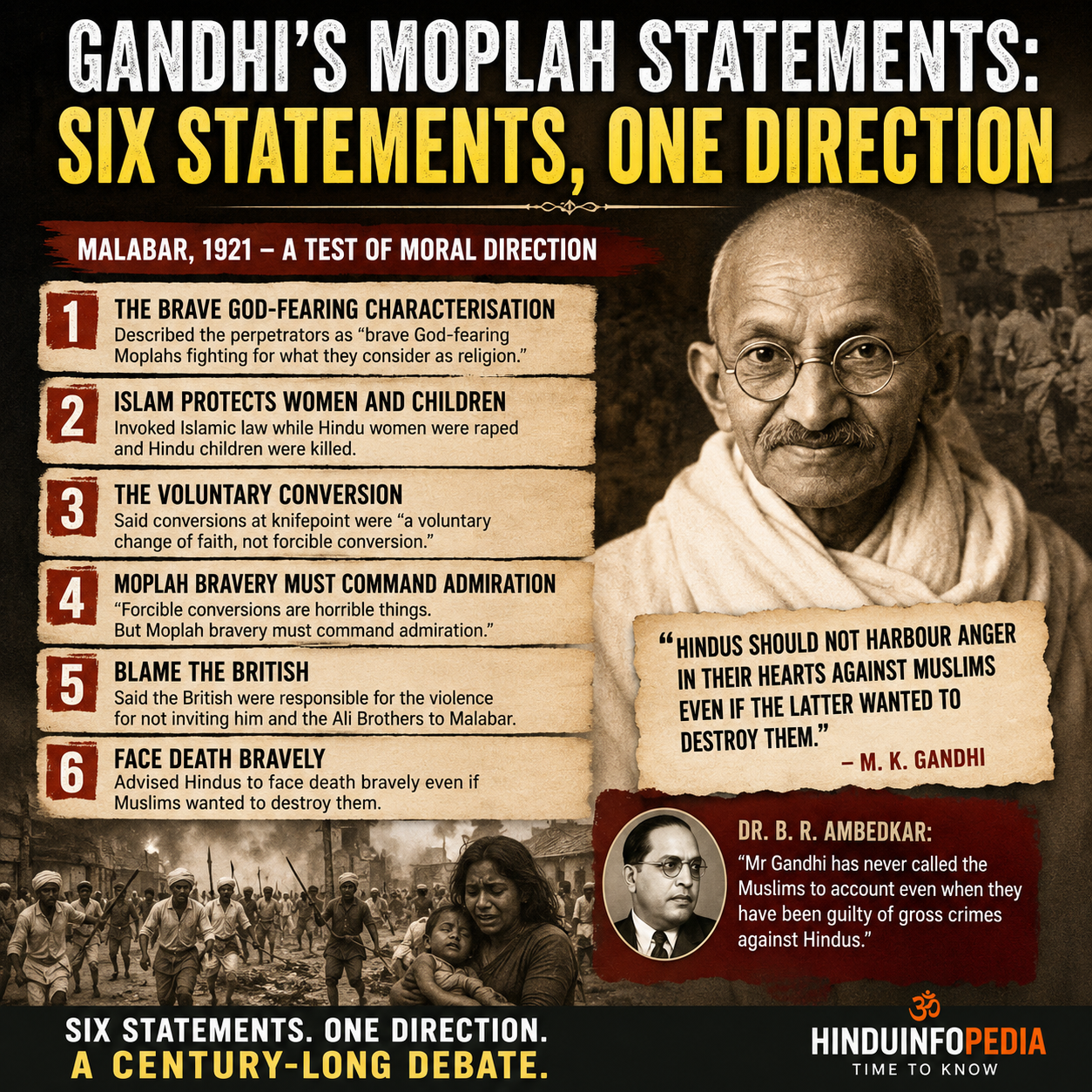
Statement One — The Brave God-Fearing Characterisation
Gandhi described the perpetrators as the “brave God-fearing Moplahs who were fighting for what they consider as religion and in a manner which they consider as religion.”
The reader is presented with an absolute contradiction contained within a single statement. The perpetrators are labelled brave and God-fearing — qualities of the person. The act they committed is characterised as something they merely consider religious — a distancing formulation that neither condemns nor endorses. A God-fearing man does not behead 38 neighbours and throw their bodies into a well. A brave man does not rape women and cut a six-month-old child in two. Gandhi’s characterisation of the perpetrators is incompatible with the conduct they committed.
Statement Two — Islam Protects Women and Children
Before the full scale of the massacre was acknowledged, Gandhi invoked Islamic law in defence of the perpetrators: “Islam protects even in war women, children, and old men from molestation. Islam does not justify jehad except under well-defined conditions. So far as I know the law of Islam, the Moplahs could not, on their own initiative, declare jehad.”
This statement was made while Hindu women were being raped and Hindu children were being killed in Malabar. The documented history of political Islam’s encounter with Sanatana Dharma — examined here — places Gandhi’s invocation of Islamic protection for women and children in its full historical context.
Statement Three — The Voluntary Conversion
When the documented evidence of forced conversions could no longer be denied, Gandhi stated: “And if the Hindus became Musalmans to save themselves from death, it was a voluntary change of faith and not forcible conversion.”
A Hindu who converts to Islam at knifepoint — presented with the choice of conversion or death — has made a voluntary choice according to Gandhi’s documented formulation. The full implications of this statement — legally, morally, and in its living consequences for Ghar Wapsi and reconversion debates — are documented in later blog (60).
Statement Four — Moplah Bravery Must Command Admiration
Gandhi went further: “Forcible conversions are horrible things. But Moplah bravery must command admiration.”
The word “but” in this statement is the prosecution’s single most precise linguistic exhibit in the Moplah arc. It negates what precedes it. The condemnation lasted four words. The admiration was the lasting characterisation — and it was not merely observed but prescribed: bravery *must command* admiration. The full dissection of this statement — the “but” and the “must” as documented exhibits — is in later blog (61).
Statement Five — Blame the British
Gandhi’s speech in Calicut on September 16, 1921 redirected responsibility from the perpetrators to the colonial administration. He stated that the British Government bore responsibility for the Moplah violence because they had failed to invite the Ali Brothers and Gandhi himself to enter Malabar and restore calm.
The British did not invite Gandhi to India in 1915. They did not invite him to Champaran in 1917. They did not invite him to launch Non-Cooperation in 1920. He required no invitation for any of these acts. The one act for which he required a British invitation was entering Malabar to stop the killing of Hindus. The full implications of this uninvited precedent — and what entering Malabar would have cost Gandhi’s political relationships — are documented in later blog (62).
Statement Six — Face Death Bravely
The direction of Gandhi’s Moplah statements reached its final form decades later: “Hindus should not harbour anger in their hearts against Muslims even if the latter wanted to destroy them. Even if the Muslims want to kill us all we should face death bravely. If they established their rule after killing Hindus we would be ushering in a new world by sacrificing our lives.”
Gandhi prescribed brave death to Hindus facing Muslim violence. Gandhi himself — facing British imprisonment — pleaded guilty, cited health grounds, and walked out of Yerwada Jail after two years of a six-year sentence. Bhagat Singh lived Gandhi’s prescription — hanged at thirty-three, no negotiation, no plea, no health grounds. The full asymmetry between what Gandhi prescribed and what Gandhi did is documented in later blog (63). The documented evidence of systematic Hindu elimination — examined here — places Gandhi’s brave death prescription in its measurable long-term context.
Ambedkar’s Documentation
Ambedkar was incensed at Gandhi’s selectivity on the Moplah massacre. “Mr Gandhi has never called the Muslims to account even when they have been guilty of gross crimes against Hindus. Mr Gandhi has never protested against such murders. Not only have the Muslims not condemned these outrages but even Mr Gandhi has not called upon the leading Muslims to condemn them.”
Ambedkar was not a peripheral critic. He was the architect of India’s Constitution — a Dalit, a constitutionalist, a Congress contemporary, and the man Gandhi had personally coerced through the Poona Pact fast of 1932. His systematic characterisation of Gandhi’s communal asymmetry — documented while Gandhi was alive — is examined in full in later blog (64).
The Prosecution’s Position
Gandhi’s Moplah Statements does not claim Gandhi hated Hindus. It places six documented statements before the reader. It places six documented statements before the reader and asks the reader to examine their direction.
The Complicity Test placed five exhibits before the reader and asked one question. Gandhi’s Moplah Statements adds six documented statements to the record. The prosecution frames its observations as questions — not conclusions:
- Did Gandhi consistently characterise perpetrators of violence against Hindus with attributes of honour — brave, God-fearing, admirable — while offering only mild acknowledgment of the acts themselves?
- Did he consistently invoke the theology of the perpetrating community in their defence — regardless of whether that theology supported the acts committed?
- Did he consistently reframe documented coercion as voluntary choice?
- Did he consistently redirect responsibility toward the British administration — making the colonial government the cause of Muslim violence against Hindus?
- Did he consistently instruct the victim community to have virtue — courage, faith, acceptance of death — rather than demanding justice or protection?
- Did this consistent direction protect all his political relationships simultaneously — while placing the entire burden of accommodation on the Hindu community?
The series does not answer these questions. Gandhi’s Moplah Statements places six statements on the record. Ambedkar asked the same questions while Gandhi was alive. The five blogs that follow examine each statement in full. The reader will identify whether six documented applications constitute a direction — or something else.
Six statements. Brave and God-fearing for the killers. Islam protects women — stated while women were being raped. Voluntary conversion — stated about conversions at knifepoint. Moplah bravery must command admiration — stated after 2,500 Hindus were killed. Blame the British — stated while the massacre was ongoing. Face death bravely — the direction’s final form, applied to all future Hindu victims of Muslim violence. The prosecution places six statements and six questions before the reader. The five blogs that follow examine each statement in full. The reader will answer.
Feature Image: Click here to view the image.
Videos
Glossary of Terms
- Moplah Massacre: The large scale communal violence in Malabar in nineteen twenty one involving killings, forced conversions, displacement, and attacks on Hindus during the Khilafat and Non Cooperation period.
- Malabar: A region in present day Kerala that became the centre of the Moplah violence in nineteen twenty one.
- Moplahs: A Muslim community of the Malabar region historically associated with the Moplah rebellion and the nineteen twenty one violence.
- Khilafat Movement: A political movement launched after the First World War to support the Ottoman Caliphate, later aligned by Mahatma Gandhi with the Non Cooperation Movement.
- Non Cooperation Movement: Gandhi led movement launched in nineteen twenty urging Indians to withdraw cooperation from British institutions and governance.
- Voluntary Conversion: Gandhi’s controversial formulation describing conversions made under threat of death during the Moplah violence as voluntary rather than forcible.
- Political Islam: A term referring to the use of Islamic religious identity, doctrine, or institutions in political mobilisation and governance.
- Ghar Wapsi: A reconversion movement seeking the return of converted individuals or communities to their ancestral Hindu fold.
- Yerwada Jail: A prison in Pune where Gandhi was imprisoned by the British and later released before completing his full sentence.
- Bhagat Singh: Indian revolutionary executed by the British in nineteen thirty one, referenced in the series as a contrast to Gandhi’s prescription of sacrifice and courage.
- Poona Pact: The nineteen thirty two political agreement between Mahatma Gandhi and Dr B R Ambedkar concerning electoral representation for Dalits.
- Communal Asymmetry: A recurring phrase in the series describing the unequal moral and political standards allegedly applied to different communities during communal violence.
- Complicity Test: A framework introduced earlier in the series examining whether repeated actions, silences, or statements indicate indirect enabling of harmful outcomes.
- Direction: A key phrase in the series referring to a repeated pattern of statements or actions pointing toward a consistent moral or political tendency.
- Documented Statements: Verified public statements by Gandhi presented in the series as primary evidence for evaluating his response to the Moplah violence.
#Gandhi #Moplah #Malabar #Ambedkar #Khilafat #History #Hindu #India #Congress #HinduinfoPedia
Scan Through The Entire Series
Gandhi’s Peace Efforts: The Questions Before the Mahatma (0)