
Gandhi’s Cause Inversion: What Gandhi’s Own Contemporaries Documented Seeing (109)
भारत / GB
Part 109: Mahatma Gandhi’s Peace Efforts | Series Index
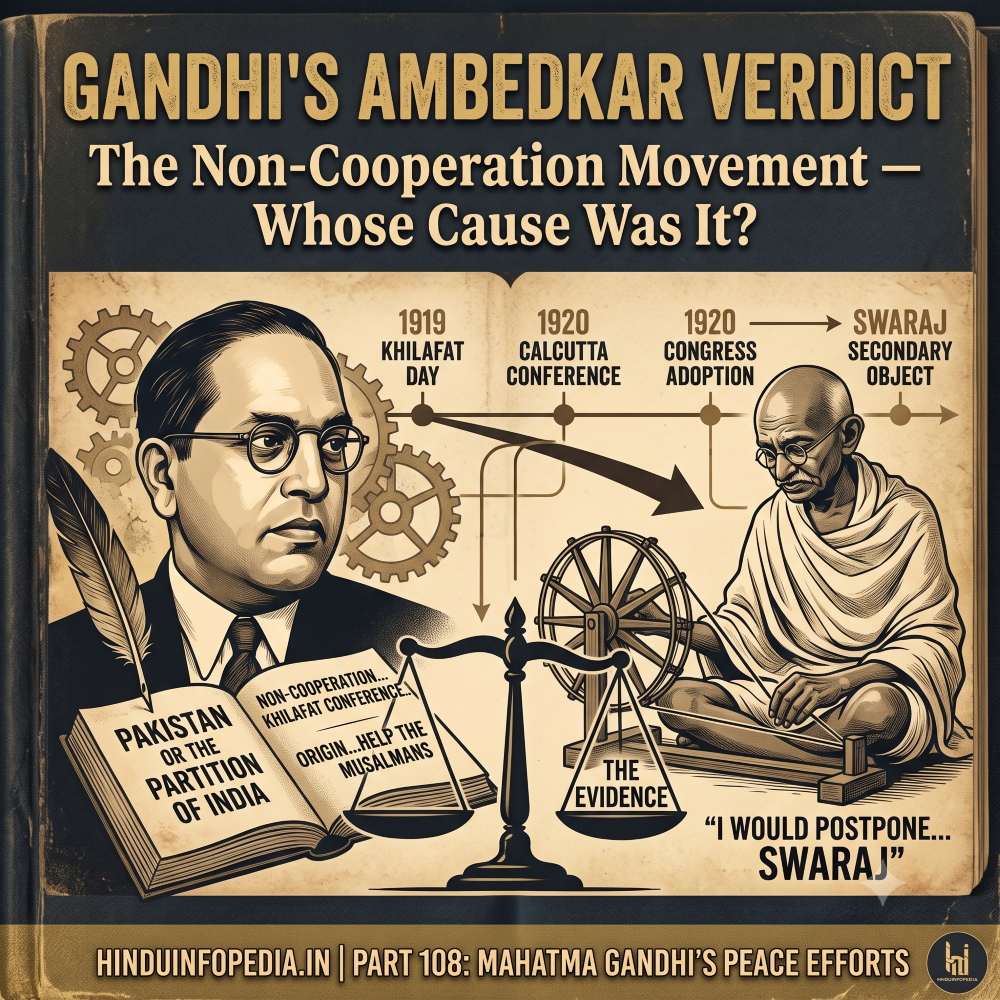
Blog 107 placed Gandhi’s own documented words before the reader — “I would postpone Swaraj for Khilafat.” Blog 108 placed Ambedkar’s primary source verdict — the Non-Cooperation Movement was initiated by the Khilafat Committee, not for Swaraj but for Khilafat. This post places the third evidentiary layer: what Gandhi’s own named contemporaries documented seeing, warning against, and being shocked by — in real time.
Thank you for reading this post, don't forget to subscribe!The Action Taken: Gandhi reiterated to the Hindu public that their support for the Khilafat must not be made contingent on any reciprocal promise or formal pact regarding cow protection.
Who Paid the Price: The political bargaining position of the Hindu community, whose concerns were relinquished upfront as a unilateral moral offering.
The Alternative Bypassed: Structuring a reciprocal, mutual civic agreement addressing communal flashpoints simultaneously with the anti-colonial alliance.
Why This Matters: Codified the principle of unilateral political surrender: instructing one community to concede its leverage without demanding reciprocal civic guarantees.
The Cause Inversion Was Not Discovered in Retrospect
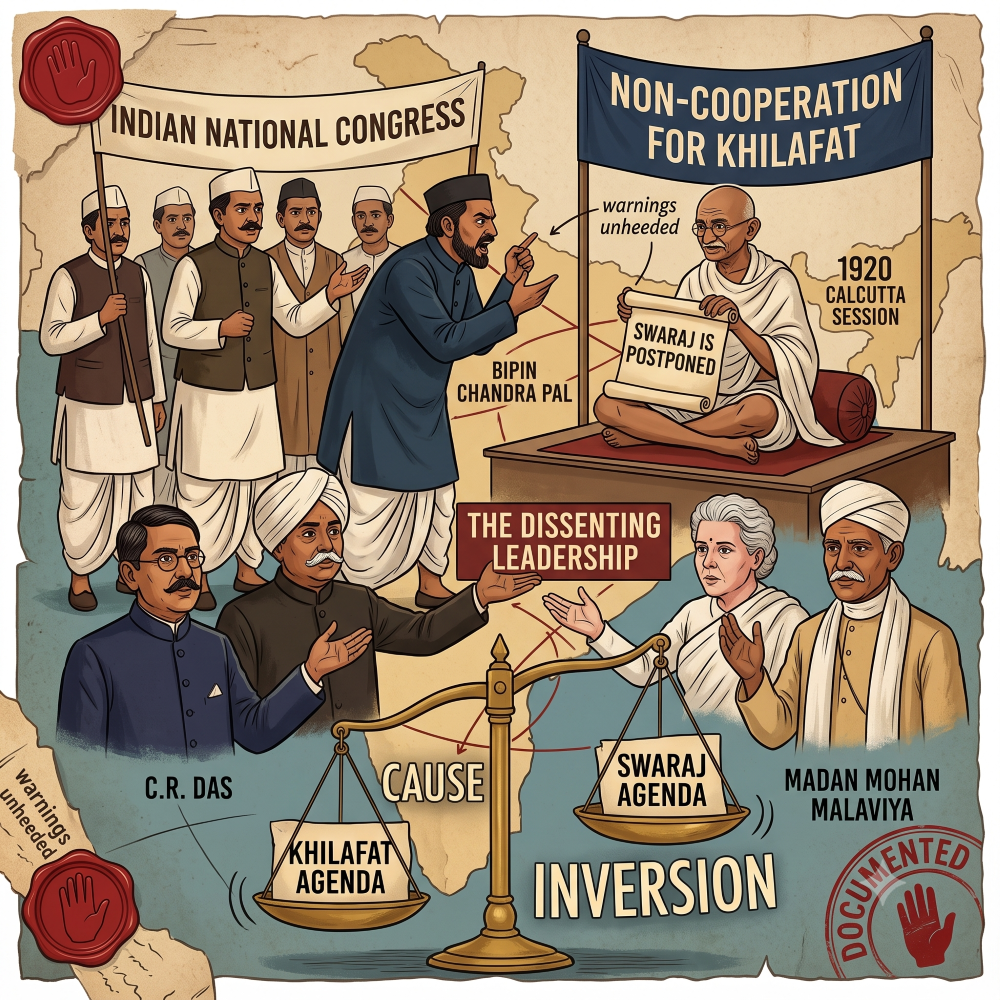
Gandhi’s Cause Inversion places one documented observation before the reader at the outset. The finding that the Non-Cooperation Movement served the Khilafat cause rather than Swaraj — established from Gandhi’s own documented words in Blog 107 and from Ambedkar’s primary source verdict in Blog 108 — was not something later historians uncovered from a distance. It was visible, and documented, to named Indian leaders who were present at the time.
The prosecution places those named contemporary reactions before the reader as the third independent evidentiary layer on the same documented finding.
Those Who Warned — Documented
Gandhi’s Cause Inversion places the documented warnings first.
Annie Besant — documented in Blog 106. First woman Congress President. One of six documented dissenters at the September 1920 session. Her documented warning: mass religious mobilisation would produce consequences Gandhi could not control. Her documented post-Moplah verdict named what the consequence was.
Henry Polak — Gandhi’s own close friend and fellow barrister, who had worked alongside Gandhi in South Africa. Polak warned Gandhi directly that on the Khilafat question he was behaving in “an ill-informed and dangerous manner.” This was not a political opponent. This was a documented personal friend placing a documented warning on the record.
Bipin Chandra Pal — of the “Lal-Bal-Pal” radical nationalist trio, Pal did not stay silent at the September 1920 Calcutta session. He openly moved an amendment to Gandhi’s Non-Cooperation resolution, arguing that a mission should first be sent to the British Prime Minister demanding self-government before launching mass agitation. He warned the assembly against substituting blind faith for logic and cautioned against centering a national struggle on mass religious emotionalism. His amendment was defeated, but his documented public opposition at Calcutta places him among those who warned, not those who stayed silent.
Lokmanya Bal Gangadhar Tilak — the tallest documented Congress leader before Gandhi. Tilak had serious documented reservations about mixing the parochial religious issue of Khilafat with the secular national movement. He died on August 1 1920 — the same documented date on which Non-Cooperation commenced — leaving those who shared his reservations without a leader of comparable stature. His death created the vacuum Gandhi walked into. The documented question the prosecution places before the reader: had Tilak lived, would the September 1920 Calcutta session have produced the same result?
Those Who Saw and Stayed Silent — Documented
Gandhi’s Cause Inversion places the documented silence of named leaders alongside the documented warnings.
Lala Lajpat Rai — presided over the very September 1920 Calcutta special session at which Gandhi’s Non-Cooperation/Khilafat resolution was adopted. In his presidential address he expressed documented reservations about the wisdom of tying Non-Cooperation so strictly to the Khilafat cause. He later chose to court imprisonment to maintain a unified national front — a man who presided over a deeply divided house, held documented reservations about what he was presiding over, and was documented as deeply shocked by the post-Khilafat communal fallout that followed.
Madan Mohan Malaviya — documented reservations about the merger of religious and secular causes. Opposed Gandhi at Calcutta. Later presided over the first All India Hindu Mahasabha session at Varanasi after the post-Khilafat riots — the documented Hindu political response to what the Khilafat experiment had produced.
Sardar Vallabhbhai Patel — participated in the Non-Cooperation Movement and was arrested. One documented account records his private position as “unconvinced about a slave country fighting for the maintenance of a foreign Muslim Empire.” His public conduct supported the movement; the documented private reservation, if accurate, reflects the documented pattern of leaders who carried reservations inside a movement Gandhi’s authority had made difficult to challenge publicly.
Jawaharlal Nehru — actively supported the Non-Cooperation/Khilafat movement and immersed himself in it. His autobiography reflects deep involvement. However, he later documented ideological reservations about religious mobilisation as a basis for nationalism. The man Gandhi placed as Congress President in 1929, 1936, and 1946 would later write that the religious basis of the Khilafat cause was structurally incompatible with secular nationalism — a retrospective verdict that carries weight precisely because it came from within Gandhi’s own chosen successor.
Lala Lajpat Rai wrote to Chittaranjan Das that he did not fear the seven crore Muslims of India, but that the armed Muslim populations of Afghanistan, Central Asia, Arabia, Mesopotamia, and Turkey combined would pose a grave national threat to India. Ambedkar later quoted this letter in Pakistan or the Partition of India — placing it on primary source record. Later resigned from Congress alongside Motilal Nehru to form the Swaraj Party after Gandhi’s suspension of the movement at Chauri Chaura — documented disillusionment with Gandhi’s unilateral authority over the movement’s direction.
What the Silence Establishes
Gandhi’s Cause Inversion places the documented pattern before the reader as an exhibit in itself. The September 1920 Calcutta session produced a divided house. Besant, C.R. Das, Lajpat Rai, and Malaviya all opposed Gandhi. Pal moved an amendment. The resolution passed with a majority of approximately 1,886 to 884 — not because the old guard agreed, but because the entire Muslim bloc and the new mass base Gandhi had built gave him the numbers. Gandhi’s momentum prevailed post-Tilak, not because dissent was absent, but because the documented authority Gandhi had built since 1920 overcame documented opposition from Congress’s most experienced leadership.
The documented cause inversion — Non-Cooperation for Khilafat, not for Swaraj — was visible to those present. The documented warnings and documented opposition at Calcutta are the prosecution’s third independent evidentiary layer on what that inversion was.
The Prosecution’s Position
Gandhi’s Cause Inversion places three questions before the reader.
- Did named contemporary Indian leaders — Polak, Besant, Pal, Lajpat Rai, Malaviya, Das, Tilak — document warnings against or opposition to the Khilafat decision at the time it was made, establishing that the cause inversion was visible in real time to those present, not only in retrospect?
- Did the resolution pass not because the experienced Congress leadership agreed, but because Gandhi’s Muslim bloc majority and new mass base overrode documented opposition from Congress’s most senior figures — and does that documented mechanism belong before the reader alongside the documented outcomes?
- Does the documented pattern — Pal’s amendment defeated, Besant and Das and Malaviya outvoted, Das and Motilal Nehru later resigning to form the Swaraj Party after Gandhi’s unilateral Chauri Chaura suspension — reflect the documented consequences of placing that authority in one man’s hands?
The series does not answer. Gandhi’s Cause Inversion places the named contemporary reactions, the documented warnings, and the documented silence before the reader as the third independent evidentiary layer. The reader will examine what Gandhi’s own contemporaries saw — and complete the sentence.
Invitation To Defence
The floor belongs to the defense. We now invite them to present their exhibits and challenge the narrative established by the prosecution.
September 1920, Calcutta. Tilak dead since August 1 — the day Non-Cooperation commenced. Polak: ill-advised and dangerous. Pal moved an amendment — defeated. Besant, C.R. Das, Lajpat Rai, Malaviya: opposed Gandhi. The Muslim bloc and the new mass base gave Gandhi his numbers. The experienced leadership of the independence movement was overrun by the majority Gandhi had built. The cause inversion was not discovered later. It was seen, warned against, and voted down — at the time. The prosecution places the named contemporary reactions before the reader. The reader will complete the sentence.
← Part 108 | Series Index | Exhibits Master Table
Feature Image: Click here to view the image.
Videos
Glossary of Terms
- Cause Inversion: A key concept in this series describing the argument that the Non-Cooperation Movement primarily advanced the Khilafat cause instead of Swaraj.
- Non-Cooperation Movement: A mass movement launched in 1920 under Gandhi’s leadership, involving the boycott of British institutions and goods.
- Khilafat Movement: A pan-Islamic political movement in British India seeking to preserve the Ottoman Caliphate after the First World War.
- Swaraj: Self-rule or national independence, the principal political objective of the Indian freedom movement.
- Primary Source Verdict: A conclusion derived directly from contemporary documents, speeches, letters, memoirs, or official records rather than later interpretations.
- Contemporary Evidence Layer: A term used in this series for documentary evidence provided by leaders who witnessed events as they occurred.
- September 1920 Calcutta Special Session: The Congress session where Gandhi’s Non-Cooperation resolution linked with the Khilafat issue was adopted after extensive debate.
- Moplah Rebellion: The violent uprising in Malabar in 1921 that followed the Khilafat and Non-Cooperation period and became central to subsequent political debates.
- Swaraj Party: A political party founded in 1923 by C.R. Das and Motilal Nehru after disagreements over Gandhi’s suspension of the Non-Cooperation Movement.
- Chauri Chaura Incident: The February 1922 violent incident after which Gandhi suspended the Non-Cooperation Movement.
- Muslim Bloc: The organized support base within Congress politics that backed Gandhi’s Khilafat-linked strategy during the 1920 debates.
- Mass Base: The large popular support mobilized by Gandhi through nationwide political campaigns.
- Documented Opposition: Recorded objections made by contemporary leaders through speeches, resolutions, letters, memoirs, or official proceedings.
- Prosecution Position: The analytical framework used throughout this series that presents documented evidence for examination without claiming judicial authority.
- Independent Evidentiary Layer: A separate category of documentary evidence used to corroborate conclusions through multiple independent sources.
#Gandhi #Khilafat #Swaraj #Congress #India #History #Freedom #Ambedkar #Patel #Nehru #Tilak #NonCooperation #Politics #HinduinfoPedia
Gandhi’s Peace Efforts: The Questions Before the Mahatma (0)