
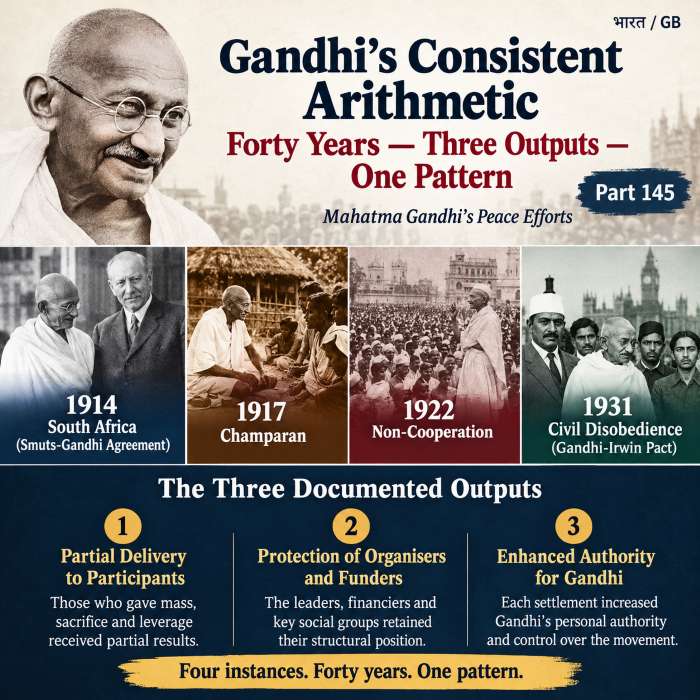
Gandhi’s Consistent Arithmetic: Forty Years — Three Outputs — One Pattern (145)
भारत / GB
Part 145: Mahatma Gandhi’s Peace Efforts | Series Index
Blog 144 placed the documented revelation of the switch before the reader — Gandhi’s authority after the February 1922 suspension was larger than before it because he had demonstrated he held the operational control of the movement. This post, “Gandhi’s Consistent Arithmetic”, places the documented arithmetic of forty years before the reader — not as a characterisation of motive, but as a documented pattern across every settlement from South Africa to the Gandhi-Irwin Pact.
Thank you for reading this post, don't forget to subscribe!The Action Taken: Gandhi served his 1922 sentence in a segregated special yard at Yerwada Central Prison, equipped with private quarters, a personal library, a spinning wheel, and companion prisoners.
Who Paid the Price: Thousands of ordinary satyagrahis who served sentences in crowded communal barracks under strict penal discipline and hard labor.
The Alternative Bypassed: Demanding that the leadership share the exact same prison conditions, rations, and labor assigned to ordinary satyagrahi prisoners.
Why This Matters: Graded colonial detention: the imperial state treated Gandhi as an elite political prisoner with special privileges, distinguishing him from ordinary sedition convicts.
The Method — Arithmetic Not Motive
Gandhi’s Consistent Arithmetic places its method before the reader at the outset. The series does not use the word selfish. Motive is not provable from the documented record — and the series’ standard is to place only what the documented record establishes before the reader.
What the documented record establishes across forty years is not motive. It is arithmetic. The arithmetic of who received partial delivery, who was protected, and whose authority was enhanced by each documented settlement — placed before the reader as a documented pattern, not as a characterisation.
The Three Documented Outputs
Gandhi’s Consistent Arithmetic places three documented outputs before the reader. Across every documented settlement from South Africa 1914 to the Gandhi-Irwin Pact 1931, the same three outputs appear in the documented record.
Output 1 — Partial delivery to those who paid. The participants who provided the documented mass, the documented sacrifice, and the documented leverage received partial documented delivery — never full, never structural, never the documented demand in its entirety.
Output 2 — Protection of those who organised and funded. The documented organisers and funders of each campaign — the merchant communities, the professional classes, the lawyers from landowning families — received documented protection of their structural position in each settlement. The prosecution places one documented observation alongside this: the arithmetic is not simply Congress versus the British. It is about which social groups bore different risks when mass political mobilisation was activated and then controlled. There was documented tension between nationalist mobilisation and sections of Bombay’s commercial and business community — merchants who supported Gandhi’s movement financially but whose documented commercial interests required the movement to remain within bounds that did not threaten the economic infrastructure they depended on. When Gandhi suspended, the commercial community’s documented structural position was not among the casualties.
Output 3 — Enhanced authority for the man who held the dam. Gandhi’s documented personal authority was enlarged by each settlement — not diminished. The act of settling, suspending, or negotiating confirmed his documented unilateral authority over the movement’s documented decisions.
South Africa 1914 — The First Instance
Gandhi’s Consistent Arithmetic places the South Africa settlement before the reader. Seven years of documented resistance. The Smuts-Gandhi Agreement 1914.
Output 1: Indian marriages recognised, three-pound tax abolished — partial documented delivery to Indian workers.
Output 2: The Gujarati merchant community — who had funded the NIC and Gandhi’s documented legal work — received documented protection of their commercial and property rights. The structural discrimination framework remained intact but the merchant community’s documented specific grievances were addressed.
Output 3: Gandhi left South Africa with a documented international reputation — “The saint has left our shores,” Smuts documented. Gandhi returned to India as the documented architect of the first successful Indian Satyagraha. His authority on arrival in India in 1915 was built on the South Africa documented record.
Tamil indentured labourers — the most structurally disadvantaged documented community in South Africa — remained in the most structurally unchanged position after the settlement.
Champaran 1917 — The Second Instance
Gandhi’s Consistent Arithmetic places the Champaran arithmetic before the reader — established in detail in Blog 143 of this series.
Output 1:
The tinkathia system was abolished — the documented structural demand of the campaign. 25% refund of illegal exactions was delivered. Partial documented delivery to the tenant farmers on the cash demand; the structural cultivation obligation was ended.
Output 2:
The zamindari land ownership framework — the structural class of the lawyers and organisers who built the Champaran campaign — remained intact. The documented legal team, drawn from landowning and professional families, organised a campaign whose settlement did not threaten their structural position.
Output 3:
Gandhi arrived in Champaran relatively unknown in India. He left as a documented national figure — the man who had gone to the villages, documented the farmers’ grievances with rigorous precision, and extracted a partial settlement. His documented authority in India was established on the Champaran arithmetic.
The landless agricultural labourers — the most autonomously organised and most structurally vulnerable documented participants — were invisible in the settlement’s documented terms.
Non-Cooperation 1922 — The Third Instance
Gandhi’s Consistent Arithmetic places the Non-Cooperation arithmetic before the reader.
Output 1:
No documented settlement. No prisoner release. No concession. Zero documented delivery to the 60,000 participants who had been jailed, whose documented property had been confiscated, whose documented livelihoods had been disrupted.
Output 2:
The movement’s elite nationalist leadership — the Congress Working Committee, the lawyers and professionals who had organised the movement — were not the participants facing documented death sentences at Chauri Chaura. Malaviya’s documented private legal intervention saved 153 of 172 — not an organisational response, a private one.
Output 3:
Gandhi’s documented authority after the February 1922 suspension was, as Blog 144 established, larger than before it. He had demonstrated he held the switch. The inner circle’s documented reactions — national calamity, greatest blunder — did not produce Gandhi’s removal from leadership. They produced the Swaraj Party — a documented institutional response that worked within Gandhi’s movement, not against it.
The 172 Chauri Chaura participants initially sentenced to death — 19 executed, 110 given life imprisonment — were the documented human cost of the arithmetic’s third output.
Civil Disobedience 1931 — The Fourth Instance
Gandhi’s Consistent Arithmetic places the Civil Disobedience arithmetic before the reader.
Output 1:
The Gandhi-Irwin Pact — established in Blogs 17-20 and Blog 138 of this series. Not one of the eleven demands met in full. The colonial apparatus intact. The 60,000 jailed participants’ documented sacrifice produced no documented structural change.
Output 2:
The Congress organisation — its documented leadership, its documented institutional continuity — was preserved by the Pact. The Pact’s amnesty covered non-violent civil disobedience prisoners. The revolutionary wing — Bhagat Singh, Sukhdev, Rajguru — was excluded. The organisational structure Gandhi led was protected. The participants who had operated outside Gandhi’s documented non-violent framework were not.
Output 3:
Gandhi sailed to London for the Second Round Table Conference as Congress’s sole documented representative. He had been named Time magazine’s Man of the Year in January 1931 — recognition for the 1930 Salt March, awarded before the Pact was signed. The recognition was for the documented mass mobilisation. Bhagat Singh, Sukhdev, and Rajguru were hanged on March 23 1931 — eighteen days after Gandhi signed the Pact that secured the London seat.
The Documented Pattern
Gandhi’s Consistent Arithmetic places the four documented instances before the reader as a consolidated pattern.
Across forty years — South Africa 1914, Champaran 1917, Non-Cooperation 1922, Civil Disobedience 1931 — the documented arithmetic produced the same three outputs in each instance. Partial delivery to participants. Protection of organisers and funders. Enhanced authority for Gandhi.
The most structurally vulnerable documented participants — Tamil indentured labourers, landless Champaran labourers, Chauri Chaura defendants, Bhagat Singh — received the least from each documented settlement.
The series does not call this selfish. It places the arithmetic before the reader. The reader supplies the word.
The Prosecution’s Position
Gandhi’s Consistent Arithmetic places three questions before the reader.
- Do the four documented instances — South Africa 1914, Champaran 1917, Non-Cooperation 1922, Civil Disobedience 1931 — each produce the same three documented outputs: partial delivery to participants, protection of organisers and funders, enhanced authority for Gandhi — establishing a documented pattern across forty years?
- Does the documented position of the most structurally vulnerable participants in each instance — Tamil indentured labourers, landless Champaran labourers, 172 Chauri Chaura defendants, Bhagat Singh — placed alongside the three documented outputs, constitute an exhibit the reader places alongside Gandhi’s documented unchallengeable authority over each settlement’s documented terms?
- Does the consistent documented arithmetic — the same three outputs across four documented instances spanning forty years — belong before the reader as a documented pattern whose characterisation the reader, not the prosecution, supplies?
The series does not answer. The four documented instances and their three documented outputs are placed before the reader. The reader will examine the pattern — and supply the word the prosecution does not.
Invitation To Defence
The floor belongs to the defense. We now invite them to present their exhibits and challenge the narrative established by the prosecution.
South Africa 1914: merchants received, Tamil labourers left behind, Gandhi confirmed as international figure. Champaran 1917: tinkathia abolished, 25% delivered, zamindari intact, landless invisible, Gandhi confirmed as national figure. Non-Cooperation 1922: no settlement, 172 sentenced to death, Gandhi’s authority largest after suspension than before. Civil Disobedience 1931: nothing in full, Bhagat Singh hanged eighteen days after signature, Gandhi sailed to London as Time’s Man of the Year. Four instances. Forty years. Three outputs. One pattern. The series does not supply the word. The reader will.
Feature Image: Click here to view the image.
Videos
Glossary of Terms
- Consistent Arithmetic: A unique phrase used in this blog to describe the recurring three-part pattern identified across Gandhi’s documented settlements: partial delivery to participants, protection of organisers and funders, and enhanced authority for Gandhi.
- Documented Pattern: The recurring pattern identified in the documented record across South Africa 1914, Champaran 1917, Non-Cooperation 1922, and Civil Disobedience 1931.
- Partial Delivery: The blog’s term for providing participants with only part of their demands or expected gains, rather than full or structural settlement.
- Enhanced Authority: The increase in Gandhi’s documented decision-making authority following each settlement, suspension, or negotiation.
- Smuts-Gandhi Agreement: The 1914 South Africa settlement between Gandhi and Jan Smuts that recognised Indian marriages and abolished the three-pound tax while leaving the broader discriminatory framework intact.
- Tinkathia System: The Champaran cultivation arrangement that required tenant farmers to grow indigo on a prescribed portion of their land and was abolished during the 1917 settlement.
- Non-Cooperation: The 1920–1922 mass political movement associated with Gandhi that was suspended in February 1922 after the Chauri Chaura incident.
- Chauri Chaura Defendants: The 172 participants initially sentenced to death following the Chauri Chaura violence, of whom 19 were executed and 110 received life imprisonment according to the blog.
- Civil Disobedience: The mass political campaign associated with Gandhi, culminating in the 1930 Salt March and the Gandhi-Irwin Pact of 1931.
- Gandhi-Irwin Pact: The 1931 agreement between Gandhi and Lord Irwin that enabled Gandhi to attend the Second Round Table Conference but did not fully meet any of the eleven demands identified in the blog.
- Revolutionary Wing: The revolutionary group represented in the blog by Bhagat Singh, Sukhdev, and Rajguru, whose position was not covered by the Gandhi-Irwin Pact’s amnesty.
- Second Round Table Conference: The London conference for which Gandhi travelled in 1931 as Congress’s sole documented representative.
- Output: A unique analytical term used in the blog for one of the three recurring results identified from the documented settlements: partial delivery, protection of organisers and funders, and enhanced authority for Gandhi.
- Exhibit: A prosecution-oriented term used in the series for a documented fact or body of evidence placed before the reader for examination alongside other evidence.
- Invitation to Defence: A recurring series phrase that formally gives the defence an opportunity to present its exhibits and challenge the narrative established by the prosecution.
#HinduinfoPedia #Gandhi #MahatmaGandhi #India #History #IndianHistory #Congress #FreedomMovement #Satyagraha #CivilDisobedience #NonCooperation #Champaran #BhagatSingh #GandhiIrwinPact
Gandhi’s Peace Efforts: The Questions Before the Mahatma (0)