
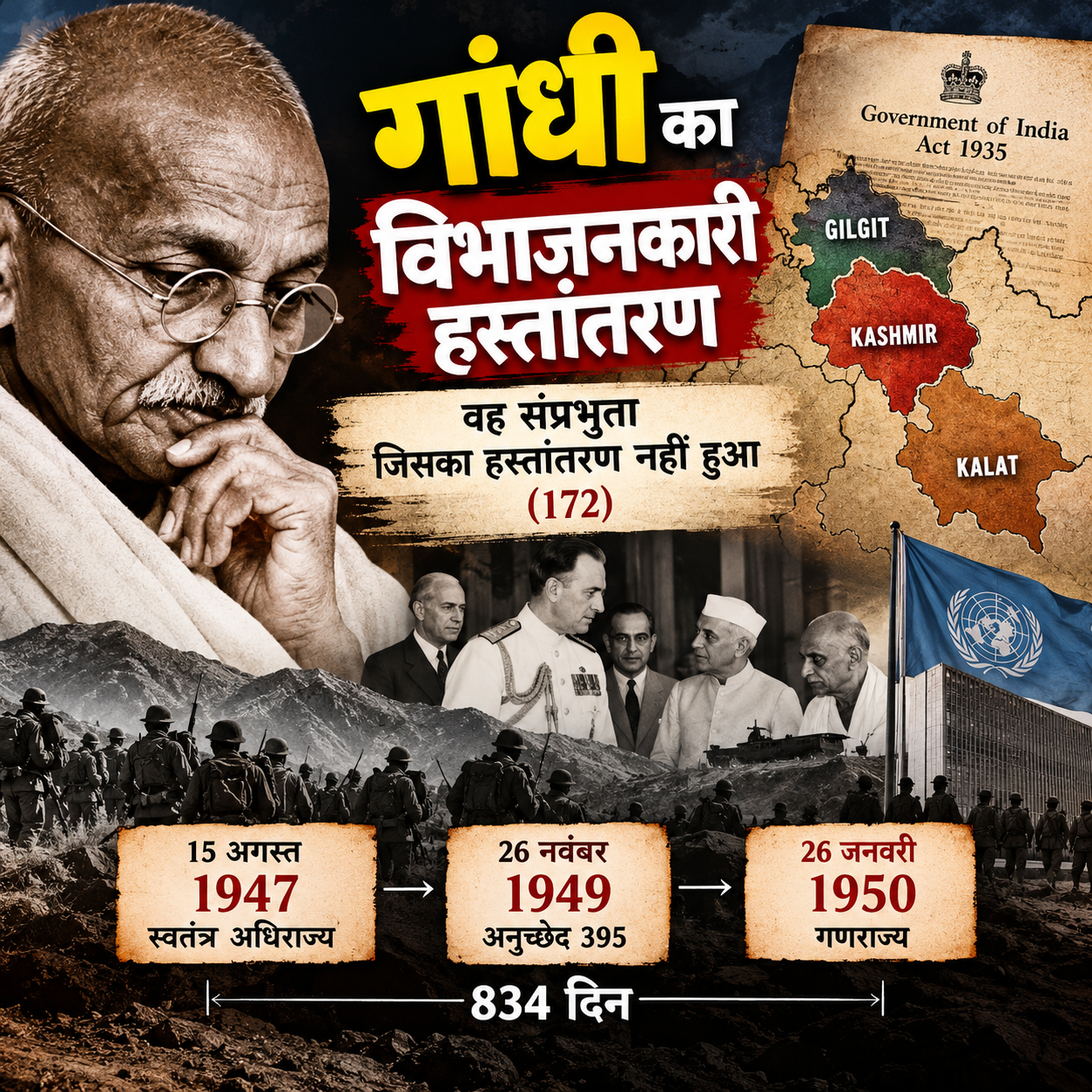
Gandhi Sovereignty Transfer Partition: The Sovereignty That Was Not Transferred (172)
भारत / GB
Part 172: Mahatma Gandhi’s Peace Efforts | Series Index
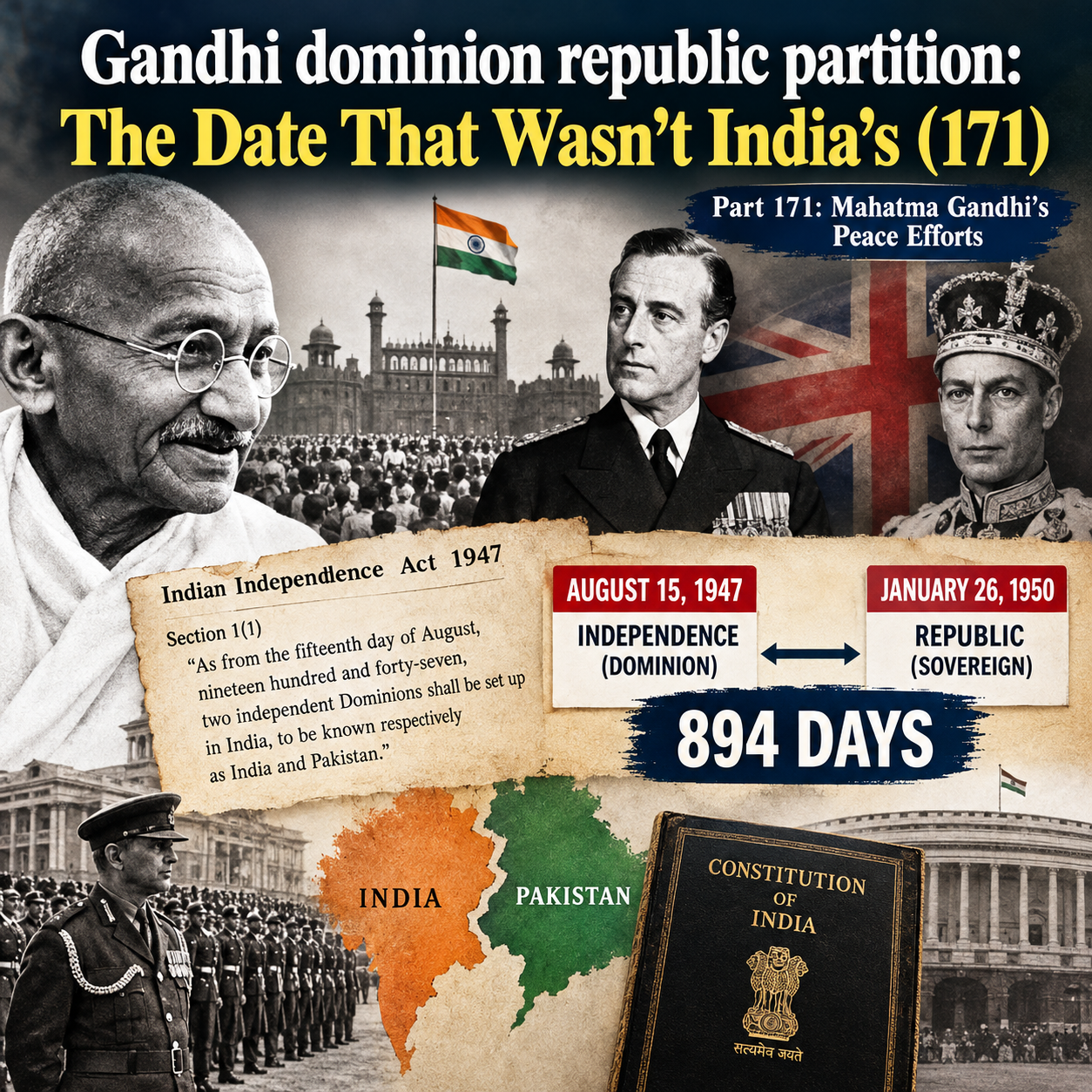
Blog 171 placed before the reader the Gandhi dominion republic partition — the 834 days between August 15, 1947, the date India was told it was independent, and November 26, 1949, the date India’s own Constituent Assembly passed Article 395, the clause that repealed British statutory authority over India. January 26, 1950 is the date that decision came into operative effect: Republic Day, when the machinery stopped. Three dates, three separate events. This post examines what the Dominion period produced at its territorial edges — decisions taken during those 834 days, while the British statutory framework remained operative and the sovereign act of repeal had not yet been passed. The Gandhi Sovereignty Transfer Partition is the prosecution’s exhibit for the proposition that what was transferred on August 15, 1947 was administrative office — not sovereignty.
Thank you for reading this post, don't forget to subscribe!THE HISTORICAL RECORD — THE SOVEREIGNTY THAT WAS NOT TRANSFERRED
The Pattern: On August 15, 1947, India was declared an independent Dominion. The head of state was King George VI. The governing statute was the Government of India Act 1935. India’s own Constituent Assembly did not pass the clause repealing that statute until November 26, 1949 — 834 days later. Three territorial decisions of permanent consequence — Gilgit, Kalat, Kashmir — were taken inside that window, while the sovereign decision to end British statutory authority had not yet been made. The Gandhi Sovereignty Transfer Partition is the name the prosecution gives to those 834 days and what they contained.
The Lethal Exhibit: Sardar Vallabhbhai Patel integrated 565 princely states using one method: direct negotiation, followed by police or military action where required. The Hyderabad Police Action of September 1948 required five days. The Junagadh question was resolved within six months. One state — Kashmir — was referred to the United Nations Security Council on January 1, 1948, over Patel’s documented objection. The record is closed for Hyderabad and Junagadh. For Kashmir it is not.
Why it matters: Gandhi’s April 1946 intervention at the Congress Working Committee determined that Nehru, not Patel, would lead the negotiations for transfer of power — and therefore govern India during those 834 days. That intervention sits alongside the territorial record of the Dominion period: which decisions were taken under Nehru’s method, which under Patel’s, and what each produced. The reader will place the two methods and their outcomes before the record.
The Statute That Governed the 834 Days
The Indian Independence Act 1947 created two Dominions. It did not create two sovereign republics. The constitutional framework under which both new states governed themselves was the amended Government of India Act 1935 — a statute of the British Parliament, not one the independent legislature of a sovereign state had enacted for itself.
That statute remained India’s governing framework for 834 days — from August 15, 1947 until November 26, 1949, the date India’s own Constituent Assembly passed Article 395, the repeal clause. That was the sovereign decision: the elected assembly of India, answerable to no British authority, chose on that date to legislate the end of British statutory authority over India. January 26, 1950 is the date that decision came into operative effect — the Republic was proclaimed, the Crown’s office was terminated, the machinery stopped. The decision and its execution were two separate acts, separated by sixty days.
The Gandhi Sovereignty Transfer Partition is the 834-day gap between the date India was told it was independent and the date India’s own assembly passed the law ending British rule. What India celebrated on August 15, 1947 was the transfer of administrative office. The sovereign act of will — the legislative decision to repeal the colonial statutes — came 834 days later.
The contrast between the constitutional heads of the two new Dominions is a structural fact within this window. India invited Lord Mountbatten to serve as its Governor-General. Pakistan did not invite a British officer; Jinnah assumed the office himself. Under Section 8(2) of the Indian Independence Act, the Governor-General held no independent executive discretion — he was bound to act on the advice of the Indian Cabinet. The prosecution is not claiming Mountbatten held executive authority he did not hold. It is placing the structural decision before the reader: India’s leadership chose to retain a British Viceroy as its first constitutional head of state. That choice required an invitation. The invitation is the exhibit. Pakistan did not extend one.
The Structural Reading: Three Decisions, One Window
Three territorial decisions of permanent consequence were taken between October 26, 1947 and March 27, 1948 — a window of 152 days entirely within the 834-day Dominion period, entirely within the tenure of Lord Mountbatten as India’s constitutional head of state, and entirely within the period in which the Government of India Act 1935 was operative and India’s own assembly had not yet passed the clause repealing it.
The first was Kashmir. The Instrument of Accession was signed by Maharaja Hari Singh on October 26, 1947, and accepted by India on October 27. The legal position was established: Kashmir was Indian territory. On January 1, 1948 — sixty-six days later — Nehru referred the matter to the United Nations Security Council. Patel’s objection to the referral is in the documented record. The referral converted a bilateral military question into an international dispute with no agreed resolution mechanism. The Line of Control that resulted has not moved in seventy-eight years.
The second was Gilgit. The Instrument of Accession made Gilgit-Baltistan part of Indian sovereign territory from October 27, 1947. On November 1, 1947 — five days later — Major William Brown, Commandant of the Gilgit Scouts and a serving British officer, led a coup against the Maharaja’s Governor. Brown’s first action after the coup was a telegram to Peshawar requesting a Pakistani Political Agent. Muhammad Alam Khan was installed as Pakistani administrator on November 16, 1947. The London Gazette of July 1948 recorded Brown’s MBE. The court-martial record is blank. Gilgit-Baltistan remains outside Indian administrative control.
The third was Kalat. On August 11, 1947, Ahmad Yar Khan, Khan of Kalat, declared Kalat an independent sovereign state. He offered India an Instrument of Accession. Kalat was non-contiguous with India — separated by Pakistani territory — which placed the same geographic constraint on Indian acceptance that the Congress applied to Junagadh. The contiguity constraint is on the record. The documented exhibit, however, is Mountbatten’s conduct: the available record shows pressure applied toward Pakistan accession, not mediation between options. Prince Abdul Karim led an armed uprising against forced annexation. On March 27, 1948, Kalat was annexed by Pakistan. The Balochistan Liberation Army, established as institutional continuation of that resistance, remains on the record.
Three decisions. Three territorial outcomes. One 834-day window in which India’s own assembly had not yet passed the sovereign decision to end British statutory authority. One constitutional head of state — a British officer — during whose tenure all three were resolved.
The prosecution does not claim that Mountbatten directed any of these outcomes. It places the structural fact before the reader: these decisions were taken while British officers commanded both armies, a British officer was India’s constitutional head of state, and the Government of India Act 1935 was the operative framework — the framework India’s own assembly had not yet legislated to repeal.

The contrast between the two methods available to the Indian leadership in 1947 is not hypothetical. It is recorded.
Patel’s method: direct negotiation, with the Instrument of Accession as the instrument of integration, backed by police or military action where required. Applied to 565 princely states, the method produced 565 integrations. The Hyderabad Police Action of September 1948 — Operation Polo — required five days. The Nizam’s resistance had been sustained and internationally connected; the operation was nonetheless complete within a week. The Junagadh question — where the Nawab had acceded to Pakistan despite a Hindu-majority population and a land border with India — was resolved within six months through a referendum, without international referral.
Nehru’s method — applied, in Gandhi’s design, to Kashmir — referred the question to the United Nations Security Council on January 1, 1948, within the 834-day window. The Security Council placed the matter under Chapter VI of the UN Charter (Pacific Settlement of Disputes). The resulting Commission on India and Pakistan produced a resolution on August 13, 1948 calling for a plebiscite conditioned on Pakistani troop withdrawal. Pakistan did not withdraw. The plebiscite was never held. The ceasefire line of January 1, 1949 became the Line of Control.
The prosecution places this comparison before the reader plainly: Patel’s method closed 565 questions. Nehru’s method, applied to one question, produced a frozen line that has not moved in seventy-eight years. Gandhi’s April 1946 intervention at the Congress Working Committee determined which man governed India during those 834 days — and therefore which method was applied to Kashmir.
The prosecution does not claim the outcomes were equivalent in difficulty or circumstance. It places the sequence before the reader.
Gracey’s Refusal and the Limits of Dominion Command
General Sir Douglas Gracey was Commander-in-Chief of the Pakistan Army from August 15, 1947. He was a British officer on contractual service to the new Dominion — one of the British officers commanding both armies during the 834-day period in which India’s own assembly had not yet passed the sovereign repeal.
In October 1947, when tribal lashkars supported by Pakistani irregular forces crossed into Kashmir, Pakistan’s Governor-General Muhammad Ali Jinnah ordered Gracey to commit regular Pakistan Army units to the operation. Gracey refused. He cited the War Office’s standing instruction: if British-officered Dominion forces were ordered to engage each other, all British officers on contract to both armies would be mass-withdrawn. That contractual mechanism — not a legal veto, not a constitutional authority — was what Gracey placed before Jinnah. Field Marshal Auchinleck held the position of Supreme Commander during the transition period, but his mandate was strictly limited to administering the division of armed forces assets between the two new states. He had no operational command over either Dominion army. The lever Gracey cited was contractual, not constitutional — but it was a lever that ran to the British War Office, not to either Dominion government.
The Gandhi Sovereignty Transfer Partition places this on the record as a structural description of what those 834 days were: a period in which the armies of both new states were commanded at the apex by British officers whose contractual arrangements ran to Whitehall, and in which operational decisions were constrained by levers the British War Office held. India’s own assembly passed the sovereign decision to end that framework on November 26, 1949. Until that date, the framework remained.
The Prosecution’s Position
Gandhi’s Thirty Years places three questions before the reader. Each question concerns the same proposition: that what was transferred on August 15, 1947 was sovereignty.
- Does the documented record — the Government of India Act 1935 as India’s governing statute for 834 days after the Dominion was declared; Lord Mountbatten as India’s constitutional head of state during the period in which Gilgit was lost, Kalat’s accession was declined, and Kashmir was referred; and the invitation India extended to a British Viceroy that Pakistan did not — constitute an exhibit the reader places alongside the claim that sovereignty was transferred on August 15, 1947?
- Does the comparison between Patel’s method — 565 integrations, Hyderabad in five days, Junagadh in six months — and the outcome produced by the method applied to Kashmir during those 834 days, constitute an exhibit the reader places alongside Gandhi’s April 1946 decision to place Nehru rather than Patel at the apex of the transfer negotiations?
- Does Gracey’s refusal to commit Pakistani forces to Kashmir — citing the War Office contractual mechanism under which mass withdrawal of all British officers from both armies would follow if they engaged each other — constitute an exhibit the reader places alongside the claim that full military sovereignty was operative in either Dominion from August 15, 1947?
The series does not answer. Gandhi’s Thirty Years places the Gandhi Sovereignty Transfer Partition before the reader: 834 days between August 15, 1947, the date India was told it was independent, and November 26, 1949, the date India’s own assembly passed the law that ended British statutory authority over India. Three territorial decisions of permanent consequence were taken inside that window. January 26, 1950 — Republic Day — is the date that decision came into operative effect. The reader will place the statute, the Governor-General, and the three decisions alongside the claim that sovereignty was transferred on August 15 — and complete the sentence.
Invitation To Defence
The floor belongs to the defense. We now invite them to present their exhibits and challenge the narrative established by the prosecution.
August 15, 1947: India was told it was independent. The Government of India Act 1935 remained operative. A British officer was Governor-General — by India’s invitation. British officers commanded both armies. November 26, 1949 — 834 days later: India’s own Constituent Assembly passed Article 395, the clause repealing British statutory authority over India. That was the sovereign decision. January 26, 1950: that decision came into operative effect. The Republic was proclaimed. Three dates, three separate acts. Gilgit was lost, Kalat was declined, Kashmir was referred — all within the 834-day window. Patel closed 565 questions by direct action. Kashmir was referred by Nehru, over Patel’s documented objection. The Gandhi Sovereignty Transfer Partition places these before the reader — and the reader will complete the sentence.
← Part 171 | Series Index | Exhibits Table | Forensic Archive
Feature Image: Click here to view the image.
Videos
Glossary of Terms
1. Gandhi Sovereignty Transfer Partition: A phrase used in the blog to describe the 834-day period between India’s declaration as an independent Dominion on August 15, 1947, and the Constituent Assembly’s passage of Article 395 on November 26, 1949, which repealed the British statutory framework.
2. Sovereignty: The supreme authority of a state to govern itself and make its own laws without being subject to an external power.
3. Dominion of India: The independent Dominion established on August 15, 1947, under the Indian Independence Act 1947, before India became a republic on January 26, 1950.
4. Indian Independence Act 1947: An Act of the British Parliament that created the Dominions of India and Pakistan and established the legal framework for the transfer of power.
5. Government of India Act 1935: British legislation that continued, in amended form, as the governing constitutional framework of India during the Dominion period.
6. Article 395: The article of the Constitution of India that repealed the Indian Independence Act 1947 and the Government of India Act 1935 when the Constitution came into effect.
7. Constituent Assembly: The representative body responsible for framing India’s Constitution and making the constitutional decisions that established the Republic of India.
8. Instrument of Accession: A legal document through which a princely state agreed to accede to India or Pakistan under the arrangements surrounding the end of British rule.
9. Princely States: Territories ruled by hereditary princes under British paramountcy that had to determine their political relationship with India or Pakistan during the transfer of power.
10. Dominion Period: The period during which India functioned as a Dominion under a constitutional framework derived from British legislation, before the Constitution became operative on January 26, 1950.
11. Line of Control (LoC): The military control line separating the areas of the former princely state of Jammu and Kashmir administered by India and Pakistan.
12. United Nations Security Council (UNSC): The United Nations body to which Jawaharlal Nehru referred the Kashmir question on January 1, 1948.
13. Operation Polo: The September 1948 military operation through which the Indian government brought Hyderabad under its control; the operation lasted five days.
14. Gilgit-Baltistan: A strategically important region that the blog identifies as having passed outside Indian administrative control following the events of November 1947.
15. Kalat: A former princely state whose ruler, Ahmad Yar Khan, declared it independent in August 1947; Pakistan annexed Kalat on March 27, 1948, according to the blog’s account.
#Gandhi #India #Partition #Sovereignty #Independence #History #Kashmir #Patel #Nehru #HinduinfoPedia
Scan Through The Entire Series at
Gandhi’s Peace Efforts: The Questions Before the Mahatma (0)