
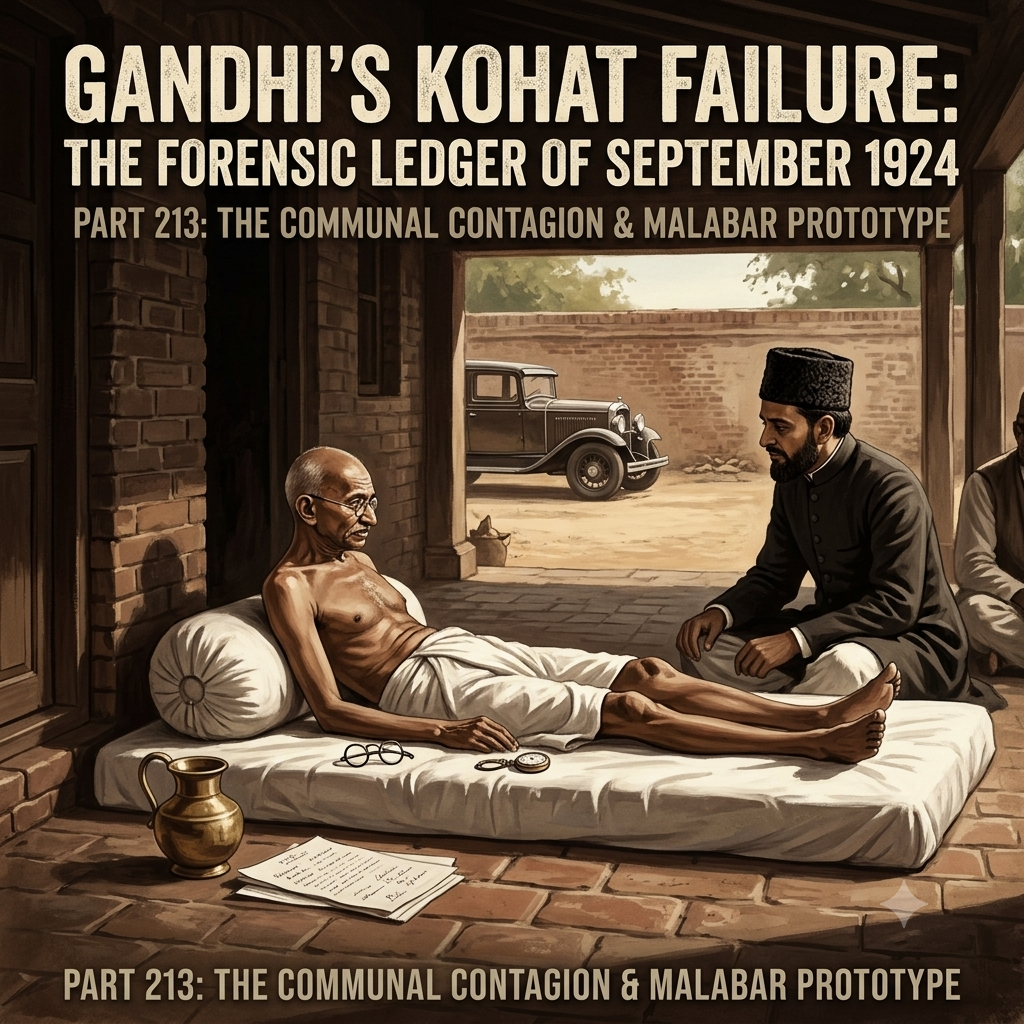
Gandhi’s Kohat Failure: Forensic Analysis Ledger of September 1924 (213)
भारत / GB
Part 213: Mahatma Gandhi’s Peace Efforts | Series Index
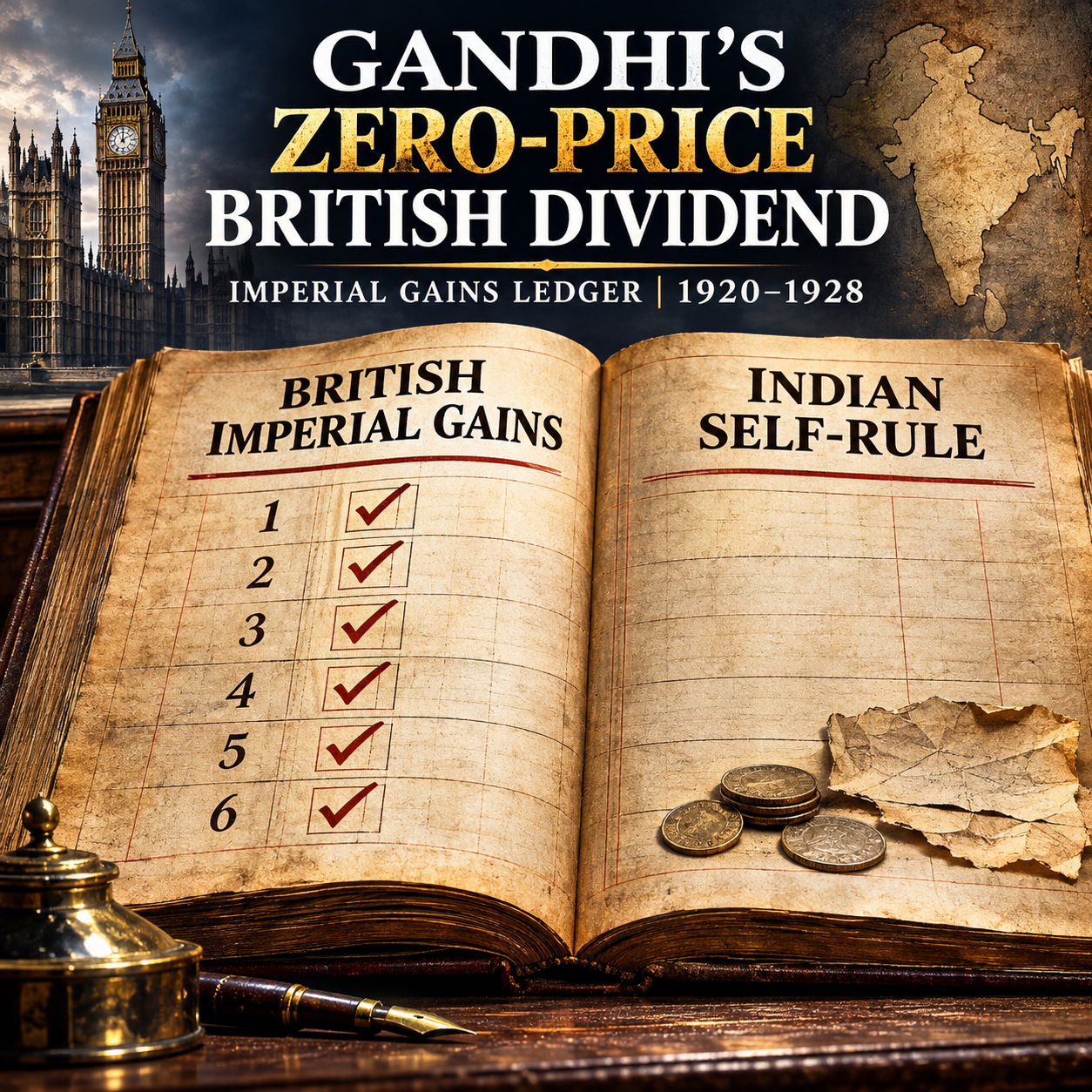
Blog 212 closed the account of The Khilafat Compact & Constructive Retreat (1919–1928), documenting the six concrete imperial gains Britain harvested from Gandhi’s February 1924 release and settling the four-party ledger of the Non-Cooperation era. This instalment opens the next arc — The Communal Contagion & Malabar Prototype — by breaking down the September 1924 Kohat expulsion and Gandhi’s Delhi fast into a complete forensic ledger across eight analytical dimensions. Detailed accounts of Gandhi’s 21-day fast are in Blog 155; the Khilafat fracturing of local neighbourhoods is in Blog 183.
Thank you for reading this post, don't forget to subscribe!THE FORENSIC LEDGER OF KOHAT (SEPTEMBER 1924)
The Action Taken: On 9–11 September 1924 — six months after Ankara abolished the Ottoman Caliphate — a mosque-mobilised attack expelled Kohat’s entire Hindu and Sikh population (approximately 3,500 residents) under British military escort to Rawalpindi, killing at least 36 and burning homes, shops, and temples. Gandhi responded with a 21-day fast at Maulana Muhammad Ali’s Delhi residence (18 September – 8 October 1924), ending with non-binding Unity Conference resolutions, conflicting March 1925 Rawalpindi reports, and a January 1925 British settlement that dropped criminal prosecutions.
Who Paid the Price: Kohat’s 3,500 Hindu and Sikh residents — permanently uprooted from businesses, property records, and community; the families of those killed; and a minority whose partial return in 1925 was purchased by granting legal immunity to perpetrators.
Why This Matters: Splitting the September 1924 record into its exact operational components establishes how a mobilization apparatus built during the Khilafat movement survived the death of the Caliphate, re-centred political focus onto Gandhi’s personal survival, and set a repeatable template of expulsion without accountability.
A Co-ordinated Attack on Hindus and Sikhs, Not a Two-Sided Riot
Following inflammatory mosque gatherings on the night of 8 September 1924 — where crowds swore a collective oath of divorce (talaq) after Sanatan Dharma Sabha secretary Jiwan Das was released on bail in the Risala-i-Vartman (Krishan Sandesh) pamphlet dispute, itself a response to an anti-Hindu poem in the Rawalpindi paper Lahaul — armed mobs attacked Kohat’s Hindu and Sikh quarters on 9 September, joined on the night of 10 September by Pashtun tribesmen breaching the city’s mud walls.
At least 36 people (predominantly Hindus and Sikhs) were killed, over 140 injured, homes, account books (bahis), shops, and temples burned, and the entire minority population of approximately 3,500 evacuated by special trains to Rawalpindi between 11 and 15 September — leaving zero Hindus or Sikhs inside Kohat and establishing the baseline of Gandhi’s Kohat failure.
From Malabar (1921) to Kohat (1924): Subcontinental Replication
The 1921 Malabar rebellion had already demonstrated that mosque-led mass mobilization could overwhelm a local minority while the Congress Working Committee — at Ahmedabad in December 1921 — passed resolutions downplaying anti-Hindu violence and preserving the Khilafat alliance. Following Malabar on the southwestern coast and 30 to 40 smaller communal outbreaks across northern India — including Multan (1922), Saharanpur (1923), and the commercial and social boycotts in Delhi’s Chandni Chowk and the Agra–Mathura belt documented in Blog 183 — the contagion reached Kohat, a garrison town of 20,000 residents (including approximately 3,500 Hindus and Sikhs) 40 miles south of Peshawar.
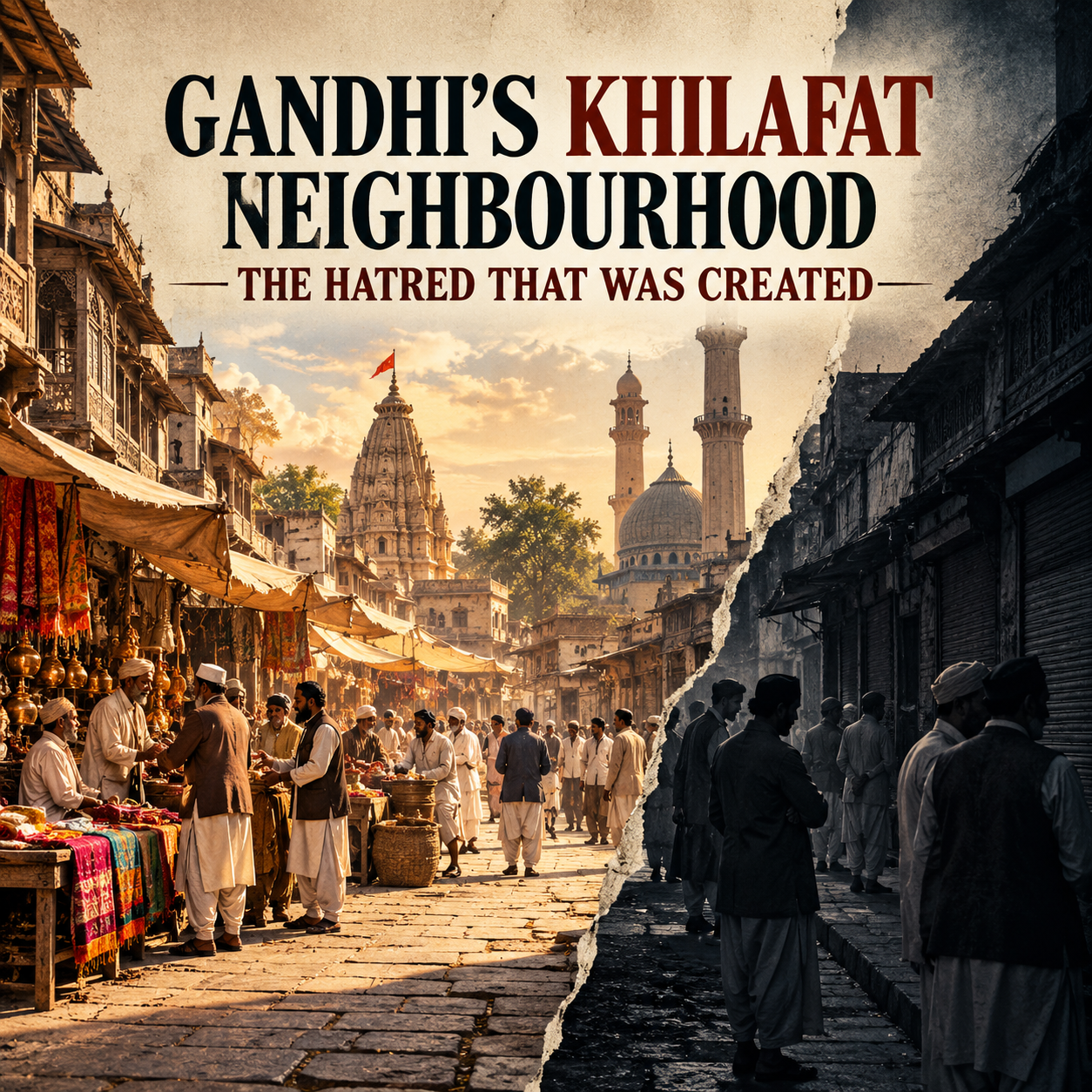
The Post-Caliphate Pivot and the Nagpur (December 1920) Machinery
Mustafa Kemal Atatürk and the Turkish Grand National Assembly abolished the Ottoman Caliphate on 3 March 1924 — six full months before the September 1924 Kohat expulsion. Although the movement’s international pretext was dead, the Khilafat formations, mosque committees, and religious slogans sealed at the Nagpur Congress session in December 1920 — where Quranic verse 9.5 and clerical declarations were chanted from the official dais — remained intact and were permanently redirected against domestic Hindu and Sikh minorities, exactly as Swami Shraddhanand had anticipated and brought directly to Gandhi’s notice.
Following the clerical declaration of British India as Dar-ul-Harb — amplified by Gandhi’s association with the Khilafat movement during the summer of 1920 — local Muslims along the Kurram–Parachinar route carried fresh, bitter memories of selling lands and homes at distress prices to trek to the Afghan border, only to return destitute after Kabul sealed the frontier in August 1920. That unresolved economic and religious resentment hardened local hostility against non-Muslim neighbours when the September 1924 mobilization ignited — completing the structural context of Gandhi’s Kohat failure at the machinery level.
A Paralysed State Shield and Severed Social Trust
Kohat’s predominantly Muslim civil police either stood passive or joined the plunder during 9–11 September. Although Kohat housed a major British military cantonment, Frontier authorities chose mass evacuation to Rawalpindi rather than street combat, operating under Frontier tribal containment doctrine in a command climate already strained by non-cooperation directives against state service.
Replicating the social and commercial fracture documented in Blog 183 across Chandni Chowk and Agra–Mathura, the Khilafat mobilization had severed multi-generational bahi-khata credit links and civic trust between Kohat’s commercial minority and surrounding Muslim networks before the September 1924 arson destroyed account books and property deeds directly.
Gandhi’s Post-Prison Role: Dipping Popularity and Containing Anti-Colonial Momentum
Released from Yerwada Prison on 5 February 1924 — documented in Blog 212 — Gandhi returned to a political landscape where the Indian National Congress had been captured by Swarajist constitutionalists (C.R. Das and Motilal Nehru) pursuing legislative council entry, while revolutionary youth cadres demanded direct action. Throughout the 1924–1928 constructive interregnum documented in Blog 211, Gandhi kept mass civil disobedience off the table, containing anti-colonial mass agitation while accommodating the constitutionalist formation.
By September 1924, Gandhi’s standing had eroded simultaneously across three fronts: among Muslims after he unilaterally halted Non-Cooperation at Bardoli (February 1922) and after Ankara abolished the Caliphate (March 1924); among Hindus turning toward the Das–Nehru formation and Hindu Sabha leaders over his silence on anti-Hindu violence; and inside Congress itself, where C.R. Das and Motilal Nehru challenged his boycotts at the June 1924 Ahmedabad AICC session and Gandhi wept publicly on the dais when the Gopinath Saha resolution was defeated by only 78 votes to 70. That three-front collapse is the immediate political context of Gandhi’s Kohat failure as a response.
Gandhi’s Venue for Fasting: Dilkusha Cottage, Delhi
Instead of travelling to Rawalpindi (nearly 500 miles away) or Kohat (roughly 800 miles northwest), Gandhi conducted his entire 21-day fast (18 September – 8 October 1924) in Delhi — insulated from burned mohallas and destitute families crowded into dharmashalas and makeshift camps.
Gandhi chose to fast inside Dilkusha Cottage, the Delhi residence of Maulana Muhammad Ali — co-leader of the Ali Brothers and head of the Khilafat organisation whose Frontier mosque network had fostered the hostility that produced the expulsion.
With Hindus increasingly aligned with the Das–Nehru formation, fasting inside Muhammad Ali’s home secured Muslim political backing, rehabilitated the Ali Brothers after their cause had died in Ankara, and forced every visiting Congress or Hindu figure to walk through Muhammad Ali’s doors — cementing the geographic and political asymmetry of Gandhi’s Kohat failure. Surrounded at Dilkusha Cottage by Muhammad Ali, Shaukat Ali, Hakim Ajmal Khan, Maulana Abul Kalam Azad, Dr. M.A. Ansari, C.F. Andrews, and Congress loyalists (fully documented in Blog 155), Gandhi had zero mandated representatives of Kohat’s 3,500 displaced Hindu and Sikh refugees at his bedside.
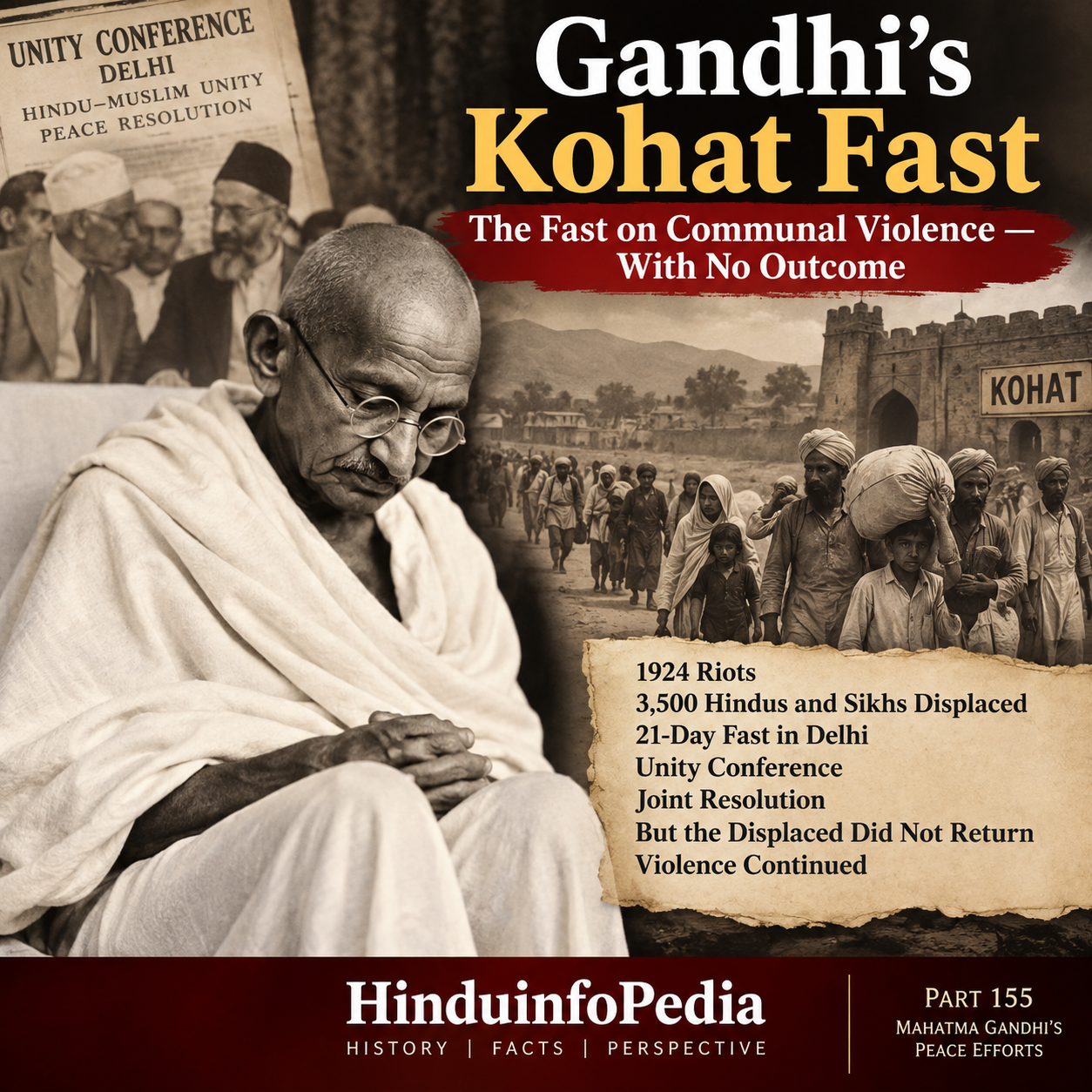
The 21-Day Fast and Full-Scale Media Capture
Throughout the 21 days, Gandhi’s fast operated as a full-scale diversionary display — daily medical bulletins on pulse, weight, and weakness monitored by Dr. Ansari, Dr. Abdur Rahman, and C.F. Andrews, telegraphed across India while Hindu delegates at the All-Party Unity Conference (26 September – 2 October 1924, presided over by Motilal Nehru, approximately 300 delegates) were pressured to reach agreement before Gandhi’s condition became critical.
Front-page newspaper coverage across British India replaced the Rawalpindi refugee camps with daily updates on Gandhi’s pulse rate and weight — diverting public urgency away from the crime, the perpetrators, and the displaced families onto Gandhi’s personal health and the Unity Conference’s manufactured peacemaking, defining Gandhi’s Kohat failure in the national public sphere.
The Zero-Consequence Ending: Four Outcomes on Record
Outcome A — 8 October 1924: Gandhi broke his fast after the Delhi Unity Conference passed unenforceable resolutions on cow protection and mosque music — signed off by Gandhi’s own Congress circle rather than mandated representatives of Kohat’s victims.
Outcome B — October–December 1924: Viceroy Lord Reading’s government barred Gandhi and Shaukat Ali from entering Kohat itself; their hearings were conducted separately in Rawalpindi.
Outcome C — January 1925: NWFP Chief Commissioner Sir Horatio Bolton brokered a local settlement allowing partial return only on the condition that criminal prosecutions against identified perpetrators be dropped — while Gandhi advised displaced residents not to return “on the strength of British bayonets.”
Outcome D — 26 March 1925: Gandhi and Shaukat Ali published two contradictory statements in Young India on the same day, after Shaukat Ali rejected Gandhi’s attribution of primary blame to the Muslim majority’s violence. No joint report was possible.
Zero perpetrators convicted, zero restitution paid, and the demographic clearance of Kohat locked in — the complete ledger of Gandhi’s Kohat failure at every level.
Modern Parallel
Kohat itself remained a recurring fault line after 1947. The Partition exodus of August–September 1947 completed what September 1924 had begun, driving out the remaining Hindu and Sikh population permanently. In subsequent decades, sectarian attacks targeting Shia and Christian minorities recurred across Kohat district through the 1980s and 2013, and in November 2026 militant attacks on security convoys and the Old Police Lines continued the unbroken pattern. Whenever organised expulsion is met with symbolic personal gestures, media diversion, and prosecution-dropping settlements rather than enforceable legal accountability, it establishes a repeatable operational template.
Invitation To Defence
The NWFP administrative reports of September 1924, the police records on Lahaul and Risala-i-Vartman (Krishan Sandesh), the proceedings of the December 1920 Nagpur session and June 1924 Ahmedabad AICC session, Gandhi’s Young India statements of September 1924 and 26 March 1925, and Sir Horatio Bolton’s January 1925 settlement terms are all established primary documents. The defence is invited to identify any primary record showing that Gandhi’s 21-day fast brought a single Kohat victim delegation to Dilkusha Cottage or that the January 1925 settlement secured the criminal conviction of a single perpetrator.
Split across its eight operational components, September 1924 reveals an unbroken system: a mosque-mobilised expulsion of 3,500 Hindus and Sikhs six months after Ankara abolished the Caliphate; a 21-day fast inside Maulana Muhammad Ali’s Delhi home that diverted newspaper headlines from Rawalpindi refugee camps while rescuing Gandhi’s post-prison relevance; and a January 1925 British settlement that traded criminal prosecutions for partial return — the complete forensic ledger of Gandhi’s Kohat failure.
Feature Image: Click here to view the image.
Videos
Glossary of Terms
1. Gandhi’s Kohat Failure: The term describing Gandhi’s response to the September 1924 expulsion of Kohat’s entire Hindu and Sikh population, examining the Delhi fast, political consequences, media attention, and the absence of criminal accountability.
2. Forensic Ledger: A structured analytical accounting of an incident, dividing the historical record into specific operational components to identify actions, responsible parties, consequences, and accountability.
3. Communal Contagion: The spread and replication of communal hostility, organised mobilisation, and social fragmentation from one geographical region to another, as examined through Malabar and Kohat.
4. Malabar Prototype: The 1921 Malabar rebellion, presented in the blog as an earlier example of mosque-led mass mobilisation overwhelming a local minority, establishing a pattern subsequently examined in Kohat.
5. Mosque-Mobilised Attack: An organised attack in which gatherings, religious mobilisation, and mobilisation networks associated with mosques contribute to assembling and directing hostile crowds.
6. Talaq: An Islamic term for divorce. In the Kohat account, it refers to the collective oath of divorce reportedly taken by crowds following inflammatory mosque gatherings on 8 September 1924.
7. Ottoman Caliphate: The institution of the Ottoman Islamic caliphate, abolished by Mustafa Kemal Atatürk and the Turkish Grand National Assembly on 3 March 1924, six months before the Kohat expulsion.
8. Post-Caliphate Pivot: The transition described in the blog whereby the Khilafat organisational formations, mosque committees, and religious mobilisation networks continued functioning against domestic minorities after the abolition of the Ottoman Caliphate.
9. Dar-ul-Harb: An Islamic jurisprudential expression meaning a territory considered outside the domain of Islamic rule. The blog uses it in connection with clerical declarations concerning British India and the resulting religious and political mobilisation.
10. Frontier Tribal Containment Doctrine: The administrative approach described in the blog concerning the management and containment of tribal activity in the North-West Frontier, forming part of the security and command environment during the Kohat crisis.
11. Bahi-Khata: Traditional Indian account books used by merchants and traders to maintain financial transactions, credit relationships, and business records. Their destruction during the Kohat violence represented the loss of commercial records and established credit networks.
12. Constructive Interregnum: The 1924–1928 period described in the blog during which Gandhi kept mass civil disobedience off the table while accommodating the Swarajist constitutionalist formation within Congress.
13. Media Capture: The displacement of public and newspaper attention from the Kohat victims, refugee camps, and perpetrators towards Gandhi’s personal health, daily medical bulletins, and the Delhi Unity Conference during his 21-day fast.
14. Zero-Consequence Ending: The blog’s expression for the final outcome of the Kohat settlement, in which no perpetrators were convicted, no restitution was paid, and the displaced minority’s demographic clearance remained permanent.
15. NWFP and AICC: NWFP stands for North-West Frontier Province, the administrative region in which Kohat was situated. AICC stands for All India Congress Committee, the Congress organisation whose June 1924 Ahmedabad session is discussed in the blog.
#Gandhi #Kohat #Khilafat #IndianHistory #BritishIndia #Malabar #HinduHistory #SikhHistory #CommunalViolence #History #HinduinfoPedia
Scan Through The Entire Series at