
The Machine Outlived the Caliph: How the Khilafat Apparatus Operated After Khilafat (214)
भारत / GB
Part 214: Mahatma Gandhi’s Peace Efforts | Series Index
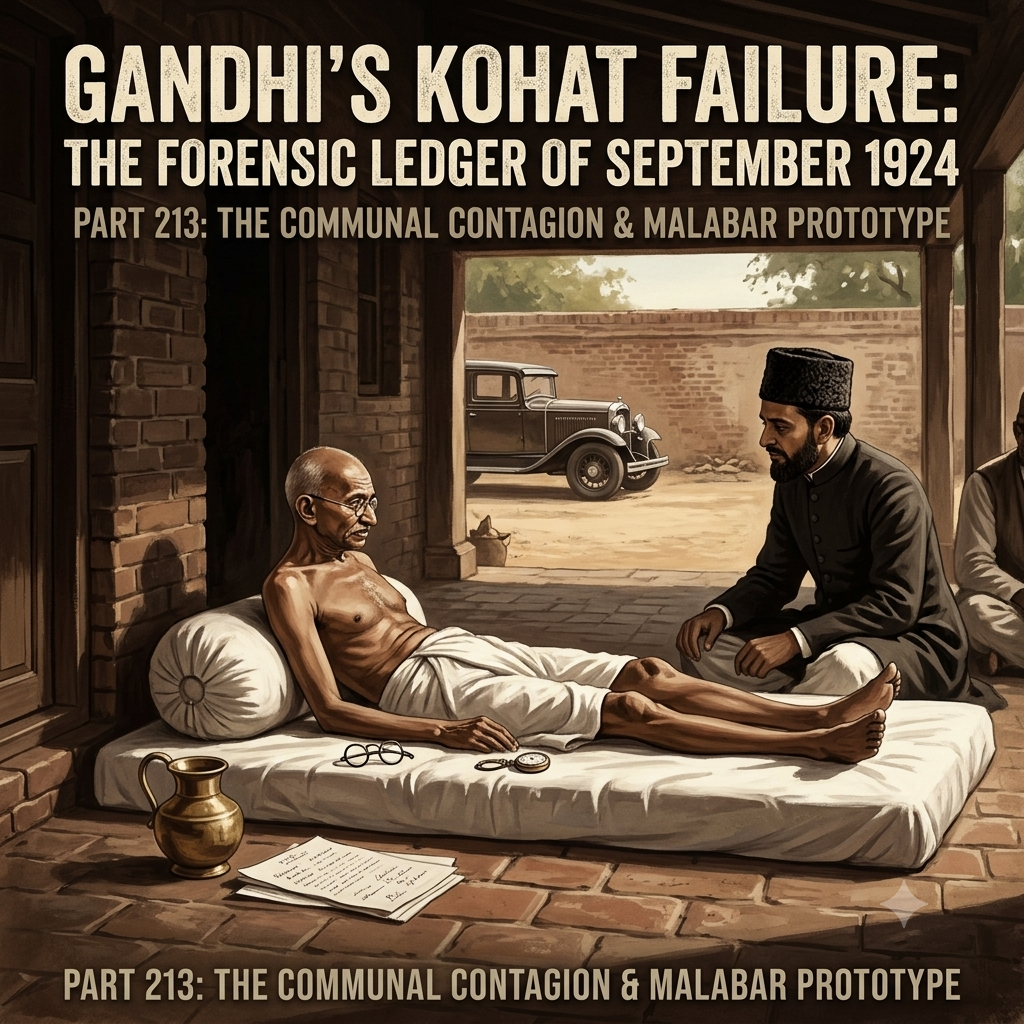
Blog 213 established the eight-dimension forensic ledger of the September 1924 Kohat expulsion — the ignition sequence, the demographic outcome, the paralysed state shield, Gandhi’s choice of venue, the media capture mechanics, and the zero-consequence ending. This instalment documents one structural fact that ledger disclosed: the Khilafat apparatus continued operating in full six months after Mustafa Kemal Atatürk abolished the Ottoman Caliphate on 3 March 1924 — and it re-directed its organizational hardware from an international Ottoman cause onto domestic Hindu and Sikh minorities without a pause.
THE POST-CALIPHATE APPARATUS: WHAT THE RECORD SHOWS
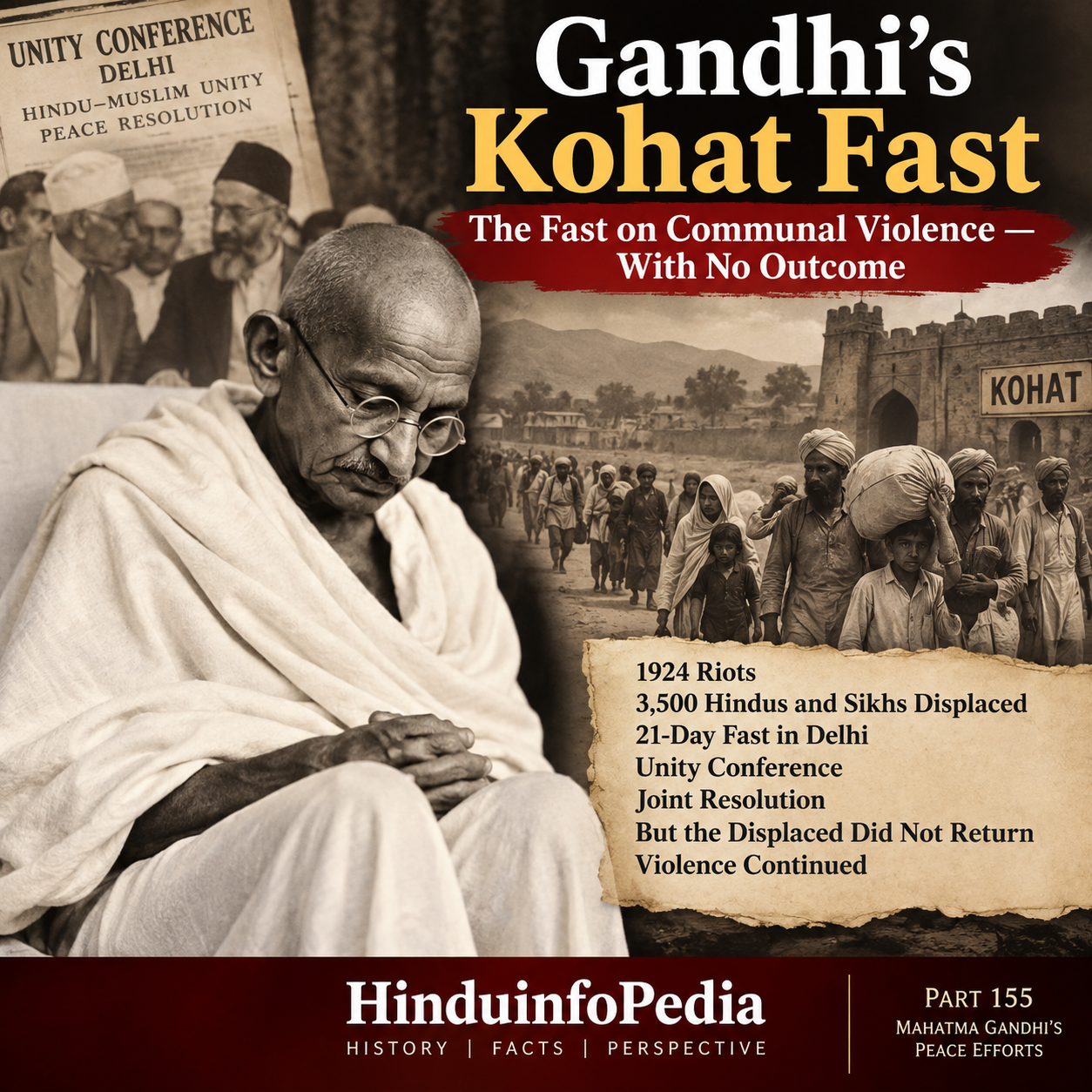
The Action Taken: On 3 March 1924, Atatürk and the Turkish Grand National Assembly abolished the Ottoman Caliphate — the stated international pretext for the Khilafat movement Gandhi had backed since 1919. Six months later, on 8–11 September 1924, the same mosque committees, clerical networks, and street apparatus that had operated under the Khilafat banner mobilised in Kohat, expelled the town’s entire Hindu and Sikh population under a mosque-led oath, and triggered a chain of events Gandhi could only respond to with a 21-day personal fast (documented in Blog 155).
Who Paid the Price: Every Hindu and Sikh community that the post-Caliphate apparatus targeted — Kohat’s 3,500 residents expelled in September 1924, and the residents of the towns and bazaars where the same network had already operated across north and northwest India between 1922 and 1924.
Why This Matters: The six-month gap between Ankara and Kohat is the clearest single piece of documentary evidence that the Khilafat organisation was never solely a movement in defence of an Ottoman institution. Its committees, its mosque-pulpit circuits, its street-level mobilisation capacity, and its capacity to impose social and commercial boycotts all continued intact after the founding pretext was removed — permanently redirected onto domestic minorities.
The Six-Month Gap: Ankara to Kohat — Riots Described
The sequence is established by dates on the public record. The Turkish Grand National Assembly’s Law No. 431 — abolishing the Ottoman Caliphate and expelling the Ottoman dynasty from Turkey — received Atatürk’s signature on 3 March 1924 and was published in the official gazette the same day. Contemporary records establish that Ankara acted directly in response to continuous interference by Indian Khilafatists in Turkey’s internal affairs, culminating in the November 1923 letter from Indian Khilafat leaders published in Istanbul newspapers before reaching Prime Minister İsmet İnönü. Six months and five days later, the Kohat mob gatherings began on the night of 8 September 1924, with the main attacks on 9–10 September — the next major documented instance of the same apparatus operating in India after the death of the institution it ostensibly existed to defend.
The six-month gap is the structural core of Gandhi’s post-Caliphate machine as a documented phenomenon: an organisation with no live international pretext, whose mosque committees and clerical networks had been active across north India since at least December 1920, did not dissolve when Ankara removed the cause it had publicly cited. It continued without interruption and without any recorded dissolution of its local committees, operating in accordance with the commitments clerics had made at Nagpur in December 1920 — including the invocation of Quranic verse 9.5, which applied specifically against non-Muslim idolaters rather than British Christians.
The Ali Brothers After Ankara: From Ottoman to Domestic Agenda
Maulana Muhammad Ali and Shaukat Ali — the two most prominent public faces of the Indian Khilafat movement, initially shielded from British prosecution in May 1921 after Gandhi brokered an apology deal with Viceroy Lord Reading at Simla before their later arrest and January 1923 release — had staked their entire political credibility on the restoration of the Ottoman Caliphate. After Atatürk’s abolition on 3 March 1924, Muhammad Ali chaired an emergency All-India Khilafat Conference in Delhi (27–28 March 1924) and addressed a Khilafat gathering in Lahore (May 1924) to contest Ankara’s decision, before later participating in international succession conferences at Cairo (Al-Azhar) and Mecca in 1926 — none of which produced a new Caliph.
Having exhausted the international track without result, the Ali Brothers re-occupied their domestic platform unchanged: the same public addresses, the same Young India column, the same Congress-stage presence, the same Quranic verses chanted at Nagpur in 1920, and the same relationship with mosque committees that had operated throughout the Khilafat years — confirming that Gandhi’s post-Caliphate machine rested on a network not dependent on any single international institution for its operational continuity, driven by the doctrinal commitments clerics had sealed at Nagpur in 1920.
The Jamiat Ulama-i-Hind Pivot
The Jamiat Ulama-i-Hind — the clerical body that had issued the 1920 fatwa declaring British India a Dar-ul-Harb (Abode of War) and providing theological sanction for both the Hijrat migration movement and the Khilafat agitation — held its annual session at Amritsar in December 1923, before the Caliphate’s abolition, where it passed resolutions on cow slaughter, music before mosques, and relations with non-Muslim communities, reaffirming the continuity of the clerical framework laid down at Nagpur in 1920. After Ankara, neither the Belgaum Khilafat Conference (December 1924) nor the Jamiat’s Moradabad session (January 1925) made any recorded call to dissolve its mosque-outreach apparatus; resolutions continued on the same domestic themes — communal relations, minority conversion activity, and the protection of Islamic practice in British India — vindicating the warnings of departing Congress leaders Annie Besant and Muhammad Ali Jinnah in 1920 that once religious mass agitation was unleashed, Congress would be unable to stop or control it.
The continuity of Jamiat engagement in communal affairs after March 1924 is part of the documented context of Gandhi’s post-Caliphate machine: the theological infrastructure that had declared India a war-zone for Muslims in 1920 — treating non-Muslim inhabitants of the land as adversaries in an active zone of conflict — did not retract that declaration when the Caliphate was abolished, and the mosque committees it had addressed across north India continued operating on the same framework, sustaining the doctrinal premise of ongoing struggle through the scriptural injunctions chanted at Nagpur in 1920.
The Talaq-Oath Mechanism at Kohat
The specific mobilisation technique documented at Kohat on the night of 8 September 1924 — a collective oath of divorce (talaq) sworn by mosque congregants before an attack, noted in Sir Horatio Bolton and Sir Denys Bray’s October 1924 inquiry records — was not a spontaneous local invention. The practice of binding collective oaths administered through mosque gatherings before communal action had been a feature of the Moplah uprisings in Malabar (1921) and in several smaller outbreaks across north India between 1921 and 1924, as documented in British administrative reports, the Moplah Rebellion Commission evidence, and the NWFP’s own September 1924 administrative correspondence.
The appearance of the talaq-oath mechanism in Kohat — invoked to target a Hindu secretary over a pamphlet answering an earlier anti-Hindu poem — six months after Ankara confirmed that Gandhi’s post-Caliphate machine had transmitted operational protocols, not merely ideology, across the network. The Kohat mosque was not improvising; it was applying a template that had operated at multiple previous sites and was guided through announcements from mosque pulpits at Friday congregations. Communities that had coexisted through two centuries of British administration and six centuries of earlier Muslim rule were fractured from within by the 1920 Dar-ul-Harb fatwa, the Hijrat migration drafts Gandhi had prepared, and the religious mobilization machinery Muhammad Ali Jinnah had warned at Nagpur in December 1920 would overtake the movement — shortly before he was heckled out of the Congress session.
The Mosque-Pulpit Network After the Caliphate
The Khilafat movement had achieved — between 1919 and 1922 — something with no precedent in the history of Indian Muslim political organisation: a functioning national network linking local mosque committees, Friday sermons (khutbahs), Urdu-language press, and clerical fatwa authority into a single agitational circuit. This circuit had operated under the Congress-Khilafat umbrella with Gandhi’s public endorsement and, crucially, with no organisational requirement that it be dismantled when Non-Cooperation was called off at Bardoli in February 1922.
After Atatürk’s abolition of the Caliphate in March 1924, neither Gandhi nor the Congress Working Committee issued any statement calling for the dissolution of Khilafat committees, the cessation of mosque-pulpit agitation, or the winding up of the communal mobilization infrastructure the movement had built — completing the documented picture of Gandhi’s post-Caliphate machine as a structure Gandhi had helped build, never formally asked to be dismantled, and was left responding to in September 1924 with a personal fast.
Organizational Hardware Outliving Its Founding Pretext
The documented record after March 1924 shows five components of the Khilafat apparatus continuing to function without an Ottoman Caliphate to defend. First, the All-India Khilafat Committee formally remained in existence and held conferences. Second, the Ali Brothers maintained their public platform inside the Congress framework, delivering addresses alongside Gandhi at joint Hindu–Muslim sessions. Third, local mosque committees established during the 1919–1922 agitation period — in Kohat’s case, in a garrison town with an established Pashtun tribal hinterland — retained their capacity to call collective gatherings and administer oaths. Fourth, the Dar-ul-Harb framework issued by the Jamiat Ulama-i-Hind in 1920 continued in force, never formally revoked. Fifth, Gandhi remained a staunch supporter of the Jamiat and Khilafat leadership, reflected in his decision to conduct his fast at the residence of those directly linked to the network that produced the Kohat expulsion.
All five components were documented and in operation on 8 September 1924 when Kohat’s mosque gathering began — establishing Gandhi’s post-Caliphate machine not as a metaphor but as an organisational description of what the September 1924 record shows was present and functioning at the moment of the expulsion.
Modern Parallel
The pattern of organizational infrastructure outliving its founding pretext — committees, clerical networks, and mobilisation circuits that continue operating after the international cause that justified their creation has ended — has recurred across the region in later decades. The Taliban’s Afghan infrastructure outlived Soviet withdrawal; Deobandi network committees established during the Afghan jihad of the 1980s continued operating through the 1990s and 2000s targeting Shia, Ahmadi, and Christian minorities in Pakistan’s Northwest Frontier, including Kohat district. The founding pretext changes; the operational hardware does not dissolve with it.
Invitation To Defence
The Turkish Grand National Assembly’s Law No. 431 (3 March 1924), the All-India Khilafat Conference proceedings of March and December 1924, Muhammad Ali’s Young India statements of March–September 1924, the NWFP administrative reports of September–October 1924, and the Congress Working Committee minutes of February 1922 and 1924 are all established primary documents. The defence is invited to identify any primary record — a Congress resolution, a Khilafat Committee announcement, or a Young India editorial — calling for the dissolution of Khilafat mosque committees or the cessation of communal mobilization activity between 3 March 1924 and 8 September 1924.
Between 3 March 1924 — when Atatürk abolished the Ottoman Caliphate — and 8–11 September 1924 — when Kohat’s mosque-led apparatus expelled the town’s entire Hindu and Sikh population — not a single Congress resolution, Khilafat announcement, or Gandhi editorial called for the dissolution of the network. The six-month gap between Ankara and Kohat is the clearest single entry in the documentary record of Gandhi’s post-Caliphate machine: an organizational apparatus built with Gandhi’s endorsement, sustained without any call to stand down, and operational on the night the Kohat oath was sworn.
Feature Image: Click here to view the image.
Videos
Glossary of Terms
Scan Through The Entire Series at
Refer to Various Arks Referred to in the Blog
https://hinduinfopedia.in/the-machine-outlived-the-caliph-how-the-khilafat-apparatus-operated-after-khilafat-214/