

Gandhi’s Khilafat Compact: The Trade — Hindu Political Capital for Muslim Mass Mobilisation (148)
भारत / GB
Part 148: Mahatma Gandhi’s Peace Efforts | Series Index
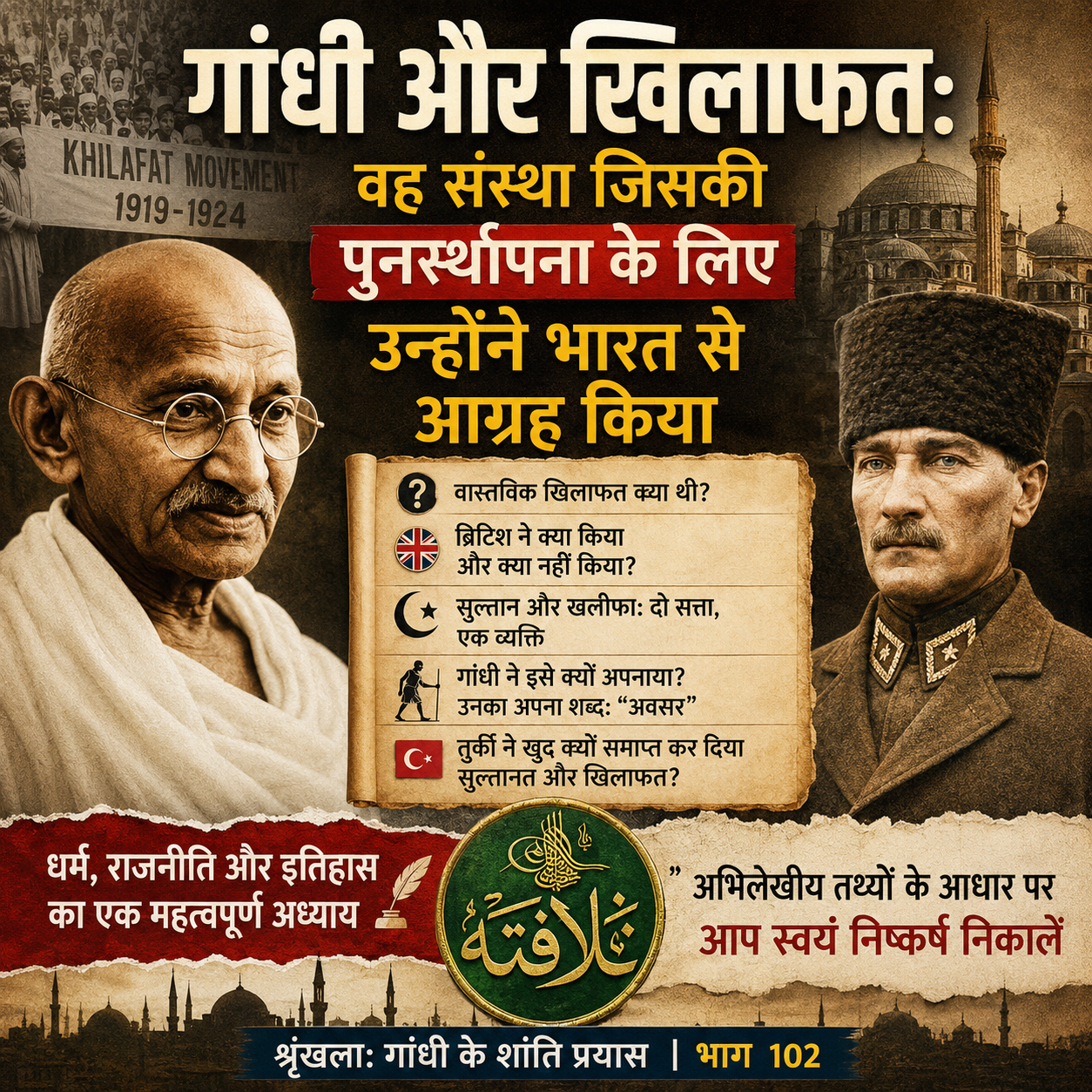
The Khilafat arc — established across Blogs 102-129 of this series — placed the documented Khilafat experiment before the reader in granular detail. This post, “Gandhi’s Khilafat Compact”, places the documented compact itself before the reader: what Gandhi traded, what he received, and what the documented collapse of the Khilafat movement left behind on both sides of the documented exchange.
Thank you for reading this post, don't forget to subscribe!The Action Taken: Subhas Chandra Bose utilized the Haripura presidency to establish the National Planning Committee and advocate modern industrialization, directly challenging Gandhi’s village-charkha economic doctrine.
Who Paid the Price: Ideological harmony within the Congress high command, as the tension between forward modernization and agrarian asceticism deepened.
The Alternative Bypassed: Formulating an integrated economic policy combining heavy state industrial planning with rural cottage development.
Why This Matters: The emergence of a viable democratic alternative: Bose articulated an assertive, modernized anti-colonial program that threatened Gandhi’s doctrinal monopoly over national strategy.
The Documented Trade
Gandhi’s Khilafat Compact places the documented exchange before the reader precisely. The compact was not stated as a trade in Gandhi’s documented public language. In Gandhi’s documented public language it was documented as Hindu-Muslim unity — the joint platform of two communities in documented solidarity against colonial rule.
The prosecution places the documented structural reality of the exchange before the reader alongside the documented public language.
What Gandhi brought to the compact: the documented Congress organisation, the documented Hindu political infrastructure, the documented mass mobilisation capacity Gandhi had established through Champaran and the documented early arc. The documented political capital of the Indian National Congress — built across three decades of documented constitutional engagement — placed at the service of a cause whose documented primary constituency was not Muslims as a political community but Muslims as a religious community. The distinction is documented and precise: Jinnah represented Muslims as a documented political community with documented constitutional rights. The Khilafat leadership represented Muslims as a documented religious community whose documented primary obligation — documented in Mohammad Ali’s own words — was to the Caliphate as a religious institution, preceding all political considerations.
What the Khilafat leadership brought: the documented Muslim religious community mass — mobilised not as a political constituency but as a documented religious community under documented religious obligation. The mosque networks, the documented religious authority structures, the documented Ulema — these were not political organisations. They were documented religious institutions whose documented mobilisation was framed as a farz — a documented religious duty — not as a political compact.
The documented exchange: Gandhi’s documented Congress infrastructure and the political capital accumulated by Congress as a documented secular all-India organisation — in return for Muslim religious community participation in the Non-Cooperation Movement. The prosecution places the documented distinction before the reader: political community participation can be negotiated, redirected, and sustained on political terms. Religious community participation mobilised on a documented religious obligation — the Caliphate — cannot be redirected when that religious cause dissolves. The documented collapse of 1924 established precisely this.
The Ottoman Cause
Gandhi’s Khilafat Compact places the documented cause at the centre of the compact before the reader. The Khilafat was not an Indian cause. It was a documented Ottoman cause — the restoration of the Turkish Caliphate, in which a documented religious Muslim leadership and a documented political leadership of a sovereign state were merged into one institution. The Khalifa was simultaneously the documented head of the Muslim religious community worldwide and the documented political ruler of the Ottoman state. The cause Gandhi adopted was therefore not simply political — it was the documented restoration of a merged religious-political sovereign authority whose jurisdiction Gandhi was asking Indian Hindus to support.
The documented Indian Muslim leadership — Mohammad Ali, Shaukat Ali, the Khilafat Committee — had a documented primary loyalty to the Caliphate that was explicitly documented as transcending Indian nationalism. Their documented stated position: the restoration of the Khalifa was a religious obligation that preceded all other political considerations.
Gandhi’s documented public position: he supported the Khilafat cause as a just cause — documented in Young India across 1920-1922. His documented private acknowledgement — established in Blog 103 of this series — was that he understood the cause was primarily religious and Ottoman rather than Indian and constitutional.
The prosecution places the documented cause alongside the documented compact: Gandhi traded Congress’s documented political capital — accumulated as a secular all-India organisation — and its infrastructure for religious mass mobilisation in service of a cause whose documented primary constituency was not Indian and whose documented primary goal was not Indian independence.
The Documented Template
Gandhi’s Khilafat Compact places the documented template the compact established before the reader.
The documented compact placed Congress’s primary documented political demand — Swaraj, the documented all-India constitutional demand for self-governance — in a documented secondary position relative to the Khilafat cause. The documented statement, established in Blog 107 of this series: “I would postpone the issue of Swaraj for Khilafat.” By treating Congress as the documented counterpart to the Khilafat Committee in a communal compact — while publicly documenting Congress as a secular all-India organisation — Gandhi simultaneously subordinated Congress’s documented secular all-India demand to an Ottoman religious cause, and structurally positioned Congress as the Hindu side of a communal bargain it publicly denied being part of.
The prosecution places the documented template this established before the reader: the documented pattern of placing Hindu political demands in a documented secondary position relative to documented Muslim religious or political demands — in exchange for documented Muslim mass participation — as the documented governing framework Gandhi established for the Congress in 1920. Established in Blog 121 of this series as Gandhi’s documented appeasement template.
The Documented Collapse — 1924
Gandhi’s Khilafat Compact places the documented collapse before the reader. The Khilafat cause was abolished not by the British but by the documented Turkish nationalist movement. Mustafa Kemal Atatürk’s documented abolition of the Caliphate on March 3 1924 removed the cause the entire compact had been built upon.
The documented consequences of the collapse — placed before the reader in sequence:
The Khilafat Committee dissolved. The documented Muslim mass mobilisation that had been the compact’s documented contribution to the Non-Cooperation Movement dispersed without a cause. The documented political capital Gandhi had contributed to the compact through Congress — three years of documented organisational infrastructure, three years of documented goodwill across communities, the documented suspension of the primary constitutional demand of Swaraj — was not returned. It had been spent.
Gandhi received neither the documented Muslim support nor the documented Hindu goodwill back. The documented Muslim political leadership — now without the Khilafat cause — moved in documented directions that did not follow Gandhi’s documented framework. Jinnah’s documented arc — established in Blogs 81-98 of this series (The Jinnah Arc, Split Between Congress and Muslim League, Closing Arc) — was the documented consequence on the Muslim political side. The documented riot cascade of 1921-1931 — established in Blog 80 of this series — was the documented consequence on the communal side.
The Documented Balance Sheet
Gandhi’s Khilafat Compact places the documented balance sheet before the reader.
What the compact produced — documented across this series: the largest documented civilian uprising in colonial history, November 1921 peak alarm, the documented Non-Cooperation Movement at its documented maximum pressure.
What the compact cost — documented across this series: 72 documented communal riots in 3 years, the Moplah rebellion 1921, the documented subordination of Swaraj to Khilafat, the documented riot cascade of 1921-1931, the documented Jinnah arc, the documented communal electoral framework that produced the Lahore Resolution 1940, the documented Great Calcutta Killings 1946, the documented Partition 1947.
The prosecution places the documented compact and its documented balance sheet before the reader without characterisation. Gandhi’s Khilafat Compact places one documented question before the reader: did the documented trade — Congress’s documented political capital — accumulated as a secular all-India organisation — and its documented infrastructure, placed in service of Muslim religious mass mobilisation in service of an Ottoman cause — produce a documented return that justified the documented cost placed on the written record across 147 blogs of this series?
The series does not answer. The reader will examine the documented compact and the documented balance sheet — and complete the sentence.
The Prosecution’s Position
Gandhi’s Khilafat Compact places three questions before the reader.
- Did the documented compact — Gandhi’s Congress infrastructure and its documented political capital traded for Muslim religious mass participation in Non-Cooperation — establish a documented template of placing Hindu political demands in a secondary position relative to documented Muslim religious causes, documented by Gandhi himself in his recorded statement “I would postpone the issue of Swaraj for Khilafat”?
- Did the documented collapse of the Khilafat cause in March 1924 — through Atatürk’s documented abolition of the Caliphate — leave Gandhi with neither the documented Muslim support nor the documented Hindu goodwill the compact had spent, establishing that the documented trade produced a net documented loss on both sides of the exchange?
- Does the documented balance sheet — the largest documented civilian uprising on one side, the documented riot cascade, Moplah rebellion, Jinnah arc, Partition, and Great Calcutta Killings on the other — constitute an exhibit the reader places alongside the documented compact Gandhi entered in September 1920?
The series does not answer. Gandhi’s Khilafat Compact places the documented trade, the documented Ottoman cause, the documented template, and the documented collapse before the reader. The reader will examine what the compact and its documented balance sheet established — and complete the sentence.
Invitation To Defence
The floor belongs to the defense. We now invite them to present their exhibits and challenge the narrative established by the prosecution.
September 1920: Gandhi trades Congress’s documented political capital and infrastructure for Muslim religious mass mobilisation. The cause: Ottoman Caliphate restoration — documented as transcending Indian nationalism. Gandhi documented: “I would postpone the issue of Swaraj for Khilafat.” March 1924: Atatürk abolished the Caliphate. The cause dissolved. The compact’s return: neither Muslim support nor Hindu goodwill back. The documented balance sheet: November 1921 peak pressure on one side — 72 riots, Moplah, Jinnah arc, Partition, Great Calcutta Killings on the other. The prosecution places the documented compact and its documented balance sheet before the reader. The reader will complete the sentence.
Feature Image: Click here to view the image.
Videos
Glossary of Terms
- Khilafat: The campaign to restore the Ottoman Caliphate, presented by its Indian Muslim leadership as a religious obligation.
- Khilafat Compact: The documented political exchange in which Gandhi placed Congress’s political capital and organisational infrastructure in service of Muslim religious mass mobilisation around the Ottoman cause.
- Political Capital: The accumulated political influence, organisational strength, public credibility, and goodwill available to Congress after decades of political activity.
- Muslim Religious Mass Mobilisation: The mobilisation of Muslim communities through religious institutions and religious obligation rather than primarily through political representation.
- Ottoman Cause: The cause of restoring the Ottoman Caliphate, which the article identifies as the central purpose behind the Khilafat movement.
- Swaraj: The principal Congress demand for self-government, which Gandhi documented as being postponed in favour of the Khilafat cause.
- Non-Cooperation Movement: The mass political movement associated with Gandhi and Congress in which Khilafat-supported Muslim mobilisation became an important component.
- Religious Obligation: The duty invoked by Khilafat leadership to describe Muslim responsibility toward restoration of the Caliphate, preceding other political considerations.
- Appeasement Template: The series’ term for the documented pattern of placing Hindu political demands in a secondary position relative to Muslim religious or political demands in pursuit of Muslim participation.
- Documented Trade: The article’s analytical description of the exchange between Congress’s political capital and Muslim religious mass mobilisation.
- Documented Balance Sheet: The article’s framework for examining the documented gains and costs associated with Gandhi’s Khilafat Compact.
- Jinnah Arc: The series’ term for the documented political trajectory of Jinnah and the developing separation between Congress and the Muslim League.
- Riot Cascade: The series’ term for the documented sequence of communal riots extending from 1921 to 1931.
- Great Calcutta Killings: The documented communal killings in Calcutta in 1946, included in the article’s stated balance sheet of later consequences.
- Invitation to Defence: The article’s closing device that invites the defence to present its exhibits and challenge the narrative established by the prosecution.
#Gandhi #Khilafat #Congress #Swaraj #India #History #Muslim #Hindu #Jinnah #Partition #HinduinfoPedia
Gandhi’s Peace Efforts: The Questions Before the Mahatma (0)
Refer to Various Arks Referred to in the Blog