
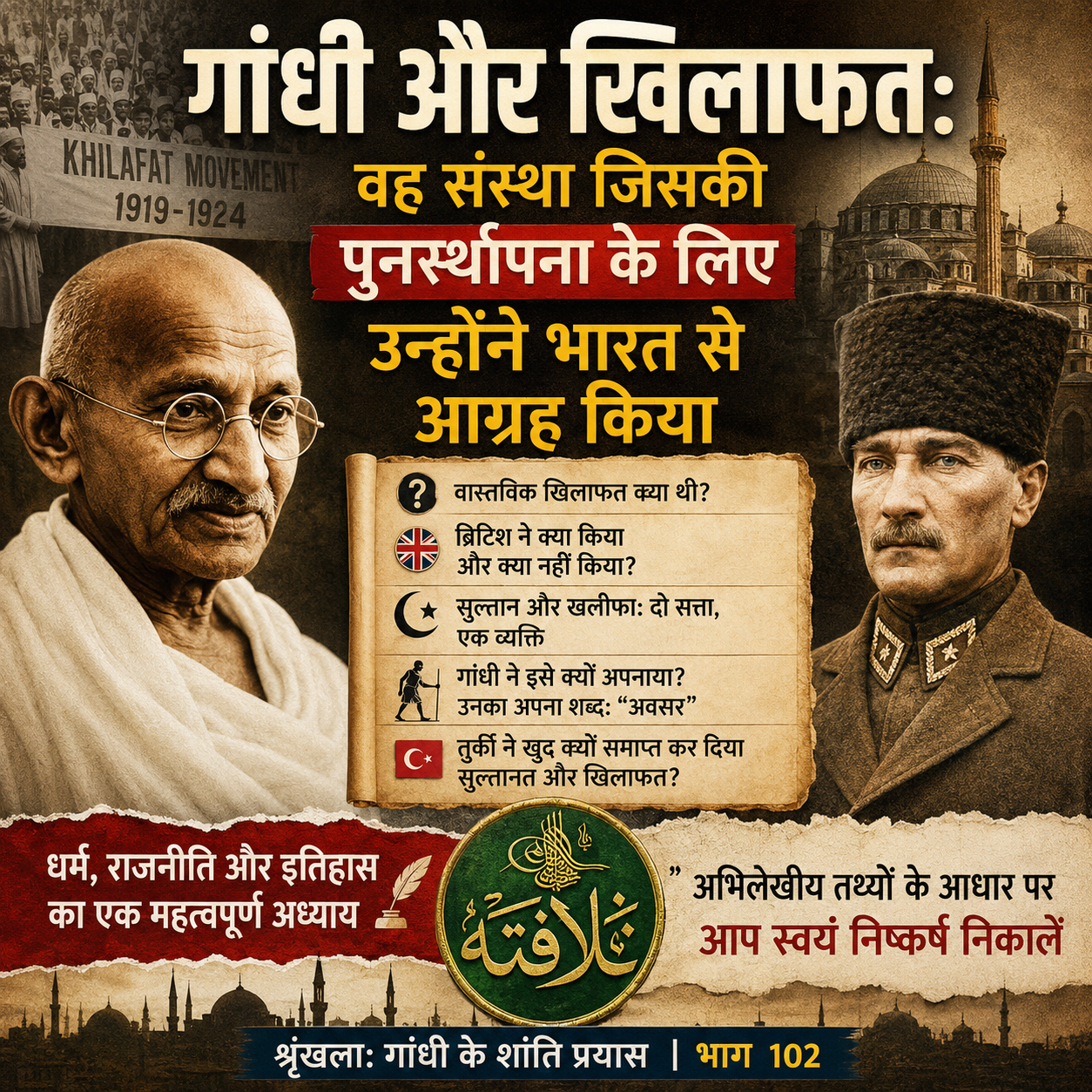
Gandhi’s Khilafat: The Institution He Asked India to Restore (102)
भारत / GB
Part 102: Mahatma Gandhi’s Peace Efforts | Series Index
Blogs 99-101 compiled the prosecution’s Jinnah arc — eighteen exhibits closing on Gandhi’s own self-assessment of March 20 1940. This post opens the Khilafat arc: what the Ottoman Caliphate was as an institution, what its documented condition was in 1919, and what Gandhi was specifically asking India to restore when he made that restoration a non-negotiable condition of the Non-Cooperation Movement.
Thank you for reading this post, don't forget to subscribe!The Action Taken: Gandhi insisted that Hindu support for the preservation of the Turkish Sultan’s imperial and religious dominion must be pure, unconditional, and divorced from political calculations.
Who Paid the Price: Secular nationalist principles, as unconditional religious sacrifice was codified as the highest form of political morality.
The Alternative Bypassed: Negotiating reciprocal civic and political commitments between communities before mobilizing for a theological goal.
Why This Matters: Locked the national movement into an asymmetrical bargain where one community’s support was demanded as a spiritual duty while requiring no reciprocal concessions from clerical allies.
Two Separate Organisations — One Man Leading Both
Gandhi’s Khilafat: The Institution He Asked India to Restore places one documented structural fact before the reader at the outset.
The All India Khilafat Conference was not a Congress organisation. It was a Muslim political organisation formed in 1919. The Indian National Congress was a separate organisation fighting for Indian independence. In June 1920, Gandhi led the All India Khilafat Conference at Allahabad as its head — not as a Congress representative, not as an advisor, but as the head of a separate organisation. In September 1920, Gandhi then took that cause into Congress at the Calcutta session and secured its formal adoption alongside Swaraj. The two organisations and their causes were merged by Gandhi’s documented personal intervention in both.
What the British Actually Did — and Did Not Do
Gandhi’s Khilafat: The Institution He Asked India to Restore places a documented distinction before the reader that the movement’s own framing obscured.
The British did not dismantle the Caliphate. They did not attack Islam as a religion. What the British and Allied powers did was militarily defeat the Ottoman Empire in the First World War and dismember its territories under the Treaty of Sèvres — detaching Arab lands including Palestine, Syria, Iraq, and portions of Arabia, and reducing the Sultan’s territorial power.
The Caliphate — the religious claim of the Sultan to be the supreme authority over the worldwide Muslim community — was never a British target. The British acted against the Ottoman Sultan as a defeated enemy head of state. The Sultan happened also to hold the Caliph title.
The Khilafat Movement’s documented logic conflated the two: because the Sultan and the Caliph were the same person, Indian Muslim leaders interpreted the weakening of the Sultan’s temporal power as an attack on the Caliph’s religious authority. But that conflation was the movement’s own construction — not a documented British act against Islam as a religion.
The Institution — Two Entities, One Title
Gandhi’s Khilafat: The Institution He Asked India to Restore places the documented character of the Ottoman Caliphate before the reader.
The Ottoman institution conflated two distinct entities in one person. The Sultan was the temporal ruler — head of state, commander of the military, the political entity that had sided with Germany and Austria-Hungary in the First World War and been militarily defeated. The Caliph was the claimed supreme religious authority over the worldwide Muslim community — a title the Ottoman sultans had formally adopted in the sixteenth century, whose doctrinal legitimacy was disputed by Arab Muslim scholars throughout its existence.
The Khilafat Movement’s own three documented demands confirm that what was being sought was territorial and political, not purely religious: the Khalifa must retain control over Muslim holy places; pre-war territories must be restored to the Khalifa; and the regions of Arabia, Syria, Iraq, and Palestine must remain under Muslim sovereignty. None of these demands could be met without restoring the Sultan’s defeated territorial power.
The Vatican comparison places this before the reader precisely: the Pope’s religious authority does not depend on territorial restoration. The Caliph’s claimed authority, as the Khilafat Movement framed it, required the revival of a defeated empire’s territorial control. This was a demand for a foreign empire’s political restoration — not a demand that the British stop interfering with Muslim religious practice, because the British had not done so.
Gandhi’s Documented Reason for Joining
Gandhi’s Khilafat: The Institution He Asked India to Restore places Gandhi’s own documented rationale before the reader. Gandhi was not a Muslim. He held no investment in the Caliph as a religious authority. His documented stated reason for adopting the Khilafat cause — recorded across multiple contemporary sources — was that it gave him the means to bring Muslims into the Non-Cooperation Movement and achieve Hindu-Muslim unity against the British.
Gandhi saw in the Khilafat cause an opportunity — his own documented word. A political demand dressed in religious language, emotionally resonant with India’s Muslim population, that could be adopted by Congress to build the broadest possible coalition against British rule. Jinnah’s documented 1920 Nagpur objection — examined in Blog 82 — named exactly this: that entangling the secular independence movement with a religious cause was a structural mistake. Gandhi’s mobilised crowd shouted him down.
What the Turks Themselves Did
Atatürk’s Turkey resolved the Sultan-Caliph conflation by demonstrating the two were separable — and abolishing both. In 1922 the Turkish National Legislature abolished the Sultanate — the temporal power — first. In 1924, after an Indian Muslim delegation specifically requested the Caliphate’s preservation, the Turkish parliament abolished it entirely.
The institution Gandhi had personally headed a movement to restore was abolished by the Turkish people themselves — confirming that the religious claim and the political claim were two different things, and that Turkey chose to retain neither.
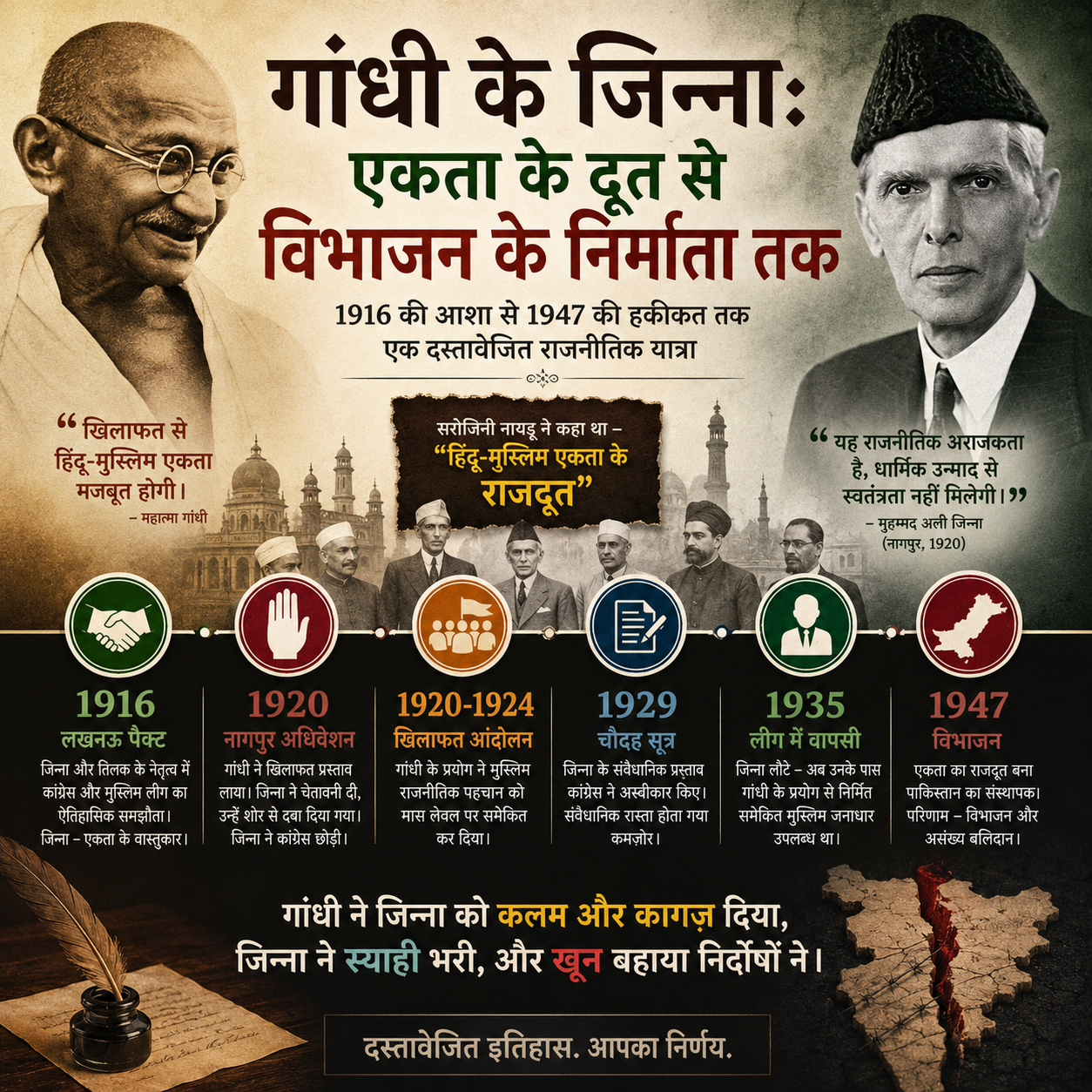
The Prosecution’s Position
Gandhi’s Khilafat: The Institution He Asked India to Restore places three questions before the reader.
- Did the British attack the Caliphate as a religious institution — or did they defeat the Ottoman Sultan as a wartime enemy, with the Caliphate title being an incidental attribute of the same person?
- Did the Khilafat Movement’s own documented demands — territorial restoration, control over holy places, Muslim sovereignty over Arabia, Syria, Iraq, and Palestine — constitute a demand for religious freedom, or a demand for the restoration of a defeated foreign empire’s territorial power?
- Did Gandhi adopt this cause as a documented political calculation — his own stated word, “opportunity” — to build Hindu-Muslim unity, knowing the British had not attacked Islam as a religion but had defeated the Ottoman Sultan as a military enemy?
The series does not answer. Gandhi’s Khilafat: The Institution He Asked India to Restore places the documented distinction between the British act and the Khilafat demand, Gandhi’s documented personal role and stated rationale, and the Turkish abolition of 1924 before the reader. The reader will examine what Gandhi adopted — and complete the sentence.
Invitation To Defence
The floor belongs to the defense. We now invite them to present their exhibits and challenge the narrative established by the prosecution.
The British defeated the Ottoman Sultan — a wartime enemy. They did not touch the Caliphate as a religious institution. The Khilafat Movement’s own demands were territorial: restore pre-war borders, restore control over holy places, restore Muslim sovereignty over Arab lands. Gandhi headed the Khilafat Conference as its head, then secured Congress’s adoption of it — his documented word: an opportunity. 1924: the Turks abolished the Caliphate themselves. The prosecution places the documented distinction before the reader. The reader will complete the sentence.
← Part 101 | Series Index | Exhibits Master Table
Feature Image: Click here to view the image.
Videos
Glossary of Terms
- Khilafat Movement: A political movement launched in British India after the First World War seeking the restoration of the Ottoman Caliphate and the authority of the Caliph.
- Ottoman Caliphate: The institution through which the Ottoman Sultan claimed religious leadership over the global Muslim community until its abolition in 1924.
- Ottoman Sultan: The hereditary ruler of the Ottoman Empire who also held the title of Caliph during the later Ottoman period.
- Caliph: A title claimed by certain Muslim rulers as the supreme religious leader of the worldwide Muslim community.
- Treaty of Sèvres: The 1920 treaty that partitioned much of the Ottoman Empire after its defeat in the First World War.
- Non-Cooperation Movement: The nationwide movement launched by Gandhi in 1920 urging Indians to withdraw cooperation from British institutions.
- All India Khilafat Conference: The political organisation established in 1919 to campaign for preserving the Ottoman Caliphate in the post-war settlement.
- Swaraj: The demand for self-rule or self-government that became a central objective of the Indian freedom movement.
- Mustafa Kemal Atatürk: The founder of modern Turkey who abolished the Sultanate in 1922 and the Caliphate in 1924.
- Turkish Grand National Assembly: The national legislature of Turkey that abolished both the Sultanate and the Caliphate.
- Temporal Authority: Political and territorial governing power exercised by a state or ruler, distinct from religious authority.
- Religious Authority: Leadership or influence derived from religious office, doctrine, or spiritual recognition.
- Khilafat Arc: A thematic section of this series examining the origins, objectives, historical context, and consequences of Gandhi’s support for the Khilafat Movement.
- Sultan–Caliph Conflation: The central analytical concept of this blog describing the merging of the Sultan’s political office with the Caliph’s religious title in one individual.
- Documented Opportunity: Gandhi’s recorded description of the Khilafat issue as an opportunity to achieve Hindu-Muslim unity through the Non-Cooperation Movement.
#Gandhi #Khilafat #Caliphate #Ottoman #Jinnah #Congress #History #India #Freedom #Turkey #Ataturk #HinduinfoPedia
Gandhi’s Peace Efforts: The Questions Before the Mahatma (0)