
Gandhi’s Appeasement Template: The Structure Gandhi Built in 1920 Continues (121)
भारत / GB
Part 121: Mahatma Gandhi’s Peace Efforts | Series Index
Blogs 102-120 placed the Khilafat experiment before the reader in full — the cause, the warnings, the experiment, the admission, the destruction, the language pattern, the dispensation. This post places the structural template that experiment produced before the reader — and asks whether that template outlasted the Khilafat movement itself.
Thank you for reading this post, don't forget to subscribe!The Action Taken: In September 1924, communal rioting in Kohat resulted in the killing of over 150 Hindus, the destruction of the entire commercial bazaar, and the total evacuation of more than 3,000 Hindu refugees to Rawalpindi.
Who Paid the Price: The entire minority Hindu population of Kohat, who suffered total dispossession, death, and exile from their ancestral homes.
The Alternative Bypassed: Demanding immediate imperial military protection, compensation, and statutory restitution from the provincial authorities.
Why This Matters: The extreme manifestation of the post-Khilafat riot cascade: an entire minority population was expelled from a frontier town under targeted communal violence.
The Architecture — Established in 1920
Gandhi’s Appeasement Template places the architecture of the 1920 decision before the reader as a structural exhibit, not a moral one.
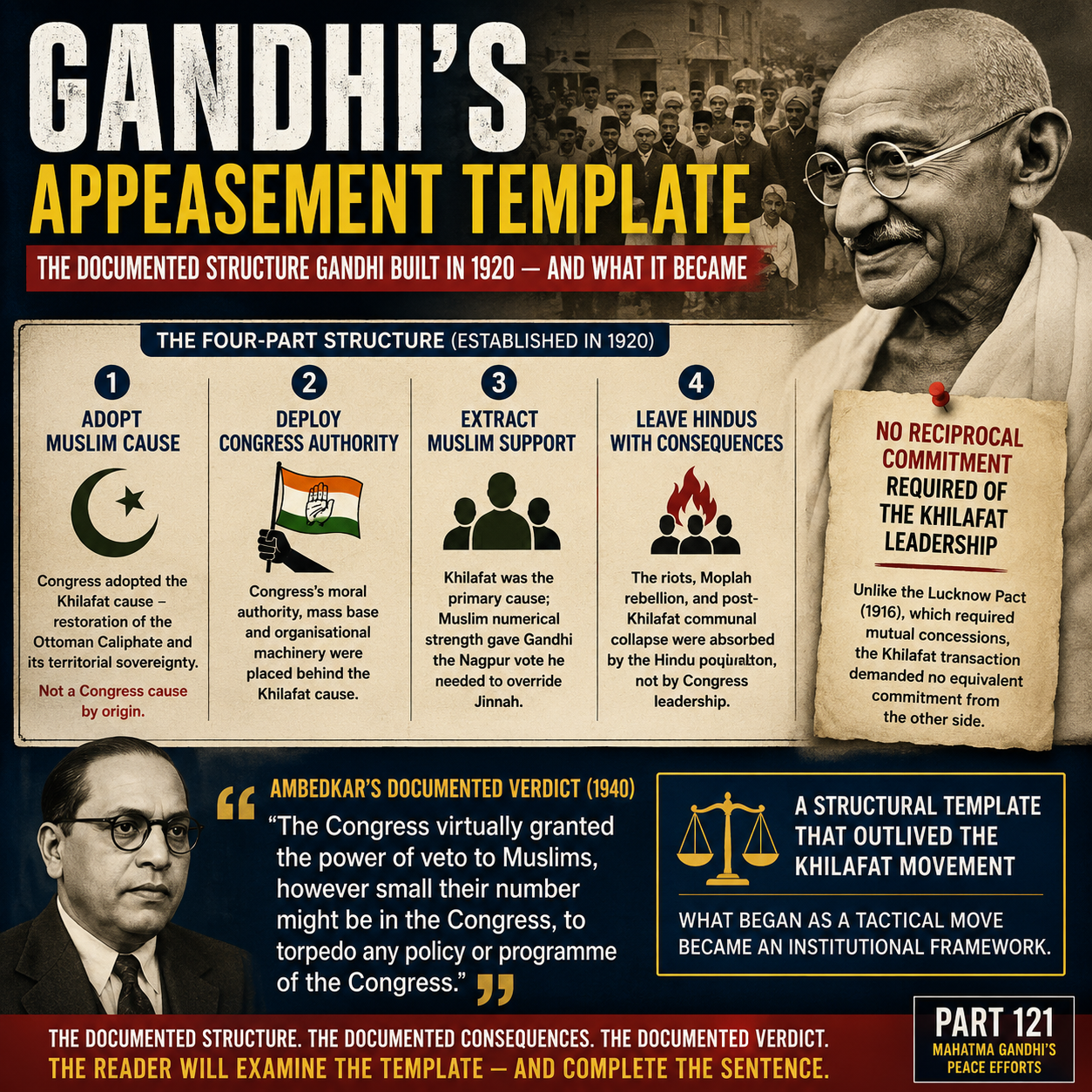
Read together, the decisions placed on record across this series reveal a four-part transactional structure:
First — adopt a specific Muslim community cause as a Congress demand. The cause: restoration of the Ottoman Caliphate and its territorial sovereignty. Not a Congress cause by origin — taken up by Congress at Gandhi’s direction, placed on the record across Blogs 102-108 (102, 103, 104, 105, 106, 107, 108).
Second — deploy Congress’s moral authority, mass base, and organisational machinery behind the adopted cause. The Non-Cooperation Movement, established in Blog 108 as initiated by the Khilafat Committee and adopted by Congress, placed the full weight of the independence movement behind a Muslim community religious-political demand.
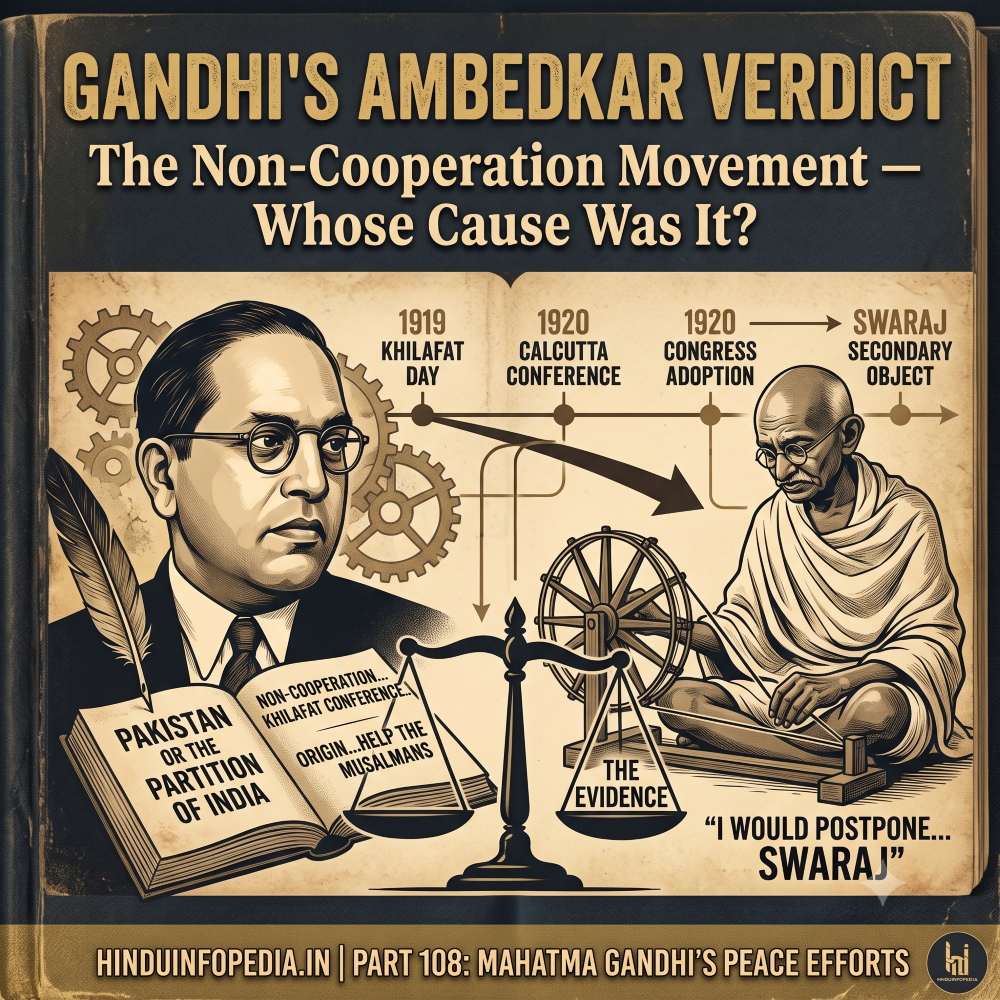
Third — draw Muslim numerical support into the Congress programme. Ambedkar’s primary source verdict from Pakistan or the Partition of India, established in Blog 108: “Swaraj was added as a secondary object to induce the Hindus to join it.” The transaction ran in the opposite direction for Muslim support — Khilafat was the primary cause; Muslim numerical strength gave Gandhi the Nagpur vote he needed to override Jinnah — the mechanism established in Blog 108.
Fourth — the communal consequences fell on the Hindu population of British India. The riot frequency data (S. Gopal), the Moplah rebellion, the post-Khilafat communal collapse — placed before the reader across the series — record what the Hindu population absorbed. The record does not show equivalent consequences falling on the Congress leadership that had adopted the cause.
Gandhi’s Appeasement Template places this four-part structure before the reader as the exhibit. Not “Gandhi appeased Muslims” — a characterisation the series does not supply. The four-part transactional architecture of the 1920 decision — adopt Muslim cause, deploy Congress authority, draw Muslim support into the Congress programme, while communal consequences fell on the Hindu population — is placed before the reader from the series’ own primary source record.
What the Template Required of the Muslim Community
Gandhi’s Appeasement Template places one further observation before the reader. The record shows no equivalent reciprocal commitment placed on the Khilafat leadership in exchange for Congress’s adoption of their cause and deployment of its full authority behind it.
The Lucknow Pact of 1916 — Jinnah’s constitutional instrument — had required reciprocal concessions on the record: Muslim League support for Congress’s political programme in exchange for constitutional safeguards for Muslim minorities. It was a negotiated exchange between two political entities, each giving something verifiable.
The record shows no equivalent reciprocal commitment from the Khilafat leadership. The Congress Working Committee resolution on the Moplah atrocities — established in this series — called upon “every Congress and Khilafat worker to spread the message of non-violence even under the gravest provocation.” Not a demand that the Khilafat leadership condemn the violence. A call for non-violence directed at Congress workers — including Hindu workers — while the Khilafat alliance itself continued undisturbed.
What the Template Produced Institutionally
Gandhi’s Appeasement Template places Ambedkar’s institutional verdict before the reader. From Pakistan or the Partition of India, franpritchett.com:
“The Congress virtually granted the power of veto to Muslims, however small their number might be in the Congress, to torpedo any policy or programme of the Congress.”
Ambedkar placed an institutional observation on the written record: a structural position in which Muslim numerical support gave the community a veto over Congress policy — regardless of the merits of any specific position. Read alongside the events of 1920 placed on record earlier in this series, Ambedkar’s observation identifies an institutional condition consistent with the transactional structure described above.
The Template as Pattern
Gandhi’s Appeasement Template does not assert that post-independence Congress policy was Gandhi’s deliberate design. It places the four-part structure of the 1920 decision before the reader alongside the institutional consequence Ambedkar identified — and asks the reader to examine what structural template the 1920 decision left in Indian political life.
Gandhi’s Appeasement Template places the origin point before the reader: the four-part transactional architecture Gandhi built in 1920 — evidenced from the series’ own primary source record — is placed alongside the institutional consequence Ambedkar identified in 1940. The reader examines whether the template Gandhi built outlasted the cause it was built for.
The Prosecution’s Position
Gandhi’s Appeasement Template places three questions before the reader.
- Did the 1920 Khilafat decision reveal — read across the series’ primary source record in Blogs 102-120 — a four-part transactional architecture: adopt Muslim community cause, deploy Congress authority, draw Muslim numerical support into the Congress programme, while communal consequences fell on the Hindu population rather than on the Congress leadership that had adopted the cause?
- Did the Khilafat transaction require no reciprocal commitment from the Khilafat leadership equivalent to the Lucknow Pact’s mutual concessions — and did the CWC’s Moplah resolution direct non-violence at Congress workers while leaving the Khilafat alliance undisturbed?
- Does Ambedkar’s 1940 observation — placed on the written record during Gandhi’s own lifetime — identify an institutional condition consistent with the transactional structure placed before the reader above: “the Congress virtually granted the power of veto to Muslims, however small their number might be in the Congress, to torpedo any policy or programme of the Congress”?
The series does not answer. Gandhi’s Appeasement Template places the four-part structure, the absence of reciprocal commitment, and Ambedkar’s institutional verdict before the reader. The reader will examine what structural template the 1920 decision left in Indian political life — and complete the sentence.
Invitation To Defence
The floor belongs to the defence. We now invite them to present their exhibits and challenge the narrative established by the prosecution.
1920. The architecture — read across the series’ primary source record: adopt Muslim community cause, deploy Congress authority behind it, draw Muslim support into the Congress programme, while communal consequences fell on the Hindu population. No reciprocal commitment on the record from the Khilafat leadership. Ambedkar, 1940: “The Congress virtually granted the power of veto to Muslims, however small their number might be in the Congress, to torpedo any policy or programme of the Congress.” Read alongside the 1920 decisions, Ambedkar’s observation identifies an institutional condition consistent with the transactional structure above. The prosecution places both before the reader. The reader will examine what the template produced — and complete the sentence.
Feature Image: Click here to view the image.
Videos
Glossary of Terms
- Gandhi’s Appeasement Template: The key phrase of this blog describing the four-part political structure the series argues emerged from Gandhi’s support for the Khilafat Movement in nineteen twenty.
- Transactional Structure: A four-stage political arrangement identified in this series involving adoption of a Muslim cause, Congress support, Muslim political backing, and resulting communal consequences.
- Khilafat Movement: A movement launched to preserve the Ottoman Caliphate after the First World War, later supported by Gandhi and the Indian National Congress.
- Ottoman Caliphate: The institution headed by the Ottoman Sultan, regarded by many Muslims as the Caliphate until its abolition in nineteen twenty-four.
- Non-Cooperation Movement: The nationwide movement launched in nineteen twenty, adopted by Congress after its initiation by the Khilafat Committee according to sources discussed in this series.
- Lucknow Pact: The nineteen sixteen constitutional agreement between the Indian National Congress and the All-India Muslim League providing mutual political concessions.
- Moplah Rebellion: The nineteen twenty-one uprising in the Malabar region that resulted in widespread violence and is examined in this series as a consequence of the Khilafat period.
- Congress Working Committee (CWC): The principal executive body of the Indian National Congress responsible for major policy decisions and official resolutions.
- Institutional Veto: Dr. B. R. Ambedkar’s description of a political condition in which a minority could effectively block Congress policies regardless of numbers.
- Primary Source Record: Contemporary documents, speeches, resolutions, correspondence, and published writings used as direct historical evidence throughout this series.
- Communal Consequences: Social and political effects arising from religious tensions, including riots and violence discussed in relation to the Khilafat period.
- Structural Template: The long-term political pattern that the blog argues originated in nineteen twenty and may have continued beyond the original Khilafat issue.
- Congress Authority: The political legitimacy, organizational strength, and public influence of the Indian National Congress employed in support of the Khilafat cause.
- Pakistan or the Partition of India: Dr. B. R. Ambedkar’s analytical work examining constitutional developments, communal politics, and the causes leading to Partition.
- Prosecution Position: The evidentiary framework used throughout the Gandhi Prosecution series to present documented historical exhibits before inviting readers to evaluate the evidence.
#Gandhi #Khilafat #Congress #Ambedkar #Jinnah #Partition #History #India #Politics #Freedom #Nationalism #Appeasement #HinduinfoPedia
Gandhi’s Peace Efforts: The Questions Before the Mahatma (0)
Refer to Various Arks Referred to in the Blog