
Gandhi’s Moplah Calculus: The Different Standards For Handling Violence (154)
भारत / GB
Part 154: Mahatma Gandhi’s Peace Efforts | Series Index
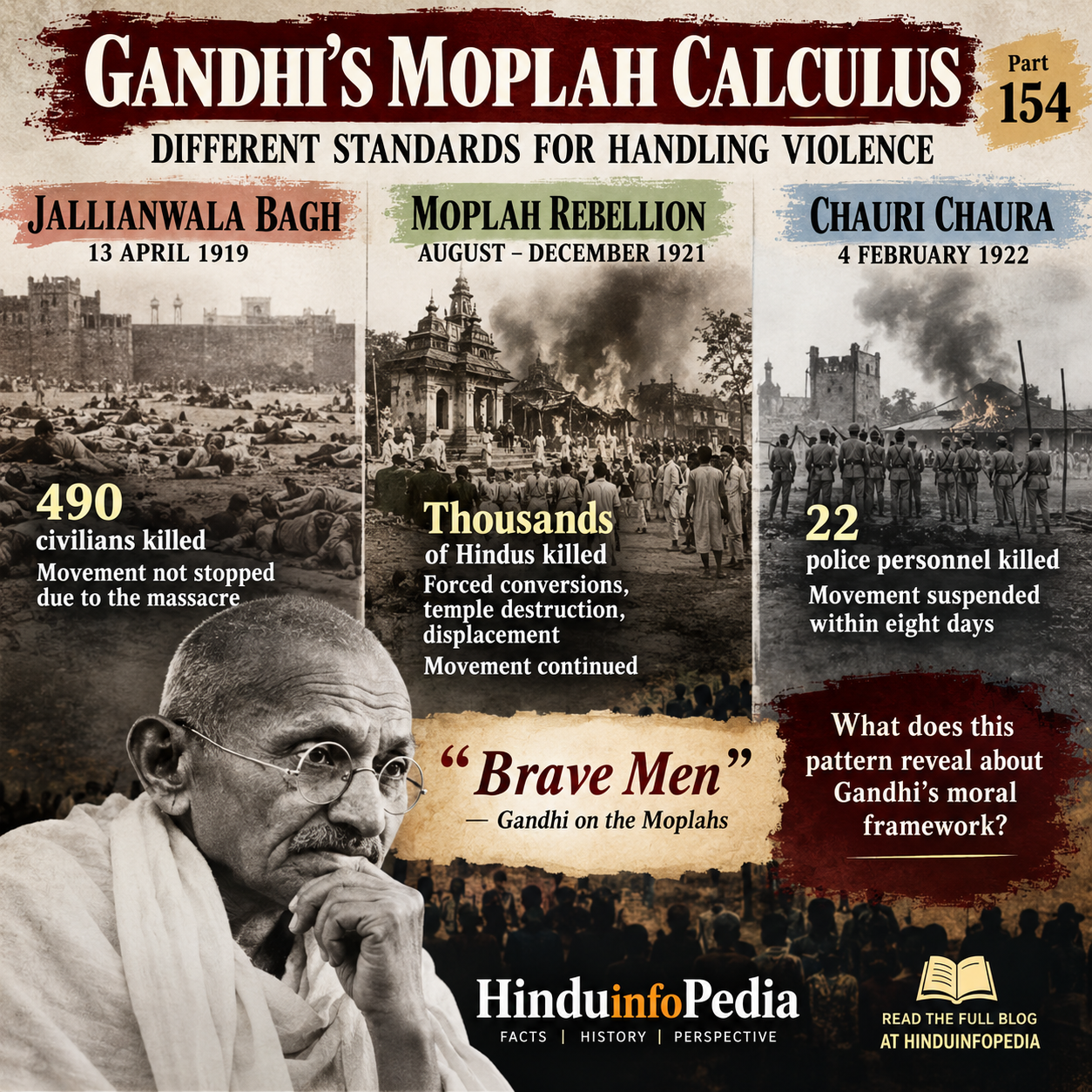
Blog 150 placed the documented asymmetry before the reader: 490 documented civilian deaths at Jallianwala Bagh — civil disobedience was suspended due to crowd violence elsewhere, not the state massacre. 22 documented police deaths at Chauri Chaura as a reaction to the Police excesses on peaceful civilians — the national movement stopped. This post places, Gandhi’s Moplah Calculus, a third documented entry in that asymmetry before the reader: the Moplah rebellion of 1921 — documented Hindu deaths in the thousands, documented forced conversions, documented destruction — and what Gandhi documented as his response.
Thank you for reading this post, don't forget to subscribe!The Action Taken: The national leadership elevated the death of Ganesh Shankar Vidyarthi into a transcendent spiritual model of non-violent mediation, using his murder to argue that unarmed self-sacrifice was the only legitimate answer to armed communal mobs.
Who Paid the Price: Grassroots party volunteers, who were encouraged to adopt unarmed sacrificial pacification in lieu of organizing community defense or insisting on state police protection.
The Alternative Bypassed: Demanding systematic, armed police accountability and the immediate judicial prosecution of organized riot conspirators.
Why This Matters: Demonstrates how tragic losses of life were converted into political theology, validating an impossible sacrificial standard while leaving the root causes of organized violence unaddressed.
The Documented Events — August to December 1921
Gandhi’s Moplah Calculus places the documented record of the 1921 Moplah rebellion before the reader. The rebellion began in August 1921 in the Malabar region of present-day Kerala. The documented participants were Moplah Muslims — a community with agrarian grievances against Hindu landlords — who launched a documented uprising that combined documented agrarian violence with documented communal targeting of the Hindu population.
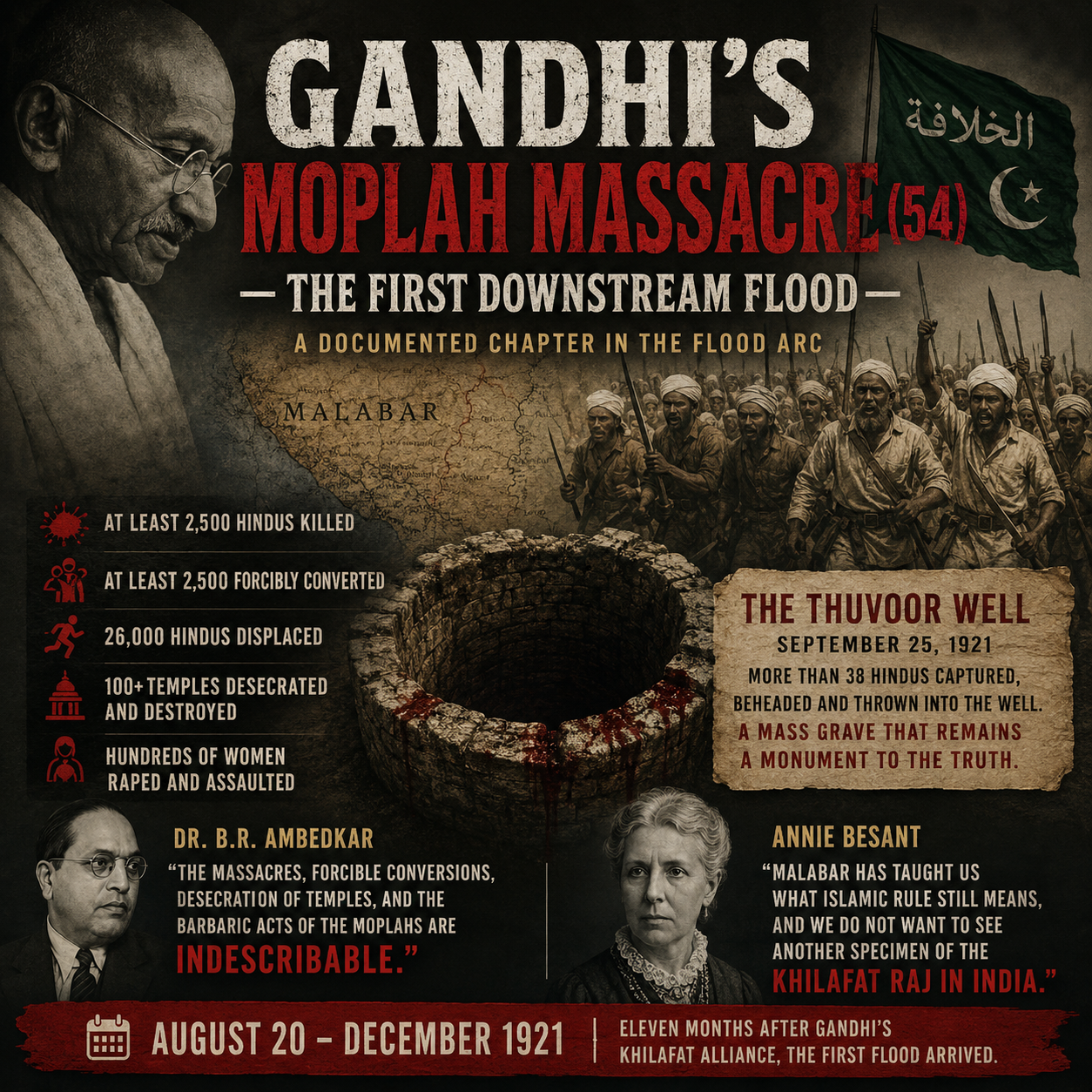
The events: Hindu deaths running into the thousands across documented contemporary accounts. Documented forced conversions — the figure of 2,500 Hindus forcibly converted placed before the series in Blog 57. Documented destruction of Hindu temples. Documented displacement of Hindu families across the Malabar region. Documented accounts of atrocities that were placed before the reader in detail across Blogs 54-68 of this series (Group 7, Moplah Unrest, Moplah Conclusions).
The documented context the prosecution places alongside these events: the Moplah rebellion occurred during the documented peak of the Khilafat-Non-Cooperation movement — the documented alliance Gandhi had forged in September 1920. The Ali brothers — documented Khilafat leaders — had documented organisational presence in Malabar. The documented connection between the Khilafat mobilisation and the documented Moplah uprising was placed before the reader in Blog 64 of this series through Gandhi’s own documented Calicut speech. Gandhi’s own documented word placed the national cause in second position: “I would postpone the issue of Swaraj for Khilafat” — established in Blog 107 of this series.
Gandhi’s Documented Response — The “Brave Men” Quote
Gandhi’s Moplah Calculus places Gandhi’s documented public response before the reader precisely.
Gandhi’s documented Young India statement on the Moplah rebellion carried what the series has established as the “brave men” formulation — documented in Blog 58 of this series: the Moplahs were described as brave men who believed they were acting on behalf of their religion. Gandhi’s documented framework: the Moplah violence was attributed to British provocation and agrarian conditions, not to documented communal targeting of Hindus.
Gandhi’s documented statement at Calicut — established in Blog 64: the British should have invited the Ali Brothers and Gandhi to Malabar to restore calm. The documented admission this carries: Gandhi knew the Ali Brothers held a documented key to the Moplah community’s documented mobilisation. He acknowledged the documented connection between the Khilafat leadership and the documented uprising.
Gandhi’s documented position on forced conversions: during the British news blackout of late 1921, Gandhi published letters in Young India minimising early reports of forced conversions. Sir William Vincent’s documented legislative record of January 16 1922 placed before the legislative record that the number of forced conversions “probably runs to thousands” — established in Blog 60 of this series. Gandhi later acknowledged widespread forced conversions once documented relief worker reports reached him. The documented gap between Gandhi’s early minimisation and the scale established by Vincent’s legislative record is placed before the reader in Blog 60.
Gandhi’s Moplah Calculus — Three Incidents, Three Responses
Gandhi’s Moplah Calculus places the documented three-incident comparison before the reader.
Jallianwala Bagh — April 13 1919: 490 documented civilian names. British military. The Non-Cooperation Movement had not yet been launched — it was formally adopted at the Calcutta special session September 1920. The Rowlatt Satyagraha, which was active at the time, was suspended by Gandhi on April 18 1919 — five days after Jallianwala Bagh — citing crowd violence at Nadiad and Ahmedabad as the documented trigger, not the documented massacre itself. Gandhi’s documented response to Jallianwala Bagh: systemic abstraction — his documented words: ‘the fault lay in the system and not entirely in the individuals who administered it’ — inquiry participation, documented political engagement continued.
Moplah Rebellion — August to December 1921: Documented Hindu deaths in the thousands. Documented forced conversions. Documented temple destruction. Documented Hindu displacement. Gandhi’s documented response: brave men formulation, agrarian and British provocation framing, Khilafat alliance maintained, Non-Cooperation Movement not suspended.
Chauri Chaura — February 4 1922: 22 documented police deaths after documented police firing on protesters. Gandhi’s documented response: entire Non-Cooperation Movement suspended within eight days. Bardoli Resolution. Nation declared morally unready.
The prosecution places the three documented responses before the reader in sequence — and asks the reader to examine what the documented calculus across the three incidents established.
What Gandhi’s Moplah Calculus Established
Gandhi’s Moplah Calculus places one documented observation before the reader. The movement’s documented suspension mechanism was triggered by documented crowd violence against documented authority — Chauri Chaura, 22 documented police deaths. The same documented suspension mechanism was not triggered by:
- Documented British military violence against documented unarmed Indian civilians — Jallianwala Bagh, 490 documented names.
- Documented communal violence against documented Hindu civilians — Moplah rebellion, documented thousands.
The prosecution places the documented trigger pattern before the reader without characterisation. Gandhi’s documented suspension mechanism was activated by one documented category of violence and not by two other documented categories. The prosecution asks: what does the documented trigger pattern establish about whose documented violence activated Gandhi’s documented moral framework?
The Prosecution’s Position
Gandhi’s Moplah Calculus places three questions before the reader.
- Do the three documented incidents — Jallianwala Bagh (490 civilian deaths; civil resistance suspended due to crowd indiscipline at Nadiad/Ahmedabad, not state violence), the Moplah rebellion (documented thousands of Hindu deaths, movement continued), and Chauri Chaura (22 documented police deaths, movement suspended) — placed in sequence, establish a documented pattern about whose documented violence activated Gandhi’s documented suspension mechanism?
-
Does Gandhi’s documented “brave men” formulation for the Moplahs — placed alongside his documented Bardoli Resolution characterisation of the Chauri Chaura crowd (“warning from God,” “diabolical crime,” nation morally unready; Gandhi’s phrase “Himalayan Miscalculation” belongs to the Rowlatt Satyagraha of April 1919, as established in Blog 134 of this series) — constitute a documented asymmetry of moral characterisation that the reader places alongside the documented trigger pattern?
- Does Gandhi’s documented maintenance of the Khilafat alliance — the documented framework that Blog 64 established Gandhi knew connected the Khilafat leadership to the Moplah uprising — during and after the documented Moplah violence, constitute an exhibit the reader places alongside the documented three-incident calculus?
The series does not answer. Gandhi’s Moplah Calculus places the documented three-incident pattern, the documented brave men formulation, and the documented Khilafat alliance maintenance before the reader. The reader will examine what the documented calculus established — and complete the sentence.
Invitation To Defence
The floor belongs to the defense. We now invite them to present their exhibits and challenge the narrative established by the prosecution.
August-December 1921: documented thousands of documented Hindu deaths, documented forced conversions, documented temple destruction — the Moplah rebellion during the documented peak of Gandhi’s Khilafat-Non-Cooperation movement. Gandhi’s documented response: brave men, British provocation, agrarian conditions. Movement not suspended. February 4 1922: 22 documented police deaths after documented police fired on protesters. Gandhi’s documented response: movement suspended within eight days. Nation declared morally unready. The prosecution places the documented calculus before the reader. The reader will complete the sentence.
Feature Image: Click here to view the image.
Videos
Glossary of Terms
- Gandhi’s Moplah Calculus: The series term for comparing Gandhi’s documented responses to violence in the Moplah rebellion, Jallianwala Bagh, and Chauri Chaura.
- Moplah Rebellion: The 1921 uprising in the Malabar region involving Moplah Muslims, documented in the blog as including agrarian violence and communal violence against Hindus.
- Khilafat-Non-Cooperation Movement: The documented political alliance and movement associated with Gandhi, the Khilafat leadership, and the Non-Cooperation campaign during the period of the Moplah rebellion.
- Khilafat Alliance: Gandhi’s documented political alliance with the Khilafat leadership, including the Ali brothers, which remained in place during and after the Moplah violence.
- Brave Men Formulation: Gandhi’s documented description of the Moplahs as brave men who believed they were acting on behalf of their religion.
- Systemic Abstraction: The analytical description of Gandhi’s response to Jallianwala Bagh, in which responsibility was placed on the system rather than entirely on individual administrators.
- Documented Trigger Pattern: The series’ term for the pattern in which Gandhi’s movement-suspension mechanism was activated by Chauri Chaura but not by the documented violence at Jallianwala Bagh or during the Moplah rebellion.
- Suspension Mechanism: The documented process through which Gandhi stopped or suspended a mass movement in response to particular forms of violence.
- Jallianwala Bagh and Chauri Chaura: Two documented incidents used in the blog’s comparison of Gandhi’s responses to violence: the 1919 massacre of Indian civilians and the 1922 killing of 22 police personnel after police firing on protesters.
- Bardoli Resolution: The resolution associated with Gandhi’s decision to suspend the Non-Cooperation Movement after Chauri Chaura and his assessment that the nation was morally unready.
- Himalayan Miscalculation: Gandhi’s phrase for the error associated with the Rowlatt Satyagraha of April 1919; the blog distinguishes it from his later response to Chauri Chaura.
- Rowlatt Satyagraha: The civil resistance campaign active in 1919 that Gandhi suspended five days after Jallianwala Bagh, citing crowd violence at Nadiad and Ahmedabad.
- Forced Conversions: The documented conversion of Hindus by coercion during the Moplah rebellion; the blog places the figure of 2,500 in its earlier series discussion and cites later legislative evidence suggesting thousands.
- Civil Disobedience: The form of civil resistance referred to in the Jallianwala Bagh comparison, distinguished in the blog from the later Non-Cooperation Movement.
- GB: The abbreviation appearing with India in the blog heading, referring to Great Britain.
#Gandhi #Moplah #MoplahRebellion #JallianwalaBagh #ChauriChaura #Khilafat #NonCooperation #IndianHistory #HinduHistory #GandhiHistory #HinduinfoPedia
Scan Through The Entire Series at
Gandhi’s Peace Efforts: The Questions Before the Mahatma (0)
Refer to Various Arks Referred to in the Blog
Gandhi’s Moplah Calculus: The Different Standards For Handling Violence (154)