Gandhi’s Voluntary Conversion: Knifepoint Called Choice (60)
भारत / GB
Part 60: Mahatma Gandhi’s Peace Efforts | Series Index
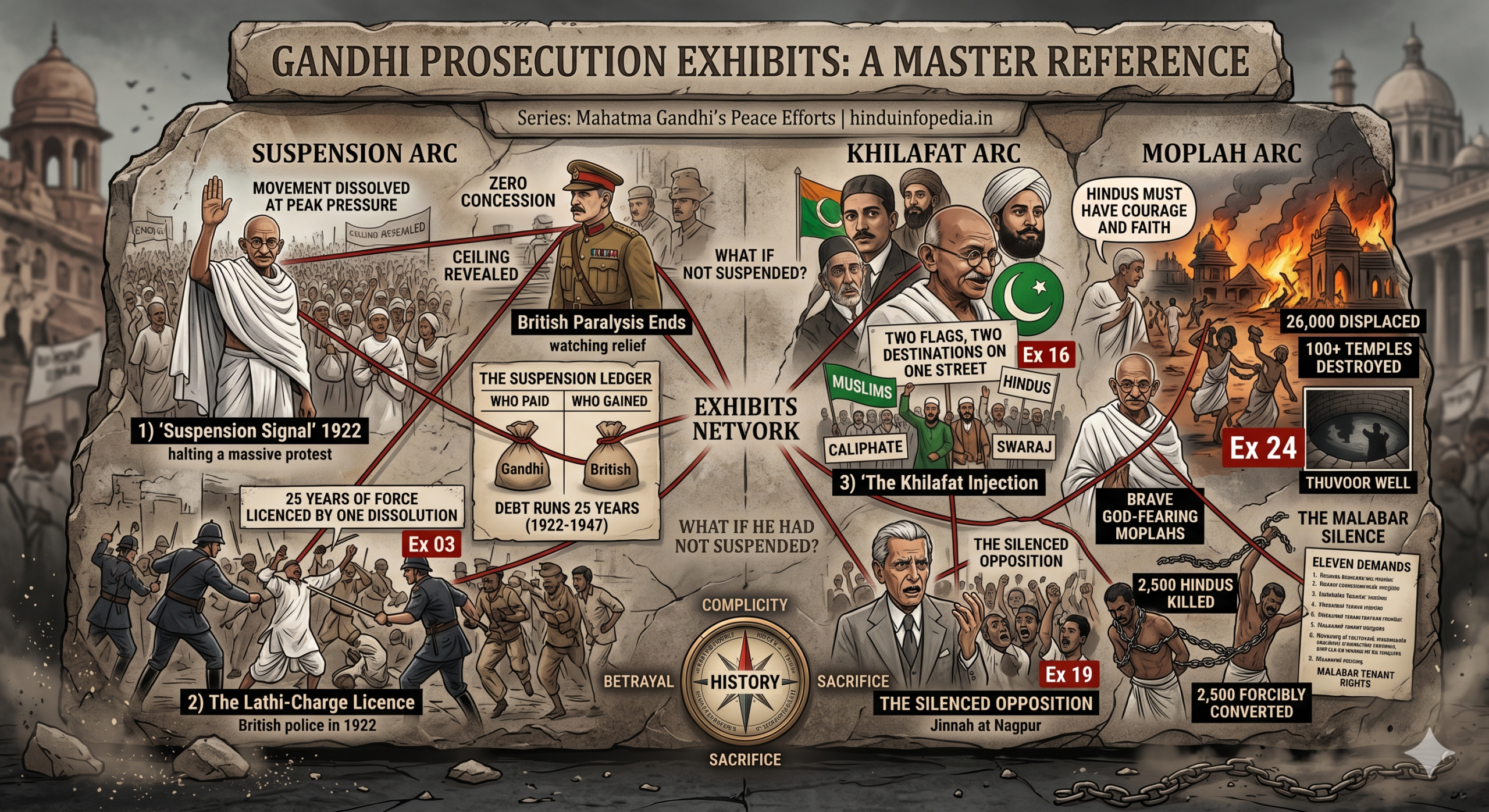
Blog 59 documented six Gandhi statements on the Moplah massacre — each examined in dedicated blogs in this arc. This post examines Statement Three in full: Gandhi’s documented claim that Hindus who converted to Islam under threat of death had made a voluntary change of faith. The statement is placed before the reader precisely as Gandhi made it — and examined against three major standards of voluntary choice of voluntary choice available in law, morality, and Islamic jurisprudence itself.
Thank you for reading this post, don't forget to subscribe!The Action Taken: Gandhi argued that if Hindus converted to Islam to save themselves from death, it was a voluntary change of faith and not forcible conversion, while the Home Member recorded that forced conversions ran to thousands.
Who Paid the Price: Thousands of forcibly converted victims who were denied moral recognition and legal rehabilitation status by the national leadership.
The Alternative Bypassed: Acknowledging the legal, theological, and physical reality that conversions under immediate threat of execution are null and void due to total coercion.
Why This Matters: The extreme legal and ethical paradox of the record: survival under knifepoint was redefined as voluntary choice, shielding the perpetrators from moral condemnation.
The Statement — Stated Precisely
Gandhi’s Voluntary Conversion begins with the statement placed in full:
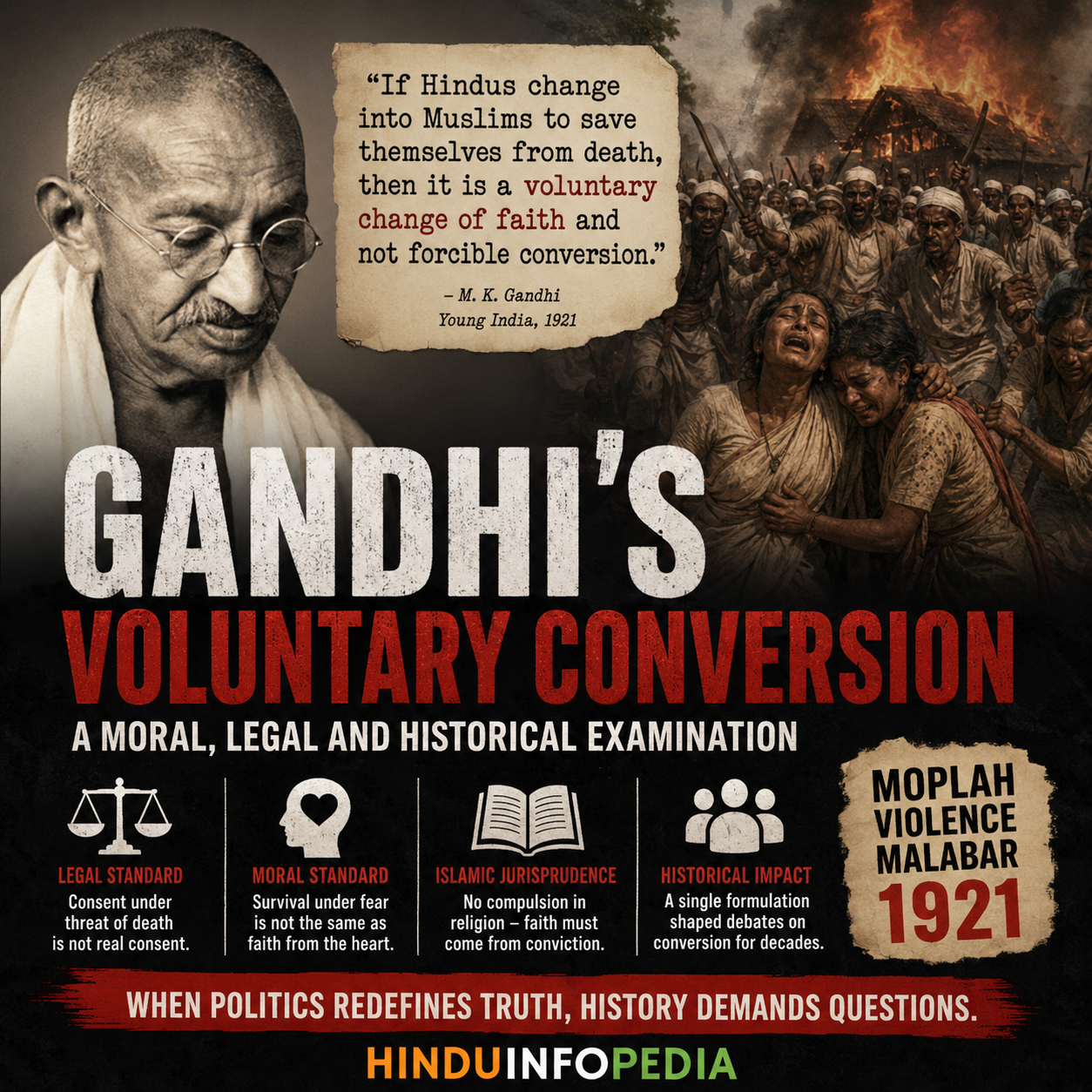
“And if the Hindus became Musalmans to save themselves from death, it was a voluntary change of faith and not forcible conversion.”
This statement was made by Gandhi in Young India while the Moplah massacre was ongoing — while Hindu families in Malabar were being presented with the documented choice of conversion or death.
The prosecution places this statement before the reader and examines it against three standards: the legal definition of voluntary, the moral definition, and Islamic jurisprudence’s own position on the validity of coerced conversion.
The Legal Standard
In law — in every jurisdiction that has addressed the question — a voluntary act is one made free from coercion, duress, or undue influence. A choice made under threat of death is not voluntary. It is made under the most extreme form of duress available — the threat of immediate loss of life.
The Malabar district court records document the conditions under which Moplah conversions took place — armed men, the choice of Koran or sword, families converted en masse. These are not disputed records. They were produced by the British colonial administration’s own judicial proceedings — the same authority Gandhi would publicly submit to and honour in his 1922 sedition trial.
Under every legal standard available in 1921 — British colonial law, Indian personal law, international law — a conversion obtained under threat of death is not voluntary. It is coerced.
Gandhi called it voluntary.
The Moral Standard
The moral standard on voluntary choice has been consistent across every ethical tradition that has addressed it — Hindu, Islamic, Christian, secular. A choice made to preserve one’s life from immediate violent threat is not a free exercise of conscience. It is survival under compulsion.
The Hindu who converted to Islam in Malabar in 1921 to save himself from being beheaded did not experience a change of heart. He experienced a change of identity imposed by force. The Vedantic tradition, the Dharmic framework, and every subsequent Indian religious and legal understanding has recognised this distinction — the difference between sincere conversion and survival conversion.
Gandhi — who claimed the Vedantic tradition as his own, who cited the Bhagavad Gita as his guide — called survival conversion voluntary. He applied a standard that no tradition he claimed to follow would support.
Islamic Jurisprudence’s Own Standard
In Statement Two of Blog 59, Gandhi invoked Islamic law to defend the Moplah perpetrators — citing Islamic protection for women and children in war.
Islamic jurisprudence’s own position on coerced conversion is documented and precise. A conversion obtained by force — ikrah in Arabic — is not considered valid by the overwhelming consensus of Islamic scholars across all major schools of jurisprudence. The Quran itself states: “There is no compulsion in religion” (2:256). A conversion extracted under threat of death does not satisfy the Islamic legal requirement of sincere profession of faith — the shahada must be uttered from genuine conviction, not from fear of death — a doctrinal requirement that holds even within a jurisprudence that separately mandates Jizia for Ahl al-Kitab and prescribes distinct treatment for Mushrikeen.
Gandhi invoked Islamic law in Statement Two to defend the Moplahs. Islamic law in Statement Three contradicts his voluntary conversion formulation. The same law Gandhi cited to defend the perpetrators condemns the instrument they used.
The Living Consequence — Ghar Wapsi
Gandhi’s voluntary conversion formulation has a documented living consequence that the series places before the reader.
If conversions obtained under threat of death are voluntary — as Gandhi’s statement asserts — then reconversion to Hinduism has no basis. The converted Hindu made a free choice of faith. There is nothing to reverse. This is the framework Gandhi’s statement established in 1921 — and it runs through every subsequent Indian legal and political debate on reconversion.
The Ghar Wapsi- Reconversion movement — the return home, the reconversion of those who converted under duress — is opposed within the framework Gandhi’s voluntary conversion formulation enabled. The families forcibly converted in Malabar in 1921 who wished to return to Hinduism faced a framework that called their conversion voluntary. Gandhi established that framework while the conversions were ongoing.
Ambedkar’s Response to This Specific Statement
Ambedkar documented Gandhi’s voluntary conversion formulation with specific incensement. He noted that Gandhi’s characterisation of knifepoint conversion as voluntary was part of a consistent pattern — Gandhi excusing Muslim conduct to protect Hindu-Muslim unity, reframing documented coercion as voluntary choice to avoid placing the Khilafat alliance’s downstream consequences on the record.
Ambedkar placed the specific contradiction precisely: Gandhi claimed to stand for truth as his highest principle — Satyagraha, the force of truth. The voluntary conversion statement placed Gandhi’s claimed highest principle against his documented political calculation. Ambedkar did not assert which prevailed. He placed the two before the reader — as the prosecution does now.
The Prosecution’s Position
Gandhi’s Voluntary Conversion does not claim Gandhi supported forced conversion. It places one documented statement before the reader and asks the reader to examine it against three standards that Gandhi himself claimed to honour — legal, moral, and the Islamic jurisprudence he had just invoked.
The prosecution frames its position as questions:
- Can a choice made under threat of immediate death satisfy any accepted definition of voluntary?
- Did Gandhi know the documented conditions under which Malabar Hindus were converting when he made this statement?
- Did Gandhi’s invocation of Islamic law in Statement Two — and Islamic jurisprudence’s own condemnation of coerced conversion — contradict the voluntary conversion formulation he made three statements later?
- Did Gandhi’s voluntary conversion formulation serve the preservation of the Khilafat alliance — by removing the most damaging documented evidence of what the alliance had produced?
- What does calling knifepoint conversion voluntary mean for a man who claimed truth as his highest principle?
The series does not answer. The statement is on record. The three standards are documented. The reader will examine the statement against the standards and complete the sentence.
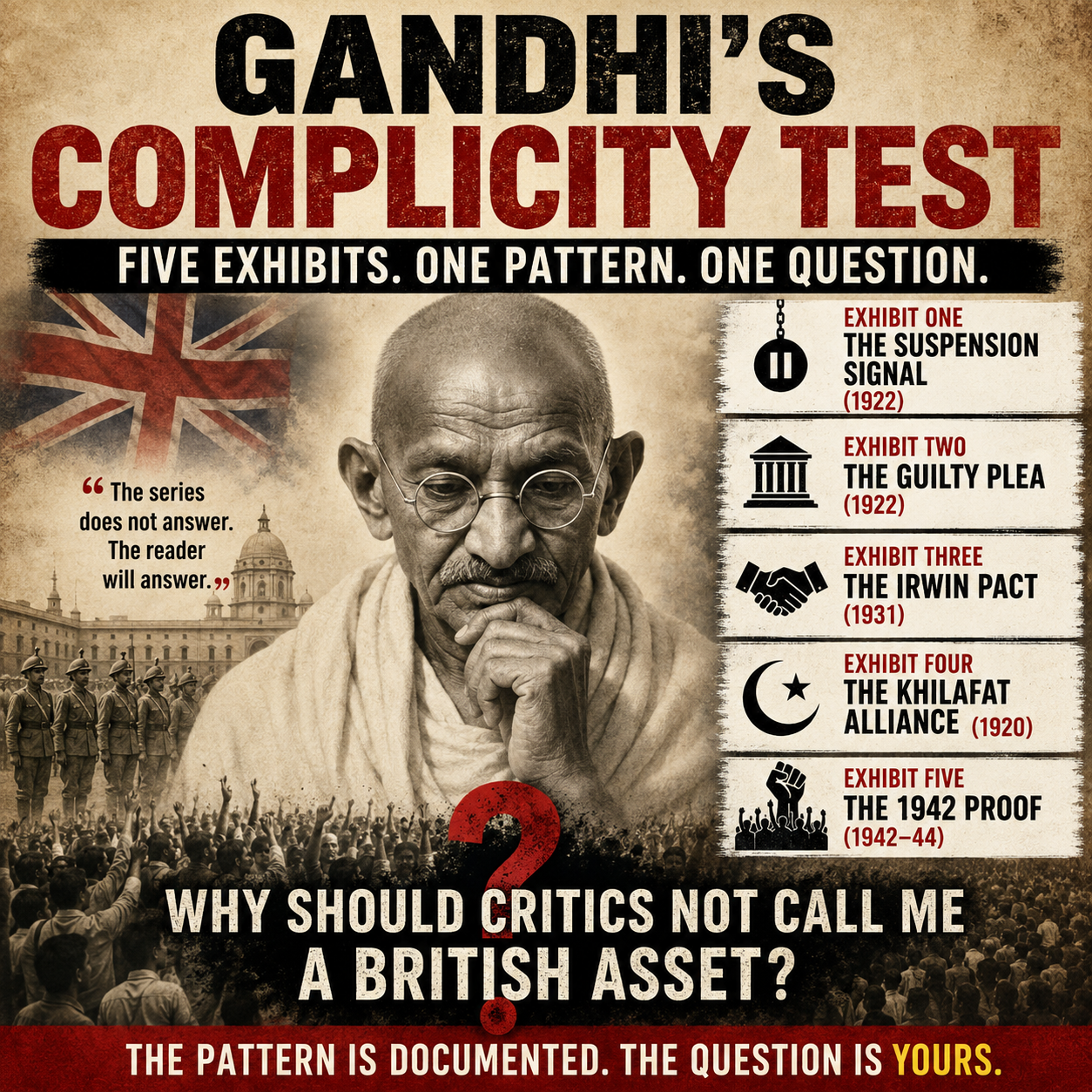
Gandhi’s Voluntary Conversion places one statement before the reader: conversion at knifepoint is voluntary. Three standards examine it — legal, moral, Islamic jurisprudence. All three reach the same conclusion. Only Gandhi’s documented statement reaches a different one. The prosecution places the statement and the three standards before the reader. The reader will identify what a man who claimed truth as his highest principle was doing when he called knifepoint conversion voluntary.
Feature Image: Click here to view the image.
Videos
Glossary of Terms
- Moplah Massacre: The 1921 violence in Malabar during the Khilafat period in which thousands of Hindus faced killings, displacement, forced conversions, and attacks by sections of the Moplah Muslim peasantry.
- Malabar: A historical region in present-day northern Kerala that became the center of the 1921 Moplah violence and related communal conflict.
- Voluntary Conversion: Gandhi’s controversial formulation describing conversions to Islam under threat of death during the Moplah violence as voluntary rather than forced.
- Forced Conversion: A religious conversion carried out under coercion, violence, intimidation, or threat of death rather than free consent.
- Duress: A legal concept describing actions performed under coercion or threat, especially threat to life or safety, invalidating genuine consent.
- Islamic Jurisprudence: The body of Islamic legal interpretation and doctrine derived from the Quran, Hadith, and scholarly legal traditions.
- Ikrah: An Arabic Islamic legal term referring to coercion or compulsion, especially forcing a person to act against free will.
- Shahada: The Islamic declaration of faith affirming belief in Allah and Prophet Muhammad, regarded in Islamic doctrine as requiring sincere conviction.
- Khilafat Movement: A political movement launched in British India after World War I to defend the Ottoman Caliphate, strongly supported by Gandhi during the Non-Cooperation era.
- Ghar Wapsi: Literally “homecoming”; a reconversion movement aimed at bringing back Hindus who had converted to other religions, especially under coercive historical circumstances.
- Satyagraha: Gandhi’s doctrine of resistance based on truth and moral force, central to his political and ethical philosophy.
- Vedantic Tradition: A major stream of Hindu philosophical thought rooted in the Upanishads and focused on spiritual truth, self, and ultimate reality.
- Young India: Gandhi’s English-language weekly journal used to publish his political opinions, commentary, and public statements during the freedom movement.
- Koran or Sword: A phrase historically associated with forced conversion narratives in which individuals were allegedly given the choice between conversion and death.
- Prosecution Framework: A recurring narrative structure in this series where Gandhi’s statements are placed before readers like evidentiary exhibits for examination against legal, moral, and historical standards.