
Gandhi’s Asymmetry of Clemency: Two Hangings — Two Reactions (77)
भारत / GB
Part 77: Mahatma Gandhi’s Peace Efforts | Series Index
Blog 76 documented Gandhi’s erasure of ahimsa — individual accountability dissolved into collective fault. This post places two documented cases of Gandhi’s clemency advocacy before the reader and examines what the documented record shows about the manner and force of each.
Thank you for reading this post, don't forget to subscribe!The Action Taken: Gandhi formulated the public axiom: “The Mussalman as a rule is a bully, and the Hindu as a rule is a coward,” assigning psychological cowardice as the root cause of Hindu victimization in riots.
Who Paid the Price: The victimized communities across Multan, Saharanpur, and Kohat, whose physical injuries were blamed on their own psychological weakness.
The Alternative Bypassed: Recognizing that the primary cause of communal victimization is unpunished criminal aggression and the failure of state security.
Why This Matters: Inverted the moral culpability of communal violence: the aggressor’s behavior was explained as natural bravery, while the victim’s slaughter was attributed to personal moral failure.
Case One — Abdul Rashid, 1927
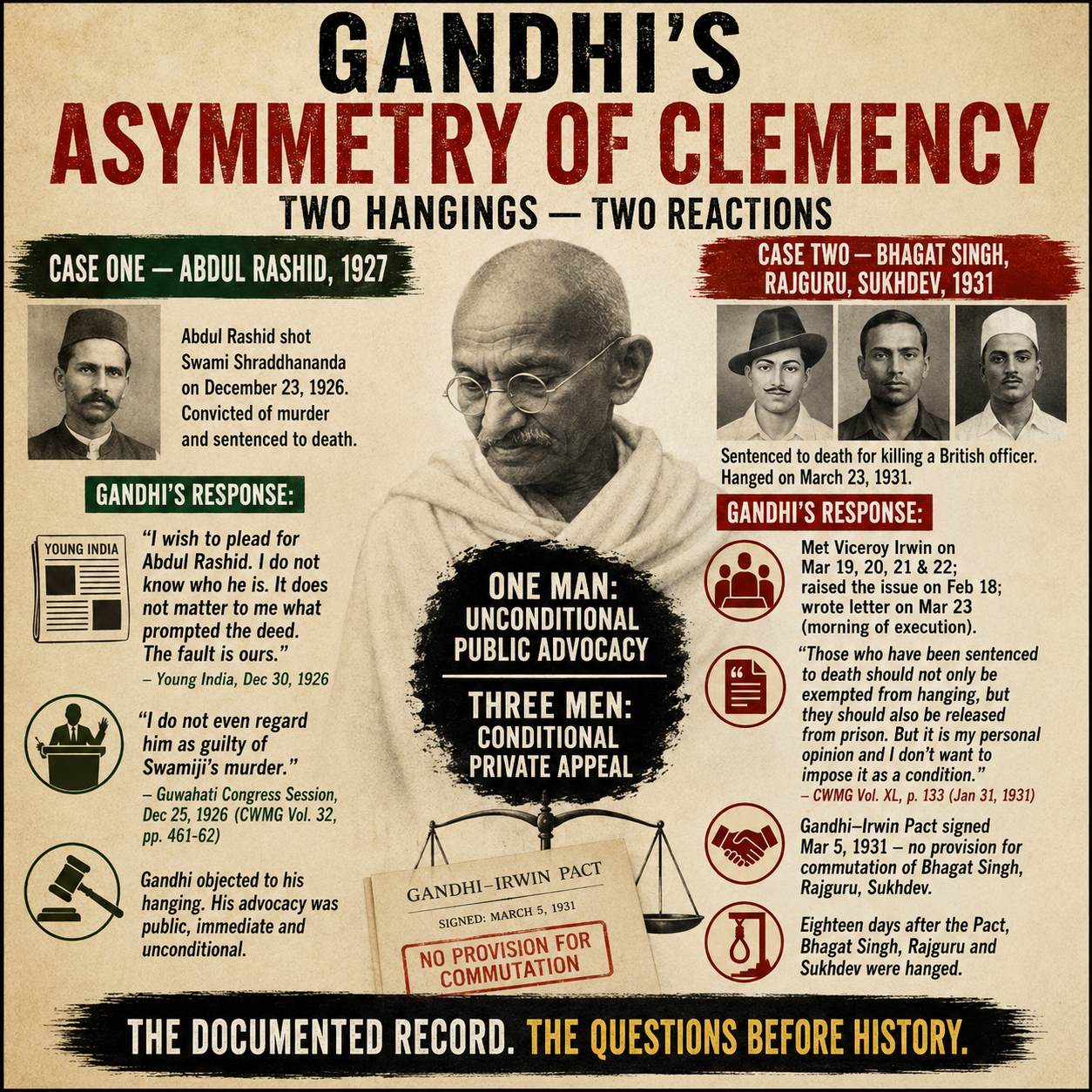
Abdul Rashid shot Swami Shraddhananda twice at point-blank range in his sickbed on December 23, 1926. He was tried, convicted of capital murder, and sentenced to death.
Gandhi’s documented advocacy was immediate, public, and unconditional.
Young India, December 30, 1926: “I wish to plead for Abdul Rashid. I do not know who he is. It does not matter to me what prompted the deed. The fault is ours.”
Guwahati Congress address, December 25, 1926 — CWMG Vol. 32, pp. 461-62: “I do not even regard him as guilty of Swamiji’s murder.”
Gandhi objected to the hanging of Abdul Rashid after he was sentenced to death. His advocacy was placed on the public record in his own publication, at a national Congress session, as an unconditional moral position.
Case Two — Bhagat Singh, Rajguru, Sukhdev, 1931
Bhagat Singh, Rajguru, and Sukhdev were sentenced to death under a special tribunal for the killing of a British police officer. They were hanged on March 23, 1931.
Gandhi made documented attempts to secure commutation — this is on the record. He raised the matter with Viceroy Irwin on February 18, met Irwin on March 19, 20, 21, and 22, and wrote a personal letter on the morning of March 23 itself.
What the documented record also establishes: Gandhi’s January 31, 1931 statement — CWMG Vol. XL, p. 133: “Those who have been sentenced to death should not only be exempted from hanging, but they should also be released from prison. But it is my personal opinion and I don’t want to impose it as a condition.”
The Gandhi-Irwin Pact, signed March 5, 1931, did not contain any provision concerning Bhagat Singh, Rajguru, or Sukhdev. Eighteen days separated the signing of the Pact from their execution.
Bhagat Singh had given Vidyarthi his platform in Pratap — documented in Blog 71. Vidyarthi was released from jail under the same Pact on March 9. Bhagat Singh was hanged on March 23. Vidyarthi died on March 25. The Pact that released Vidyarthi did not save Bhagat Singh — and Gandhi had documented that he did not want to impose commutation as a condition of that negotiation.
The Documented Asymmetry
Gandhi’s Asymmetry of Clemency places the two documented records before the reader as a precise comparison — one case carrying unconditional public advocacy, the other carrying documented private attempts explicitly qualified as personal opinion.
Abdul Rashid: Unconditional public advocacy. Young India editorial. Congress session address. Explicit statement that he was not guilty. Objection to the hanging placed on public record without qualification.
Bhagat Singh: Multiple documented private meetings with the Viceroy. Personal letter on the morning of execution. Documented statement that commutation was his personal opinion and he did not want to impose it as a condition. Pact signed without the commutation as a provision.
Gandhi’s Asymmetry of Clemency does not characterise what this asymmetry means. It places the documented framing of each case before the reader — unconditional and public in one, conditional and private in the other — and asks the reader to examine the difference.
The Legal Meaning of “Plead”
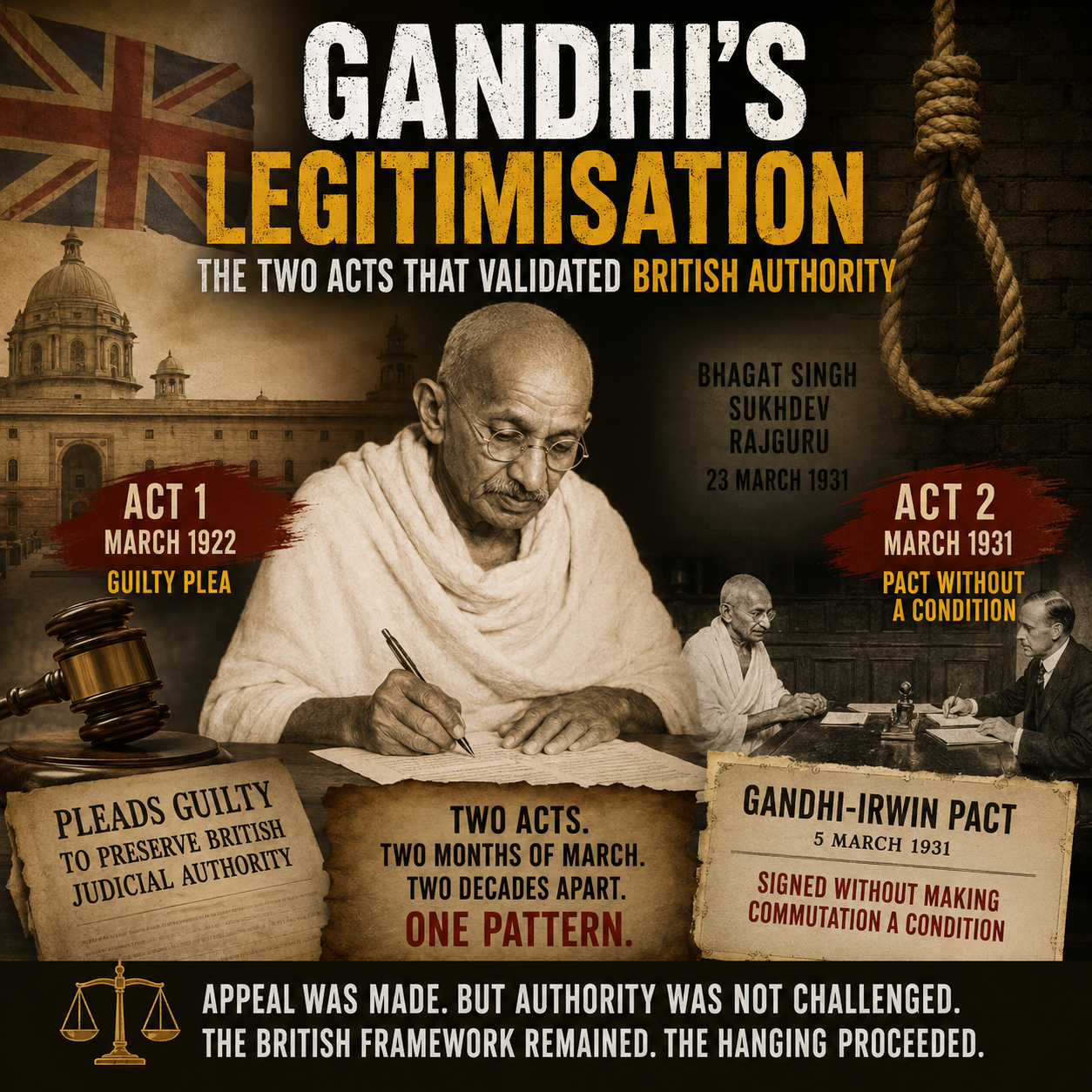
Gandhi’s Asymmetry of Clemency places one specific word before the reader.
Young India December 30 1926: “I wish to plead for Abdul Rashid.”
Plead in its documented legal meaning: to argue a case before a court or authority on someone’s behalf. Gandhi was offering professional advocacy for the man who shot Shraddhananda in his sickbed.
Abdul Rashid killed one person — a Hindu religious leader, ill, seventy years old, in his own room.
Bhagat Singh, Rajguru, and Sukhdev were sentenced to death for killing a British officer in retaliation for the lathi-charge that killed Lala Lajpat Rai — one of the most prominent nationalist leaders of the independence movement. Their documented target was not the man they killed but the officer who had ordered the charge. Gandhi’s own documented response to Jallianwala Bagh — the massacre that preceded Lajpat Rai’s death and shaped the political context in which Bhagat Singh acted — was that the fury against General Dyer was largely misdirected. CWMG Vol. 18, p. 46, Young India, July 14, 1920.
For the man who killed a Hindu religious leader: Gandhi offered to plead. For the men who killed a British officer in retaliation for nationalist deaths Gandhi had called misdirected fury: Gandhi documented it as personal opinion and not a condition of negotiation.
What Gandhi’s Own Words Establish
Gandhi’s Asymmetry of Clemency draws its argument entirely from Gandhi’s own documented words in two cases.
For Abdul Rashid: Gandhi stated publicly and without qualification that he did not know who Abdul Rashid was, that what prompted the deed did not matter to him, and that the fault was ours. He objected to the execution. He called Abdul Rashid his brother at a national Congress session.
For Bhagat Singh: Gandhi documented his own position in CWMG Vol. XL p. 133 — commutation was his personal opinion and he did not want to impose it as a condition. The Pact was signed. The Pact contained no provision for commutation. Bhagat Singh was hanged eighteen days later.
The prosecution places no interpretation on this record. Gandhi’s documented words in both cases are the evidence.
The Prosecution’s Position
Gandhi’s Asymmetry of Clemency places the documented record before the reader as four questions — each answerable from the primary sources cited.
- Did Gandhi place his advocacy for Abdul Rashid on the public record — unconditionally, in his own publication and at a national Congress session?
- Did Gandhi state, on the record, that his advocacy for Bhagat Singh was his personal opinion and he did not want to impose it as a condition?
- Did the Gandhi-Irwin Pact contain any provision for the commutation of Bhagat Singh, Rajguru, and Sukhdev — or did eighteen days separate the signing of the Pact from their execution?
- Does the documented difference in framing — unconditional and public in one case, conditional and private in the other — establish anything about the nature of Gandhi’s clemency advocacy across the two cases?
Gandhi’s Asymmetry of Clemency does not answer. The primary sources are CWMG Vol. 32, CWMG Vol. XL, Young India December 30 1926, and the documented text of the Gandhi-Irwin Pact. Ambedkar’s documented assessment in Pakistan or the Partition of India is placed alongside them: Gandhi was anxious to preserve Hindu-Muslim unity and did not mind the murder of a few Hindus. The reader will examine the documented record across all four primary sources and complete the sentence.
Abdul Rashid — sentenced to death for shooting a seventy-year-old Hindu religious leader in his sickbed. Gandhi: unconditional public advocacy, Young India editorial, Congress address, explicit statement he was not guilty. Bhagat Singh — sentenced to death for killing a British officer. Gandhi: it is my personal opinion and I do not want to impose it as a condition. The Pact was signed. Eighteen days later, Bhagat Singh was hanged. The prosecution places both documented records before the reader.
Feature Image: Click here to view the image.
Videos
Glossary of Terms
- Gandhi’s Asymmetry of Clemency: A term coined in this blog to describe the documented difference in Gandhi’s public and private advocacy for clemency in the Abdul Rashid and Bhagat Singh cases.
- Clemency Advocacy: Efforts made to seek mercy, pardon, or commutation of a convicted person’s sentence, particularly a death sentence.
- Abdul Rashid: The man convicted of murdering Swami Shraddhananda in December 1926 and whose execution Gandhi publicly opposed.
- Swami Shraddhananda: A prominent Hindu religious leader and Arya Samaj reformer who was assassinated by Abdul Rashid in 1926.
- Young India: Gandhi’s influential weekly publication through which he expressed political, social, and moral positions.
- CWMG (Collected Works of Mahatma Gandhi): The official multi-volume compilation of Gandhi’s speeches, writings, correspondence, and public statements.
- Guwahati Congress Session: The Indian National Congress session where Gandhi publicly commented on Abdul Rashid and the Shraddhananda murder case.
- Bhagat Singh, Rajguru, and Sukhdev: Revolutionary nationalists executed by the British government in March 1931 for their role in the Saunders assassination case.
- Commutation: The reduction of a legal punishment to a lesser penalty, such as replacing a death sentence with imprisonment.
- Gandhi-Irwin Pact: The 1931 agreement between Mahatma Gandhi and Viceroy Lord Irwin that led to concessions during the Civil Disobedience Movement.
- Special Tribunal: A special court established by the British colonial government to try Bhagat Singh and his associates.
- Lala Lajpat Rai: Veteran nationalist leader whose death after a police lathi-charge inspired revolutionary retaliation by Bhagat Singh and his associates.
- Jallianwala Bagh Massacre: The 1919 mass killing of unarmed civilians by British troops in Amritsar, a defining event in India’s freedom struggle.
- Documented Asymmetry: A key phrase in this blog referring to the contrast between Gandhi’s publicly declared advocacy for Abdul Rashid and his qualified advocacy for Bhagat Singh.
- Plead: To argue or appeal on behalf of a person before an authority; in this blog, the term is examined through Gandhi’s statement regarding Abdul Rashid.
#Gandhi #BhagatSingh #History #India #FreedomStruggle #Congress #MahatmaGandhi #Nationalism #Politics #BritishRaj #Revolutionary #HistoricalFacts #HinduinfoPedia
Gandhi’s Peace Efforts: The Questions Before the Mahatma (0)