
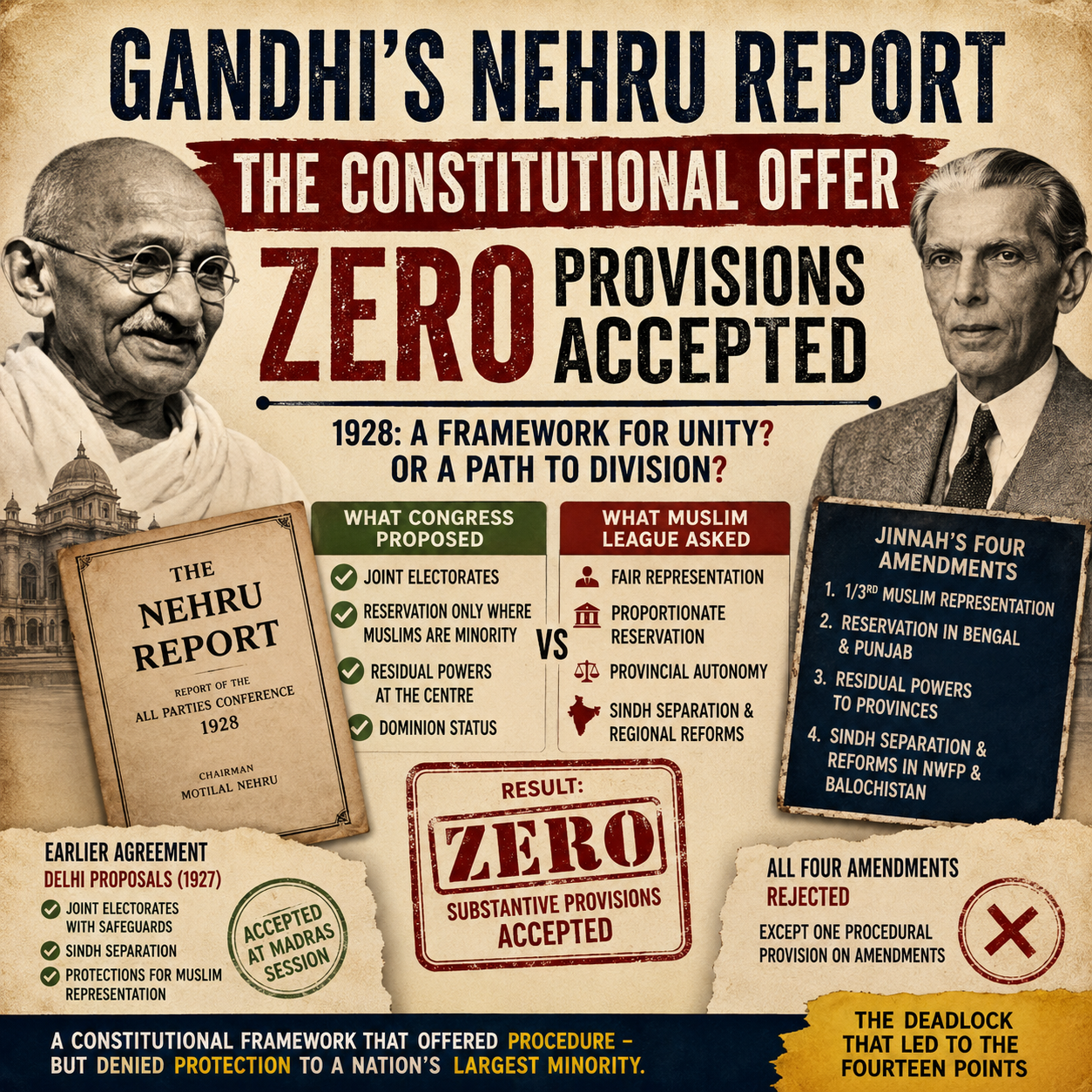
Gandhi’s Nehru Report: The Constitutional Offer — Zero Provisions Accepted (83)
भारत / GB
Part 83: Mahatma Gandhi’s Peace Efforts | Series Index
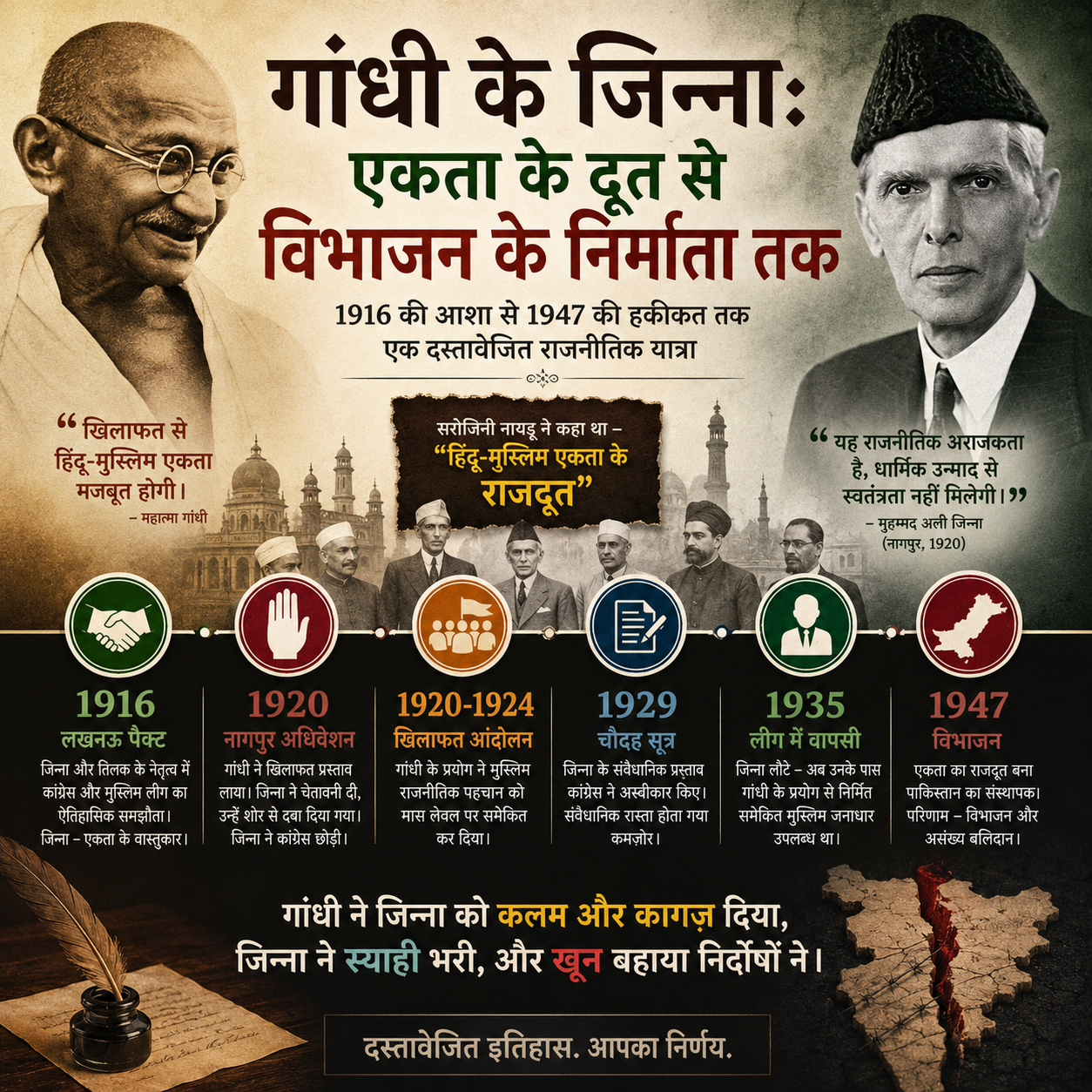
Blog 81 documented the body language of Jinnah’s Fourteen Points — fourteen defensive provisions, none aggressive. Blog 82 documented the full Jinnah transformation arc. This post examines the Congress constitutional framework that made the Fourteen Points necessary — the Nehru Report of 1928 — and what it accepted and rejected of Muslim political demands.
Thank you for reading this post, don't forget to subscribe!The Action Taken: Gandhi and the Congress high command rejected all four constitutional compromise amendments moved by Jinnah regarding central legislative representation in the Nehru Report.
Who Paid the Price: The final opportunity to achieve a united, constitutional nationalist consensus prior to the Round Table Conferences.
The Alternative Bypassed: Accepting minor statutory modifications in central representation to secure a binding, united front against the Raj.
Why This Matters: Jinnah’s famous “parting of the ways”: the uncompromising rejection of moderate constitutional safeguards convinced Muslim moderates that Congress majoritarianism offered no legal security.
The Context — What the Nehru Report Was
Gandhi’s Nehru Report begins with what the All Parties Conference convened in 1928 in response to the Simon Commission — a British parliamentary committee on Indian constitutional reform that had no Indian members. Indians were producing their own constitutional framework to demonstrate that India could govern itself.
The committee was chaired by Motilal Nehru. Its report, published August 1928, proposed Dominion Status for India — self-government within the British Commonwealth, not complete independence. Gandhi supported Dominion Status at this point. He had not yet adopted Purna Swaraj.
The Nehru Report was therefore a proposed constitutional framework for shared governance of a diverse country — a document that would need to accommodate Hindu, Muslim, Sikh, and other communities to be workable. Gandhi’s Nehru Report places one precise question before the reader: what did the Nehru Report offer the Muslim community within that shared governance framework?
What Congress Had Already Agreed
At the Madras Congress session in December 1927, Congress had agreed to the Delhi Proposals — a set of Muslim political demands that included joint electorates with reserved seats, creation of Sindh as a separate province, and constitutional protections for Muslim representation. These were documented agreements between Congress and the Muslim League — placed on record at the Madras Congress session. Gandhi held unchallengeable authority over Congress at this point, documented across Blogs 21–22. The agreements were made under that authority.
Gandhi’s Nehru Report documents that reversal precisely.
The Nehru Report rejected separate electorates, rejected reservation of Muslim seats in Bengal and Punjab on population basis, and placed residual powers at the centre rather than in the provinces — directly contradicting what Congress had agreed at Madras just twelve months earlier. These provisions faced strong opposition from the Hindu Mahasabha and other advocates of a stronger centralised constitutional framework. Gandhi held unchallengeable authority over Congress throughout this period. The reversal occurred under that authority.
What Jinnah Asked For — And What Was Accepted
At the All Parties Conference in Calcutta in December 1928, Jinnah presented four amendments to the Nehru Report on behalf of the Muslim League:
One-third Muslim representation in the central legislature. Reservation of seats in Bengal and Punjab proportionate to Muslim population until adult suffrage was established. Residual powers vested in provinces rather than the centre. Sindh as a separate province with immediate constitutional reforms in NWFP and Balochistan.
All four were put to vote. All four were rejected. The documented record on the Nehru Report’s treatment of Muslim demands is precise. As Wikipedia’s article on the Fourteen Points of Jinnah states directly: the Nehru Report did not uphold a single demand of the Muslim League. One procedural provision proposed by Jinnah was accepted — that constitutional amendments require a four-fifths majority in both Houses plus unanimous approval at a joint session. Every substantive protection provision was rejected.
What the Nehru Report Proposed Instead
The Nehru Report proposed joint electorates — replacing separate electorates with a system where Muslims would vote in the same constituencies as the Hindu majority. It recommended reservation of Muslim seats only in provinces where Muslims were a minority. It placed residual powers at the centre — where the Hindu majority would dominate. It recommended Dominion Status, not independence. Gandhi’s Nehru Report places this documented finding before the reader: a constitutional framework for shared governance that offered one procedural protection and zero substantive protections to the second largest community in the country it proposed to govern. The riot cascade documented in Blog 80 had been running for five years when this framework was produced. The consolidated Muslim political identity Gandhi had built through the Khilafat experiment was offered nothing that would make its constitutional participation in a united India viable.
The Global Parallel — The Lebanon Formula
The prosecution places one international parallel before the reader — not as advocacy but as documented historical context for examining the Nehru Report’s choices. Lebanon in 1943 was a society far more acutely fractured than India in 1928 — multiple armed sectarian communities, active external interference, and a history of intercommunal massacres that made constitutional failure an immediate existential threat. Lebanese leadership recognised that pure majoritarian democracy would produce civil war. The National Pact of 1943 crafted a structural power-sharing formula: The President must always be a Maronite Christian. The Prime Minister must always be a Sunni Muslim. The Speaker of Parliament must always be a Shia Muslim. Parliamentary seats were divided at a locked 6:5 ratio between communities. The formula maintained structural balance and kept the peace for decades. The documented parallel the prosecution places before the reader: Jinnah’s request for locked 33% Muslim representation at the centre and residual powers vested in provinces was structurally similar to what Lebanon’s National Pact achieved through its locked community ratios. The Nehru Report rejected every equivalent provision. The prosecution does not draw the conclusion. It places the two documented constitutional moments before the reader — Lebanon 1943 and India 1928 — and asks the reader to examine what the presence or absence of structural protection produced in each case.
The Prosecution’s Position
Gandhi’s Nehru Report places three questions before the reader.
- Did Congress agree to Muslim political protections at Madras in December 1927 — and did the Nehru Report reverse those agreements twelve months later under Hindu Mahasabha pressure?
- Did the Nehru Report — a proposed constitution for shared governance of a diverse country — accept any of the four substantive amendments Jinnah presented on behalf of the Muslim League at Calcutta in December 1928?
- Did Gandhi, who held unchallengeable authority over Congress as documented across Blogs 21-22, deploy that authority to ensure the Nehru Report accommodated the minimum Muslim political protections Jinnah had identified — or did he support a Dominion Status framework that offered zero substantive protections?
The documented sequence places three things before the reader simultaneously — Gandhi’s unchallengeable authority over Congress established in Blogs 21–22, the Madras agreements Congress made and the Nehru Report reversed, and the Calcutta session where every substantive Muslim demand was put to vote and rejected. The reader who has followed the series will examine these three documented facts together and complete the sentence. The Nehru Report was the last documented attempt to produce a constitutional framework for a united India that both Congress and the Muslim League could accept. It failed. Jinnah’s Fourteen Points followed. Their rejection followed. Pakistan followed eighteen years later. The prosecution places the documented sequence before the reader without characterisation.
December 1927 — Congress agreed to Muslim political protections at Madras. August 1928 — Nehru Report reversed those agreements. December 1928 — Jinnah presented four amendments at Calcutta. All four rejected. Zero substantive Muslim demands accepted. March 1929 — Jinnah presented fourteen points. Gandhi’s Nehru Report places this documented sequence before the reader alongside Gandhi’s documented unchallengeable authority over Congress. The reader will complete the sentence.
Feature Image: Click here to view the image.
Videos
Glossary of Terms
- Nehru Report: The constitutional framework drafted in 1928 under the chairmanship of Motilal Nehru, proposing Dominion Status for India and a system of shared governance, while rejecting several Muslim political safeguards sought by the Muslim League.
- Dominion Status: A constitutional arrangement under which India would govern itself internally while remaining within the British Commonwealth and recognizing the British Crown as the symbolic head of state.
- Simon Commission: A British parliamentary commission appointed in 1927 to recommend constitutional reforms for India. Its lack of Indian members triggered widespread opposition and led Indian leaders to draft alternative constitutional proposals.
- Delhi Proposals: A set of political demands advanced by Muslim leaders in 1927, including joint electorates with safeguards, Sindh’s separation, and constitutional protections for Muslim representation, which Congress initially accepted at the Madras session.
- All Parties Conference: A gathering of major Indian political organizations convened to formulate a common constitutional framework for India’s future governance.
- Separate Electorates: An electoral system in which members of a religious or communal group vote exclusively for representatives from their own community.
- Joint Electorates: An electoral arrangement in which all eligible voters participate in the same constituency elections regardless of religious or communal identity.
- Residual Powers: Constitutional powers not specifically assigned to either the central or provincial governments. The location of these powers became a major point of dispute between Congress and the Muslim League.
- Muslim League: The principal political organization representing Muslim political interests in British India, led during this period by Muhammad Ali Jinnah.
- Fourteen Points: The fourteen constitutional demands presented by Muhammad Ali Jinnah in 1929, intended to safeguard Muslim political rights after the rejection of his proposed amendments to the Nehru Report.
- Dominion Framework: A governance model proposed in the Nehru Report that envisioned self-rule within the British Empire rather than complete independence.
- National Pact of 1943: Lebanon’s unwritten constitutional agreement that allocated key political offices and parliamentary representation among religious communities to maintain sectarian balance.
- Structural Protection: Constitutional mechanisms designed to guarantee political representation or influence for minority communities regardless of electoral majorities.
- Madras Congress Session (1927): The annual Congress meeting where the Delhi Proposals and several Muslim political safeguards were formally accepted before being reconsidered during the Nehru Report process.
- Purna Swaraj: The doctrine of complete independence from British rule, officially adopted by Congress in 1929, replacing earlier support for Dominion Status.
#NehruReport #Gandhi #Jinnah #Congress #Partition #IndiaHistory #MuslimLeague #Constitution #FreedomMovement #PoliticalHistory #HinduinfoPedia
Gandhi’s Peace Efforts: The Questions Before the Mahatma (0)
Refer to Various Arks Referred to in the Blog