
Gandhi’s Moplah Silence: What Gandhi Did Not Do (68)
भारत / GB
Part 68: Mahatma Gandhi’s Peace Efforts | Series Index
Blog 67 documented the vindicated critics — Besant and Jinnah, whose warnings Gandhi overrode at Nagpur in 1920 and were confirmed within eleven months by the Moplah massacre. This post closes the Moplah arc. Gandhi’s Moplah Silence places one documented exhibit before the reader: not what Gandhi said — that has been documented across Blogs 58-65 — but what Gandhi did not do. The silence of action. Placed alongside what he did do in a comparable situation in the same month.
Thank you for reading this post, don't forget to subscribe!The Action Taken: Following the military suppression of the rebellion, the national leadership organized no structured political rehabilitation or land-tenure security for the 100,000+ displaced refugees.
Who Paid the Price: Impoverished Hindu tenants and smallholders who suffered permanent dispossession, trauma, and demographic displacement across southern Malabar.
The Alternative Bypassed: Committing national Congress funds and political leverage to enforce comprehensive legal restitution and physical protection for the returning population.
Why This Matters: Documents the long-term physical residue: once the political utility of the agitation lapsed, the human victims were abandoned without institutional restitution.
What Gandhi Did — November 1921, Bombay
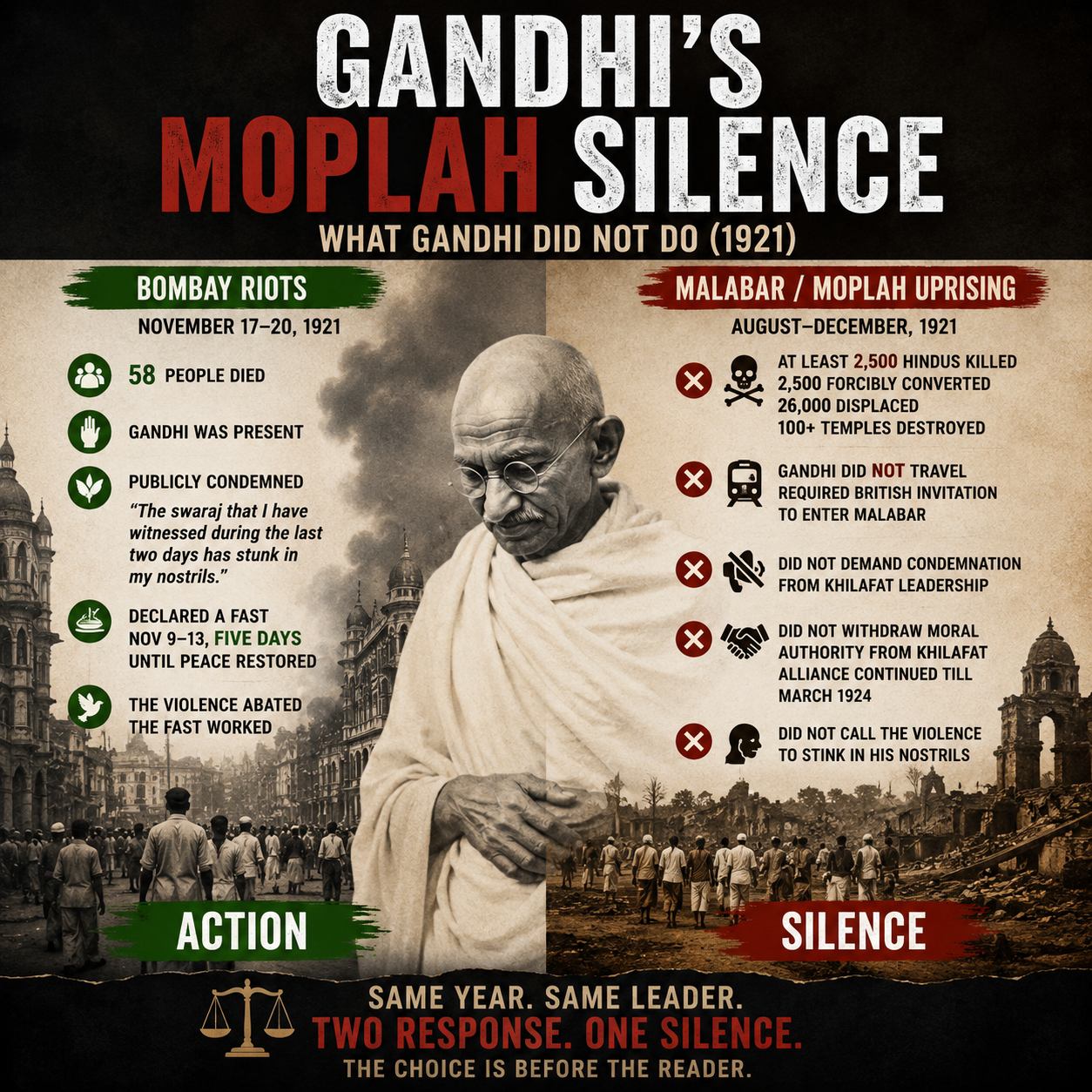
November 17-20, 1921 — Bombay. The Prince of Wales riots. Muslim and Hindu supporters of the Non-Cooperation and Khilafat movements attacked Parsi, Christian, and Jewish minorities who had welcomed the Prince. 58 people died in four days.
Gandhi was in Bombay. He witnessed the violence directly. On November 19, 1921, he issued a leaflet: “The swaraj that I have witnessed during the last two days has stunk in my nostrils.”
He declared a hunger strike — fasting from November 19-23, five days — until peace was restored. The violence abated.
The instrument Gandhi deployed for Bombay: immediate personal intervention, public condemnation of the violence, a five-day fast staking his own health on the restoration of order.
What Gandhi Did Not Do — August to December 1921, Malabar
August 20, 1921 — the Moplah uprising began. At least 2,500 Hindus were killed. 2,500 were forcibly converted. 26,000 were displaced. More than 100 temples were destroyed. The uprising ran for four months.
Gandhi did not fast.
Gandhi did not travel to Malabar — as Blog 63 documented, he required a British invitation before he would enter Malabar, though he had required no invitation for Champaran, the Salt March, or the Non-Cooperation Movement.
Gandhi did not demand condemnation from the Khilafat leadership. As Blog 64 documented, he told Hindus that verbal disapproval from Muslims was not a test of Muslim friendship — removing condemnation as a requirement of the alliance.
Gandhi did not withdraw the moral authority of the independence movement from the Khilafat alliance. As Blog 66 documented, the alliance continued until the Turks abolished the Caliphate in March 1924.
Gandhi did not call the violence to stink in his nostrils.
The Arithmetic of the Two Silences and the One Action
The prosecution places the documented arithmetic before the reader without characterisation. Gandhi’s Moplah Silence is built entirely from what the documented record shows was absent — and what the Bombay record shows was present.
Bombay November 1921 — 58 dead. Gandhi present. Gandhi fasted five days. Gandhi condemned the violence publicly.
Malabar August-December 1921 — at least 2,500 Hindus dead, 2,500 forcibly converted. Gandhi absent. Gandhi did not fast. Gandhi called the perpetrators brave and God-fearing.
Both events occurred in the same months of the same year. Gandhi was the acknowledged moral authority of the independence movement in both cases. The instrument of personal fast — deployed immediately for 58 dead in Bombay — was not deployed for 2,500 dead in Malabar.
What the Silence Cost
Gandhi’s Moplah Silence has one documented consequence that the prosecution places before the reader precisely.
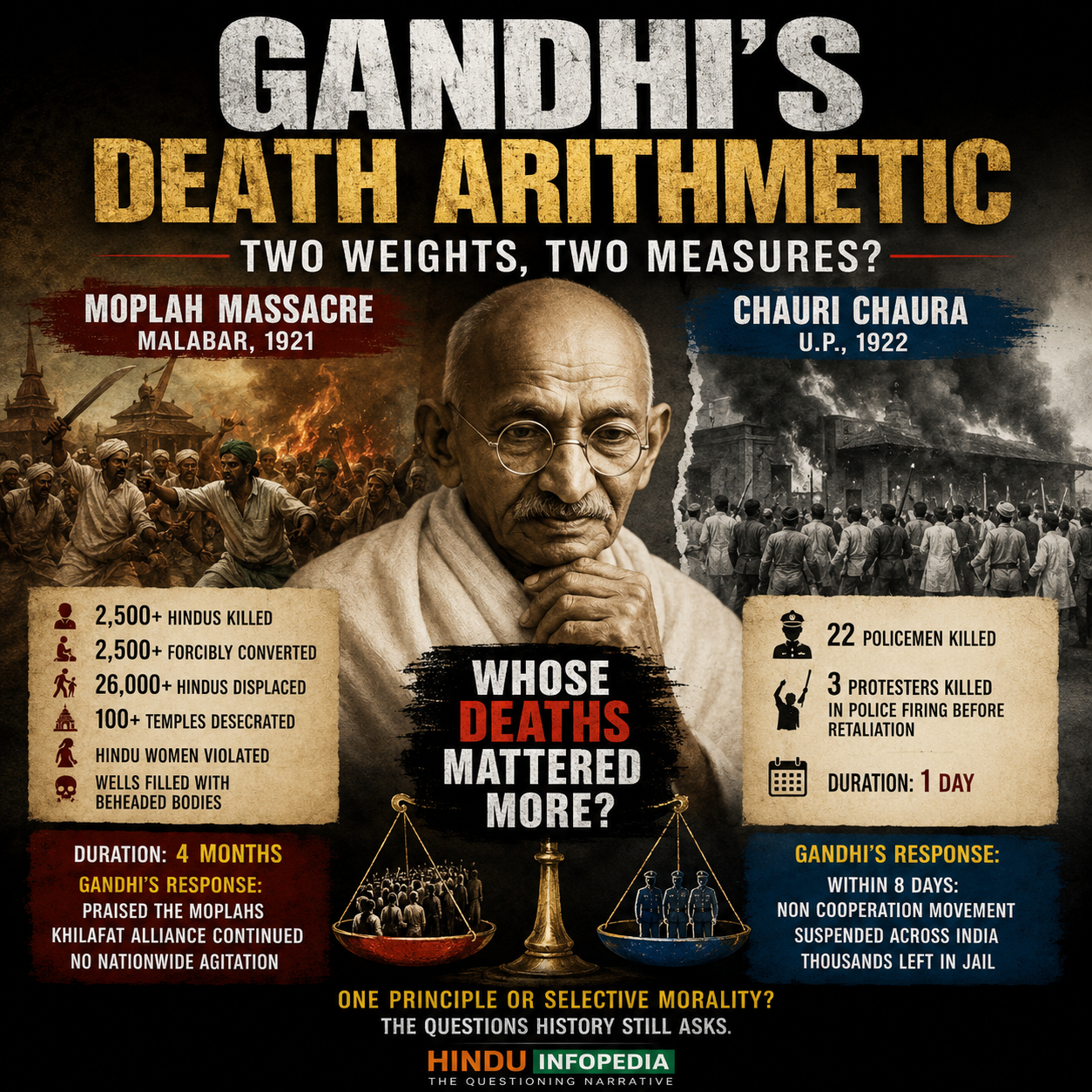
The Bombay fast worked. The violence abated on November 20 — within days of Gandhi’s intervention. 58 people had died. The fast stopped further killing.
The Moplah massacre ran from August to December 1921 — four months. At least 2,500 Hindus were killed. 2,500 were forcibly converted. 26,000 were displaced. The full documentation is in Blog 54.
The prosecution does not assert that a Gandhi fast would have stopped the Moplah massacre as it stopped the Bombay riots. It places the documented outcome of the instrument deployed in Bombay alongside the documented outcome of the instrument not deployed in Malabar. The reader will examine both.
Gandhi’s Moplah Silence is the closing exhibit of the Moplah arc — not because it is the last word on Gandhi’s communal conduct, but because it places the entire arc’s documentation into its simplest form. Fourteen blogs have documented what Gandhi said about the Moplah massacre. This blog documents what Gandhi did not do. The two records together — the documented statements and the documented silence of action — constitute the prosecution’s Moplah exhibit in its complete form.
The Prosecution’s Position
Gandhi’s Moplah Silence does not claim Gandhi was indifferent to all suffering. It places two documented records side by side — his conduct in Bombay and his conduct regarding Malabar — in the same months of the same year. His documented record shows genuine personal courage and genuine personal intervention in situations he chose to enter or stay away from.
Gandhi’s Moplah Silence places the documented record of what Gandhi did not do — alongside the documented record of what he did do in the same month — and asks the reader to examine the difference.
- Did Gandhi deploy his personal fast — a documented instrument of immediate moral intervention — for 58 deaths in Bombay in November 1921?
- Did Gandhi deploy the same instrument for at least 2,500 deaths in Malabar across the same months?
- Did Gandhi condemn the Bombay violence in his own published words within days?
- Did Gandhi’s published words on Malabar call the perpetrators brave and God-fearing — as Blogs 58-65 documented?
The prosecution places the two documented records before the reader. Both events are in the same months. Both involved violence Gandhi had the documented capacity to respond to. The instrument deployed in Bombay was available for Malabar. The reader will examine the documented difference and complete the sentence.
Bombay, November 1921 — 58 dead. Gandhi fasted five days. The swaraj he witnessed had stunk in his nostrils. Malabar, August-December 1921 — 2,500 Hindus killed, 2,500 forcibly converted, 26,000 displaced. Gandhi did not fast. Gandhi did not go. Gandhi did not demand condemnation. Gandhi called the perpetrators brave and God-fearing. The prosecution places the two documented records before the reader. Same year. Same months. Same man. The reader will complete the sentence.
Feature Image: Click here to view the image.
Videos
Glossary of Terms
- Moplah Massacre: The 1921 Malabar violence involving killings, forced conversions, displacement, and destruction during the Moplah uprising in British India.
- Khilafat Movement: A pan-Islamic political movement supported by Gandhi and Indian Muslim leaders to preserve the Ottoman Caliphate after World War I.
- Non-Cooperation Movement: Gandhi-led mass protest movement launched in 1920 against British colonial rule through boycott and civil resistance.
- Malabar: A region in present-day Kerala where the 1921 Moplah uprising and communal violence occurred.
- Prince of Wales Riots: Violent riots in Bombay in November 1921 linked to protests against the visit of the Prince of Wales.
- Gandhi’s Moplah Silence: A key phrase in this series referring to Gandhi’s alleged absence of equivalent moral intervention during the Moplah violence compared to Bombay riots.
- Silence of Action: A phrase in this series describing the absence of direct intervention, fast, or political escalation despite large-scale violence.
- Bombay Fast: Gandhi’s five-day fast during the 1921 Bombay riots intended to restore communal peace and public order.
- Moral Intervention: Use of personal fasts, public condemnation, and political pressure as ethical tools to influence public conduct.
- Forced Conversion: Conversion under coercion, intimidation, or threat during communal violence.
- Communal Violence: Violence between religious communities, particularly Hindus and Muslims in colonial India.
- Ahimsa: Gandhi’s doctrine of nonviolence used as both moral philosophy and political strategy.
- Khilafat Alliance: The political cooperation between Gandhi’s Congress movement and Khilafat leadership during 1920–1924.
- Moral Asymmetry: A recurring theme in the series describing unequal moral or political responses to communal violence.
- Prosecution’s Position: A recurring series phrase presenting the blog’s argument in a courtroom-style evidentiary framework.
#Gandhi #Moplah #Malabar #Khilafat #Congress #Partition #History #India #Hindu #Kerala #MahatmaGandhi #FreedomStruggle #ColonialIndia #HinduinfoPedia
Gandhi’s Peace Efforts: The Questions Before the Mahatma (0)