
Gandhi’s Vindicated Critics: The Warnings That Proved Accurate Within Twelve Months (67)
भारत / GB
Part 67: Mahatma Gandhi’s Peace Efforts | Series Index
Blog 66 documented the continuation of the Khilafat alliance after the Moplah massacre — maintained until the Turks abolished the Caliphate, not dissolved by Gandhi. This post documents the critics Gandhi had silenced before the massacre — and what they wrote after it confirmed their warnings.
Thank you for reading this post, don't forget to subscribe!The Action Taken: The warnings published in 1920 by Besant, Jinnah, and Pal—predicting that religious mobilization would culminate in fanatical sectarian riots—were realized in Malabar within twelve months.
Who Paid the Price: The constitutional dissenters who were driven out of nationalist leadership for accurately forecasting the trajectory of faith-based mobilization.
The Alternative Bypassed: Heeding contemporary warnings and establishing strict safeguards to separate religious grievances from mass political action.
Why This Matters: Establishes that the tragedy was fully anticipated by contemporary leaders; the leadership proceeded with full knowledge of the articulated risks.
The Silenced Critics — Recalled
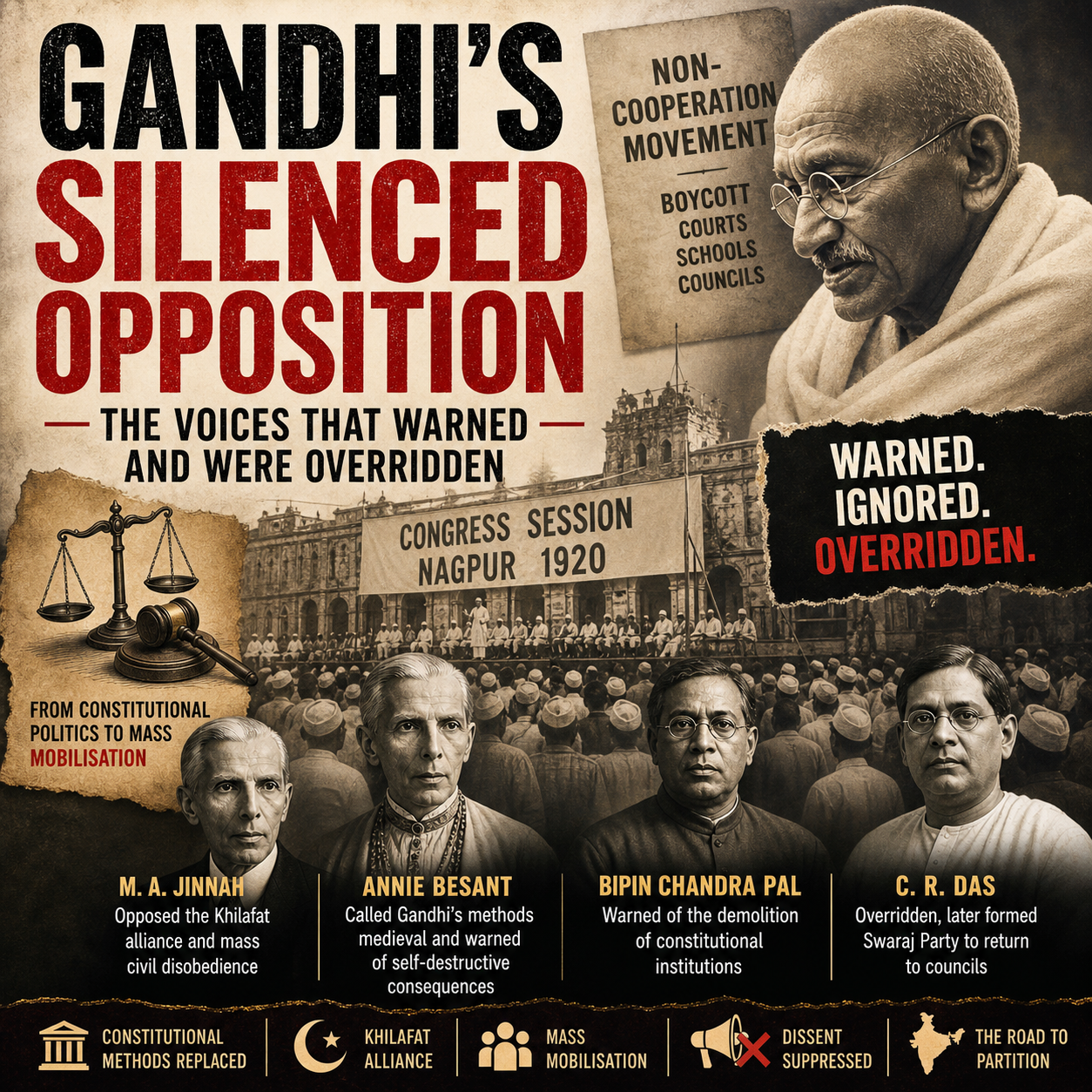
Blog 49 documented the silencing — Jinnah shouted down at Nagpur, Besant dismissed, Pal bypassed, Tilak’s warnings overridden before his death. Each warned that the Khilafat alliance would introduce communal dynamics the independence movement was not designed to manage.
Gandhi’s Vindicated Critics places their warnings alongside what they wrote and said after the Moplah massacre confirmed those warnings. The prosecution does not need to assert the connection. The critics made it themselves — in dated, published, verifiable documents. The prosecution does not need to characterise the pattern. The critics documented it themselves — while Gandhi was alive, while the Congress was operating under his authority, while the alliance he had built was still in place.
Besant — The Most Precise Vindication
Annie Besant warned at Nagpur in 1920 that the Khilafat alliance would introduce pan-Islamic energy the Congress framework could not manage. She was effectively silenced — her constitutional warnings overridden by the Muslim majority Gandhi’s alliance had activated at the session.
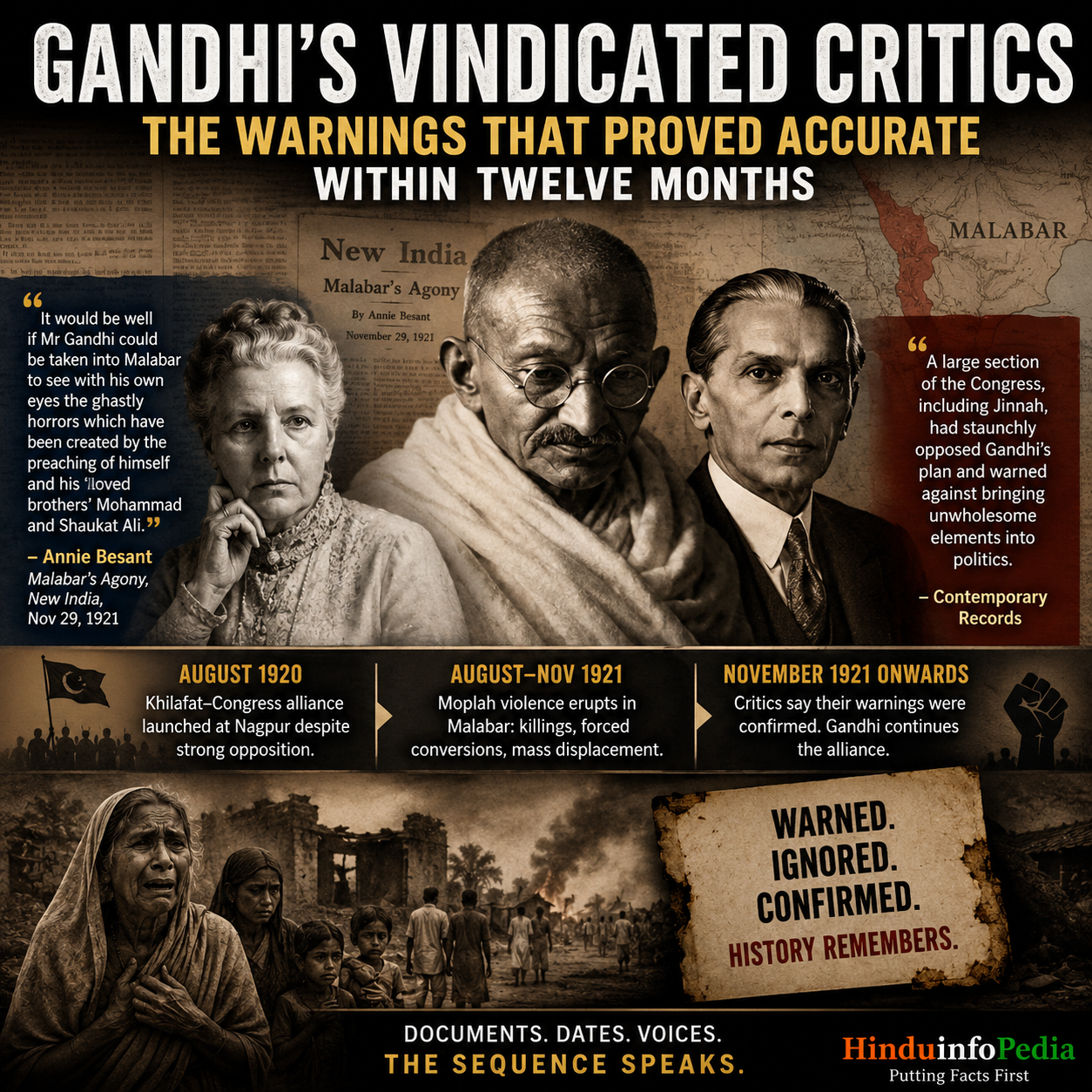
On November 29, 1921 — while the Moplah massacre was ongoing — Besant published Malabar’s Agony in New India. The prosecution carries her documented words:
“It would be well if Mr Gandhi could be taken into Malabar to see with his own eyes the ghastly horrors which have been created by the preaching of himself and his ‘loved brothers’ Mohammad and Shaukat Ali.”
“The Khilafat Raj is established there; on August 1, 1921, sharp to the date first announced by Mr Gandhi for the beginning of Swaraj and the vanishing of British Rule, a Police Inspector was surrounded by Moplahs revolting against that Rule.”
“They murdered and plundered abundantly, and killed or drove away all Hindus who would not apostatize. Somewhere about a lakh of people were driven from their homes with nothing but the clothes they had on, stripped of everything.”
“Malabar has taught us what Islamic rule still means, and we do not want to see another specimen of the Khilafat Raj in India.”
Besant documented the precise connection — the Non-Cooperation and Khilafat preaching had produced the Moplah uprising. Her warning at Nagpur was that this energy was unmanageable. The Moplah massacre was her warning confirmed — documented in her own published words on November 29, 1921.
Jinnah — The Warning About Unwholesome Elements
Jinnah had warned Gandhi at Nagpur that bringing pan-Islamic mobilisation into the independence movement was a category error — secular nationalism yoked to a religious cause. He was shouted down by the Muslim majority Gandhi’s alliance had activated.
After the Moplah massacre, Jinnah’s documented position was on record: a large section of the Congress, including Jinnah, had staunchly opposed Gandhi’s plan and warned against bringing unwholesome elements into politics.
The unwholesome elements Jinnah had warned against had produced precisely what he had warned they would produce — religious violence directed at Hindu civilians, conducted under the banner of the same cause Gandhi had legitimised.
Besant’s Direct Charge
Besant’s Malabar’s Agony carried one specific charge that the prosecution places before the reader precisely. Besant wrote that the ghastly horrors had been created by the preaching of Gandhi and his “loved brothers” Mohammad and Shaukat Ali. She did not frame the Moplah massacre as an unintended consequence of a well-meaning policy. She named Gandhi’s preaching as a direct cause — in a published article, on November 29, 1921, while the massacre was ongoing.
Of particular significance was Besant’s charge that by making Non-Cooperation part of the Khilafat movement, Gandhi’s Gandhism was also part of the violence that gave rise to it, and he could not escape responsibility.
The prosecution carries this charge not as its own assertion but as Besant’s documented published statement — made by the woman Gandhi had silenced at Nagpur, confirmed by the events she had predicted would follow. Gandhi’s Vindicated Critics carries Besant’s charge in her own words.
What the Vindications Establish
Gandhi’s Vindicated Critics places the documented sequence before the reader — not as the prosecution’s assertion but as the critics’ own published record:
The warnings were made before September 1920 — before Gandhi formalised the alliance. The warnings were specific — communal dynamics, unmanageable pan-Islamic energy, the wrong instrument for the independence movement’s stated purpose. The warnings were documented in speeches, articles, and Congress session records.
The warnings were overridden. Gandhi formalised the alliance. The Khilafat movement reached Malabar through the Congress-Khilafat platform. The first Moplah uprising began on August 20, 1921 — eleven months later.
The vindications were documented by the same critics — in Besant’s case, in a published article naming Gandhi specifically, published while the massacre was ongoing.
The gap between warning and confirmation was eleven months.
The Prosecution’s Position
Gandhi’s Vindicated Critics does not claim the critics were infallible or that their warnings were motivated purely by concern for India’s communities. It places two documented sequences before the reader — the warnings before September 1920, and the vindications after August 1921 — and asks the reader to examine the gap between them.
- Were the warnings Gandhi overrode at Nagpur specific enough to have predicted what happened in Malabar?
- Did the critics who made those warnings document their vindication in their own published words within twelve months?
- Did Gandhi respond to their vindications by withdrawing the alliance or by maintaining it — as Blog 66 documented?
The series does not answer. Gandhi’s Vindicated Critics places the warnings before the reader. The vindications are documented. The alliance’s continuation after both is documented. The reader will examine the sequence and complete the sentence.
Besant warned at Nagpur in 1920. Jinnah warned at Nagpur in 1920. Both were overridden. On November 29, 1921, Besant published Malabar’s Agony — naming Gandhi specifically, documenting what his preaching had produced. The gap between warning and vindication was eleven months. The alliance Gandhi had built continued for two years and four months after the vindication arrived. The prosecution places the documented sequence before the reader.
Feature Image: Click here to view the image.
Videos
Glossary of Terms
- Khilafat Movement: A pan-Islamic political movement launched after World War I to preserve the Ottoman Caliphate, later integrated by Gandhi into the Non-Cooperation movement.
- Non-Cooperation Movement: Gandhi-led mass political agitation launched in 1920 urging Indians to boycott British institutions, courts, schools, and titles.
- Moplah Massacre: The 1921 Malabar violence involving sections of Moplah Muslims, marked by killings, forced conversions, displacement, and attacks on Hindus during the rebellion.
- Pan-Islamic Mobilisation: Political mobilisation based on global Islamic identity and solidarity beyond regional or national boundaries.
- Nagpur Session: The 1920 Congress session where Gandhi consolidated support for the Non-Cooperation and Khilafat alliance despite opposition from several senior leaders.
- Annie Besant: Irish-born theosophist, Congress leader, and Home Rule advocate who warned against the Khilafat alliance and later criticised its consequences in Malabar’s Agony.
- Muhammad Ali Jinnah: Constitutional nationalist leader who opposed Gandhi’s mass agitation methods and warned against mixing religious mobilisation with Congress politics.
- Malabar’s Agony: Annie Besant’s November 29, 1921 article in New India documenting atrocities during the Moplah violence and directly criticising Gandhi’s Khilafat alliance.
- Khilafat Raj: A phrase used by Annie Besant to describe the temporary dominance of Khilafat-aligned rebels in parts of Malabar during the 1921 uprising.
- Congress-Khilafat Alliance: The political partnership forged by Gandhi between the Indian National Congress and Khilafat leadership to expand anti-British mobilisation.
- Vindicated Critics: A phrase used in this series for leaders whose earlier warnings against the Khilafat alliance appeared confirmed by later communal violence and political developments.
- Constitutional Nationalism: A political approach favouring negotiated reforms, legal methods, and constitutional processes instead of mass emotional or religious mobilisation.
- Mohammad and Shaukat Ali: Prominent Khilafat leaders and close Gandhi allies during the Non-Cooperation movement.
- Communal Dynamics: Political and social tensions arising from religious identity mobilisation between communities.
- Prosecution’s Position: A recurring series phrase indicating that the article presents documented sequences and evidence in a prosecutorial narrative framework rather than claiming judicial finality.
#Gandhi #Khilafat #Moplah #Jinnah #AnnieBesant #Congress #Malabar #History #India #Caliphate #NonCooperation #Hindu #Politics #FreedomStruggle #HinduinfoPedia
Gandhi’s Peace Efforts: The Questions Before the Mahatma (0)
Refer to Various Arks Referred to in the Blog
Gandhi’s Vindicated Critics: The Warnings That Proved Accurate Within Twelve Months (67)