
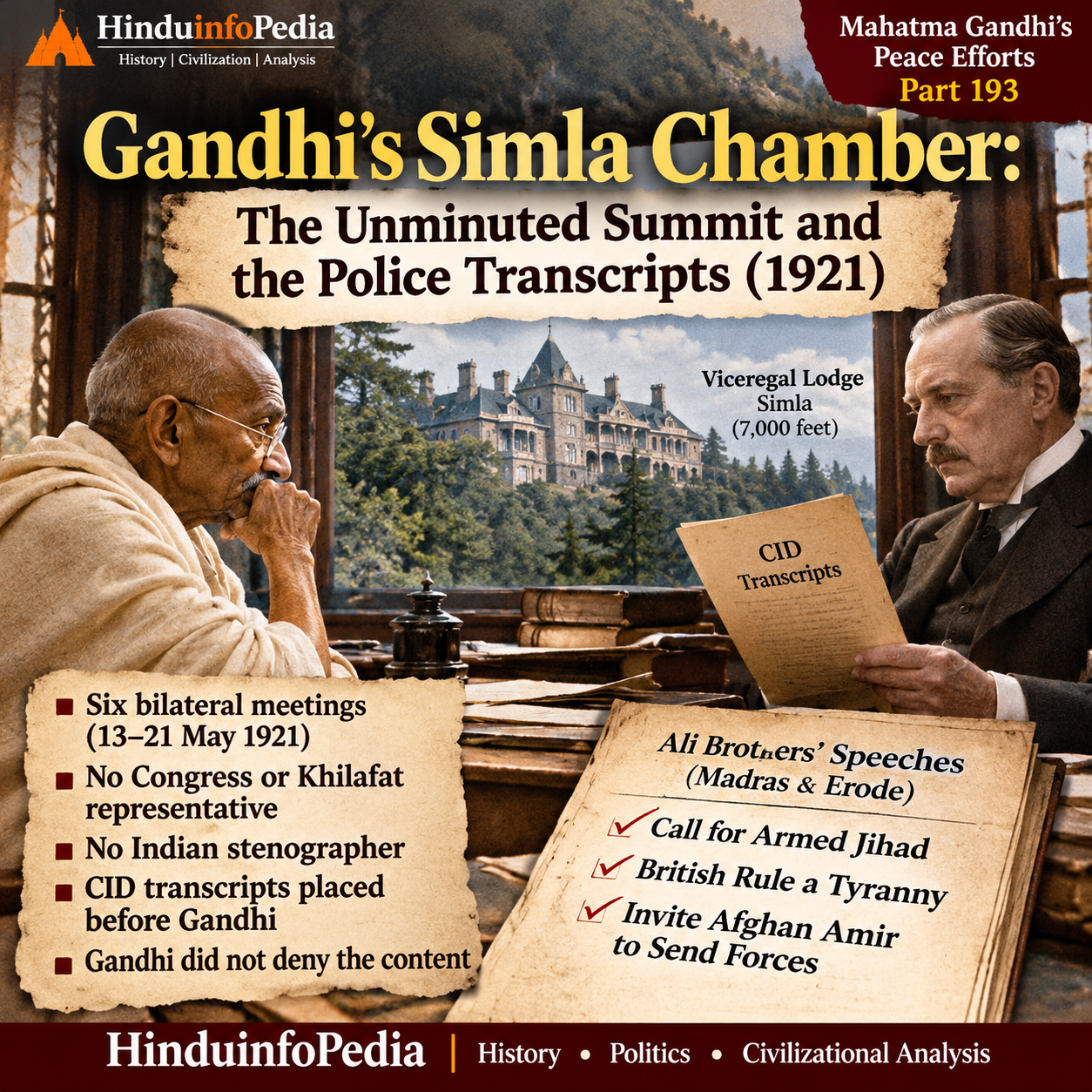
Gandhi’s Simla Chamber: The Unminuted Summit and the Police Transcripts (193)
भारत / GB
Part 193: Mahatma Gandhi’s Peace Efforts | Series Index
The previous blog documented Gandhi’s tampered fuse — the three Young India interventions in February and March 1921 through which he converted the district administration’s public statutory alarm into evidence of imperialist bad faith. By spring 1921 the national public had been taught that official concern about Malabar was manipulation rather than warning. This blog documents what happened when that teaching collided, in private, with the Viceroy of India. In May 1921, Gandhi’s Simla Chamber — the six bilateral interviews held at 7,000 feet with no Indian stenographer, no Congress delegation, and no CWC representative present — placed before Gandhi something his Young India readers would never see: CID records of the Ali brothers calling for armed jihad, with passages read out in the room.
Thank you for reading this post, don't forget to subscribe!GANDHI’S SIMLA CHAMBER — THE ASYMMETRIC RECORD
The Pattern: In May 1921, the Viceroy of India — Lord Reading — summoned Gandhi to Simla for a series of bilateral interviews that would run across six sessions between 13 and 21 May. The meetings were held at Viceregal Lodge, 7,000 feet above Shimla. Six prolonged sessions ran between 13 and 18 May, concluding with a final audience on 21 May. No Congress Working Committee member attended. No Khilafat Committee representative was present. No Indian stenographer was in the room. The asymmetry of the record is total: Reading cabled clinical dispatches to Secretary of State Montagu in London; Gandhi published moral reframing in Young India weeks later. What was said in the room survives primarily in Reading’s hand. Gandhi’s Simla Chamber — the geographical isolation, the procedural exclusion, the asymmetric documentary record — is not coincidence. It is the architecture of a confrontation designed to produce a usable outcome.
The Lethal Exhibit: Reading placed before Gandhi CID records of the Ali brothers’ public speeches — at Madras and Erode — in which Mohamed Ali and Shaukat Ali had explicitly called on Muslims to defend the Caliphate by armed force, had described the British administration of India as a tyranny warranting armed resistance, and had invited the Afghan Amir to send forces into India in support of the Muslim cause. These were not intelligence assessments. They were records of what Gandhi’s closest Khilafat allies had said in public, taken down by CID officers and placed before Gandhi in Gandhi’s Simla Chamber. Accounts of the Simla sessions record that passages were read out to Gandhi; Gandhi did not deny their accuracy.
Why it matters: Gandhi’s Simla Chamber is the fourth and most direct of the channels establishing Gandhi’s live bomb knowledge — Malabar. The defence has three remaining channels to defeat after this one. But Gandhi’s Simla Chamber stands alone as the only channel that produced a contemporaneous acknowledgement from Gandhi that the state’s alarm had evidentiary force: he conceded the transcripts’ content, he agreed that the speeches were dangerous, and he undertook to broker a retraction. That concession — documented in Reading’s dispatches — is the prosecution’s sharpest single exhibit. The concession took place not in a public article, not in a party report, but in a sealed room at 7,000 feet with the Viceroy of India.
The Geography of Exclusion
Simla was not an accidental venue. By May 1921 the Government of India’s summer seat had been established in the Himalayan hill station for decades, and Viceregal Lodge — constructed in 1888 — served as the administration’s working headquarters through the summer months. Reaching Simla from Bombay required a journey of several days, culminating in a narrow-gauge railway ascent from Kalka to 7,000 feet. The logistical threshold was not trivial.
The choice of Simla for the six prolonged sessions of May 1921 — running from 13 to 18 May with a final audience on 21 May — had three structural consequences. First, the geographical distance from Bombay, Madras, and Delhi made it effectively impossible for Gandhi’s colleagues in the Congress Working Committee or the All-India Khilafat Committee to attend at short notice. The bilateral format — Viceroy and Gandhi, with their respective secretaries — was not imposed; it was produced by the venue’s inaccessibility. Second, the press was excluded. The Simla sessions generated no contemporaneous Indian press reporting beyond brief notices that meetings had taken place. Third, no Indian stenographer was present in Reading’s private interviews with Gandhi. The documentary record of what passed between them in the room would be produced entirely on the British side.
Gandhi’s Simla Chamber therefore began with an asymmetry built into its physical conditions: one party would cable clinical dispatches to London; the other would publish moral reframing weeks later in his own newspaper. That asymmetry is not conjecture. It is what the archives contain.
Reading’s Dispatches and Gandhi’s Young India
Lord Reading communicated his account of the Simla interviews to Secretary of State Montagu in London through the official India Office channel. His correspondence — preserved in the Reading Papers (MSS.EUR.E.238, Volumes 3–4, India Office Records) — gives the British side’s contemporaneous record of what was said, what was placed before Gandhi, how Gandhi responded, and what was agreed. Secondary accounts drawing on this correspondence, together with the later agreed statement, constitute the principal surviving record of the private sessions; the precise wording and dates of individual private dispatches are not reproduced in the publicly available sources.
Reading was a former Lord Chief Justice of England, trained in the precise notation of legal proceedings. His communications to Montagu describe the sequence of argument, Gandhi’s specific responses, and Reading’s assessment of the outcome. They constitute the most detailed record available of what Gandhi was told in Gandhi’s Simla Chamber.
Gandhi’s own published response to the Simla meetings appears in Young India issues of 1 June and 8 June 1921 — written after the meetings had concluded and after Gandhi had already begun brokering the Ali brothers’ retraction. His Young India articles frame the Simla encounter in the vocabulary of moral negotiation: the Viceroy as a reasonable interlocutor, the Ali brothers’ speeches as expressions of sincere religious grievance, the demand for retraction as an overreach that Gandhi had nonetheless agreed to assist in moderating. The vocabulary of Gandhi’s Young India and the vocabulary of Reading’s dispatches are not incompatible. They are accounts of different things: Reading records what the transcripts contained and Gandhi’s concession of their force; Gandhi publishes what that concession enabled him to present as a reasonable settlement.
The gap between Reading’s dispatches and Gandhi’s Young India is Gandhi’s Simla Chamber. It is the space between what was said in the room and what was permitted to reach the reading public.
The CID Transcripts on the Table
The central evidentiary act of Gandhi’s Simla Chamber was Reading’s production of the CID shorthand transcripts. These were verbatim records of speeches the Ali brothers had delivered at public meetings in Madras, Erode, and Gorakhpur in the months preceding May 1921. The Erode speech had already attracted specific attention from the Madras Government before the Simla sessions: the provincial administration had queried the Madras CID on the effect of Mohamed Ali’s Erode address on the Moplah community in particular — establishing that the connection between the Ali brothers’ inflammatory rhetoric and the specific conditions in Malabar was part of the provincial intelligence picture before Gandhi arrived at Viceregal Lodge.
The content of the passages placed before Gandhi, as reported in Reading’s correspondence, included the following documented elements. Mohamed Ali had stated at a Madras meeting that Muslims were obliged by the Quran to defend the Caliphate by any means including force, and had extended an invitation to the Afghan Amir — Amanullah Khan — to send Afghan forces into India to assist in the liberation of Muslims from British rule; the Madras speech is the primary documented instance of this language. Shaukat Ali had characterised the British administration of India as a tyrannical occupation warranting armed resistance. The CID officers who recorded these speeches were present at the meetings; according to accounts of the Simla sessions, passages from the speeches were read out to Gandhi rather than the transcripts themselves being handed to him.
Secondary accounts of the Simla interviews record that at the opening sessions Reading placed the speech passages before Gandhi and had them read out. Gandhi did not immediately deny their accuracy. The accounts then record Gandhi’s position: that the speeches, while inflammatory in language, reflected the sincere religious convictions of the Ali brothers rather than a plan for actual armed insurrection; that the Congress policy of non-violence meant the speeches would not be acted upon; and that the proper response was not prosecution but a public undertaking from the Ali brothers clarifying that they did not advocate violence within the Non-Cooperation framework.
Reading’s response, as recorded in his communications to Montagu, was an ultimatum: unless the Ali brothers publicly retracted the specific statements that called for armed resistance and foreign military intervention, the Government would proceed with their prosecution under the sedition provisions of the Indian Penal Code. Gandhi could choose between brokering a retraction that would make prosecution unnecessary or watching his closest Khilafat allies face criminal trial on the basis of their own recorded words.
What Gandhi Conceded in the Room
Reading’s correspondence records the outcome of Gandhi’s Simla Chamber. By the final sessions Gandhi had left Simla and was traveling toward Bombay, where he would broker the Ali brothers’ signed statement of 30 May. Reading’s communications document what Gandhi had conceded before departing.
Gandhi had conceded that the passages were accurate — that the words in them had been spoken. Gandhi had conceded that statements calling for armed defence of the Caliphate and inviting Afghan military intervention were dangerous. Gandhi had conceded that he could not guarantee the Ali brothers would not be followed by their audiences even if they subsequently retracted. And Gandhi had agreed to travel to Bombay and secure from the Ali brothers a public statement that would demonstrate clearly that the inflammatory passages in the Madras and Erode speeches did not represent the policy of the Khilafat movement under Gandhi’s guidance.
The Simla sessions addressed the Ali brothers’ public statements — the channel most visible to the press and most dangerous to the Government’s sedition calculus. No surviving account of the sessions that has been located — Reading’s correspondence, the agreed statement, contemporary reports, or secondary works drawing on the papers — records any discussion of the Malabar Khilafat Volunteer Corps, the arms reports from Ernad and Walluvanad, the tangal preachers at Ponnani, or the specific territorial conditions the Malabar Collector had reported to Madras. The Malabar district apparatus does not appear in the record of what the two men discussed. Whether it was raised and went unrecorded cannot be established from the surviving documentation.
The Structural Consequence of the Asymmetric Record
Reading’s 19 May 1921 letter to Montagu records his satisfaction at the outcome of the meetings. Reading noted that Gandhi had been forced to separate himself from the militant rhetoric of his Khilafat allies and had undertaken the task of policing his own frontline commanders — accepting, in effect, the role of internal disciplinarian for the Raj’s most immediate political liability. Reading believed that Gandhi had been placed in a position where he would have to choose between his Khilafat alliance and his claim to lead a movement of principled non-violence — and that Gandhi had chosen the alliance by making the retraction as narrow as possible. The precise phrasing of Reading’s characterisation of the outcome is documented in his private correspondence; the exact phrase “psychological victory” is not reproduced in the publicly available sources, but the substance — Gandhi compelled to police his own allies on the Viceroy’s demand — is anchored in the 19 May letter itself.
Gandhi’s Simla Chamber closed in late May 1921. The Ali brothers’ signed statement would follow on 30 May. The next blog documents the anatomy of that statement — specifically the escape hatch its drafting contained and the operational consequence that escaped with it. What Gandhi’s Simla Chamber established, beyond the specific transaction it produced, was this: by 28 May 1921, Gandhi held knowledge that his own closest Khilafat allies had publicly called for armed resistance in the name of the Caliphate; that the Government held verbatim records of those calls; and that the Government was prepared to prosecute. He held that knowledge in documented form, in a sealed room, fourteen weeks before the Malabar rebellion broke out.
Invitation To Defence
Reading’s correspondence in the India Office Records (Reading Papers, MSS.EUR.E.238) documents the Simla sessions. The CID records of the Ali brothers’ speeches are referenced in the same archive. Gandhi’s Young India articles of 1 June and 8 June 1921 are part of CWMG Vol.20. Gandhi’s Simla Chamber is not a matter of inference from political circumstance. It is a matter of documented record. We invite the defence to place before the reader an account of these meetings that is consistent with Gandhi’s innocence of the knowledge Reading’s correspondence records he received.
13–21 May 1921: six bilateral sessions at Viceregal Lodge, Simla. Reading’s correspondence to Montagu records CID passages from the Ali brothers’ calls for armed jihad placed before Gandhi. The passages were read out. Gandhi did not deny their accuracy. Gandhi conceded they were dangerous. Gandhi agreed to broker a retraction. No surviving account of the Simla sessions records any instruction to the Malabar Khilafat Volunteer Corps. Gandhi’s Simla Chamber closed. The Malabar apparatus kept drilling. The rebellion broke out on 20 August 1921.
Feature Image: Click here to view the image.
Videos
Glossary of Terms
1. Gandhi’s Simla Chamber: A coined expression referring to the six private meetings between Mahatma Gandhi and Viceroy Lord Reading at Viceregal Lodge, Simla, in May 1921, where CID records of the Ali brothers’ speeches were presented to Gandhi.
2. Unminuted Summit: A series of high-level political meetings for which no Indian stenographer was present and no Indian-side official minutes were prepared, leaving the surviving documentary account largely dependent on British records.
3. Asymmetric Documentary Record: An unequal historical record in which Lord Reading’s official dispatches preserved the British account of the discussions, while Gandhi subsequently presented his own public interpretation through Young India.
4. Viceregal Lodge: The official summer headquarters of the British Viceroy in Simla, where Gandhi and Lord Reading held their private meetings in May 1921. The building was constructed in 1888.
5. Lord Reading: Rufus Isaacs, the Viceroy of India from 1921 to 1926, who summoned Gandhi to Simla and conducted the six bilateral meetings concerning the speeches of the Ali brothers.
6. CID (Criminal Investigation Department): The colonial government’s police intelligence and investigation department responsible for recording and investigating public speeches and activities considered potentially threatening to British administration.
7. CID Shorthand Transcripts: Police records containing the recorded speeches of Mohamed Ali and Shaukat Ali at public meetings, including Madras and Erode. Passages from these records were reportedly read aloud to Gandhi during the Simla meetings.
8. Bilateral Sessions: Meetings conducted between two principal parties. In this instance, they refer to the private discussions between Viceroy Lord Reading and Mahatma Gandhi without Congress or Khilafat representatives participating.
9. Khilafat Movement: A political and religious mobilisation among Indian Muslims concerning the future of the Ottoman Caliphate after the First World War. Gandhi supported the movement and associated with its principal leaders, Mohamed Ali and Shaukat Ali.
10. Ali Brothers: Mohamed Ali and Shaukat Ali, prominent leaders of the Khilafat Movement who delivered public speeches concerning the Caliphate, British rule and resistance. Their recorded statements became central to the Simla discussions.
11. Armed Resistance: The use or advocacy of military force against an established government or occupying authority. The speeches attributed to the Ali brothers included references to armed resistance against British rule.
12. Afghan Amir Amanullah Khan: The ruler of Afghanistan from 1919 to 1929, whom Mohamed Ali reportedly invited to send military forces into India in support of the Muslim cause against British rule.
13. Sedition Provisions: Legal provisions under the Indian Penal Code used by the British administration to prosecute speech or conduct considered threatening to the authority of colonial government.
14. Young India: Gandhi’s English-language weekly publication through which he communicated his political views. His public account of the Simla meetings appeared in its issues dated 1 and 8 June 1921.
15. Malabar Khilafat Volunteer Corps: An organisation associated with the Khilafat mobilisation in Malabar. Its activities, along with reports concerning arms in Ernad and Walluvanad, form an important contextual issue because the surviving accounts of the Simla meetings do not record any discussion of these matters.
#Gandhi #MahatmaGandhi #IndianHistory #BritishIndia #KhilafatMovement #Simla #LordReading #HinduinfoPedia
Scan Through The Entire Series at
Refer to Various Arks Referred to in the Blog
Gandhi’s Simla Chamber: The Unminuted Summit and the Police Transcripts (193)