
Gandhi’s Perpetual Debt: Twenty-Five Years of Re-payments on a Zero-Price (38)
भारत / GB
Part 38: Mahatma Gandhi’s Peace Efforts | Series Index
Blog 31 established the seller who set the price at zero — with or without knowing that the price of zero is not actually zero and will put the seller into perpetual debt by unilaterally withdrawing the movement that had potential to eliminate the British Raj. Blog 35 documented the first payment: thirty-one Indians killed by the state (including 6 who died in custody), one hundred and seventy-two sentenced to death, the Chauri Chaura defendants left without the movement that might have saved them. This post asks what “perpetual” means. The debt did not close in 1922. It compounded — across three decades, across two keys Gandhi turned, across consequences that outlasted him by seventy-six years and are still running today.
Thank you for reading this post, don't forget to subscribe!The Action Taken: Gandhi set the transaction price of terminating peak civil non-cooperation at zero, asking for no constitutional concessions or prisoner releases in exchange for stopping.
Who Paid the Price: The broader nationalist movement, which spent the next seven years fractured and demoralized trying to rebuild collapsed mass leverage.
The Alternative Bypassed: Formulating a structured exit treaty that traded movement cessation for provincial self-governance or fiscal autonomy.
Why This Matters: Demonstrates that setting an exit price at zero permanently altered British administrative deterrence calculations, proving that mass resistance would stand down without concessions.
The Debt That Opens in 1922
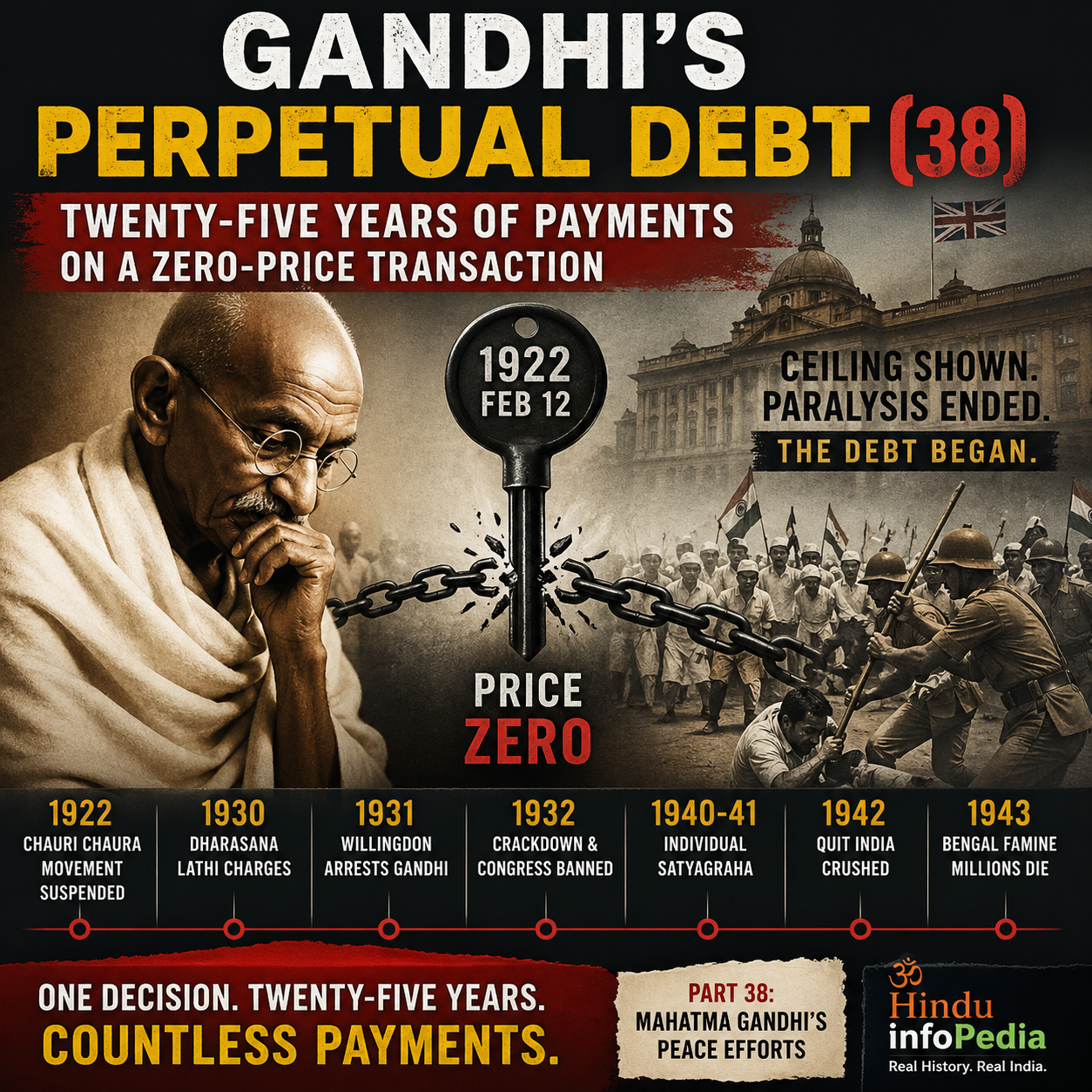
Gandhi’s Perpetual Debt begins with a precise transaction. February 12, 1922 — the movement dissolved, the ceiling shown, the British paralysis ended. The seller set the price at zero. The first instalment was paid immediately — the thirty thousand came out of jail to nothing, the 172 were sentenced to death (in addition to 6 who died in custody), the arrested protesters walked into lathis with no movement to protect them.
But a perpetual debt is not a single payment. It is a structure — one that accrues interest on every subsequent transaction that the original act made possible.
This blog carries one column: the British paralysis debt — what the suspension of 1922 made possible for the colonial administration across the remaining twenty-five years of British rule. It opened on February 12, 1922. It closed in August 1947 when the British left. In between, it extracted payments from every person who participated in every movement Gandhi led — because every one of those movements was conducted against an administration that knew Gandhi’s ceiling and planned accordingly.
The Payments — 1922 to 1947
The suspension of February 12, 1922 gave the British administration information it used in every subsequent calculation. Blog 32 documented the mechanism in full. This post documents the payments that mechanism extracted.
The lathi charges at Dharasana in 1930 — columns of volunteers walking forward, being beaten, falling, the next column walking forward. The British did not stop because they knew Gandhi would not escalate beyond satyagraha. The volunteers paid with their bodies. The movement paid with its moral pressure — expended against an adversary that had calculated it could absorb the cost.
The Willingdon arrest of 1931 — within days of Gandhi’s return from London after the Round Table Conference. The movement that had built the pressure for that conference had been dissolved through the Irwin Pact. Gandhi returned to an India whose movement infrastructure had not been rebuilt. Willingdon arrested him from a position of complete safety — the same calculation the British had made in 1922, now confirmed as repeatable.
The 1932 crackdown — the Congress banned, the Civil Disobedience infrastructure dismantled not through mass violence but through bureaucratic instruments. Ordinances, press controls, property orders. The British had learned from 1922 that Gandhi’s ceiling could be managed not only with lathis but with administrative attrition. No Dharasana-scale confrontation required. The licence operated quietly as well as visibly.
The Individual Satyagraha of 1940 to 1941 — minimum resistance at the moment of maximum British vulnerability. Britain standing alone after Dunkirk. The Indian Army the largest available Allied force. Gandhi’s response: one leader at a time, one arrest at a time, carefully bounded. The third torch — showing the British that Gandhi’s ceiling operated even at peak British vulnerability. The payment extracted: twenty-five years of leverage, surrendered in its most valuable moment.
The largest single payment on Gandhi’s Perpetual Debt was Quit India 1942. The British crushed it with over a thousand deaths — because the uprising had no Gandhian ceiling they recognised and no organised satyagraha framework that would self-limit. Twenty years of torches had shown them exactly what a Gandhian movement would and would not do. The 1942 dead were not a Gandhian movement. They were crushed with the confidence that two decades of Gandhi’s consistent choices had given the British administration. They paid with their lives for the information Gandhi had provided in 1922.
The Structural Cost
The personal payments — marched, beaten, jailed, died — are one ledger. The structural cost runs deeper and wider.
Every year the British administration operated with the certainty that Gandhi’s ceiling gave them was a year the extraction machine ran without the obstruction a sustained ungovernable movement would have created. The Bengal Famine of 1943 killed between two and three million people while India’s grain was exported to feed the British war effort. The extraction machinery did not pause because Gandhi had a movement — it paused only when the movement made extraction politically costly. The suspension of 1922 removed that cost. The twenty-five years that followed were twenty-five years of extraction against a population whose instrument of resistance had shown its ceiling to the people running the machine.
Independence delayed is not a neutral cost.
Every year of British rule after 1922 — when the movement was at its strongest and the British had no clean answer — was a year of revenue extraction, trade policy designed to deindustrialise India, famine policy that treated Indian lives as an acceptable cost of imperial logistics, and administrative decisions made by people who knew the resistance had a ceiling and had calculated accordingly.
The debt Gandhi’s suspension opened was not paid only by the people who marched. It was paid by every Indian who lived under British rule in the twenty-five years that followed — and by the millions who did not survive them. The next post documents this structural cost in further.
When the Debt Closed — and What Remains
Gandhi’s Perpetual Debt — the British paralysis column — closed in August 1947. The British left. The column stopped accruing.
But 1947 was not the end of the cost. Gandhi’s final unilateral act — the selection of India’s first Prime Minister, overriding a man who had won twelve of fifteen Pradesh Congress Committee nominations — ensured the cost crossed the boundary. The framework that selection installed ran for sixty-seven years. The next post documents what crossed with it.
The transaction of February 12, 1922 also opened a second column — one that has nothing to do with the British paralysis debt and everything to do with a key Gandhi turned two years earlier, in 1920. That column did not close in 1947. It has not closed since. The series will document it in full when the Khilafat arc is reached. It is named here only so the reader knows that Gandhi’s Perpetual Debt has two entries beyond the one this blog has carried — and that both are still being counted.
The Prosecution’s Position
Gandhi’s Perpetual Debt — the British paralysis column — is the prosecution’s most precisely bounded argument. It does not require intention. It requires only the arithmetic.
February 12, 1922: ceiling shown, paralysis ended, licence issued. August 15, 1947: British left, column closed. In between: Dharasana, Willingdon, 1932, Dunkirk, 1942. Paid by the volunteers, the jailed, the beaten, the dead — and by every Indian who lived under the extraction machine across twenty-five additional years of British rule made operationally confident by the information Gandhi’s suspension had provided.
The seller set the price at zero — with or without knowing that the price of zero is not actually zero and will put the seller into perpetual debt. The arithmetic was consistent. The debt was real. It compounded for twenty-five years. It was paid by people who had not signed the transaction that opened it.
Gandhi’s Perpetual Debt — the British paralysis column — opened on February 12, 1922 and closed on August 15, 1947. Twenty-five years. Dharasana, Willingdon, the 1932 crackdown, Dunkirk, the 1942 dead. The Bengal Famine. The extraction machine running unobstructed. The people who paid were not the man who set the price. The man who set the price called it a principled act. The principled act compounded for twenty-five years at the adversary’s benefit. The debt is closed. The record is not. The British paralysis column closed in 1947. But 1947 was not the end of the cost. Gandhi’s final unilateral act — the selection of India’s first Prime Minister — ensured the cost crossed the boundary. The next post documents what crossed with it.
Feature Image: Click here to view the image.
Videos
Glossary of Terms
- Gandhi’s Perpetual Debt: A conceptual framework used in this series to describe long-term political and structural consequences triggered by specific decisions, framed as an accumulating “debt” paid over time.
- Zero-Price Transaction: The idea that withdrawing a mass movement without extracting concessions effectively sets its “price” at zero, creating downstream costs rather than immediate gains.
- British Paralysis: A condition in which colonial administration was constrained by mass resistance, limiting its ability to act decisively without political or operational risk.
- British Paralysis Debt: The blog’s central construct referring to the cumulative costs imposed on Indians between 1922 and 1947 after the British gained strategic clarity on movement limits.
- Ceiling (Gandhian Ceiling): The perceived upper limit of escalation within Gandhian movements, beyond which actions would not proceed, shaping adversary expectations.
- Satyagraha: A method of nonviolent resistance associated with Mahatma Gandhi, emphasizing moral force over physical confrontation.
- Chauri Chaura Incident (1922): A violent episode in Uttar Pradesh where protesters killed policemen, leading to Gandhi’s suspension of the Non-Cooperation Movement.
- Dharasana Satyagraha (1930): A nonviolent protest during the Salt Movement where volunteers faced brutal police beatings without retaliation.
- Irwin Pact (1931): An agreement between Gandhi and Lord Irwin that paused civil disobedience in exchange for limited concessions.
- Willingdon Arrest (1931): The arrest of Gandhi ordered by Lord Willingdon shortly after the Round Table Conference.
- Civil Disobedience Movement: A major phase of India’s freedom struggle involving mass refusal to comply with British laws.
- Individual Satyagraha (1940–41): A limited protest campaign where individuals, rather than masses, challenged British authority during World War II.
- Quit India Movement (1942): A mass uprising demanding an end to British rule, suppressed with widespread arrests and casualties.
- Bengal Famine (1943): A catastrophic famine in eastern India during World War II resulting in millions of deaths under British administration.
- Extraction Machine: A term used in the blog to describe the colonial economic system that systematically extracted resources and wealth from India.
#Gandhi #IndianHistory #FreedomStruggle #QuitIndia #BritishRaj #ColonialIndia #Satyagraha #BengalFamine #History #India #HinduinfoPedia