
Gandhi’s Forgotten Lawyer: The Man Who Saved 151 Lives Gandhi Left Behind (37)
भारत / GB
Part 37: Mahatma Gandhi’s Peace Efforts | Series Index
Blog 35 documented the colonial arithmetic — twenty-two policemen killed, one hundred and seventy-two Indians sentenced to death,(while 6 had already died in custody) thirty-one killed by the state in total. Blog 36 documented the people who marched for Gandhi’s release and walked into British force without protection. This post documents the one man who did not leave the one hundred and seventy-two to their fate — who went to the Allahabad High Court with a legal brief and saved one hundred and fifty-one of them from the gallows. He was not Gandhi. He was Gandhi’s Forgotten Lawyer.
Thank you for reading this post, don't forget to subscribe!The Action Taken: While the central Congress leadership had dissolved the movement and boycotted the courts, Madan Mohan Malaviya broke the non-cooperation boycott to legally defend the condemned peasants.
Who Paid the Price: Madan Mohan Malaviya, who was criticized by strict non-cooperators for legitimizing a colonial judicial court to argue the appeals.
The Alternative Bypassed: Leaving the 172 defendants to hang under the strict boycott dogma of refusing to plead before colonial courts.
Why This Matters: Statutory legal defense saved 151 men from execution, demonstrating that constitutional and legal intervention preserved human life when absolute non-cooperation had abandoned the defendants.
The Man Who Returned to Court
Gandhi’s Forgotten Lawyer had not appeared in a courtroom for ten years.
Madan Mohan Malaviya had earned his law degree from Allahabad University in 1891 and built a reputation at the Allahabad High Court as one of the most formidable civil lawyers of his generation. The Chief Justice who heard the Chauri Chaura appeal would later thank him — on the record — for the quality of his advocacy and for allowing the proceedings to be conducted with fairness. That is not a compliment a judge pays to a competent lawyer. It is a compliment a judge pays to a great one.
Malaviya had stepped back from legal practice when he entered full-time politics. He was four times President of the Indian National Congress. He founded Banaras Hindu University in 1916 — the largest residential university in Asia, built not on British government grants but on funds he personally raised from maharajas, merchants, and ordinary Indians across a decade of sustained effort. He ran newspapers. He sat in the Central Legislative Assembly. He had more than enough to occupy a man.
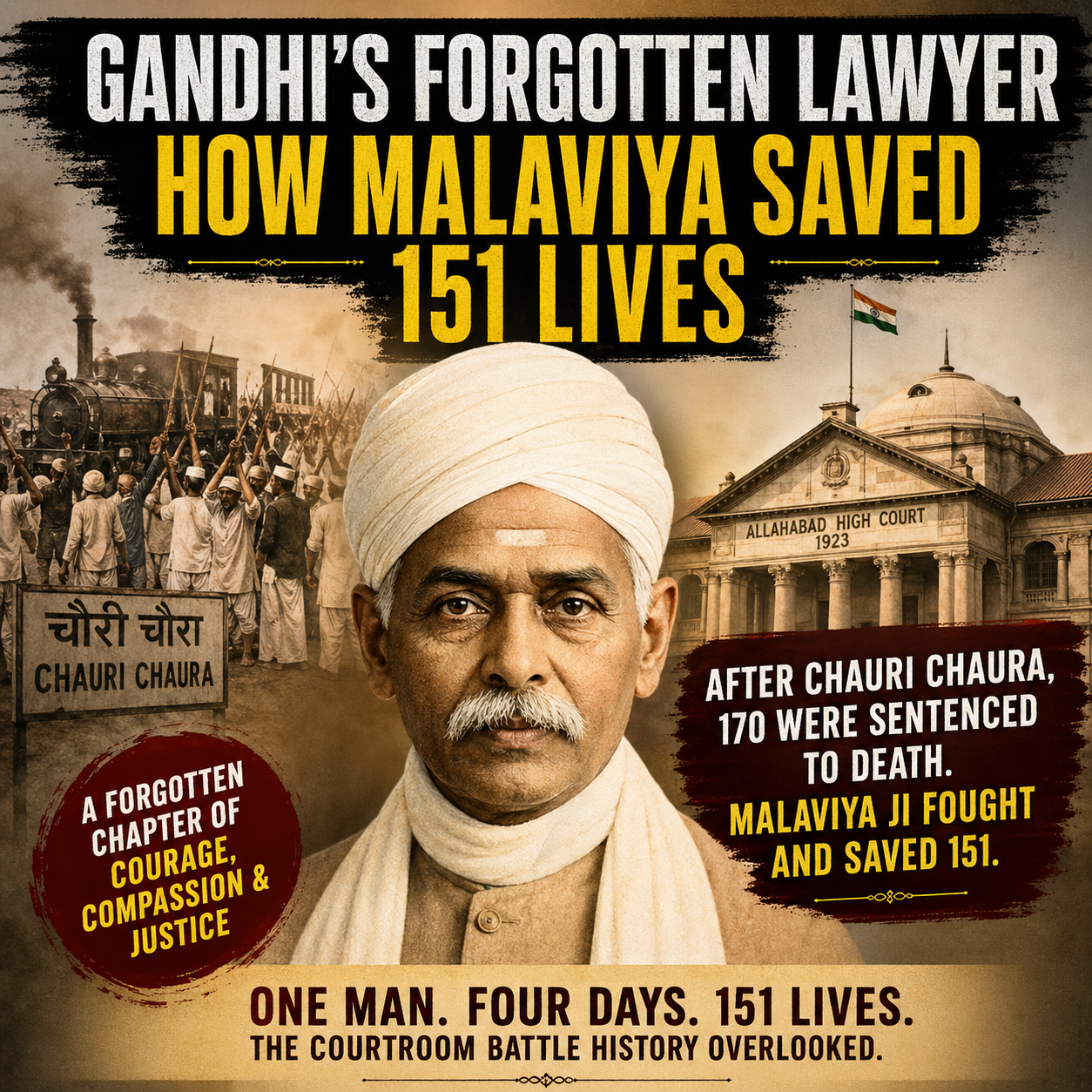
When he appeared in the High Court in 1923 after an interval of ten years, it was to support the appeal of the 172 persons sentenced to death by the Session Judge of Gorakhpur in the Chauri Chaura case.
Gandhi did not ask him to go. Congress did not instruct him. He went because one hundred and seventy-two people were facing the gallows and someone had to argue for them.
What He Argued
Malaviya argued that the mass death sentences were legally unsustainable and violated principles of natural justice. He argued for four consecutive days. The argument was not sentimental — it was precise, technical, and legally rigorous. He was not asking for mercy. He was establishing that the Sessions Court had exceeded what the law permitted and that the colonial administration had converted a riot into a mass execution in violation of its own judicial standards.
On 30 April 1923, the Allahabad High Court pronounced the final judgements. It freed 151 persons from a death sentence. 110 death sentences were commuted to life imprisonment and the court held that only 19 persons would face the gallows.
The 19 who were hanged were: Nazar Ali, Bhagwan Ahir, Lal Mohammad, Shyamsundar, Abdullah, Vikram Ahir, Dudhi Singh, Kali Charan, Lauti Kumar, Mahadev Singh, Meghu Tiwari, Raghuvir, Ramlakhan, Ramroop, Sahdev, Rudali, Mohan, Sampat, and Sitaram. They were hanged between 2 and 11 July 1923.
One hundred and fifty-one people were alive on 1 May 1923 who would have been dead without Malaviya’s four days in court.
Who Malaviya Was — and Why He Was Deleted
Gandhi’s Forgotten Lawyer is not forgotten by accident. He is forgotten by design — the design of a historiography that could not accommodate him.
Malaviya was a politician, educationist, and four-time President of the Indian National Congress. He was posthumously awarded the Bharat Ratna in 2014. He founded Banaras Hindu University. He served in the Central Legislative Assembly for decades. By any standard of contribution to Indian public life, he belongs among the first rank of the independence generation.
But Malaviya operated with an independent political philosophy that put him in repeated tension with the Congress-Gandhi axis. He was the founder of the Akhil Bharatiya Hindu Mahasabha — a Hindu nationalist organisation — while simultaneously serving as Congress President. He believed the Congress needed to protect Hindu interests explicitly, not subsume them into a composite nationalism that Gandhi’s framework required. He opposed the Khilafat compact. He did not share Gandhi’s view that Hindu-Muslim political unity required Congress to adopt pan-Islamic causes as its own.
The Congress-Gandhi historiography that shaped how the independence movement was remembered had no space for a man who saved 151 Chauri Chaura defendants from the gallows without Gandhi’s instruction — because the story it needed to tell required Gandhi at the centre of every act of resistance and rescue. Malaviya was at the centre of the most consequential single legal act of the 1922 aftermath. Gandhi was in Yerwada Jail, reading, praying, and spinning.
The Bharat Ratna came in 2014 — ninety-one years after Malaviya saved 151 lives. The standard Gandhi-Congress historiography did not award it. A different government did.
The Mirror Malaviya Holds
Gandhi’s Forgotten Lawyer is the prosecution’s most uncomfortable exhibit — not because it documents British violence or colonial arithmetic, but because it documents what one Indian man did for the one hundred and seventy-two that another Indian man did not.
The series has documented across six blogs what Gandhi did not do for the people the suspension left behind. He did not fast. He did not call satyagraha. He did not file appeal. He did not call his followers home from the streets when they walked into British batons on his behalf.
Malaviya did none of the things Gandhi was famous for. He did not fast. He did not spin. He did not speak to mass meetings. He went to court, argued for four days, and saved 151 people from the gallows.
The prosecution does not claim Gandhi was obligated to be Malaviya. It claims that the contrast between what Malaviya did and what Gandhi did not do is a documented fact — and that the documented fact belongs in the record of what the suspension of February 12, 1922 produced for the people who had built the movement it dissolved.
Malaviya saved 151. Gandhi saved none of them.
The Chief Justice thanked Malaviya on the record for his advocacy. The standard history of the independence movement does not carry his name in the Chauri Chaura chapter. Gandhi’s Suspension Ledger has a column for what Gandhi received from the suspension — enhanced unilateral authority, demonstrated indispensability to both sides. It does not have a column for what Malaviya received for saving 151 people from the gallows.
He received the Bharat Ratna ninety-one years later.
The Names Malaviya Saved
The 151 people Malaviya saved from the gallows do not have individual names in the available record — the High Court commutation orders recorded case numbers, not the kind of biographical detail that produces a named list. What the record carries is the number: 151.
The 19 who were hanged have names — documented in the High Court judgment. They are in Blog 35. They are the names the colonial administration chose to keep in the record. The 151 Malaviya saved are the names history did not need to record because they survived.
Gandhi’s Forgotten Lawyer is named in this series because the 151 people he saved deserve a sentence that places the man who saved them next to the man who did not. Madan Mohan Malaviya went to the Allahabad High Court in 1923 without being asked, argued for four consecutive days, and brought 151 people home from the gallows.
The Suspension Arc ends here. What Gandhi’s consistent choices built — across the signal, the counterfactual, the licence, the torch, the ledger, the accounting, the unled crowd, and the forgotten lawyer — is the record this arc has placed before the reader. The series does not add a verdict. The reader has the full account.
Gandhi’s Forgotten Lawyer returned to a courtroom he had left ten years earlier, argued for four days, and saved 151 people from the gallows. He was not asked by Gandhi. He was not instructed by Congress. He went because the people were there and someone had to speak for them. Madan Mohan Malaviya is forgotten because the history that carried Gandhi’s name had no room for a man who did what Gandhi did not.
Feature Image: Click here to view the image.
Videos
Glossary of Terms
- Gandhi’s Forgotten Lawyer: The key phrase of this blog, referring to Madan Mohan Malaviya as the largely overlooked defender of Chauri Chaura accused persons.
- Madan Mohan Malaviya: Indian nationalist leader, educationist, lawyer, founder of Banaras Hindu University, and advocate in the Chauri Chaura appeal case.
- Chauri Chaura: A 1922 incident in Gorakhpur district where protesters killed policemen, after which Gandhi suspended the Non-Cooperation Movement.
- Allahabad High Court: The colonial high court where Malaviya argued the appeal that reduced mass death sentences in the Chauri Chaura case.
- Sessions Court: A higher trial court under British India that originally awarded death sentences in the Chauri Chaura case.
- Yerwada Jail: Prison in Pune where Gandhi was confined during part of the aftermath of Chauri Chaura.
- Banaras Hindu University: Major Indian university founded in 1916 by Madan Mohan Malaviya.
- Bharat Ratna: India’s highest civilian award, conferred posthumously on Malaviya in 2014.
- Congress-Gandhi Historiography: A series term describing historical narratives centered heavily on Gandhi and Congress leadership.
- Non-Cooperation Movement: Mass anti-colonial movement led by Gandhi from 1920 to 1922.
- Colonial Arithmetic: A coined series phrase referring to numerical consequences of British repression, arrests, deaths, and sentences.
- Suspension Arc: A coined phrase in this series describing the chain of events after Gandhi suspended the movement.
- Gallows: A structure used for execution by hanging; used in the blog for death sentences.
- Satyagraha: Gandhi’s doctrine of nonviolent resistance through truth-force and civil disobedience.
- High Court Appeal: Legal challenge filed against a lower court judgment seeking reversal or reduction of punishment.
#Gandhi #Malaviya #ChauriChaura #Congress #History #India #Freedom #BHU #Trial #Lawyer #HinduinfoPedia
Scan Through The Entire Series at
Gandhi’s Peace Efforts: The Questions Before the Mahatma (0)