
Gandhi’s Suspension Ledger: Who Paid, Who Gained (34)
भारत / GB
Part 34: Mahatma Gandhi’s Peace Efforts | Series Index
Blogs 30 to 32 have documented the signal, the counterfactual, and the mechanism. The British had no clean answer in February 1922. The suspension gave them one. The lathi charges that followed were issued by an administration that knew Gandhi’s ceiling. This post does not add another argument. It opens the ledger — and reads both columns.
Thank you for reading this post, don't forget to subscribe!The Action Taken: Gandhi deployed a five-day fast when Indian protesters clashed with domestic opponents in Bombay (Nov 1921), but called no fast or movement suspension after the imperial massacre at Jallianwala Bagh (1919).
Who Paid the Price: Domestic political cadres whose tactical actions were subjected to moral penalties that were never applied to imperial violence.
The Alternative Bypassed: Applying an equal, consistent standard of moral intervention to sovereign colonial violence and domestic resistance alike.
Why This Matters: Places before the reader the asymmetry of the fast: moral sanctions and movement halts were activated against Indian resistance, but never deployed to halt colonial military crackdowns.
The Ledger the Series Has Been Building
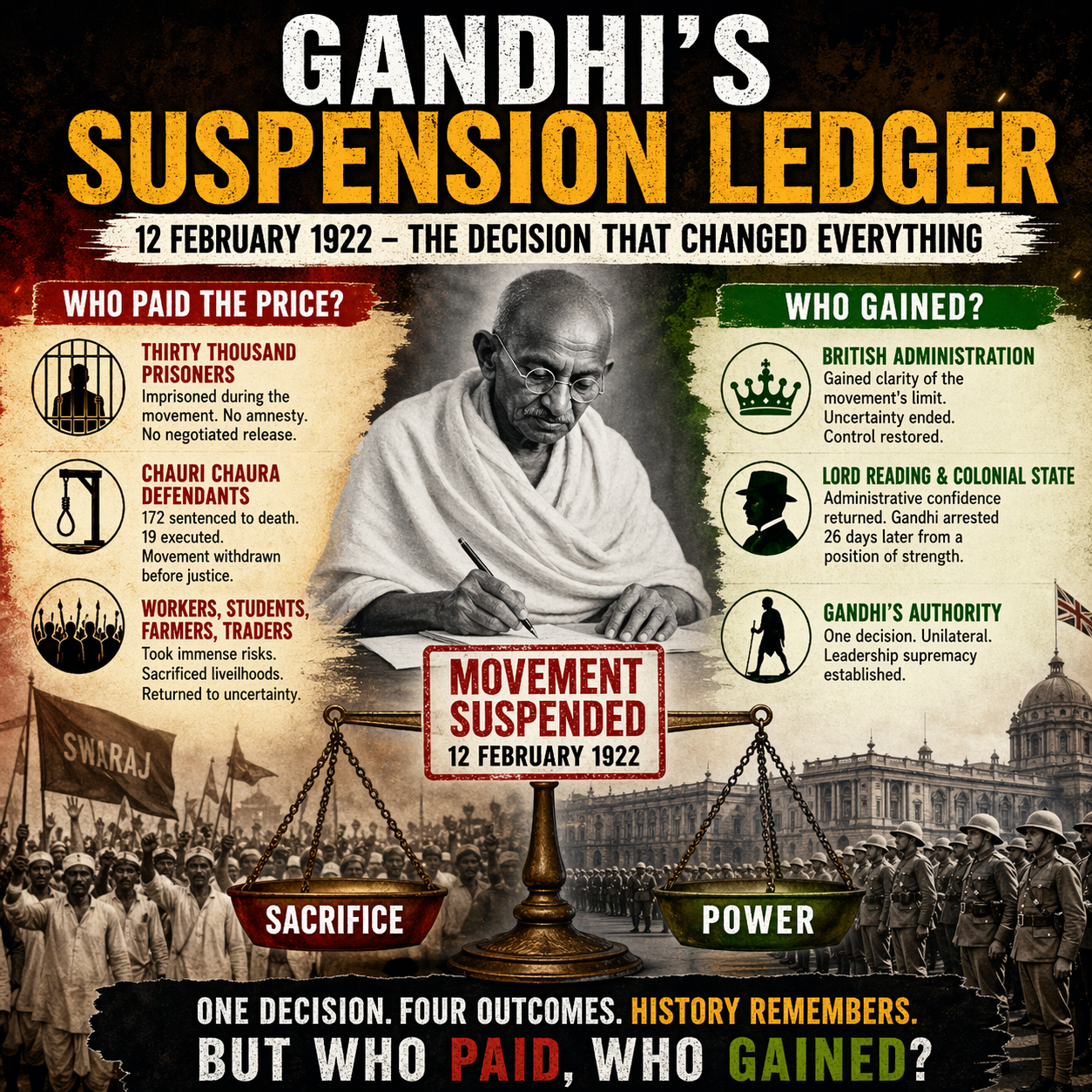
Gandhi’s Suspension Ledger is not a new prosecution. It is the prosecution already built, read in the one format that makes every item visible simultaneously — a two-column account of who paid and who gained from the single act of February 12, 1922.
The series operates on documented facts. Gandhi’s Suspension Ledger applies that standard to its strictest test: not what the suspension meant in the abstract, but what it produced in the concrete — for each identifiable party, in the documented record.
The ledger has four entries. Each is a group of people who intersected with the Non-Cooperation Movement. Each has a column for what they contributed and a column for what they received when the suspension closed the account.
Entry One — The Thirty Thousand
What they contributed: Imprisonment. As of February 12, 1922, approximately thirty thousand people were in jail across British India. They had gone to jail voluntarily — students who had left their colleges, lawyers who had abandoned their practices, merchants who had closed their shops, farmers who had stopped paying revenue. The Non-Cooperation Movement had been built on their sacrifice — not on Gandhi’s alone, but on the accumulated cost paid by thirty thousand individuals whose names are not in the history books.
They had not been consulted about the suspension. They were informed of it — from prison — after it had been announced.
What they received: Zero concession. The British government made no commitment in exchange for the suspension. No prisoner release was negotiated. No amnesty was secured. No partial delivery of any demand was extracted. The thirty thousand came out of jail to a movement that no longer existed. The sacrifice that had built the movement’s moral pressure produced nothing the suspension preserved for them.
Entry Two — The Chauri Chaura Defendants
What they contributed: They were the trigger. On February 5, 1922, a crowd at Chauri Chaura — provoked, by most accounts, by police lathi charges on Congress volunteers — attacked and burned a police station. Twenty-two policemen died. The Chauri Chaura defendants were the people Gandhi cited as the reason the movement had to be suspended. Their act — real, documented, violent — was the moral justification for dissolving everything.
What they received: 172 people were convicted and sentenced to death by the Sessions Court. The movement that might have made those sentences a political liability for the British had been dissolved seven days before the trial even began. Pandit Madan Mohan Malaviya argued the appeals in the Allahabad High Court and saved 151 from the gallows — but 19 were hanged. They were the moral justification Gandhi cited for the suspension. They were also the people the suspension left most exposed. The movement that might have created political pressure for their defence, for commutation, for negotiation over their sentences — that movement was dissolved seven days after the incident that produced their prosecution. Gandhi performed a personal five-day fast as “penance” for the violence, yet the ledger reveals a stark asymmetry: the Mahatma’s penance was symbolic and spiritual, while the physical price of that atonement was paid by the defendants on the gallows. Gandhi’s suspension did not save them. It removed the only instrument that could have made their fate a political cost to the British.
The defendants were the moral justification for the suspension. They were also its most direct victims.
Entry Three — The British Administration
What they contributed: Seventeen months of documented strain. Lord Reading’s dispatches record genuine alarm — revenue shortfalls, compliance failures, enforcement under pressure across multiple provinces. The administration was not about to collapse, but it was facing something its governance model had not been designed to manage. The British paid for seventeen months with strategic uncertainty — not knowing Gandhi’s ceiling, not knowing whether to use force, negotiate, or wait.
What they received: The answer to the question they could not answer. The ceiling — its location, its trigger mechanism, its enforceability, the Congress’s inability to override it. Gandhi’s Suspension Ledger’s British column contains the single most valuable piece of strategic intelligence the colonial administration received in the entire independence movement. They paid nothing for it. It arrived as a free gift on February 12, 1922. Twenty-six days later they arrested Gandhi from a position of complete safety — an act they had not dared attempt for seventeen months.
Entry Four — Gandhi
What he contributed: The announcement. One statement, at Bardoli, on February 12, 1922. No negotiation. No consultation. No institutional process.
What he received: His authority after the suspension was larger than before it. This is not an assertion — it is the documented record of what the suspension demonstrated to both the British and to India. To the British: he was the only man who could turn the movement off. To India: the revolution existed only as long as he permitted it to exist. The man who could stop a revolution at its peak — without concession, without consultation, without institutional challenge — had demonstrated a form of authority more complete than any electoral mandate could have produced. Motilal Nehru was furious. C.R. Das was furious. Their fury changed nothing. The authority that had suspended the movement remained intact — and grew precisely because it had shown it could act above the institution’s capacity to refuse.
Gandhi’s Suspension Ledger for Gandhi: contributed one announcement, received enhanced unilateral authority over the independence movement.
The Ledger Balanced
Gandhi’s Suspension Ledger does not require characterisation. The four entries state themselves.
The thirty thousand — contributed imprisonment, received nothing.
The Chauri Chaura defendants — provided the moral justification for the suspension, received prosecution without the pressure that might have tempered it. Nineteen were hanged.
The British administration — contributed seventeen months of documented strain and strategic uncertainty, received the answer to the question that had been constraining their conduct. Collected it at zero cost.
Gandhi — contributed one announcement, received an authority demonstration that made him more indispensable to both sides than he had been before it.
The prosecution has stated from Blog 10 onward that the arithmetic was consistent. Gandhi’s Suspension Ledger is the arithmetic of one specific act, stated in its plainest form. The series does not add a verdict. The ledger is the verdict.
One question remains — not for the ledger, which is closed, but for the reader who has now read it. The Chauri Chaura defendants were Gandhi’s stated reason for the suspension. Their deaths were the direct consequence of it. The thirty thousand were the movement’s foundation. Their sacrifice produced nothing the suspension preserved.
The British received the answer to the question that had been constraining them for seventeen months.
Gandhi received authority.
If the account is settled and the figures are documented, who was the architect of the loss?
The series has never called this selfish. It calls it arithmetic. The reader has now seen the four columns. The reader will supply the word.
Four entries. Four documented outcomes. The thirty thousand received nothing. Nineteen Chauri Chaura defendants were hanged. The British received the answer they needed at zero cost. Gandhi’s authority grew. Gandhi’s Suspension Ledger is not a prosecution. It is an account. The account is settled. The question is who signed it.
Feature Image: Click here to view the image.
Videos
Glossary of Terms
- Gandhi’s Suspension Ledger: A conceptual framework used in this series to evaluate the outcomes of Mahatma Gandhi’s February 12, 1922 decision by comparing “who paid” versus “who gained.”
- Non-Cooperation Movement: A mass protest led by Mahatma Gandhi (1920–1922) urging Indians to withdraw support from British institutions to achieve self-rule.
- Chauri Chaura Incident: A violent घटना on February 5, 1922 in Chauri Chaura where a mob burned a police station, killing 22 policemen, triggering the movement’s suspension.
- Suspension of February 12, 1922: The unilateral decision by Mahatma Gandhi to halt the Non-Cooperation Movement following Chauri Chaura.
- Thirty Thousand Prisoners: Approximate number of आंदोलनकारियों jailed during the movement, representing its grassroots sacrifice base.
- Moral Justification Doctrine (Series Term): The principle used in the blog to describe how a single violent event was used to justify dismantling an entire mass movement.
- Strategic Ceiling (Series Term): The implied limit of escalation revealed to the British about how far the movement could go before being withdrawn.
- British Administration (Colonial State): The governing authority of British India that managed law, revenue, and enforcement during the independence struggle.
- Lord Reading Dispatches: Official communications of Lord Reading documenting administrative strain during the movement.
- Sessions Court Sentences: Trial-level judgments where 172 accused in Chauri Chaura were initially sentenced to death.
- Allahabad High Court Appeals: Legal appeals led by Madan Mohan Malaviya that reduced death sentences, saving 151 accused.
- Symbolic Penance: Reference to Gandhi’s five-day fast undertaken as moral atonement for violence.
- Unilateral Authority (Series Term): The demonstrated ability of a single leader to override institutional processes without consultation.
- Ledger Framework (Series Term): Analytical method of presenting historical events as balanced accounts of inputs (sacrifice) and outputs (gains).
- Arithmetic of Power (Series Term): The blog’s core idea that outcomes of political actions can be measured objectively rather than morally interpreted.
#Gandhi #NonCooperation #ChauriChaura #IndianHistory #FreedomStruggle #BritishRaj #Independence #Congress #ColonialIndia #HistoryAnalysis #HinduinfoPedia
Scan Through The Entire Series at
Gandhi’s Peace Efforts: The Questions Before the Mahatma (0)