
Gandhi’s Non-Cooperation: The First Time India Said No (7)
भारत / GB
Part 7: Mahatma Gandhi’s Peace Efforts | Series Index
The Timing of Beginning of Gandhi’s Non-Cooperation
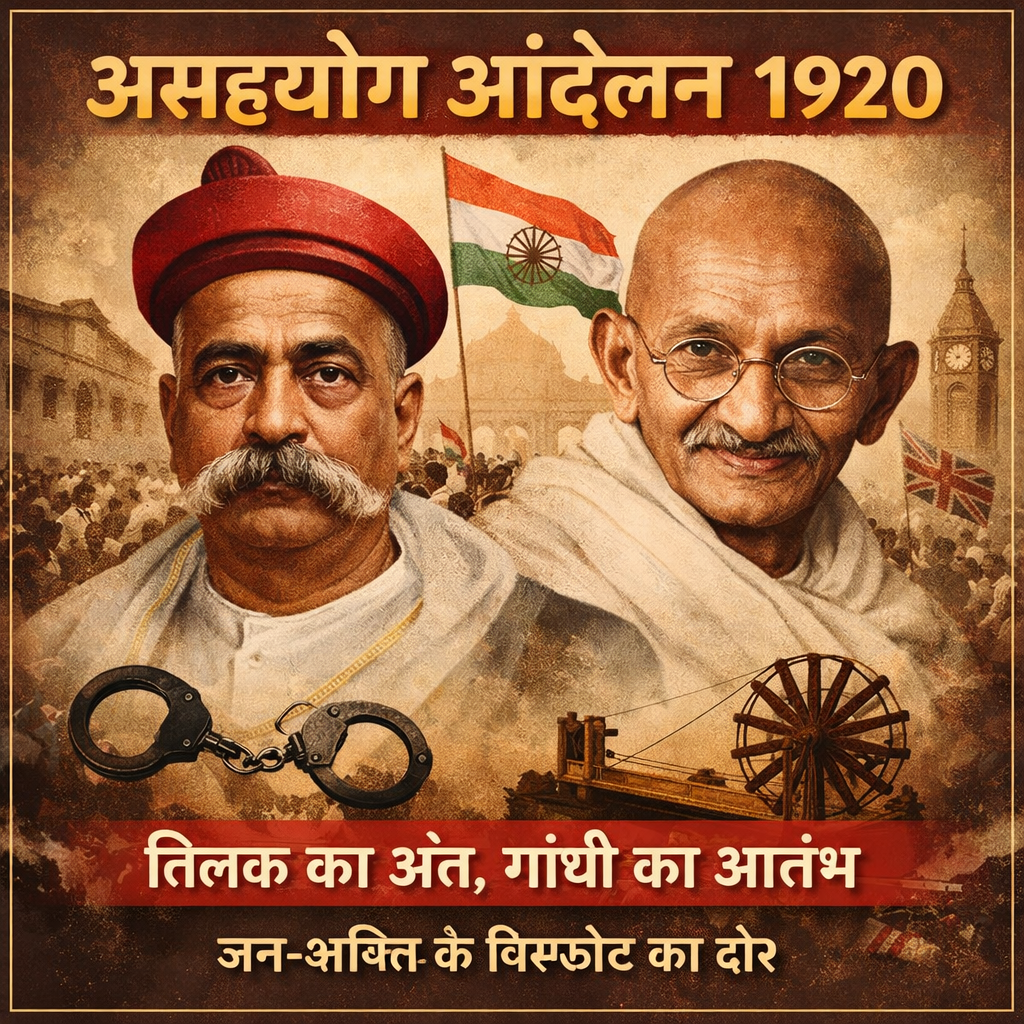
Having traversed London, endured Pietermaritzburg, tested Satyagraha in South Africa, and applied it in Champaran, Gandhi had built his method. With the spinning wheel, he showed a fully loaded cannon — and did not use it. The instrument was built. The man was trusted. Now, the moment of maximum mass. Now came the moment of maximum mass. Under these charged circumstances, he launched the Non-Cooperation Movement on the very day his most potent ideological rival, Bal Gangadhar Tilak, passed away. Was this timing a symbolic final seal on the “Extremist” philosophy Tilak had championed? Let us analyse?
Thank you for reading this post, don't forget to subscribe!The Action Taken: Following the death of Lokmanya Tilak, Gandhi aligned the Non-Cooperation movement with the Khilafat Committee, launching the first nationwide civilian boycott in modern Indian history.
Who Paid the Price: Students leaving government institutions, lawyers abandoning active practices, and merchants burning imported inventory without alternative institutional infrastructure.
The Alternative Bypassed: The secular constitutional petitioning methods of the pre-1920 Congress leadership.
Why This Matters: Mobilized an unprecedented all-India mass resistance by joining national Swaraj to an extra-territorial religious issue on a single executive platform.
The Vacuum Tilak Left
Gandhi’s Non-Cooperation Movement was launched on August 1, 1920. It is one of the most precisely dated ironies in Indian political history — that day was also the day Bal Gangadhar Tilak died. The man who had defined the militant edge of Indian nationalism for two decades — who had given the movement its fighting vocabulary, its mass festivals, its willingness to name the British as the enemy — breathed his last in Bombay as Gandhi was announcing the next chapter from a Khilafat platform.
The Indian National Congress in 1920 was not a mass organisation. It was a gathering of Western-trained lawyers who met once a year in a major city, passed resolutions, sent petitions to London, and went home. The British approved of it. Gandhi was consciously and deliberately going to change all of that — not incrementally, but completely, and in one movement. The vacuum Tilak left was enormous. Gandhi filled the entire sky.
The Logic of Non-Cooperation
The Strategic Insight
Gandhi’s Non-Cooperation Movement rested on a single observation of extraordinary precision. The British ruled three hundred million Indians with a handful of officials and soldiers. They did so because Indians cooperated — staffed the courts, attended the schools, bought the goods, filled the armies, paid the taxes. The entire colonial apparatus was built on Indian participation. Withdraw that participation and the apparatus had nothing to stand on.
This was not an idealistic argument. It was a structural one. Gandhi’s Non-Cooperation Movement did not ask Indians to fight the British. It asked them to stop helping the British — a far simpler, safer, and more scalable demand. Every lawyer who left a British court, every student who left a British school, every merchant who refused a British shipment was not risking his life. He was simply declining to show up. The genius of Gandhi’s Non-Cooperation Movement was that it turned absence into a weapon.
The Programme
The programme adopted at the Calcutta Congress in September 1920 and ratified at Nagpur in December was comprehensive. Lawyers were to leave British courts. Students were to leave government schools and colleges. Indians were to surrender titles and honours. Foreign cloth was to be boycotted. Elections to the new legislative councils were to be ignored. The membership fee for Congress was reduced to four annas — making it accessible to every Indian regardless of income, for the first time in the organisation’s history.
Gandhi also announced the Tilak Swaraj Fund — named for the man who had died on the day the movement launched — to finance the struggle. The target was one crore rupees. It was subscribed within months. India was ready.

Gandhi’s Non-Cooperation: The Nation That Said No
What followed was unprecedented in the history of colonial governance anywhere in the world. Gandhi’s Non-Cooperation Movement turned India’s political life upside down inside twelve months.
Thousands of students walked out of government-aided schools and colleges across the country. National institutions sprang up to receive them — Gujarat Vidyapith, Bihar Vidyapith, Kashi Vidyapith, Tilak Maharashtra Vidyapith, Jamia Millia Islamia in Delhi. These were not symbolic gestures. These were functioning universities built in months because Gandhi asked for them. Motilal Nehru, C.R. Das, and Vallabhbhai Patel — among the highest-earning lawyers in India — gave up their practices. Motilal Nehru burned his Western wardrobe and put on khadi. Subhas Chandra Bose resigned from the Indian Civil Service — one of the most prestigious and secure positions available to an Indian under the Raj — to join the movement.
By the end of 1921, over 30,000 people were in jail. Gandhi had asked Indians to flood the prisons — “Our triumph consists in thousands being led to prisons like lambs to the slaughter house” — and they had answered. Women who had never left their homes donated jewellery to the Tilak Swaraj Fund. In Assam, tea garden labourers went on strike chanting “Gandhi Maharaj ki Jai.” In Andhra, forest laws were defied. When the Prince of Wales visited India in November 1921, he was greeted not by cheering crowds but by empty streets and hartals from Bombay to Calcutta.
The movement achieved something that no Congress session had ever managed — it brought Hindus and Muslims into the same political space under a single leadership. Imports of foreign cloth were halved between 1921 and 1922. The British government, as Britannica records, was “visibly shaken” — confronted with a united Indian front for the first time. The Viceroy met Gandhi in May 1921 and could reach no agreement. The colonial apparatus had no answer for a population that had decided to stop cooperating.

The Movement and the Man It Made
Gandhi’s Non-Cooperation Movement did more than shake a government. It transformed the Indian National Congress from an elite annual gathering into a mass organisation with village-level committees, a four-anna membership, and millions of ordinary Indians who had now participated in a political act. The movement that Tilak had always wanted — the movement that reached the farmer, the woman, the student, the labourer — had arrived. It had arrived under Gandhi.
As historian A.R. Desai observed, the national movement had been restricted to the upper and middle classes until 1917. Gandhi’s Non-Cooperation Movement gave it a mass basis for the first time. That transformation outlasted the movement itself. The organisational infrastructure built in 1920–22 — the national schools, the village Congress committees, the culture of Swadeshi — became the foundation on which every subsequent movement was built.
A Controlled Burn
The Non-Cooperation Movement was not a request; it was an eviction notice served by three hundred million people. Before 1920, the British ruled through a psychological spell—the myth of their own invincibility. Gandhi’s genius was realizing that the British Empire was a service-based industry: it only ran because Indians provided the labor.
However, the power of Non-Cooperation wasn’t in its conclusion, but in the proof that India could finally say “No.” The British realized they were living on borrowed time. The “Gist” is this: Gandhi built a nuclear reactor, powered up the entire country, and then pulled the rods out just as it hit critical mass. It was a recurring pattern of “stopping short.” Much like how he bypassed the core Zamindari exploitation in Champaran or left the Tamil indentured laborers adrift in South Africa, he sparked the fire but extinguished it the moment the heat threatened the internal status quo. He proved the masses could break the British, but he wasn’t willing to let them break the system.
Was it a “Fixed Match?” Keep reading the series to look for answers.
The movement was called off in February 1922. What happened and why is a question this series will return to. Part 8 follows Gandhi to the sea.
When a whole nation says no at once — what makes it stop?
Series Index
Feature Image: Click here to view the image.
Video
Glossary of Terms
- Non-Cooperation Movement (1920–1922): Gandhi’s first mass civil disobedience campaign in India — a call to boycott British institutions, return colonial honours, withdraw from British courts and educational institutions, and refuse to pay taxes. Launched in response to the Jallianwala Bagh massacre and Khilafat movement. Suspended by Gandhi after the Chauri Chaura violence of February 1922.
- INC (Indian National Congress): The principal political organisation of the Indian independence movement, founded in Bombay in 1885 by Allan Octavian Hume. Initially a moderate constitutional body petitioning for greater Indian representation within British rule. Gandhi joined on his return to India in 1915 and transformed it from an elite debating society into a mass movement.
- Satyagraha: Sanskrit compound — Satya (truth) and Agraha (insistence/force). Gandhi’s political method of non-violent resistance to unjust laws through mass civil disobedience, non-cooperation, and willing acceptance of legal consequences including imprisonment. First formulated in South Africa; later applied at continental scale in India.
- Gandhi Class Framework: The analytical concept applied in this series to describe Gandhi’s consistent pattern of principled advocacy for those already organised within existing power structures, combined with symbolic invocation of the most vulnerable — without giving them structural representation. Established in the NIC period and repeated at continental scale in India after 1915.
- Khadi: Handspun and handwoven cloth — the product of the charkha. Gandhi’s central economic weapon against the colonial cloth drain. Wearing khadi was simultaneously an act of economic defiance, a statement of self-reliance, and a visible marker of participation in the independence movement.
- Swadeshi: Sanskrit compound meaning “of one’s own country” — the economic nationalism movement advocating purchase and use of Indian-made goods over imported British products. Gandhi universalised it through the charkha, making it accessible to illiterate rural populations with no capital.
- Zamindari System: The system of land tenure in British India under which zamindars — landlords — held revenue collection rights and extracted rent from tenant farmers. Formally abolished by Zamindari Abolition Acts in the early 1950s.
- Indentured Labour: The system under which Indians were contracted to work on British colonial plantations from 1838 to 1917. The indentured Indian community in Natal formed a distinct and lower social stratum from the Gujarati merchant class Gandhi primarily represented.
- Champaran Satyagraha (1917): Gandhi’s first major political campaign in India — systematic documentation of abuses under the tinkathia indigo system. Produced the abolition of the tinkathia obligation but left the underlying tenancy structure intact.
- Bal Gangadhar Tilak (1856–1920): Indian nationalist leader who defined the militant wing of the independence movement — the “Extremists” who demanded immediate Swaraj and rejected the moderate petition approach. Founded mass political festivals (Ganesh Chaturthi, Shivaji Jayanti) to build popular nationalism. Died on 1 August 1920 — the exact day Gandhi launched the Non-Cooperation Movement.
- Motilal Nehru (1861–1931): One of India’s highest-earning lawyers before the Non-Cooperation Movement. Gave up his legal practice, burned his Western wardrobe, and adopted khadi at Gandhi’s call in 1920. Father of Jawaharlal Nehru. Co-founded the Swaraj Party after the NCM’s suspension. A symbol of elite sacrifice for the nationalist cause.
- C.R. Das (Chittaranjan Das, 1870–1925): Senior barrister and one of the leading lawyers of British India. Abandoned his practice to join the Non-Cooperation Movement. Later co-founded the Swaraj Party with Motilal Nehru. Known as Deshbandhu — “Friend of the Nation.”
- Vallabhbhai Patel (1875–1950): Gujarat-based lawyer who abandoned his legal practice to join Gandhi’s Non-Cooperation Movement. Later led the Bardoli Satyagraha (1928) and became the first Deputy Prime Minister of independent India. Known as the “Iron Man of India” for integrating the princely states into the Indian Union.
- Subhas Chandra Bose (1897–1945): Indian nationalist leader who resigned from the Indian Civil Service — one of the Raj’s most prestigious positions — to join the Non-Cooperation Movement. Later broke with Gandhi’s non-violence doctrine and formed the Indian National Army to seek independence through armed struggle with Axis support.
- Khilafat Movement (1919–1924): The Indian Muslim political movement demanding that the British protect the Ottoman Caliphate after World War I. Gandhi allied the Non-Cooperation Movement with the Khilafat cause — bringing Muslim political mobilisation into the broader independence struggle for the first time. The alliance produced the unprecedented Hindu-Muslim unity of 1920–1922.
- Hartal: A complete shutdown of commercial and public activity — shops closed, markets empty, public transport halted — used as a form of mass civil disobedience in the Indian independence movement. Hartals greeted the Prince of Wales across India in November 1921 during the Non-Cooperation Movement.
- Four-Anna Membership: Gandhi’s reduction of the Indian National Congress membership fee to four annas — approximately one-sixteenth of a rupee — during the Non-Cooperation Movement. Transformed Congress from an elite club into a mass organisation accessible to farmers, labourers, and the rural poor for the first time.
- Tilak Swaraj Fund: The fundraising initiative launched by Gandhi at the start of the Non-Cooperation Movement, named after Bal Gangadhar Tilak who died on its launch day. Target: one crore rupees. Subscribed within months — demonstrating the financial mobilisation capacity of a genuinely mass movement.
- Nagpur Congress (December 1920): The Indian National Congress session at Nagpur that formally ratified the Non-Cooperation programme — including the four-anna membership, village-level committee structure, and the full boycott programme. Transformed Congress’s constitutional structure to enable mass participation.
- Calcutta Congress (September 1920): The special session of the Indian National Congress in Calcutta that first formally adopted Gandhi’s Non-Cooperation programme — before full ratification at Nagpur in December. Gandhi introduced the programme from a Khilafat platform, marking the formal alliance of Hindu and Muslim political mobilisation.
- Prince of Wales India Visit (November 1921): The official visit of the future King Edward VIII to India in November 1921 — intended as a demonstration of imperial continuity and Indian loyalty. Met instead by hartals, empty streets, and mass protest from Bombay to Calcutta. The contrast with official expectations made it the Non-Cooperation Movement’s most visible symbolic victory.
- Chauri Chaura Incident (February 1922): The event in which a crowd of protesters in Chauri Chaura, United Provinces, set fire to a police station, killing twenty-two constables. Gandhi cited the violence as his reason for suspending the Non-Cooperation Movement — a decision controversial within the independence movement, seen by many as stopping a mass uprising at the moment of maximum momentum.
- Gujarat Vidyapith: The national university founded by Gandhi in Ahmedabad in 1920 — one of several alternative educational institutions established during the Non-Cooperation Movement boycott of government schools and colleges. Still operational. Named in honour of the Gujarati cultural and political tradition that formed Gandhi’s political base.
#GandhiNonCooperation #BalGangadharTilak #KhilafatMovement #CongressMassMovement #HartalBoycott #TilakSwarajFund #NonCooperationMovement #MahatmaGandhiSeries #GandhiPeaceEfforts #ColonialIndia #KhadiMovement #IndianIndependence #GandhiClassFramework #HinduinfopediaGandhi #Gandhi #Satyagraha #NCM1920 #ChauriChaura #IndiaFreedom #Swadeshi
Related Blogs
Scan Through The Entire Series at
Gandhi’s Peace Efforts: The Questions Before the Mahatma (0)
Previous Blogs on Mahatma Gandhi
- https://hinduinfopedia.in/martyrs-of-indian-independence-and-gandhis-influence/
- https://hinduinfopedia.in/rowlatt-act-and-gandhi/
- https://hinduinfopedia.in/gandhis-post-independence-actions-and-legacy/
- https://hinduinfopedia.in/gandhis-personal-ideologies-and-methodologies/
- https://hinduinfopedia.in/communal-relations-in-indian-history-gandhis-legacy/
- https://hinduinfopedia.in/ideological-divides-and-gandhis-leadership/
- https://hinduinfopedia.in/gandhis-post-independence-actions-and-legacy/
- https://hinduinfopedia.in/gandhi-revisited-a-critical-legacy/
- https://hinduinfopedia.in/indira-gandhis-actions-the-competition-terminator/
- https://hinduinfopedia.in/nonviolent-policy-and-making-of-gandhi-in-south-africa/
- https://hinduinfopedia.org/ambedkars-buddhist-political-move-divergence-from-gandhi-on-caste-issues/
- https://hinduinfopedia.org/mahatma-gandhi-and-nonviolence/
- https://hinduinfopedia.org/mahatma-gandhi-and-his-principles-analyzed/
- https://hinduinfopedia.org/subhash-chandra-bose-contrasting-strategies-with-gandhi/
- https://hinduinfopedia.in/on-this-day-5-march-2024-tuesday/
- https://hinduinfopedia.in/akshardham-temple-terror-attack-2002/
- https://hinduinfopedia.in/nathuram-godse-murderer-patriot-or-fractured-youth/
- https://hinduinfopedia.in/remembering-indian-freedom-struggle-of-february-5/
- https://hinduinfopedia.org/indias-freedom-struggle-and-quit-india-movement-ii/
- https://hinduinfopedia.org/indian-freedom-fighters-legacy-of-gopal-krishna-gokhale/
Follow us:
- English YouTube: https://www.youtube.com/@Hinduofficialstation
- Hindi YouTube: https://www.youtube.com/@HinduinfopediaIn
- X: https://x.com/HinduInfopedia
- Instagram: https://www.instagram.com/hinduinfopedia/
- Facebook: https://www.facebook.com/Hinduinfopediaofficial
- Threads: https://www.threads.com/@hinduinfopedia