
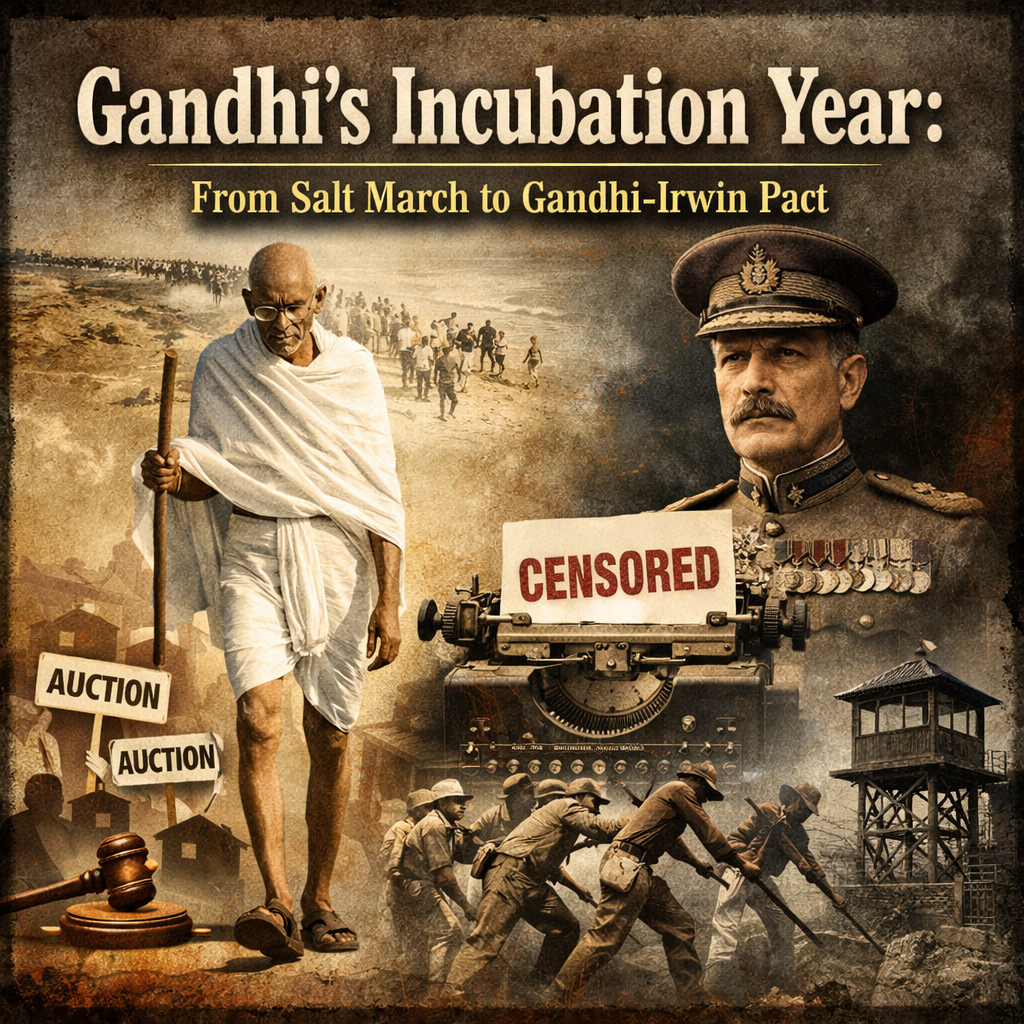
Gandhi’s Incubation Year: Twelve Months Britain Used Before Signing (19)
भारत / GB
Part 19: Mahatma Gandhi’s Peace Efforts | Series Index
Gandhi’s Incubation Year: How British Ogganised Post Salt March
Traversing Gandhi’s life as a student, his self-realisation in South Africa, his visit to Champaran and the two Satyagrahas that had potential to free India from foreign rule but terminated half way, we are now in the process of analysing what the salt march brought to India and Indians against what they lost. The previous post documented what the pact’s clauses actually said — five concessions, each carrying a qualifying clause that narrowed its operative scope. Before the next post measures those clauses against the eleven demands, this post documents something the standard account of the Gandhi-Irwin Pact almost never examines: what Britain did with the twelve months between the Salt March and the signing table.
Thank you for reading this post, don't forget to subscribe!The Action Taken: British authorities utilized the protracted 12-month negotiation period to auction off seized properties, suppress documentation of police beatings, and rebuild deterrence networks.
Who Paid the Price: Rural agitators who endured unrecorded police dispersals while leadership was engaged in prolonged negotiations.
The Alternative Bypassed: Independent public inquiry commissions that would have placed police conduct on the official record.
Why This Matters: Demonstrates how prolonged negotiation windows allowed colonial authorities to restore operational deterrence while neutralizing grassroots momentum.
The Year Nobody Counts
Gandhi’s Incubation Year is the period between April 6, 1930 — the day Gandhi picked up salt at Dandi — and March 5, 1931 — the day he signed the pact with Irwin. Standard accounts treat this as the period of the Civil Disobedience Movement. It was also something else: the period in which the British colonial administration, operating under Emergency Powers Ordinances with no press freedom, no independent judiciary, and no negotiating partner. Over these twelve months, the colonial administration used emergency powers in ways that progressively narrowed the scope of what could ultimately be conceded in the pact.
The pact’s property return clause said: lands not yet sold to third parties. The pact’s prisoner release clause said: those not convicted of violence. The pact’s ordinance withdrawal said: except for communal disturbances. Every qualifying clause in the pact had been created by what happened during Gandhi’s Incubation Year. To understand why the pact delivered so little, it is necessary to understand what the British did while no one was watching.
Component One — Properties Auctioned
The Mechanism
The Emergency Powers Ordinances issued by Lord Irwin’s administration through the summer of 1930 gave local magistrates authority to seize property without trial and auction it to recover unpaid tax fines, salt law penalties, and land revenue arrears. The ordinances required no court order, no formal hearing, and no record of proceedings that would surface in any subsequent judicial review.
From April 1930 onward, as the Civil Disobedience Movement spread to every province, the colonial administration moved quickly. Farmers who had refused to pay land revenue had their land seized. Merchants who had participated in cloth boycotts had their goods confiscated. Satyagrahis who had made or sold illegal salt had their property taken. The seizures were systematic and rapid.
The Timing
By mid-1930, Irwin was already engaged in quiet back-channel discussions about a possible accommodation with Gandhi. He knew that any pact would require some form of property restoration. He also knew that property already sold to third parties would be legally unrecoverable under colonial property law.
Properties were auctioned through 1930 and into January and February 1931 — the period of Irwin’s formal negotiations with Gandhi in Yeravada Jail. The pact’s “not yet sold” caveat was not an oversight. It was the administrative consequence of twelve months of deliberate disposal. The farmer whose land had been seized in May 1930 and auctioned in August 1930 arrived at the pact’s signing to find his land permanently gone. The caveat protected what remained. What had already been disposed of had been disposed of by design.
Component Two — Evidence Destroyed
Press Censorship
When Webb Miller filed his dispatch about the Dharasana beatings in May 1930, British telegraph operators in India attempted to censor it. Miller threatened to expose the censorship publicly — only then was his story allowed to pass. The dispatch appeared in 1,350 newspapers worldwide and was read into the official record of the United States Senate. Dharasana became a global symbol precisely because Miller was present and the censorship failed.
The Emergency Ordinances of 1930 gave the colonial administration explicit authority to censor Congress correspondence and nationalist publications. The Madras Presidency alone issued ten Emergency Ordinances in 1930 specifically targeting publication of nationalist literature and press coverage of Congress activities. What was not reported could not be prosecuted. What was not recorded could not be presented at a negotiating table. And Indians lost for the benefit of the British.
The Interior — No Witnesses
Dharasana had cameras. The interior of India did not. In Bengal, Andhra, the interior of Gujarat, the Northwest Frontier Province — lathi charges, property destruction, public humiliations, and killings were classified under administrative categories that produced no formal record. A lathi charge was crowd dispersal. A death during crowd dispersal required no inquiry unless a British official demanded one. The Emergency Powers gave local magistrates the authority to act without producing reports that would surface in London.
By the time Gandhi sat across from Irwin in February 1931, the violence that had been inflicted during Gandhi’s Incubation Year had no documentary existence in any form that could be placed on the negotiating table. Gandhi asked for an inquiry into police brutality. Irwin refused. He could refuse because there was nothing to inquire into — at least nothing that had been recorded.
Component Three — Violence Across India
Gandhi’s Incubation Year was not a period of administrative management. It was a period of systematic violence against a population that had been disarmed by the 1878 Arms Act, surveilled by the CID, and now subjected to Emergency Powers that removed the last institutional constraints on colonial force.
On the day of Gandhi’s arrest — May 5, 1930 — Peshawar was surrounded by military. Troops, aeroplanes, tanks, and guns were deployed in the Northwest Frontier Province.
In Sholapur, the people held the town for one week before martial law was proclaimed. In Mymensingh, Calcutta, Karachi, Lucknow, Multan, Delhi, Rawalpindi, and Mardan — violence erupted as the colonial administration responded to a population that had decided to stop cooperating.
In Madras, a protest meeting on the beach on April 23 was dispersed by lathi charges and firing, leaving three people dead. In Karnataka, 10,000 people who had invaded the Sanikatta salt works were met with lathis and bullets. In Bengal, those who refused the chowkidar tax faced property seizure and physical assault that was never photographed and never reported.
The people who suffered this violence were the same people the pact’s violence exclusion would later protect Britain from compensating. They had resisted. They were classified as violent offenders. Their suffering did not appear in the pact because their suffering had been administered out of the documentary record during the twelve months before the pact was written.
Component Four — Leaders Jailed
The Systematic Arrest of Congress Leadership
Jawaharlal Nehru was arrested in April 1930 for defiance of salt laws. Gandhi himself was arrested on May 5, 1930 — placed in Yeravada Jail, where he would remain until January 25, 1931. Sardar Patel was imprisoned. Abbas Tyabji, the 76-year-old retired judge who had taken over leadership of the Dharasana march after Gandhi’s arrest, was arrested before he reached Dharasana. Kasturba Gandhi was arrested and sentenced to three months in prison.
On June 30, 1930, Pandit Motilal Nehru — serving as acting Congress president — was arrested. The Congress Working Committee was declared an unlawful association. Congress buildings were seized. The entire organisational infrastructure of the movement was dismantled while its leaders were in prison.
Negotiating Without Consultation
Gandhi began negotiations with Irwin from Yeravada Jail in August 1930, through intermediaries. He was released on January 25, 1931, and the formal meetings began in February. He negotiated on behalf of a movement whose Working Committee he could not consult, whose provincial leaders were in jail, and whose grass-roots participants — the 60,000 who had gone to prison, the farmers whose land had been auctioned, the workers whose goods had been seized — had no voice in what was being agreed in their name.
Nehru, the sitting president of Congress, still in prison, heard about the pact’s terms after they were agreed. He was not asked. The movement’s participants were not asked. Gandhi settled on behalf of people who had borne the cost of Gandhi’s Incubation Year without being consulted about the terms on which that cost would be redeemed.

The Authority Nobody Granted
Gandhi functioned as a moral sovereign — accountable to his own conscience, not to any institutional process.
He was not Congress president when he called off Non-Cooperation in 1922. He negotiated the pact without a mandate from the Working Committee, most of which was in jail. He settled on behalf of sixty thousand people without consulting a single one of them. When the Karachi session ratified the pact in March 1931, it ratified a fait accompli.
The documented reactions tell the story. Nehru, in Naini prison, wrote that opposing Gandhi was like “hitting a saint.” Lala Lajpat Rai, after the Non-Cooperation suspension: “Our defeat is in proportion to the greatness of our leader.” Motilal Nehru and C.R. Das opposed the 1922 suspension directly — and ultimately accepted it. Not because Gandhi outranked them institutionally. Because the moral framework made challenge structurally impossible.
Every major liberation leader of the twentieth century — Lenin, Ho Chi Minh, De Gaulle — operated within institutional structures that could in principle challenge them. Gandhi had nothing equivalent. The Congress Working Committee existed. It could ratify. It could not stop.
This is not democratic leadership. The series returns to this structure in Blogs 21–24.
What the Incubation Year Produced
Gandhi’s Incubation Year produced the conditions that made the pact’s concessions so narrow.
Properties auctioned during the twelve months meant the “not yet sold” caveat protected very little. Evidence destroyed during the twelve months meant Gandhi’s request for a police brutality inquiry could be refused — there was nothing to inquire into. Violence inflicted during the twelve months was classified under administrative categories that excluded its victims from the prisoner release clause. Leaders jailed during the twelve months meant Gandhi negotiated alone, without the ability to consult the movement he was settling on behalf of.
The pact did not emerge from a fair negotiation between equals who had been watching each other across a level field for twelve months. Gandhi walked into those meetings holding the strongest hand any Indian leader had ever held. But the British had spent twelve months making sure that the cards in that hand — return of property, release of all prisoners, accountability for violence — had already been disposed of, erased, classified, or jailed before the first meeting began.
Is it true that Gandhi systematically used its unaccountable power to make the pact’s eventual concessions as narrow as possible? Was he working as the ruler of Indian freedom struggle or Indian National Congress? Is there any parallel in the world where a leader decides the way Gandhi did, without consultations and without consultants and advisors?
To look for answers to these questions keep reading the blogs of the series.
The next post places the eleven demands beside the pact clauses. The gap now has a history.
The pact was not signed in February 1931. It was written during Gandhi’s Incubation Year — one property auction, one censored dispatch, one lathi charge, one arrested leader at a time. By March 5, 1931, the document had already been decided.
Series Index
Feature Image: Click here to view the image.
Videos
Glossary of Terms
- Gandhi-Irwin Pact: A 1931 agreement between Mahatma Gandhi and Lord Irwin that led to suspension of the Civil Disobedience Movement with limited concessions.
- Civil Disobedience Movement: A mass protest movement launched in 1930 against British colonial laws, especially the salt tax.
- Emergency Powers Ordinances: Special colonial laws issued in 1930 granting sweeping authority to suppress dissent without normal legal procedures.
- Dharasana Satyagraha: A non-violent protest against British salt works in May 1930, marked by brutal police repression.
- Webb Miller Dispatch: A globally circulated report exposing British brutality during the Dharasana protests.
- Yeravada Jail: A prison in Pune where Gandhi was held and from where negotiations with the British were initiated.
- Lathi Charge: A police tactic involving baton attacks on crowds to disperse protests.
- Chowkidar Tax: A colonial tax imposed on villagers to fund local policing, widely resisted during the movement.
- Congress Working Committee: The executive decision-making body of the Indian National Congress.
- Salt March (Dandi March): Gandhi’s 1930 march to the sea to produce salt, triggering nationwide civil disobedience.
- Non-Cooperation Movement: A 1920–22 movement led by Gandhi urging Indians to withdraw support from British institutions.
- Satyagraha: Gandhi’s philosophy of non-violent resistance against injustice.
- Martial Law (Colonial India): Emergency military rule imposed in areas of unrest, suspending civil liberties.
- CID (Criminal Investigation Department): Colonial intelligence agency used for surveillance of political activities.
- Purna Swaraj: The demand for complete independence from British rule, formally declared by Congress in 1930.
#Gandhi #IndianHistory #FreedomStruggle #CivilDisobedience #SaltMarch #BritishRaj #ColonialIndia #History #India #HinduinfoPedia