
Gandhi’s Pact Fine Print: What the Eight Meetings Actually Produced (18)
भारत / GB
Part 18: Mahatma Gandhi’s Peace Efforts | Series Index
Gandhi’s Pact Fine Print: The Print That Indians Failed to Read
Seventeen posts have documented the method, the mass, the chemical bomb, the ledger, the extraction machine, its price tag, and the eleven demands that constituted a termination notice served on each component of that machine. Blog 17 established what was on the table. This post opens the document that was actually signed. This blog analyses Gandhi’s Pact Fine Print to sign on to the pact.
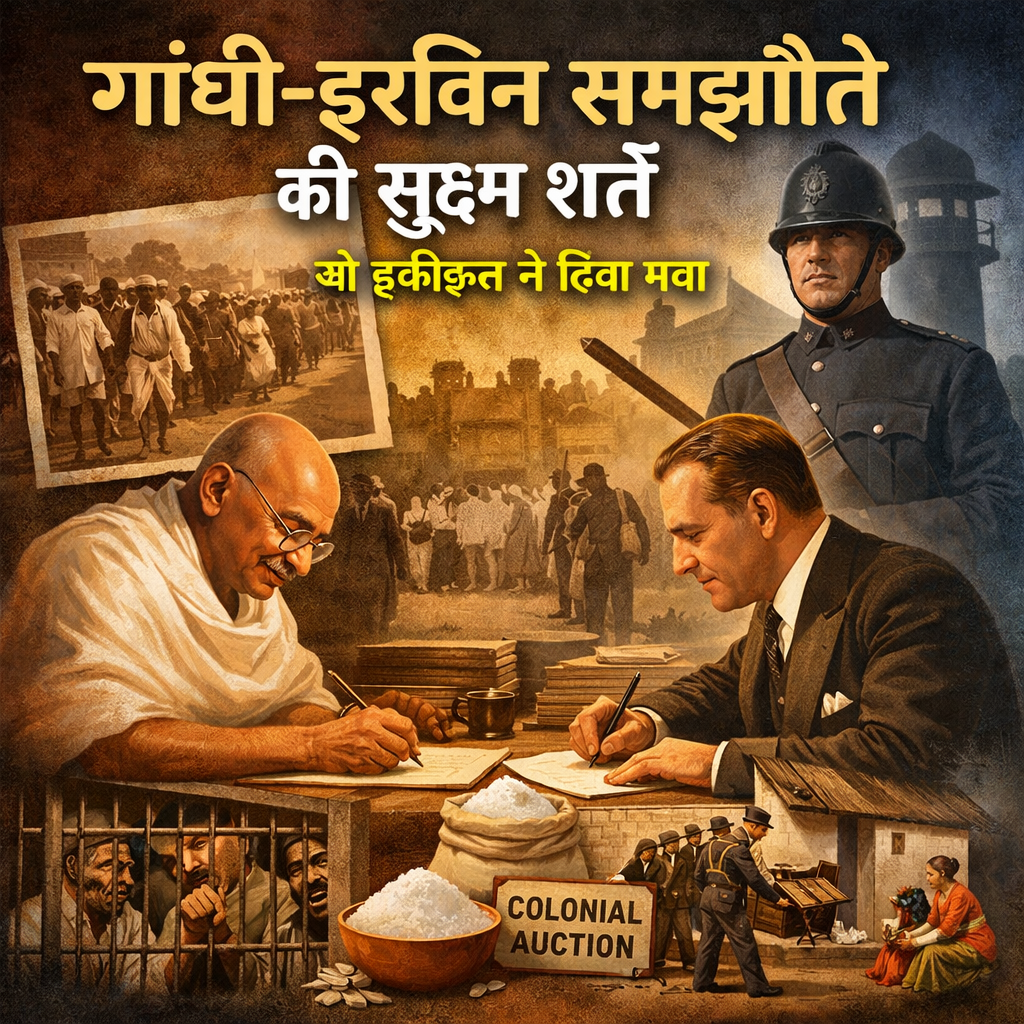
Thank you for reading this post, don't forget to subscribe!The Action Taken: After eight private meetings, Gandhi accepted conditional terms: salt collection restricted to personal coastal use, and return of confiscated lands only if not yet auctioned to third parties.
Who Paid the Price: Peasants whose seized lands had already been auctioned off, and political prisoners excluded under the undefined “violence” clause.
The Alternative Bypassed: Congress executive resolutions requiring unconditional amnesty and complete property restitution before suspending agitation.
Why This Matters: Documents the narrow yield of the signed pact: mass mobilization was surrendered for limited administrative adjustments that left the colonial machinery intact.
Eight Meetings, Twenty-Four Hours, One Document
Gandhi and Lord Irwin met eight times between February and March 1931. The meetings totalled twenty-four hours. Gandhi’s Pact Fine Print — the document signed on March 5, 1931 — was the product of those twenty-four hours.
The headline version of the pact is well known: prisoners released, salt concession granted, Congress attends Round Table Conference. The headline version is not wrong. It is incomplete. Every concession in Gandhi’s Pact Fine Print contains a qualifying clause. This post reads the qualifying clauses.
Concession One — Prisoner Release
The Headline
The British agreed to release political prisoners arrested during the Civil Disobedience Movement. Over 90,000 Indians had been imprisoned. This was presented — and received — as a significant humanitarian concession.
The Fine Print
The release applied only to prisoners not convicted of violence. The operative clause was explicit: those charged with violent offences were excluded.
This exclusion requires examination. The Civil Disobedience Movement of 1930 had been met with systematic British violence — lathi charges, property seizures, the Dharasana beatings documented by Webb Miller, the Qissa Khwani Bazaar firing in Peshawar where British troops shot unarmed protesters. Indians who had reacted to that violence — who had resisted, who had struck back, who had defended themselves or their neighbours — were classified as violent offenders under the pact’s own terms.
Gandhi’s Pact Fine Print released the peaceful and left the reactive in jail. The people most exposed to British violence, who had responded to it, served their full sentences. The people who had maintained non-violence — Gandhi’s stated principle — came out. The principle protected Gandhi’s movement’s image. It did not protect the people who had been shot at.
Provincial governments then compounded the exclusion by debating what counted as “violence” — delaying releases for hundreds in disputed categories while the pact’s architects moved on to the Round Table Conference preparations.
Concession Two — Property Restoration
The Headline
The British agreed to restore confiscated properties of satyagrahis. Farmers and merchants whose land, livestock, and goods had been seized during the movement would have their property returned.
The Fine Print
The operative clause: restoration applied to properties *not yet sold to third parties*.
During 1930, the colonial administration had operated under Emergency Powers Ordinances that permitted local magistrates to seize property without trial and auction it to recover unpaid fines and tax arrears. The British were aware, from mid-1930 onward, that negotiations were coming. Properties were auctioned through 1930 and into early 1931 — the period of Irwin’s quiet discussions with Gandhi in Yeravada Jail.
The farmer whose land had been seized in June 1930 to recover salt tax arrears, and whose land had been auctioned in September 1930 to a third party, discovered at the pact’s signing that his property was gone permanently. The caveat meant that the most exposed participants — those whose properties had been seized earliest, during the movement’s peak — had the least protection. The most recently seized properties, taken as the British prepared for negotiation, were more likely still unsold and therefore returnable.
Gandhi’s Pact Fine Print protected what had not yet been disposed of. What had already been disposed of was disposed of permanently.
Concession Three — Salt
The Headline
The salt tax was addressed. Indians received the right to produce salt. The specific demand that Gandhi had walked 241 miles to dramatise received a response in the pact.
The Fine Print
The operative clause: the right to produce salt applied to people living in coastal villages, for personal domestic consumption only.
Gandhi’s Demand 11 had called for abolition of the salt tax and the government monopoly on salt manufacture. What the pact delivered was coastal personal use rights — the right of a person living within reach of the sea to collect salt from the shore for their own household.
The commercial salt monopoly remained intact. The salt tax remained on the statute books. An Indian merchant could not produce or sell salt competitively.
An Indian farmer in Bihar or Punjab — inland, nowhere near a coast — could produce nothing. The inland poor, who paid the salt tax most heavily as a proportion of income, received nothing from the concession.
Was Salt March About Salt Act?
The Salt March was never about salt alone. Salt was the entry point — a universally consumed necessity — chosen to expose the deeper architecture of colonial extraction. By criminalising something as basic as salt, the British state demonstrated its reach into everyday life. The march translated an abstract economic system into a visible injustice. What appeared as a protest over salt was, in reality, a mass indictment of the entire extraction machinery that controlled Indian production, pricing, and survival.
The pact’s salt clause was a symbol of the demand, not a fulfilment of it. It gave back the act of picking up mud from a beach. It left the system that had made picking up mud illegal for everyone else intact.
Concession Four — Ordinances
The Headline
The emergency ordinances promulgated during the Civil Disobedience Movement were withdrawn. The repressive legislative infrastructure erected in 1930 was dismantled.
The Fine Print
The operative clause: ordinances were withdrawn except where retained for addressing communal disturbances or general lawlessness.
The Emergency Powers Ordinances of 1930 had given local magistrates arrest-without-trial authority, press censorship powers, and the right to prohibit assembly. The carve-out meant that any gathering the colonial administration characterised as potentially communally provocative, or any press commentary it classified as likely to provoke lawlessness, remained subject to the same emergency powers the pact nominally withdrew.
The instrument of suppression was not dismantled. It was renamed.
Concession Five — Fines
The Headline
Fines imposed during the movement were remitted.
The Fine Print
The operative clause: fines were remitted where not yet collected.
The pattern repeats. Fines already extracted from satyagrahis — paid under duress during the movement’s peak — were not refunded. Only uncollected fines were cancelled. The money already taken stayed taken.
What Congress Gave
In exchange for these five partially qualified concessions, Congress, or more specifically Gandhi, agreed to: Suspend the Civil Disobedience Movement completely. Participate in the Second Round Table Conference in London — the conference Gandhi had previously boycotted and which the British needed Congress to legitimise. Cooperate with British authorities on maintaining law and order during the truce period. Not interfere with British administration.
The movement that had brought the colonial administration to the edge of functional collapse — that had produced 60,000 arrests, halved cloth imports, emptied provincial revenue collections, and forced a Viceroy to spend twenty-four hours in direct negotiation with the man he had been imprisoning — was suspended in exchange for five concessions, each carrying a qualifying clause that diminished its operative scope.
Was it a literal sell-out? Many critics believe so.

What Was Not in the Document
Gandhi’s Pact Fine Print is also a document of silences. Eight demands from Gandhi’s original eleven are not addressed anywhere in the pact text.
No reduction in land revenue. No reduction in military expenditure. No reduction in civil service salaries. No abolition of the CID. No protective tariff on foreign cloth. No change to the rupee-sterling exchange rate. No reservation of coastal shipping for Indian vessels. No inquiry into police brutality during the movement — Gandhi asked for this; Irwin refused.
The extraction machine documented in Blogs 13 and 14 — the Council Bills, the Home Charges, the commercial captivity, the surveillance architecture — was not touched by a single clause in Gandhi’s Pact Fine Print. The machine that had been running for 190 years continued running on March 6, 1931, exactly as it had run on March 4.
The Salt March started to get something from the British. Instead of getting anything, it gave the British legitimacy to continue the extraction machine, the political suppression mechanism, the suppression of farmers, the export of Indian manufacturing to England, and the salt act itself.
The next post places the eleven demands beside the pact clause by clause. The gap speaks for itself.
Five concessions. Each with a qualifying clause. Eight demands met with silence. The movement suspended. The machine intact. Gandhi’s Pact Fine Print is most accurately read not by what it says — but by what it carefully does not say.
Series Index
Feature Image: Click here to view the image.
Videos