
Gandhi’s Khadi Revolution: The Spinning Wheel as a Weapon (6)
भारत / GB
Part 6: Mahatma Gandhi’s Peace Efforts | Series Index
Gandhi’s Khadi Revolution: How It Impacted Freedom Struggle
Five posts in — the Inner Temple barrister, the Pietermaritzburg night, the invention of Satyagraha, the ambulance corps under fire, the walking investigation at Champaran. The man is built. The Mahatma is named. Now the economy. Let us now Analise how Gandhi’s Khadi Revolution changed him and the fate of Indian freedom struggle.
Thank you for reading this post, don't forget to subscribe!The Action Taken: Gandhi elevated the charkha into a mandatory symbol of political loyalty and Congress membership, framing manual spinning as the supreme economic weapon against British textiles.
Who Paid the Price: Rural households directed into labor-intensive manual spinning that lacked commercial viability, rather than diversified, mechanized rural cottage industries.
The Alternative Bypassed: Modern industrial planning proposals and fiscal tariff policies advocated by contemporary economic nationalists.
Why This Matters: Built the ascetic public uniform that insulated his political decisions from empirical economic critique by framing dissent as spiritual inadequacy.
The Crime That Made the Weapon Necessary
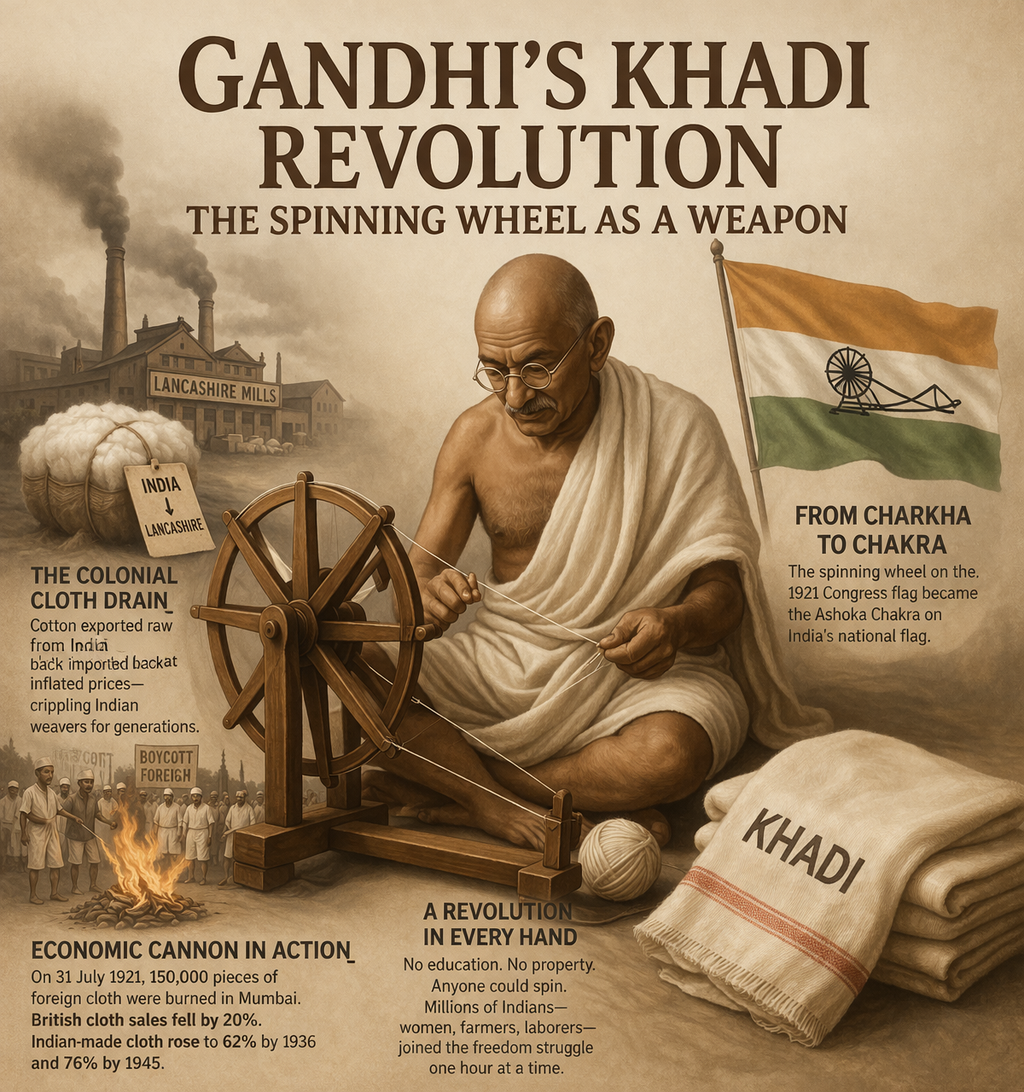
Gandhi’s Khadi Revolution did not begin with a spinning wheel. It began with a ledger. India grew the cotton. The colonial structure exported it raw to the mills of Lancashire and Manchester, spun it into cloth, then sold it back to India at artificially inflated prices. The colonial cloth drain that stripped India of its textile economy was systematic — a country that had once supplied the Roman Empire with fabric so fine that merchants called it woven air had been reduced to two roles simultaneously: raw material supplier and captive consumer. Indian weavers whose craft stretched back three thousand years were priced out of their own market by machine-made British cloth.
Dadabhai Naoroji had named this the Drain of Wealth in 1901. Every nationalist understood the argument. What none had found before Gandhi was a physical act — requiring no education, no property, no colonial credential — that translated the argument into daily economic defiance.
Gandhi’s Khadi Revolution: The Cannon Gandhi Did Not Use
Gandhi’s Own Words
Gandhi did not dress his strategy in modest language. Speaking at a Rotary Club gathering in Calcutta in August 1925, he was precise: “This spinning wheel is a cannon, yarn-balls are its ammunition, with this we shall smash Lancashire and Manchester.”
Not a symbol. Not a spiritual practice. A weapon of economic warfare aimed at a specific target. Gandhi understood that colonial rule rested on economic extraction and that the textile trade was its most visible instrument. Withdrawing Indian purchasing power from British cloth was not sentiment — it was strategy. Gandhi’s Khadi Revolution gave that strategy a physical form that three hundred million people could execute every day.
The Measurable Damage
The strategy worked. British cloth sales fell 20%. Indian-made cloth rose to 62% of the market by 1936 and 76% by 1945. Lancashire mills that had been built on Indian cloth consumption genuinely suffered. On 31 July 1921, Gandhi oversaw the burning of 150,000 pieces of imported English cloth at the Elphinstone Mill compound in Mumbai — a public pledge that was visible, irreversible, and impossible for the colonial press to ignore.
The numbers were real. The damage was real. An independence movement that had previously operated through petitions and speeches had found an economic instrument that actually hurt.

The Democratic Instrument
What distinguished Gandhi’s Khadi Revolution from every previous nationalist economic strategy was its universality. The Swadeshi movement before Gandhi had been the project of Bengali industrialists, educated professionals, and urban merchants — it required capital, commercial networks, and access to the institutional world. Gandhi gave it an instrument that required none of those things.
The charkha needed no education, no property, no caste credential, and no colonial permission. A Brahmin scholar and a landless labourer could spin side by side and both be freedom fighters in the same act. Gandhi asked every Indian to spin for one hour daily — no previous political mobilisation had offered participation on those terms, not as an audience for a speech but as an active economic combatant in the liberation struggle itself.
The participation was genuinely mass. Women who had never attended a political meeting spun. Farmers who had never read a pamphlet wore the cloth they had made. The independence movement entered every household not as an idea arriving from outside, but as a daily physical act performed within.
The Flag
In 1931, the charkha was placed on the Indian National Congress flag — the year Gandhi negotiated the Gandhi-Irwin Pact at the peak of his moral authority. The spinning wheel flew over the independence movement for sixteen years. In the weeks before August 1947, it was replaced. The objection that carried weight was that the charkha was seen by some as a Hindu symbol, unsuitable for a flag meant to represent all communities of a partitioned subcontinent. The Ashoka Chakra — the wheel of a Buddhist emperor, a secular emblem — took its place. The spinning wheel of economic resistance became the wheel of law. The revolution Gandhi’s Khadi Revolution launched in 1918 wove itself into the fabric of the nation — and then, at the last moment before independence, was quietly asked to step aside.
The substitution was practical — a spinning wheel has a distinct front and back and cannot read identically from both sides of a flag — but the wheel itself remained, now as the 24-spoke Ashoka Chakra, the wheel of law and of time. The instrument of resistance became the instrument of governance.

The Revolution That Wore Its Politics
Gandhi’s Khadi Revolution was the most original economic weapon deployed by any independence movement in the 20th century. It required no violence, could not be arrested, and scaled infinitely — every new spinner added pressure without adding risk. It simultaneously produced employment, self-reliance, national identity, and economic damage to the colonial power. It was, in Gandhi’s own word, a cannon.
What made it a revolution rather than a campaign was its durability. The Salt March lasted 24 days. Non-Cooperation ran for two years. Gandhi’s Khadi Revolution ran for three decades, sustained not by political events but by the daily discipline of millions of ordinary Indians choosing their own cloth over the Empire’s. No other instrument in the independence movement came close to that depth of daily mass participation.
Gandhi’s Khadi Revolution produced results no previous instrument had. A 20% fall in British cloth sales. Indian cloth at 76% of the market by 1945. One hundred and fifty thousand pieces of British cloth burned in a single afternoon. The cannon, by any measure, had ammunition and range. The question the numbers leave unanswered — the one this series will return to — is a simple one of arithmetic: if this much damage was achieved with the participation that existed, what would full consistent participation have produced? And why, across three decades of spinning, was that calculation never completed?
Part 7 follows the same mass energy into a different arena — when a whole nation said no at once, and what it meant when it stopped.
When a cannon is loaded and aimed — who decides the powder measure?
Series Index
Feature Image: Click here to view the image.
Videos
Glossary of Terms
- Dadabhai Naoroji (1825–1917): Indian political leader, economist, and the first Indian elected to the British Parliament (1892). A central figure in the London Indian community during Gandhi’s Inner Temple years. His economic critique of British rule — the Drain of Wealth thesis — and his constitutional approach shaped the political vocabulary Gandhi absorbed in London and applied in Natal.
- INC (Indian National Congress): The principal political organisation of the Indian independence movement, founded in Bombay in 1885 by Allan Octavian Hume. Initially a moderate constitutional body petitioning for greater Indian representation within British rule. Gandhi joined on his return to India in 1915 and transformed it from an elite debating society into a mass movement.
- Satyagraha: Sanskrit compound — Satya (truth) and Agraha (insistence/force). Gandhi’s political method of non-violent resistance to unjust laws through mass civil disobedience, non-cooperation, and willing acceptance of legal consequences including imprisonment. First formulated and deployed in South Africa — in the 1906 anti-registration campaign and the 1913 Great March. Later applied at continental scale in India against British colonial rule.
- Drain of Wealth: Dadabhai Naoroji’s 1901 economic thesis — formally titled Poverty and Un-British Rule in India — arguing that British colonial policy systematically transferred Indian wealth to Britain through trade policy, administrative salaries remitted home, and extraction of raw materials sold back as finished goods. The intellectual foundation for Gandhi’s Khadi Revolution as economic counter-weapon.
- Khadi: Handspun and handwoven cloth — the product of the charkha. Gandhi’s central economic weapon against the colonial cloth drain. Wearing khadi was simultaneously an act of economic defiance, a statement of self-reliance, and a visible marker of participation in the independence movement. The requirement that INC members wear khadi made it a political uniform.
- Charkha: The hand-operated spinning wheel — the instrument of Gandhi’s Khadi Revolution. Required no education, capital, caste credential, or colonial permission. Gandhi asked every Indian to spin one hour daily. Placed on the Indian National Congress flag in 1931. Replaced by the Ashoka Chakra on India’s national flag at independence in 1947.
- Swadeshi: Sanskrit compound meaning “of one’s own country” — the economic nationalism movement advocating purchase and use of Indian-made goods over imported British products. Pre-Gandhian Swadeshi (1905–1908) was primarily a Bengali middle-class movement. Gandhi universalised it through the charkha, making it accessible to illiterate rural populations with no capital.
- Colonial Cloth Drain: The specific mechanism of British colonial extraction in India’s textile economy — importing Indian raw cotton, manufacturing cloth in Lancashire and Manchester mills, then selling it back to India at inflated prices. Destroyed India’s traditional handloom weaving industry, which had employed millions and produced cloth traded globally for centuries.
- Non-Cooperation Movement (1920–1922): Gandhi’s first mass civil disobedience campaign in India — a call to boycott British institutions, return colonial honours, withdraw from British courts and educational institutions, and refuse to pay taxes. Launched in response to the Jallianwala Bagh massacre and Khilafat movement. Suspended by Gandhi after the Chauri Chaura violence of February 1922.
- Ashoka Chakra: The 24-spoke blue wheel on India’s national flag — taken from the Lion Capital of Ashoka at Sarnath, representing the dharmachakra (wheel of law/dharma). Replaced the charkha on the Congress flag in 1947. The wheel of Buddhist emperor Ashoka — a secular, non-denominational symbol — chosen to represent all communities of the new nation.
- Gandhi-Irwin Pact (1931): The agreement between Gandhi and Lord Irwin (British Viceroy) signed in March 1931, ending the Civil Disobedience Movement temporarily. Gandhi suspended civil disobedience; the British released political prisoners, permitted salt manufacture for personal use, and agreed to Gandhi attending the Second Round Table Conference in London. Negotiated at the peak of Gandhi’s moral authority.
- Cloth Burning Mumbai (31 July 1921): The public burning of 150,000 pieces of imported British cloth at the Elphinstone Mill compound in Mumbai, overseen by Gandhi. A visible, irreversible act of economic defiance. The largest single symbolic action of the Non-Cooperation Movement — making the boycott of British goods into a mass public spectacle that the colonial press could not ignore.
- Salt March (1930): Gandhi’s 241-mile march from Sabarmati Ashram to the coastal town of Dandi, conducted from 12 March to 5 April 1930, to protest the British salt tax. Gandhi and followers made salt from seawater in deliberate violation of colonial law. Triggered mass civil disobedience across India. Lasted 24 days — contrasted in this blog with the Khadi Revolution’s three-decade sustained participation.
- Lancashire and Manchester: The cotton textile manufacturing centres of northern England — the industrial heart of British cloth production that dominated global textile trade in the 19th century. India was their largest captive market. Gandhi’s Khadi Revolution directly targeted these mills — his August 1925 Calcutta speech named them explicitly as the cannon’s target. British cloth sales to India fell 20% as khadi participation grew.
- Elphinstone Mill (Mumbai): The textile mill compound in Mumbai where Gandhi oversaw the burning of 150,000 pieces of imported British cloth on 31 July 1921 — the largest single act of the Non-Cooperation boycott campaign. The mill was located in the heart of Mumbai’s industrial district, making the burning visible to the city’s commercial and colonial establishment.
#GandhiKhadiRevolution #KhadiMovement #CharkhaSpinningWheel #SwadeshiEconomics #DrainOfWealth #NonCooperationMovement #ColonialClothDrain #MahatmaGandhiSeries #GandhiPeaceEfforts #ColonialIndia #IndianIndependence #GandhiClassFramework #HinduinfopediaGandhi #Gandhi #Satyagraha #Khadi #Swadeshi #Champaran #AshokChakra #LancashireMills
Related Blogs
Previous Blogs of The Series
- https://hinduinfopedia.in/gandhis-peace-efforts-the-man-before-the-mahatma-1/
https://hinduinfopedia.in/?p=25527 - https://hinduinfopedia.in/gandhis-south-africa-years-inner-temple-to-nic-who-paid-the-fare2/
https://hinduinfopedia.in/?p=25633 - https://hinduinfopedia.in/gandhis-train-to-nowhere-the-pietermaritzburg-moment-and-its-limits-3/
https://hinduinfopedia.in/?p=25645 - https://hinduinfopedia.in/gandhis-boer-war-bargain-phoenix-farm-and-the-british-medal-4/
https://hinduinfopedia.in/?p=25686 - https://hinduinfopedia.in/gandhis-rural-india-champaran-real-suffering-real-limits-5/
https://hinduinfopedia.in/?p=25747
Previous Blogs on Mahatma Gandhi
- https://hinduinfopedia.in/martyrs-of-indian-independence-and-gandhis-influence/
- https://hinduinfopedia.in/rowlatt-act-and-gandhi/
- https://hinduinfopedia.in/gandhis-post-independence-actions-and-legacy/
- https://hinduinfopedia.in/gandhis-personal-ideologies-and-methodologies/
- https://hinduinfopedia.in/communal-relations-in-indian-history-gandhis-legacy/
- https://hinduinfopedia.in/ideological-divides-and-gandhis-leadership/
- https://hinduinfopedia.in/gandhis-post-independence-actions-and-legacy/
- https://hinduinfopedia.in/gandhi-revisited-a-critical-legacy/
- https://hinduinfopedia.in/indira-gandhis-actions-the-competition-terminator/
- https://hinduinfopedia.in/nonviolent-policy-and-making-of-gandhi-in-south-africa/
- https://hinduinfopedia.org/ambedkars-buddhist-political-move-divergence-from-gandhi-on-caste-issues/
- https://hinduinfopedia.org/mahatma-gandhi-and-nonviolence/
- https://hinduinfopedia.org/mahatma-gandhi-and-his-principles-analyzed/
- https://hinduinfopedia.org/subhash-chandra-bose-contrasting-strategies-with-gandhi/
- https://hinduinfopedia.in/on-this-day-5-march-2024-tuesday/
- https://hinduinfopedia.in/akshardham-temple-terror-attack-2002/
- https://hinduinfopedia.in/nathuram-godse-murderer-patriot-or-fractured-youth/
- https://hinduinfopedia.in/remembering-indian-freedom-struggle-of-february-5/
- https://hinduinfopedia.org/indias-freedom-struggle-and-quit-india-movement-ii/
- https://hinduinfopedia.org/indian-freedom-fighters-legacy-of-gopal-krishna-gokhale/
Follow us:
- English YouTube: https://www.youtube.com/@Hinduofficialstation
- Hindi YouTube: https://www.youtube.com/@HinduinfopediaIn
- X: https://x.com/HinduInfopedia
- Instagram: https://www.instagram.com/hinduinfopedia/
- Facebook: https://www.facebook.com/Hinduinfopediaofficial
- Threads: https://www.threads.com/@hinduinfopedia