
Gandhi’s South Africa Years: Inner Temple to NIC — Who Paid the Fare(2)
भारत / GB
Part 2: Mahatma Gandhi’s Peace Efforts | Series Index
Arriving in Natal: The Commission That Changed Everything
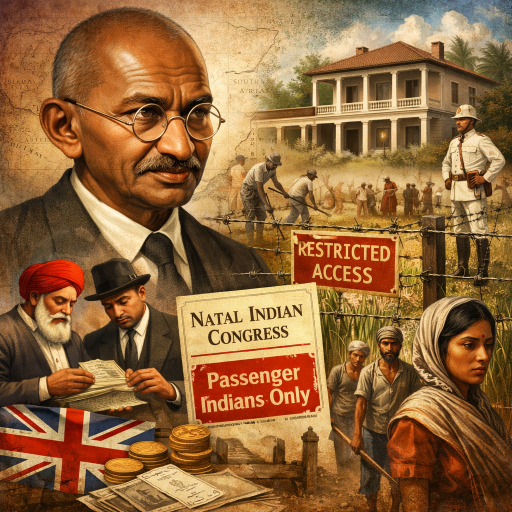
Gandhi’s South Africa years began not with a political mission but with a legal brief. In April 1893, a twenty-three-year-old barrister boarded a ship for Natal to argue a commercial dispute for the Muslim trading firm of Dada Abdulla and Co. He had struggled to find work in India. The South Africa commission was a professional lifeline — and what he found in Natal would define Gandhi’s South Africa years in ways neither he nor his merchant patrons anticipated.
Thank you for reading this post, don't forget to subscribe!The Indian population of Natal divided into two legally distinct groups. The British colonial administration itself formalised this distinction — classifying merchant-class arrivals as “Passenger Indians” who had come voluntarily and paid their own fare, and “Indentured Indians” who had arrived under five-year labour contracts for the sugar and coal industries. Gandhi arrived as the guest of the Passenger Indian community and lived, during his peak Natal years, as a high-earning barrister in a comfortable Durban villa — financed through the patron-client politics of the very merchants whose interests the NIC would be built to protect.
The Action Taken: Following the racial ejection at Pietermaritzburg station, Gandhi chose to remain in South Africa, establishing the Natal Indian Congress (1894) under the commercial retainership of merchant houses.
Who Paid the Price: Gandhi himself initially, facing intense colonial hostility and physical assault at Durban port (1897) while defending the community’s legal rights.
The Alternative Bypassed: Quiet departure and returning to domestic legal practice in India.
Why This Matters: Created the initial moral capital of his public career, demonstrating personal courage while establishing that his public campaigns were underwritten by elite commercial patronage.
The Genesis of the Natal Indian Congress
The 1885 Template
The Natal Indian Congress was not Gandhi’s invention. It was his reproduction. Nine years before he landed in Durban, Allan Octavian Hume — a retired British civil servant — had founded the Indian National Congress in Bombay with the explicit approval of Viceroy Lord Dufferin. The INC’s founding logic was identical to what Gandhi built in Natal: petition the colonial government through legal channels, seek redress within British constitutional procedure, demonstrate the community’s worthiness for inclusion. Gandhi had grown up in the political world that model created. His time in Dadabhai Naoroji’s London circle during his Inner Temple years gave him fluency in the language British power recognised as legitimate. When he sat down to found the NIC in May 1894, he was not building something new. He was building something he already knew how to use.
The Respectable Filter
The NIC was specifically designed to separate “Passenger Indians” from “Indentured Indians” in the eyes of British law. The founding petition protested the proposed disenfranchisement of Indians who held the colonial franchise — requiring property ownership and tax payment above a threshold. The Tamil indentured labourer, earning ten shillings a month and legally required by the 1895 Law 3 to re-indenture or pay a £3 annual tax, did not meet it. He was Indian. He was not the Indian whose rights the NIC was defending.
Both the British administration and the NIC merchants shared a structural interest in this arrangement. The colonial economy ran on controlled indentured labour. The merchants needed those same workers as consumers and a captive economic base. Neither group had any interest in giving Tamil labourers a political voice. Gandhi would invoke their suffering in every petition. He would not give them a seat at the table drawing up those petitions. This Gandhi class framework — principled advocacy for those already organised, symbolic invocation of those who were not — would repeat at continental scale after 1915.
What the NIC Achieved — and for Whom
The 1894 franchise petition generated press coverage in Britain and India. Gandhi’s 1896 pamphlets brought the South African Indian question into mainstream Indian public discourse for the first time. His reputation as a principled advocate was genuinely earned during these years. The Indian Relief Act of 1914 — negotiated with Jan Smuts before Gandhi’s departure — recognised Indian marriages, secured property rights, and abolished the £3 annual tax. Read in sequence, those outcomes reveal their priority: merchant property and family law came first. The £3 waiver was consequential relief that allowed former indentured workers to remain in Natal as a stable, debt-free labour pool — useful to the same merchant class that had built the NIC. The indentured system itself was not abolished until 1917, three years after Gandhi had returned to India, through campaigns including Gokhale’s and sustained nationalist pressure.
The NIC period produced a genuine institution and a genuine advocate. It also established the constituency his advocacy was structured around: those with the resources to organise, petition, and be heard by colonial power.
The Great Pivot of 1913: When the Elite Bridge Failed
Two decades of legal petitions had produced one clear lesson: the British would not voluntarily extend civic rights to even the most respectable Passenger Indians. The 1906 Asiatic Registration Act — the Black Act — demanded registration and fingerprinting of all Indians regardless of class. The British had declined to cross the bridge the NIC had spent twelve years building.
By 1913, Gandhi recruited the indentured labourers — the mass power the NIC had never organised — to force Jan Smuts to the table. The Great March was tactical necessity. Satyagraha, assembled from Thoreau, Tolstoy, and Jain ahimsa, proved it could mobilise beyond the merchant class when petition had failed.
The India Gandhi returned to in 1915 — a country he had left as a struggling young barrister — would test the same method at continental scale, with the same class questions unresolved beneath it. Part 3 examines the Pietermaritzburg platform and exactly where that night’s radicalisation stopped.
Series Index
Feature Image: Click here to view the image.
Videos
Glossary of Terms
- Indentured Labour: The system under which Indians — primarily from Bihar, eastern UP, and Tamil Nadu — were contracted to work on British colonial plantations in South Africa, Fiji, Mauritius, the Caribbean, and other territories from 1838 to 1917. Contracts bound labourers for five years under conditions documented as equivalent to slavery. The indentured Indian community in Natal formed a distinct and lower social stratum from the Gujarati merchant class Gandhi primarily represented.
- Inner Temple: One of the four Inns of Court in London with the exclusive right to call barristers to the English bar. Gandhi was admitted to Inner Temple in 1888 and called to the bar in June 1891. Membership conferred formal colonial professional accreditation recognised across British India.
- Gujarati Merchant Class: The network of Gujarati trading families — predominantly Bania and Muslim Bohra — whose commercial interests in South Africa created the conditions for Gandhi’s legal career there and who funded his early political work including the formation of the Natal Indian Congress.
- British India: The territories of the Indian subcontinent under direct British Crown administration from 1858 to 1947, following the transfer of power from the East India Company after the 1857 uprising. Administered through the India Office in London and the Viceroy in Calcutta and later New Delhi. Coexisted with approximately 565 princely states under indirect British control through paramountcy agreements.
- Ahimsa: Sanskrit term meaning non-harm or non-violence. A foundational principle in Jain, Buddhist, and Hindu ethical thought. Gandhi reconstructed ahimsa not as received religious inheritance but as a personally synthesised political philosophy — combining Jain ethics, Tolstoyan non-resistance, and Thoreau’s civil disobedience into a strategic method for mass political action under colonial conditions.
- Patron-Client Framework: The structure of obligation and reciprocity in which a wealthy or powerful patron funds or sponsors an individual in exchange for future service, loyalty, or political representation of patron interests. Applied in this series to examine Gandhi’s relationship with the Gujarati merchant community that funded his legal training and early political career.
- Henry David Thoreau (1817–1862): American writer and philosopher. His 1849 essay Civil Disobedience argued that individuals have a moral obligation to resist unjust laws through non-cooperation. Gandhi read Thoreau during his London years and later acknowledged its influence on his political methods.
- Leo Tolstoy (1828–1910): Russian novelist and moral philosopher. His later writings — particularly The Kingdom of God Is Within You — argued for radical non-violence and passive resistance to state authority. Gandhi corresponded with Tolstoy and credited his thought as a formative influence on ahimsa as political strategy.
- Dada Abdulla: South African Muslim merchant of Gujarati origin whose trading firm — Dada Abdulla and Co. — brought Gandhi to Natal in April 1893 to argue a commercial case. Abdulla was among the Passenger Indian merchant elite whose legal and commercial interests Gandhi would represent for the next two decades. The commission was Gandhi’s entry point into the South African Indian community.
- Allan Octavian Hume (1829–1912): Retired British Indian Civil Service officer who founded the Indian National Congress in Bombay in 1885 with the explicit approval of Viceroy Lord Dufferin. Hume’s INC was designed to provide a constitutional channel for educated Indian opinion within the framework of British rule — the same petition-within-the-system model Gandhi reproduced in the Natal Indian Congress nine years later.
- Dadabhai Naoroji (1825–1917): Indian political leader, economist, and the first Indian elected to the British Parliament (1892). A central figure in the London Indian community during Gandhi’s Inner Temple years. His economic critique of British rule — the Drain of Wealth thesis — and his constitutional approach to Indian political representation shaped the political vocabulary Gandhi absorbed in London and applied in Natal.
- Jan Smuts (1870–1950): South African statesman who served as Colonial Secretary of the Transvaal and later as Prime Minister of South Africa. Gandhi’s primary negotiating counterpart in the Satyagraha campaigns — they reached the Gandhi-Smuts Agreement of 1914 that produced the Indian Relief Act. Smuts later became an international statesman and played a role in drafting the UN Charter.
- Gopal Krishna Gokhale (1866–1915): Indian political leader and social reformer. Gandhi’s acknowledged political mentor. Led the moderate wing of the Indian National Congress. Conducted a tour of South Africa in 1912 examining the condition of Indian indentured labourers. Campaigned for abolition of indentured labour from India — a campaign carried through to conclusion in 1917, two years after his death.
- NIC (Natal Indian Congress): The political organisation founded by Gandhi in Durban in May 1894 to represent the interests of Indians in the British colony of Natal. Modelled on the Indian National Congress. Financed primarily by Gujarati Muslim and Hindu merchant families. Its founding petition focused on the colonial franchise — property and tax-based voting rights — that the Passenger Indian merchant class held but Tamil indentured labourers did not.
- INC (Indian National Congress): The principal political organisation of the Indian independence movement, founded in Bombay in 1885 by Allan Octavian Hume. Initially a moderate constitutional body petitioning for greater Indian representation within British rule. Gandhi joined the INC on his return to India in 1915 and transformed it from an elite debating society into a mass movement — applying the lessons of the Natal Indian Congress at continental scale.
- Satyagraha: Sanskrit compound — Satya (truth) and Agraha (insistence/force). Gandhi’s political method of non-violent resistance to unjust laws through mass civil disobedience, non-cooperation, and willing acceptance of legal consequences including imprisonment. First formulated and deployed in South Africa — in the 1906 anti-registration campaign and the 1913 Great March. Later applied at continental scale in India against British colonial rule.
- Passenger Indians: The colonial legal classification used in Natal to designate Indians who had arrived voluntarily and paid their own passage — primarily Gujarati Muslim and Hindu merchants. Distinguished in colonial law from Indentured Indians who had arrived under labour contracts. The Passenger Indian community formed the funding base and primary constituency of the Natal Indian Congress.
- Colonial Franchise: The voting rights extended to qualified residents of British colonial territories, conditioned on property ownership and minimum tax payment. In Natal, Indians who met the property and tax threshold held the franchise until the 1896 Franchise Amendment Act sought to disenfranchise them. The NIC’s founding purpose was to resist this disenfranchisement — exclusively on behalf of Passenger Indians who held the franchise, not the indentured labourers who did not.
- Asiatic Registration Act (1906): The Transvaal legislation — popularly known as the Black Act — that required all Indians and Chinese in the Transvaal to register, be fingerprinted, and carry registration certificates at all times. Its application regardless of class — affecting both the Passenger Indian merchant and the indentured labourer equally — galvanised the first organised Satyagraha campaign and marked the failure of the NIC’s class-stratified petition strategy.
- Indian Relief Act (1914): The South African legislation negotiated between Gandhi and Jan Smuts — the Gandhi-Smuts Agreement — before Gandhi’s return to India. Recognised Indian marriages under Hindu and Muslim rites (previously not legally valid), secured property rights, and abolished the £3 annual tax imposed on former indentured labourers by Natal Law 3 of 1895. The sequence of its provisions — property and family law first, tax relief second — reflects the priority order of the NIC’s merchant constituency.
- Great March (1913): The mass protest march led by Gandhi in November 1913 in which approximately four thousand Indian workers — primarily indentured Tamil coal miners from Newcastle — crossed from Natal into the Transvaal in deliberate violation of colonial movement restrictions. The first large-scale deployment of Satyagraha using indentured labour as its mobilising base — a constituency the NIC had never organised and had not represented in two decades of petitioning.
#GandhiSouthAfricaYears #NatalIndianCongress #PassengerIndians #SatyagrahaOrigins #GandhiClassFramework #BritishColonialFranchise #MahatmaGandhiSeries #GandhiPeaceEfforts #ColonialIndia #PatronClientPolitics #IndenturedLabour #IndianIndependence #HinduinfopediaGandhi #Satyagraha #GandhiMerchantPatrons #GreatMarch1913 #NIC1894 #DadaAbdulla #GandhiSouthAfrica
Related Blogs
Previous Blogs of The Series
- https://hinduinfopedia.in/gandhis-peace-efforts-the-man-before-the-mahatma-1/
https://hinduinfopedia.in/?p=25527
Previous Blogs on Mahatma Gandhi
- https://hinduinfopedia.in/martyrs-of-indian-independence-and-gandhis-influence/
- https://hinduinfopedia.in/rowlatt-act-and-gandhi/
- https://hinduinfopedia.in/gandhis-post-independence-actions-and-legacy/
- https://hinduinfopedia.in/gandhis-personal-ideologies-and-methodologies/
- https://hinduinfopedia.in/communal-relations-in-indian-history-gandhis-legacy/
- https://hinduinfopedia.in/ideological-divides-and-gandhis-leadership/
- https://hinduinfopedia.in/gandhis-post-independence-actions-and-legacy/
- https://hinduinfopedia.in/gandhi-revisited-a-critical-legacy/
- https://hinduinfopedia.in/indira-gandhis-actions-the-competition-terminator/
- https://hinduinfopedia.in/nonviolent-policy-and-making-of-gandhi-in-south-africa/
- https://hinduinfopedia.org/ambedkars-buddhist-political-move-divergence-from-gandhi-on-caste-issues/
- https://hinduinfopedia.org/mahatma-gandhi-and-nonviolence/
- https://hinduinfopedia.org/mahatma-gandhi-and-his-principles-analyzed/
- https://hinduinfopedia.org/subhash-chandra-bose-contrasting-strategies-with-gandhi/
- https://hinduinfopedia.in/on-this-day-5-march-2024-tuesday/
- https://hinduinfopedia.in/akshardham-temple-terror-attack-2002/
- https://hinduinfopedia.in/nathuram-godse-murderer-patriot-or-fractured-youth/
- https://hinduinfopedia.in/remembering-indian-freedom-struggle-of-february-5/
- https://hinduinfopedia.org/indias-freedom-struggle-and-quit-india-movement-ii/
- https://hinduinfopedia.org/indian-freedom-fighters-legacy-of-gopal-krishna-gokhale/
Follow us:
- English YouTube: https://www.youtube.com/@Hinduofficialstation
- Hindi YouTube: https://www.youtube.com/@HinduinfopediaIn
- X: https://x.com/HinduInfopedia
- Instagram: https://www.instagram.com/hinduinfopedia/
- Facebook: https://www.facebook.com/Hinduinfopediaofficial
- Threads: https://www.threads.com/@hinduinfopedia