
Gandhi’s Vicarious Guilty Plea: Gandhi’s Guilt Declares Every Satyagrahi Guilty Barring Khalifates (204)
भारत / GB
Part 204: Mahatma Gandhi’s Peace Efforts | Series Index
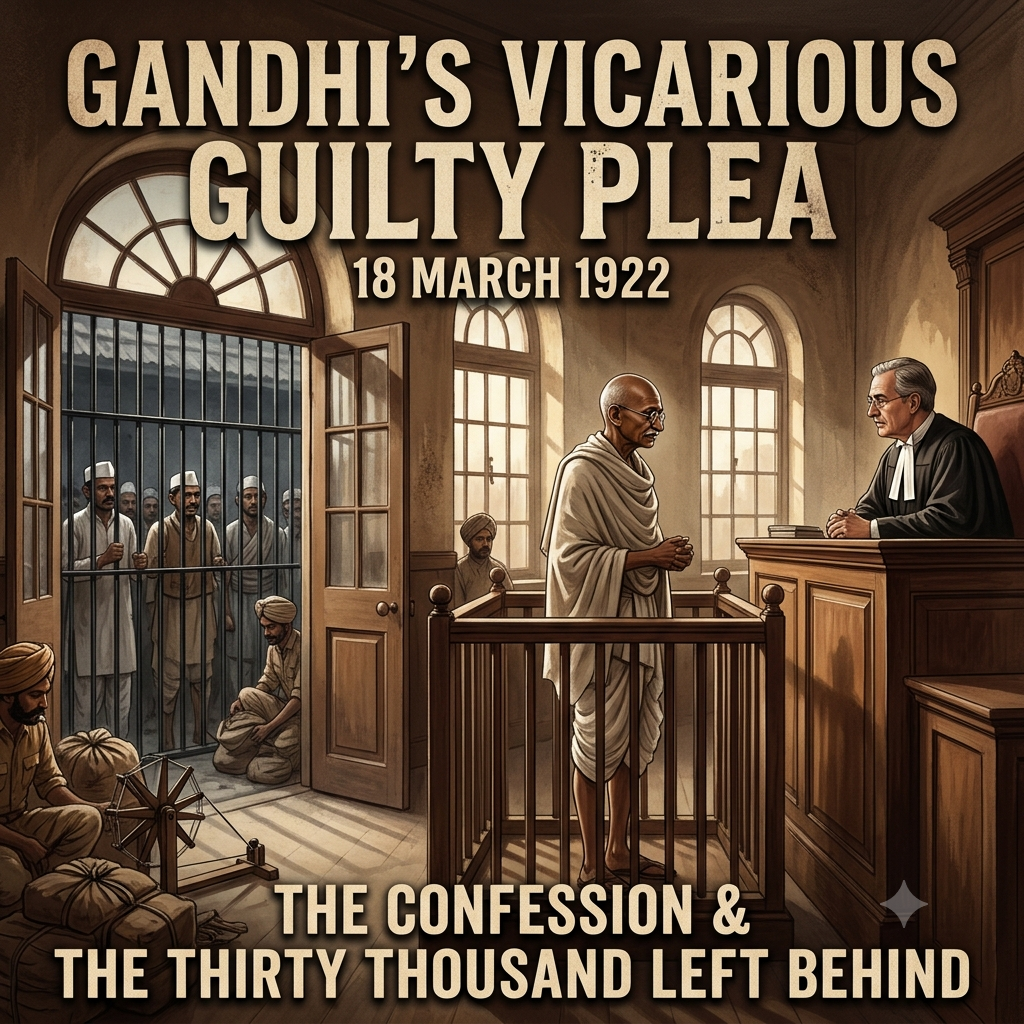
Blog 203 documented Gandhi’s Great Trial of 18 March 1922 — the guilty plea, Broomfield’s bench exchange, the six-year sentence served in two, and the thirty thousand cadres left in colonial custody without a date of resumption. This blog, Gandhi’s Vicarious Guilty Plea. places before the reader one consequence of that plea that the standard account does not name: when Gandhi pleaded guilty to sedition under Section 124A IPC, he did not plead guilty for himself alone. Thirty thousand Indians sat in colonial jails under identical charges — while millions more had staked property, government posts, courts, and livelihoods on his call. The guilty plea was entered by one man. Its legal, material, and custodial weight was distributed across all of them.
Thank you for reading this post, don't forget to subscribe!The Charge and the Plea
Section 124A IPC criminalised bringing or attempting to bring into hatred or contempt, or exciting disaffection toward, His Majesty’s Government established by law in British India. The colonial state had applied this provision uniformly across the Non-Cooperation Movement — against Gandhi, against the Congress volunteer corps, and against rank-and-file participants who picketed or distributed leaflets. Thirty thousand Indians had been prosecuted on this basis, and under Part II of the Criminal Law Amendment Act of 1908, before Gandhi’s own arrest on 10 March 1922.
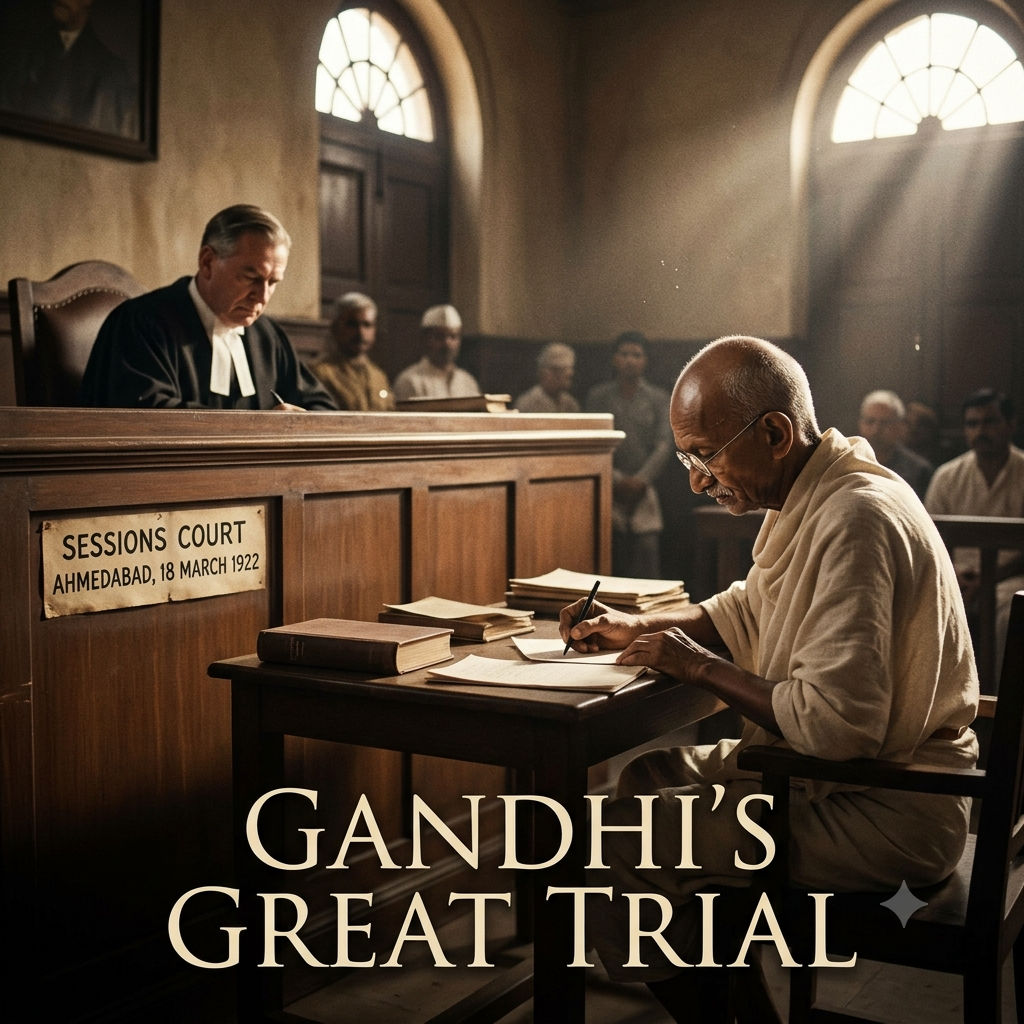
At the trial on 18 March 1922, Gandhi pleaded guilty to all three counts. He submitted a written statement to the court accepting moral responsibility for the movement and for the violence it had produced — specifically citing the events at Chauri Chaura (Gorakhpur), Bombay (the November 1921 Prince of Wales riots), and Madras. He asked for no leniency. Gandhi’s vicarious guilty plea was not contested, qualified, or hedged.
Who Was in Custody — and What Millions Had Staked — When Gandhi Pleaded
At the moment Gandhi entered his plea, approximately thirty thousand Indians remained in colonial custody under charges drawn from the same legal provisions and the same movement. They were overwhelmingly ordinary Hindus who had answered Gandhi’s call for Swaraj — volunteers, students, lawyers, and traders — alongside a smaller number of nationalist Muslims committed to India’s freedom under the Non-Cooperation framework.
Beyond the thirty thousand inside prison walls stood millions of ordinary citizens who had staked their material survival on Gandhi’s promise of “Swaraj within one year”:
- Forfeited Property and Confiscated Estates: Peasants and landholders — particularly in no-tax agitation zones like Bardoli and Guntur — faced revenue attachments, punitive police levies, and confiscation of land, cattle, and household property.
- Abandoned Public and Private Livelihoods: Thousands of government clerks, schoolteachers, village officials, lawyers, and private employees had resigned posts or absented themselves from duties under the boycott mandate, forfeiting pensions, salaries, and professional standing with no mechanism for reinstatement once Bardoli halted the campaign.
- Unreimbursed Public Donations and Sacrificed Education: Millions had contributed savings and ornaments to the Tilak Swaraj Fund and pulled children out of government schools and colleges, only to see the movement suspended without a single constitutional concession.
Gandhi was not an unlettered agitator unaware of legal consequences; he was an Inner Temple barrister with over two decades of courtroom experience in South Africa and India. He knew precisely what an uncontested guilty plea meant under colonial criminal law.
In 1897 and 1908, Bal Gangadhar Tilak had contested sedition charges on constitutional grounds — forcing the British Crown to prove its case in open court and defending the legitimacy of his followers’ political acts. Gandhi chose differently. His plea closed the proceeding in under two hours with no witnesses, no cross-examination, and no legal defence of the legitimacy of what thirty thousand jailed satyagrahis and millions of sacrificing citizens had done. Gandhi’s vicarious guilty plea left their sacrifice legally invalidated in the official archive.
The Custodial Double Standard: Yerwada First-Class vs. Ordinary Prison
As a seasoned lawyer familiar with the colonial jail manual, Gandhi also knew that the sentence imposed on him would not be served under the conditions endured by the thirty thousand rank-and-file prisoners convicted on his call. Judge Broomfield sentenced Gandhi to simple imprisonment — no hard labour — and the Bombay Government classified him at Yerwada Central Jail as a first-class political prisoner, the highest tier in the colonial prison hierarchy, with private quarters, books, writing materials, dietary arrangements, and controlled visitor access.
The thirty thousand ordinary satyagrahis — who had no famous name and no Viceregal correspondence — were sentenced predominantly to rigorous imprisonment (hard labour) or ordinary third-class confinement, subjected to flogging, solitary cells, unhygienic barracks, and loss of property, with no medical release clause and no date of resumption. By pleading guilty without contesting the Crown’s case, Gandhi secured a dignified, insulated custody for himself while leaving tens of thousands of ordinary followers to absorb the full punitive weight of the colonial prison system.
The Bardoli Admission
The Ahmedabad guilty plea did not stand alone. It was preceded by Gandhi’s written admission at Bardoli on 11–12 February 1922 — published in Young India on 16 February 1922 — that the Non-Cooperation Movement had been suspended because the people had demonstrated they were not ready for non-violent discipline. That admission preceded his arrest by twenty-six days. Together, the two acts — the public written admission of the people’s unreadiness and the courtroom guilty plea — sequentially validated the Crown’s case: that the movement had been premature, its participants unready, and their punishment legally warranted.
For the thirty thousand in custody and the millions who had forfeited jobs and property in the belief that they were engaged in legitimate political action, Bardoli and Ahmedabad delivered a single verdict: they had been wrong to answer the call. Gandhi’s vicarious guilty plea did not merely admit personal liability; it stamped institutional error onto everyone who had followed him.
The Khilafat Exemption
The guilty plea covered Gandhi’s moral culpability for the movement’s violence. It did not cover the Khilafat stream. The Malabar rebellion of August–September 1921 — which preceded Chauri Chaura by six months and produced over 2,500 casualties, mass forced conversions, and the displacement of the Hindu population across Ernad and Walluvanad — had been carried out by mosque-centred Khilafat committees under Ali Musaliar and Variankunnath Kunjahammed Haji. These were not Congress formations. They answered to the Khilafat command structure, not to Gandhi or the Congress Working Committee.
Gandhi did not repudiate the Malabar Khilafat cadres in his written statement to the court, nor did he name them in his acceptance of moral culpability for violence. In Young India of 20 October 1921 and 26 January 1922 — months before the trial — he had described the Moplah fighters as “brave, God-fearing” and had attributed the blame for the forced conversions to Hindu victims’ “cowardice.” At Ahmedabad on 18 March 1922, the Khilafat formations that had produced Malabar were absent from Gandhi’s dock. The thirty thousand ordinary Hindus and nationalist Muslims who had answered his Swaraj call were present in its consequences.
Modern Parallel
The structural inversion exposed by Gandhi’s vicarious guilty plea — where a manufactured religious grievance is wrapped in secular constitutional rhetoric, street networks operate outside any unified discipline, and ordinary citizens bear the legal and material cost while the parallel clerical apparatus escapes accountability — has recurred in contemporary Indian politics. During the 2019–2020 anti-CAA mobilizations and the agitations against the Waqf Amendment Act, no existing right of Indian citizens was revoked; instead, targeted statutory reforms were converted into existential religious grievances by activist and clerical networks operating behind a constitutionalist facade.
In both cases, the same structural asymmetry appeared when street blockades escalated into violence, including the February 2020 Delhi riots. Rank-and-file participants and targeted neighbourhoods absorbed arrests, property destruction, and criminal prosecution, while the ideological platforms that lent legitimacy to the agitation neither restrained the street formations nor answered for the harm they produced.
Invitation To Defence
The guilty plea is in the record. The thirty thousand in rigorous and ordinary custody on identical charges, the millions who forfeited property and livelihoods on the “Swaraj in one year” pledge, and Gandhi’s first-class privileges at Yerwada are in the record. The Malabar death toll — produced by Khilafat formations Gandhi could not discipline and did not repudiate in the dock — is in the record. The defence is invited to identify any primary source showing that Gandhi’s vicarious guilty plea at Ahmedabad defended, rather than legally invalidated, the sacrifices of the millions who had answered his call.
Gandhi, an experienced barrister, pleaded guilty without contest and entered first-class simple imprisonment at Yerwada. Thirty thousand who followed him remained in ordinary and rigorous colonial custody on the same charges, while millions more bore confiscated property and lost livelihoods. The Khilafat formations behind Malabar were absent from his dock and praised in his press. One man entered the plea; millions absorbed its cost.
Feature Image: Click here to view the image.
Videos
Glossary of Terms
1. Gandhi’s Vicarious Guilty Plea: A term coined in this blog to describe Gandhi’s guilty plea under Section 124A IPC, which the article argues transferred the legal and institutional consequences of his admission onto thirty thousand imprisoned Satyagrahis and millions of citizens who had followed his political call.
2. Section 124A IPC: The sedition provision of the Indian Penal Code, which criminalised bringing or attempting to bring hatred, contempt, or disaffection towards the government established by law in British India.
3. Criminal Law Amendment Act of 1908: Colonial legislation used alongside Section 124A IPC to prosecute political activists and participants in nationalist movements.
4. Inner Temple Barrister: A barrister trained through the Honourable Society of the Inner Temple in London, one of England’s historic Inns of Court. Gandhi had more than two decades of courtroom experience in South Africa and India.
5. Vicarious Liability: A legal concept involving responsibility for the acts or consequences associated with another person. In this blog, it is used in a broader political and institutional sense to describe the consequences borne by Gandhi’s followers following his personal guilty plea.
6. Rank-and-File Satyagrahis: Ordinary participants in the Satyagraha movement who undertook protests, picketing, and other forms of non-violent resistance, without holding prominent leadership positions.
7. Rigorous Imprisonment: A form of imprisonment involving compulsory hard labour, distinguished from simple imprisonment under the colonial penal system described in the blog.
8. First-Class Political Prisoner: A colonial prison classification granting comparatively privileged conditions, including private quarters, books, writing materials, special dietary arrangements, and controlled visitor access. Gandhi received this classification at Yerwada Central Jail.
9. Custodial Double Standard: A phrase used in the blog to describe the disparity between Gandhi’s privileged imprisonment at Yerwada and the ordinary or rigorous confinement endured by thousands of his followers.
10. Bardoli Admission: Gandhi’s written admission in February 1922 that the people were not ready for the non-violent discipline required by the Non-Cooperation Movement, preceding his March 1922 courtroom guilty plea.
11. Khilafat Stream: The political and religious organisational network associated with the Khilafat movement. The blog uses this expression to distinguish the Khilafat formations responsible for the Malabar events from the Congress organisational structure.
12. Moplah Fighters: Participants in the Malabar rebellion of August–September 1921, associated in the blog with the Khilafat formations operating under Ali Musaliar and Variankunnath Kunjahammed Haji.
13. Cross-Examination: The questioning of a witness by the opposing side during a judicial proceeding to examine the accuracy and credibility of testimony. The blog emphasises that Gandhi’s guilty plea concluded the proceedings without witnesses or cross-examination.
14. Viceregal Correspondence: Official or personal correspondence involving the Viceroy of British India. The blog uses the absence of such correspondence to illustrate the difference between prominent political prisoners and ordinary imprisoned Satyagrahis.
15. Swaraj: Self-government or political independence. In the blog, it refers particularly to Gandhi’s promise of achieving Swaraj within one year, on which millions of people based their political participation and personal sacrifices.
#Gandhi #Satyagraha #Swaraj #Khilafat #Malabar #IndianHistory #BritishRaj #IndianFreedom #GandhiHistory #NonCooperation #HinduinfoPedia
Scan Through The Entire Series at