
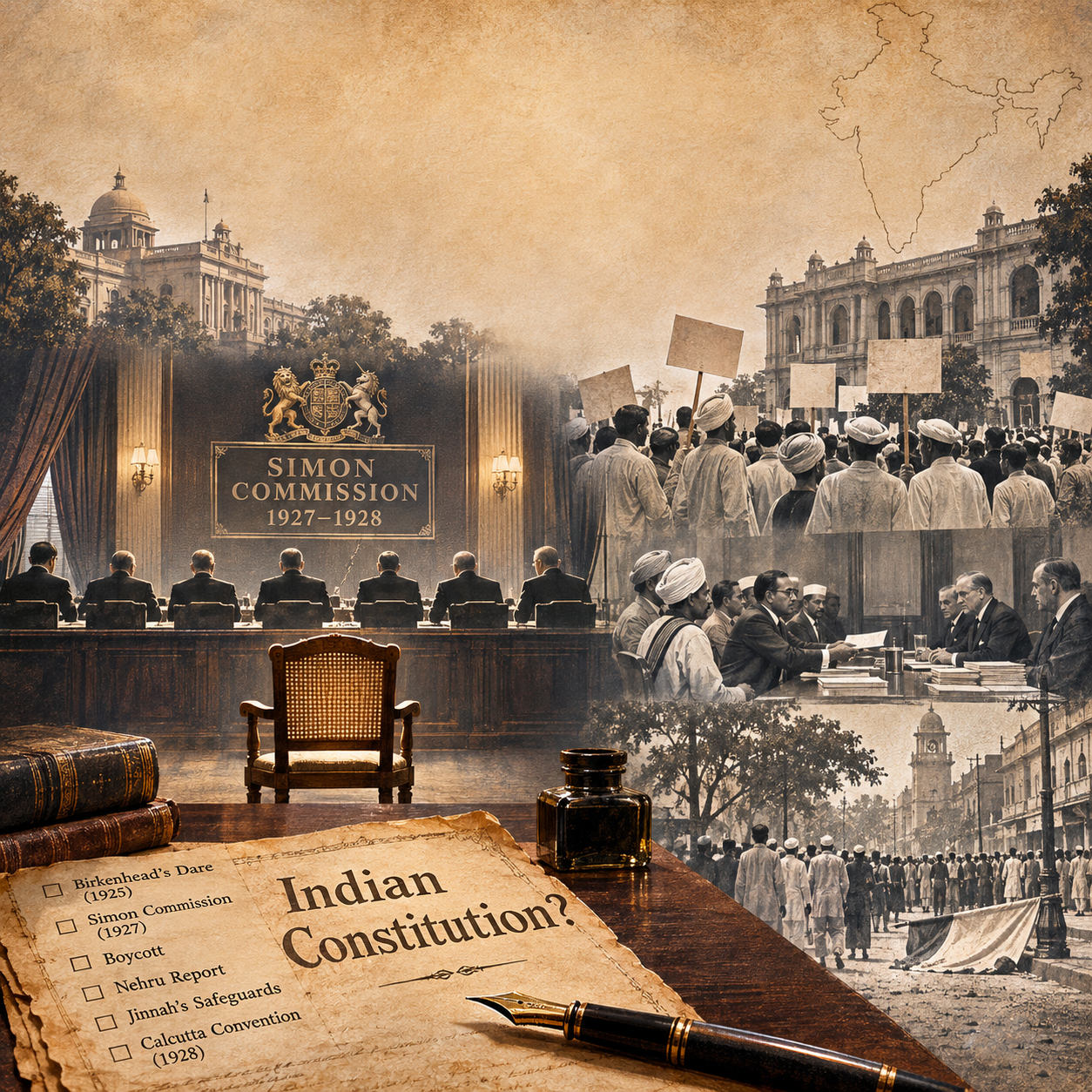
Gandhi’s Simon Challenge: The Dare, the Boycott and the Breakdown (231)
भारत / GB
Part 231: Mahatma Gandhi’s Peace Efforts (Residue Enters Constitution) | Series Index
Blog 230 followed the students who walked out of their colleges on Gandhi’s call in 1920 — the walk-out that began at Aligarh — and found that the boycott left them with nothing, while those it never moved kept their institutions and their degrees. Seven years later the same method was applied to the constitution itself. This instalment opens the constitutional chain of 1927–1935 with Gandhi’s Simon Challenge: a British dare to Indians to agree on a constitution, an all-white commission that every major party boycotted, the groups that stayed in the room and put their demands on record, the reversal of the 1927 Madras understanding, and the deadline Gandhi set at Calcutta when the agreement failed.
Thank you for reading this post, don't forget to subscribe!THE SIMON RECORD: 1925–1928
The Action Taken: In July 1925 the Secretary of State, Lord Birkenhead, told critics of British rule that an agreed Indian constitution would receive full and fair consideration. On 2 November 1927 Viceroy Lord Irwin summoned Gandhi and Jinnah to New Delhi to hand them advance notice of a seven-member Statutory Commission under Sir John Simon with no Indian member. Congress resolved at Madras (December 1927) to boycott it “at each stage and in every form” and passed a resolution for complete independence. In January 1928 Gandhi called the independence resolution “hastily conceived and thoughtlessly passed” and a “tragedy”, stayed at Sabarmati during the 1928 boycott tour, saw Congress’s 1927 Madras understanding with Jinnah reversed in the Nehru Report, and at Calcutta in December 1928 turned the unagreed report into a one-year ultimatum to Britain.
Who Paid the Price: Lala Lajpat Rai, struck in the police lathi charge at Lahore on 30 October 1928, who died on 17 November. And the national case itself: the groups that boycotted left no evidence before the Commission, while those that cooperated placed their claims for separate representation on its official record, and the Muslim League reunited behind separate electorates after the 1928 reversal.
Why This Matters: Birkenhead’s dare tested the one thing Gandhi’s 1920 compact had promised — Hindu–Muslim agreement. India met the boycott half of the test in unity, and failed the agreement half on the very terms the Khilafat years had made non-negotiable.
1. The Dare: “Produce an Agreed Constitution”
The Government of India Act of 1919 provided for a review after ten years. On 7 July 1925, in a speech in the House of Lords, Lord Birkenhead set the terms on which Britain would hear India: if the critics of British rule could put forward an agreed proposal for a constitution, it would receive full and fair consideration. The challenge was double-edged. It invited Indians to write their own constitution, and it bet that they could not agree on one.
When the Statutory Commission was named in November 1927, its membership answered the first edge. Birkenhead moved seven names in the House of Lords on 24 November 1927 — Sir John Simon, Viscount Burnham, Lord Strathcona, Edward Cadogan, Stephen Walsh, George Lane-Fox and Clement Attlee (Vernon Hartshorn soon replaced Walsh). There was no Indian among them. India would be examined; it would not be represented.
Six days before the public announcement, on 2 November 1927, Viceroy Lord Irwin summoned Gandhi and Muhammad Ali Jinnah to Viceroy’s House in New Delhi to hand them the British statement in advance. Writing in Young India that month, Gandhi framed the exclusion as a matter of self-respect—stating that Indians had no right to complain about a British parliamentary body’s composition, only a duty to abstain from giving evidence before it. Gandhi’s Simon Challenge began as a national insult, and the boycott response was swift—while Gandhi’s own framing confined his response to abstention rather than launching a street movement.
2. The Boycott That United — and the Boundaries Set From Sabarmati
Standard accounts treat 1924–1928—the four-year span following Gandhi’s early release from Yerwada Jail on 5 February 1924—as an interregnum in which constitutionalists like Motilal Nehru and C.R. Das held command while Gandhi remained in retirement at Sabarmati. The written record of 1927–1928 records Gandhi intervening at key points whenever Congress resolutions moved beyond Dominion Status.
The Congress met at Madras on 26–28 December 1927 under Dr. M.A. Ansari and resolved to boycott the Commission “at each stage and in every form”. The same session, on Jawaharlal Nehru’s motion, declared complete national independence (Purna Swaraj) the goal of the Indian people. On 4 January 1928, Gandhi wrote privately to Jawaharlal Nehru (Collected Works of Mahatma Gandhi, Vol. 41) describing the independence resolution as “hastily conceived and thoughtlessly passed”. Eight days later, in Young India (12 January 1928, “Independence vs. Swaraj”), he publicly termed the resolution a “tragedy” and defended Dominion Status within the British connection —leaving the constitutional framework with Britain intact on the public record.
When the Commission landed at Bombay on 3 February 1928, a hartal was observed across the major cities, and “Simon Go Back” followed it on every stop of its tour. Gandhi stayed at Sabarmati through the first half of 1928; on 30 January he sent his good wishes for the one-day hartal, and from the next day he concentrated on Vallabhbhai Patel’s localized land-revenue campaign in Bardoli. He did not lead the national boycott, which was carried on the ground by Ansari, the Nehrus, Lajpat Rai, Malaviya, and Jinnah’s wing of the League.
That wing is where the Congress- Muslim unity ended. On 13 November 1927, five days after the Commission was announced, the Punjab Muslim League voted to cooperate with it. In December the All-India Muslim League held two sessions: Sir Muhammad Shafi’s at Lahore for cooperation, Jinnah’s at Calcutta for boycott. The Lahore faction was disowned by Calcutta — but it did not go away.
3. Who Stayed in the Room
A boycott is a choice to be absent, and absence has a cost: the record is written by those who are present. Through 1928 the Commission took evidence across India, and three groups made their case before it.
| Group | Position on the Commission | What went on record |
|---|---|---|
| Indian National Congress | Boycott at every stage | No evidence |
| Muslim League (Jinnah) | Boycott | No evidence; demands taken to the All-Parties talks instead |
| Muslim League (Shafi), Punjab | Cooperation (voted 13 Nov 1927) | Muslim claims, including separate electorates, before the Commission |
| Justice Party, Madras | Cooperation | Non-Brahmin claims before the Commission |
| Depressed Classes (Ambedkar, Bahishkrit Hitakarini Sabha) | Gave evidence, October 1928 | Claim to direct political representation for the Depressed Classes |
In Gandhi’s Simon Challenge the pattern is the one Blog 230 traced at Aligarh. The boycott took the nationalists out of the room; those who stayed put their claims for separate treatment on the official record. This instalment does not claim that the Commission’s report simply adopted those memoranda; it did not, and its recommendations were its own. The point is narrower and documented: when the constitutional review of 1928 was conducted, the voice of the national movement was absent from its evidence, by its own decision, and the voices of separate representation were present.
4. The Agreement That Never Came
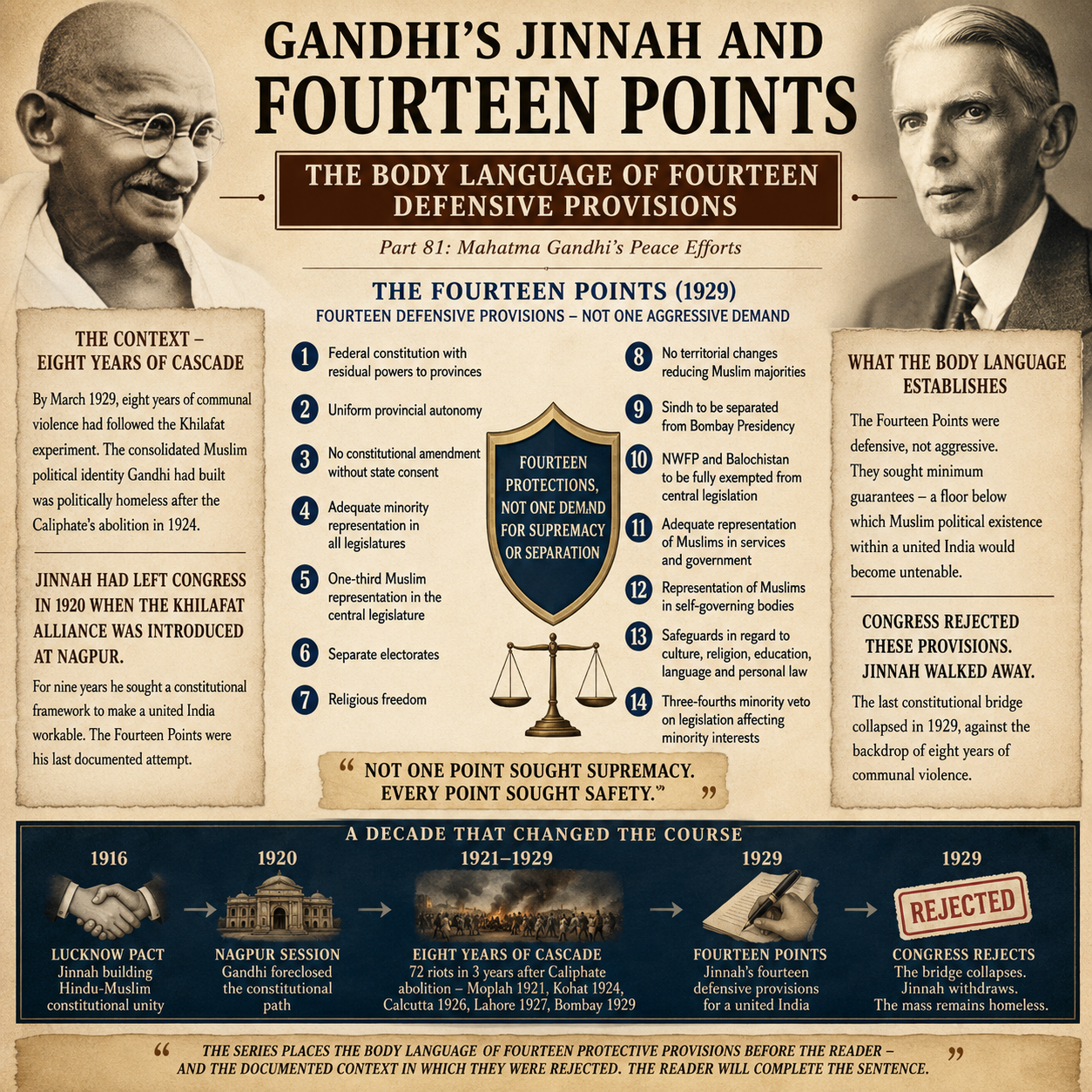
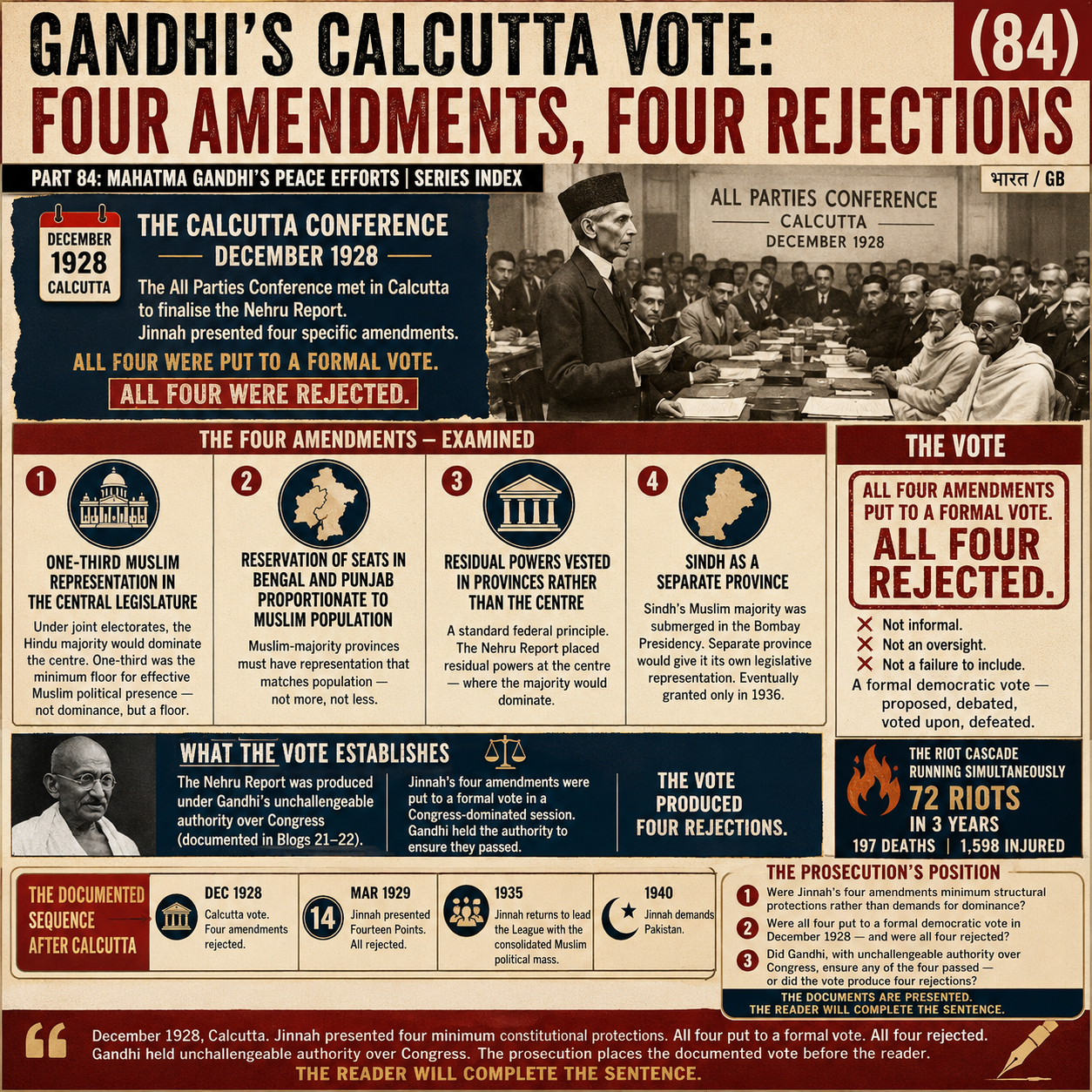
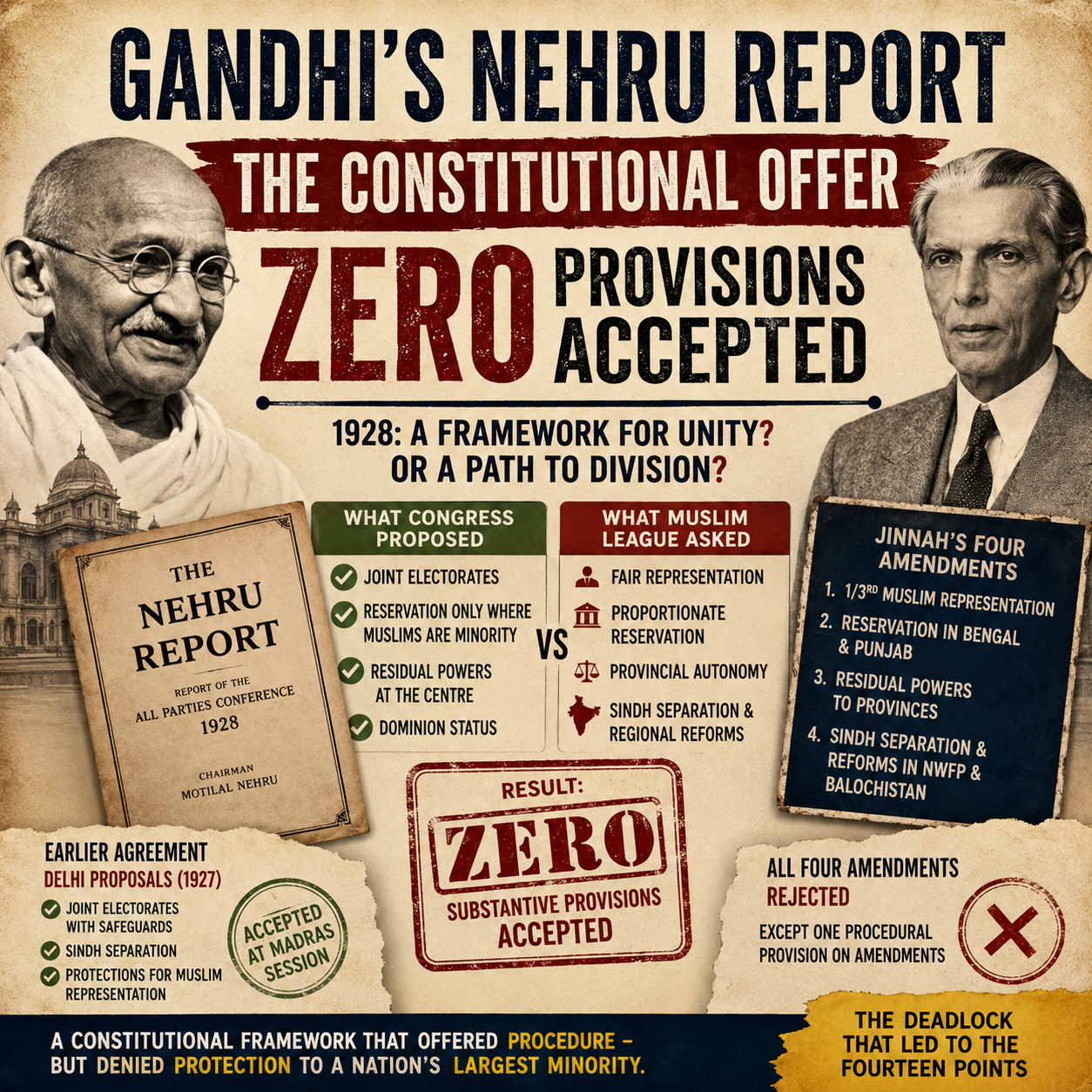
The boycott answered the insult. It did not answer the dare. For that, the Madras Congress called an All-Parties Conference, which met in 1928 and appointed a committee under Motilal Nehru. Earlier, in March 1927, Jinnah had persuaded Muslim leaders in Delhi to abandon separate electorates in exchange for four safeguards: one-third Muslim seats in the Central Legislature, representation proportional to population in Punjab and Bengal, separation of Sindh from Bombay, and reforms in the North-West Frontier Province and Baluchistan—terms accepted by the All-India Congress Committee in May 1927 and by the Madras Congress in December 1927.
When the Nehru Report appeared in August 1928 (Blog 83), pressure from the Hindu Mahasabha (M.R. Jayakar and B.S. Moonje) and Punjab Sikh leaders led the committee to drop Jinnah’s safeguards—canceling the one-third central quota and Punjab/Bengal population guarantees while retaining joint electorates. Gandhi did not intervene during the drafting to uphold the 1927 Madras commitment.
At the All-Parties Convention in Calcutta in December 1928, Jinnah’s reduced amendments on behalf of the League were put and rejected (Blog 84), while Gandhi endorsed the report on the floor as satisfying “all responsible aspirations”. The Muslim leaders who had joined the boycott left the agreement, and within three months (March 1929) Jinnah reunited with Sir Muhammad Shafi’s faction behind the Fourteen Points—restoring separate electorates permanently. The boycott front had united against Simon; it could not unite on a constitution.
5. Calcutta: The Failure Turned Into a Deadline
It was at the Calcutta Congress of December 1928 that Gandhi returned to the centre of politics. The younger wing, led by Jawaharlal Nehru and Subhas Chandra Bose, wanted complete independence at once. Gandhi’s resolution carried instead: the Congress adopted the Nehru Report, and if the British Government did not accept it by 31 December 1929, the Congress would launch non-violent non-cooperation.
The resolution did two things at once. It held the Congress together, and it pointed the failure outward. The Nehru Report had failed its own test — the agreement of the “great peoples of India” that Birkenhead’s challenge demanded — at Calcutta itself, weeks before. Gandhi’s resolution presented that same report to Britain as India’s settled demand, with a one-year clock attached. Whether this was tactical necessity or a refusal to face the communal failure is a question of interpretation, and this instalment labels it as such. What is documented is the sequence: the agreement failed in December 1928, and in the same month the failed agreement became an ultimatum.
That is the core of Gandhi’s Simon Challenge. Britain’s dare was about agreement among Indians. Gandhi’s answer was about a deadline for the British.
6. The Price at Lahore
The boycott was not cost-free on the street. When the Commission reached Lahore on 30 October 1928, Lala Lajpat Rai led a peaceful demonstration at the railway station. According to contemporary eyewitness reports, he was identified, singled out, and struck in the police lathi charge, dying on 17 November 1928. The man who had led the Hindu Mahasabha’s boycott and Punjab’s protest became the movement’s most prominent casualty of 1928 — and the revenge taken for his death by young revolutionaries in December opened another chain the series follows separately.
Read together, these events complete Gandhi’s Simon Challenge: a dare to agree, a boycott that united, a boycott front whose staunchest leader paid for it with his life at Lahore, a field left to the advocates of separate representation, an agreement that failed after the 1927 Madras terms were dropped, and a failure that Gandhi converted into a one-year deadline for Britain rather than a reckoning at home. The record had already shown what his one-year deadline of December 1920 for Swaraj had produced. The constitutional chain that follows — Lahore 1929, the salt campaign, the Round Tables and the Communal Award — begins from that conversion. It was the first time the constitution itself was put to the test of the 1920 compact; the test was failed, and the failure was renamed
Invitation To Defence
Birkenhead’s 1925 invitation to produce an agreed constitution, Viceroy Lord Irwin’s 2 November 1927 summons of Gandhi to New Delhi, the all-white membership of the Statutory Commission (House of Lords, 24 November 1927), Gandhi’s January 1928 rebuke of the Madras complete independence resolution, the reversal of Congress’s 1927 Madras acceptance of Jinnah’s Delhi Proposals, the evidence given by the Justice Party and by Ambedkar, the rejection of the League’s amendments at Calcutta, and Gandhi’s December 1928 resolution with its 31 December 1929 deadline are established exhibits. The defence is invited to produce any step taken by Gandhi between November 1927 and December 1929 to uphold Congress’s 1927 Madras agreement with Jinnah before presenting the Nehru Report to Britain as India’s demand, or any statement in which he weighed the cost of leaving the Commission’s record to those who sought separate representation.
Britain dared India to agree on a constitution. India united to boycott the commission that was meant to hear it, and then could not agree after the 1927 Madras terms were dropped. Those who stayed in the room put separate representation on the record. At Calcutta in December 1928 the agreement failed — and in the same month Gandhi handed Britain the failed agreement with a one-year deadline.
Feature Image: Click here to view the image.
Videos
Glossary of Terms
- Simon Commission: A seven-member British Statutory Commission appointed in November 1927 under Sir John Simon to review India’s constitutional system. It contained no Indian member.
- Statutory Commission: A commission established under statutory provisions to examine and review a particular matter. The Simon Commission was appointed to review the constitutional arrangements introduced under the Government of India Act of 1919.
- Lord Birkenhead’s Dare: The July 1925 challenge issued by British Secretary of State Lord Birkenhead, asking Indian political leaders to produce an agreed constitutional proposal that Britain would consider fully and fairly.
- Dominion Status: A constitutional arrangement under which India would enjoy substantial self-government while retaining a constitutional relationship with the British Crown and Empire.
- Purna Swaraj: Complete national independence, declared as the goal of the Indian people through the Congress resolution adopted at Madras in December 1927.
- Simon Go Back: The protest slogan used by Indians to oppose the Simon Commission because all seven members were British and no Indian had been included in its membership.
- All-Parties Conference: A political gathering convened in 1928 to develop an agreed constitutional proposal in response to Lord Birkenhead’s challenge. It appointed a committee under Motilal Nehru.
- Delhi Proposals of 1927: Constitutional safeguards proposed by Muhammad Ali Jinnah in March 1927, offering to abandon separate electorates in exchange for Muslim representation guarantees and other constitutional concessions.
- Nehru Report: The constitutional report prepared in 1928 by a committee chaired by Motilal Nehru. Its provisions, particularly concerning joint electorates and political representation, became a major source of disagreement.
- Separate Electorates: An electoral arrangement under which members of a particular community elect representatives from their own community rather than participating exclusively in a common electorate.
- Joint Electorates: An electoral arrangement in which voters from different communities participate in a common electorate to elect representatives, rather than voting exclusively through separate communal constituencies.
- Jinnah’s Fourteen Points: Fourteen constitutional demands presented by Muhammad Ali Jinnah in 1929 after the failure of the constitutional negotiations. They included safeguards for Muslim political representation and provincial autonomy.
- Lala Lajpat Rai: Indian nationalist leader who led the Lahore demonstration against the Simon Commission on 30 October 1928, was struck during a police lathi charge, and died on 17 November 1928.
- Calcutta Convention of 1928: The All-Parties Convention held in December 1928 where Jinnah’s proposed amendments to the Nehru Report were rejected, exposing the failure to secure an agreed constitutional settlement.
- Gandhi’s Simon Challenge: The central analytical phrase of this instalment, describing the sequence in which Gandhi and Congress confronted Britain’s challenge to produce an agreed constitution, supported the Simon Commission boycott, and subsequently faced the breakdown of constitutional agreement over the Nehru Report and Jinnah’s safeguards.
#SimonCommission #MahatmaGandhi #IndianHistory #IndianIndependence #BritishIndia #NehruReport #MuhammadAliJinnah #LalaLajpatRai #IndianPolitics #HinduinfoPedia
Scan Through The Entire Series at
Refer to Various Arks Referred to in the Blog
a https://hinduinfopedia.in/gandhis-simon-challenge-the-dare-the-boycott-and-the-breakdown-231/