
Gandhi’s Khilafat Two-Track Takeover: Jinnah Out, Mohani In (218)
भारत / GB
Part 218: Mahatma Gandhi’s Peace Efforts (Non-Cooperation & Khilafat Arc) | Series Index
In the preceding instalments, we traced how Gandhi’s 1920 endorsements were translated into Urdu mosque mobilisation (Blog 215), which classical Islamic jurists and constitutional leaders he bypassed (Blog 216), and how those 1920–1922 Khilafat interventions created the four root causes behind the September 1924 attacks on Kohat’s Hindus and Sikhs (Blog 217). Having examined the Frontier consequences, this blog, Gandhi’s Khilafat Two-Track Takeover, turns back to the institutional centre in 1920–1922 to document the two mechanisms by which the Khilafat apparatus took over Congress operations: Track 1, external extraction of Congress money, cadres, and platform legitimacy by the Ali Brothers, Abdul Bari, and the Jamiat Ulema-e-Hind outside Congress discipline; and Track 2, internal subordination of Congress policy by Hasrat Mohani from inside the Congress Working Committee after Muhammad Ali Jinnah was driven out at Nagpur.
Thank you for reading this post, don't forget to subscribe!THE TWO-TRACK KHILAFAT TAKEOVER OF THE CONGRESS (1920–1922)
The Action Taken: Between December 1920 and December 1921, the Khilafat movement worked on the Indian National Congress through two simultaneous and structurally distinct tracks. Track 1 — External Extraction: Abdul Bari, Muhammad Ali, Shaukat Ali, and the Jamiat Ulema-e-Hind drew Congress money from the Tilak Swaraj Fund, Congress cadres, national amplification through Young India, and institutional legitimacy — while operating entirely outside Congress discipline and conducting Khilafat agitation on their own theological and political terms. Track 2 — Internal Subordination: Hasrat Mohani — sitting simultaneously inside the Congress Working Committee and the Khilafat central leadership — worked from within to pull Congress policy toward Khilafat priorities, moving the Purna Swaraj resolution at the Ahmedabad Congress in December 1921 (opposed by Gandhi) to break Congress away from its constitutional Dominion Status framework.
Who Paid the Price: Muhammad Ali Jinnah — the foremost constitutional Muslim politician in India — was driven off the Nagpur Congress platform by Gandhi’s supporters in December 1920 when he opposed mixing mass agitation with clerical authority. His displacement from Congress removed the one formation that could have pursued civic Non-Cooperation without Khilafat subordination, leaving the Congress Muslim constituency divided between Track 1 extractors and Track 2 subordinators, with no independent constitutional Muslim voice inside the movement.
Why This Matters: The claim that Gandhi’s 1920–1922 Congress–Khilafat alliance represented Hindu–Muslim unity was structurally false. No third category existed: Muslims in the alliance were either extracting Congress for Khilafat purposes from outside (Track 1) or subordinating Congress to Khilafat purposes from inside (Track 2). The expulsion of Jinnah — the one Muslim leader who had built a civic, rights-based politics alongside Congress since the Lucknow Pact of 1916 — was not incidental to this structure. It was the structure.
1. Track 1 — External Extraction: Drawing Congress Resources Without Congress Discipline
The Tilak Swaraj Fund — raised in the name of Bal Gangadhar Tilak in 1920 (a collection some contemporary critics, including Dr. B.R. Ambedkar, later questioned over uncounted disbursements) to finance Non-Cooperation — became the primary financial reservoir from which Khilafat formations drew resources for agitation that Congress neither controlled, directed, nor took responsibility for, instead downplaying communal crimes when violence erupted. Abdul Bari of the Firangi Mahal seminary in Lucknow, whose fatwa network had transmitted the Dar-ul-Harb declaration through the Deobandi and Barelvi circuits documented in Blog 215, operated directly alongside Congress platforms while maintaining autonomous clerical authority over the theological content of the agitation. Muhammad Ali and Shaukat Ali toured Sindh and Punjab on joint platforms with Gandhi in July 1920, reached Urdu-language mosque audiences with Quranic injunctions — including verse 4:97 on Hijrat duty and verse 4:93 on the religious prohibition of Crown military service — that Gandhi’s English-language statements never acknowledged, and drew audiences mobilised as much by Khilafat theology as by Non-Cooperation politics.
The Jamiat Ulema-e-Hind, formally constituted at the very November 1919 Delhi Khilafat Conference where Gandhi was elected President, provided the clerical infrastructure that converted Congress’s mass-movement reach into Khilafat mobilisation at the district and sub-district level. Its fatwa networks, mosque pulpits, and madrasa circuits operated on their own institutional authority — not under Congress supervision — while benefiting from the Congress platform in amplifying its cause and presumed grievance, Congress funds, and Gandhi’s personal endorsements in Young India. This is the first track of Gandhi’s Khilafat two-track takeover: a formation outside Congress using Congress resources, Congress amplification, and Gandhi’s public authority to advance a theological-political programme Congress had not authorised and could not discipline.
2. Track 2 — Internal Subordination: Hasrat Mohani and the Congress Working Committee
Hasrat Mohani — Urdu poet, Khilafat activist, and Congress Working Committee member — occupied a structurally unique position in the 1920–1922 period: he sat simultaneously inside Congress’s governing body and inside the Khilafat central leadership, giving Khilafat leaders direct voice in Congress policy formation from within. At the Ahmedabad Congress session in December 1921, Mohani moved a resolution defining Swaraj as Purna Swaraj — complete independence free from all British connection — which Gandhi opposed as premature and which the session rejected. Mohani openly linked this demand on the session floor to British hostility toward the Ottoman Caliphate. Regardless of its immediate defeat, the resolution demonstrated how an office-bearer sitting inside both bodies simultaneously could push Congress policy away from the constitutional Dominion Status framework that Gandhi and Jinnah had represented and toward the maximalist posture of the Khilafat platform.
Mohani’s dual position — Working Committee member and Khilafat leader simultaneously — was not a personal anomaly but a structural consequence of the Nagpur compact of December 1920, by which Gandhi had made the Congress–Khilafat alliance the organisational basis of Non-Cooperation. Having driven Jinnah off the platform and out of Congress for insisting on a separation between constitutional politics and clerical agitation, Gandhi had created the condition in which the only Muslims who remained inside Congress were those prepared to operate on Khilafat terms. Mohani was the clearest expression of that condition: this is the second track of Gandhi’s Khilafat two-track takeover, internal subordination working alongside Track 1’s external extraction.
3. The Nagpur Transaction: Driving Out Jinnah to Install the Two Tracks
Muhammad Ali Jinnah attended the Nagpur Congress session of December 1920 and took the floor to oppose Gandhi’s Non-Cooperation programme on a single, precise ground: mixing mass agitation with clerical religious authority would create forces that neither Gandhi nor Congress could control or redirect once released. He addressed Gandhi directly as “Mr. Gandhi” — dropping the “Mahatma” honorific in a deliberate signal of political rather than devotional address — and was heckled off the platform by Gandhi’s supporters. He subsequently withdrew from the Congress entirely, never to return.
Jinnah’s displacement was not incidental to Gandhi’s Khilafat two-track takeover — it was its precondition. As long as Jinnah remained inside Congress with organisational credibility, a third position was structurally possible: civic Muslim politics, Non-Cooperation pursued on constitutional grounds without theological subordination to the Khilafat clerical apparatus. His removal closed that possibility. The Congress Muslim constituency was left divided between Track 1 formations extracting Congress from outside and Track 2 operators subordinating Congress from inside, with the constitutional Muslim political leadership that had co-built Congress since the Lucknow Pact of 1916 now outside the tent. Jinnah’s Nagpur warning — that the agitation would produce consequences Congress could not control — was fulfilled in under two years, producing the Malabar killings of 1921 when the Khilafat formations his expulsion had empowered redirected their theological and organisational infrastructure against Hindus and Sikhs in Malabar, Kohat, and across north India.
4. The Structural Proof: No Third Category Existed
The claim that Gandhi’s 1920–1922 Congress–Khilafat alliance represented genuine Hindu–Muslim unity depends on the existence of a third category of participants: Muslims in the alliance who were neither extracting Congress for Khilafat purposes from outside (Track 1) nor subordinating Congress to Khilafat purposes from inside (Track 2), but pursuing a civic, shared constitutional politics alongside Hindus on equal terms. The primary record of the Nagpur Congress, the Ahmedabad Congress, the Tilak Swaraj Fund disbursements, and the Khilafat Conference proceedings of 1920–1922 does not support the existence of this third category at the organisational level. The one formation that represented it — Jinnah’s constitutional Muslim politics — had been driven out of Congress at Nagpur before the alliance reached its operational peak.
P.C. Bamford’s Histories of the Non-Co-operation and Khilafat Movements (1925), compiled from Intelligence Branch reports while the events were current, documents the two formations operating in parallel: the external Khilafat apparatus drawing on Congress resources and amplification, and the internal Khilafat operators working the Congress Working Committee. Bamford’s account does not use the two-track framing, but the operational record he assembled is consistent with it. The structural proof of Gandhi’s Khilafat two-track takeover is not an inference from ideology — it is a reading of the documented organisational record of who controlled what, who was accountable to whom, and whose instructions the formations at district and sub-district level were actually following between 1920 and 1922.
Modern Parallel
The two-track mechanism documented in Gandhi’s Khilafat two-track takeover — external clerical bodies extracting political concessions while operating on autonomous religious authority, paired with internal party operators pushing sectarian agendas from within — recurred directly during the 1985–1986 Shah Bano controversy. Outside the ruling party, the All India Muslim Personal Law Board and Jamiat Ulema-e-Hind mobilised street protests and clerical edicts demanding the reversal of the Supreme Court’s secular maintenance ruling (Track 1). Simultaneously, inside the government and Parliament, Muslim ministers and MPs led by Ziaur Rahman Ansari pressed from within to subordinate constitutional gender equality to clerical demands (Track 2) — isolating and forcing the resignation of constitutionalist minister Arif Mohammad Khan in a direct repeat of Jinnah’s 1920 displacement.
The specific displacement of Jinnah at Nagpur — a constitutional Muslim politician replaced by Mohani, a Khilafat operator — was not Gandhi’s only available choice in December 1920. The primary record shows Gandhi aware of Jinnah’s objections and choosing not to accommodate them. The consequences of Gandhi’s Khilafat two-track takeover — the Malabar rebellion of 1921, the communal contagion of 1922–1924, the Kohat expulsion of 1924 — unfolded from the structure Gandhi had built at Nagpur, not from an external disruption of a unity he had genuinely constructed.
Invitation To Defence
The Congress session records of Nagpur (December 1920) and Ahmedabad (December 1921), the Tilak Swaraj Fund disbursement records, the Khilafat Conference proceedings of 1920–1921, P.C. Bamford’s 1925 Intelligence Branch compilation, and the contemporaneous correspondence of Jinnah, C.R. Das, and Motilal Nehru on the Khilafat alliance are all established archival records. The defence is invited to produce any primary document showing that a structurally independent, non-Khilafat Muslim political formation — accountable to Congress discipline rather than to Khilafat clerical authority — existed and operated inside the 1920–1922 Non-Cooperation movement at the organisational level after Jinnah’s departure from Congress in December 1920.
Between December 1920 and December 1921, the Khilafat movement worked on the Congress through two tracks simultaneously: external extraction of Congress resources by formations operating on autonomous clerical authority, and internal subordination of Congress policy by operators sitting inside the Congress Working Committee. The expulsion of Jinnah — the one Muslim leader who had objected to exactly this structure — was not incidental to Gandhi’s Khilafat two-track takeover. It was its precondition.
https://hinduinfopedia.in/gandhis-khilafat-two-track-takeover-jinnah-out-mohani-in-218/
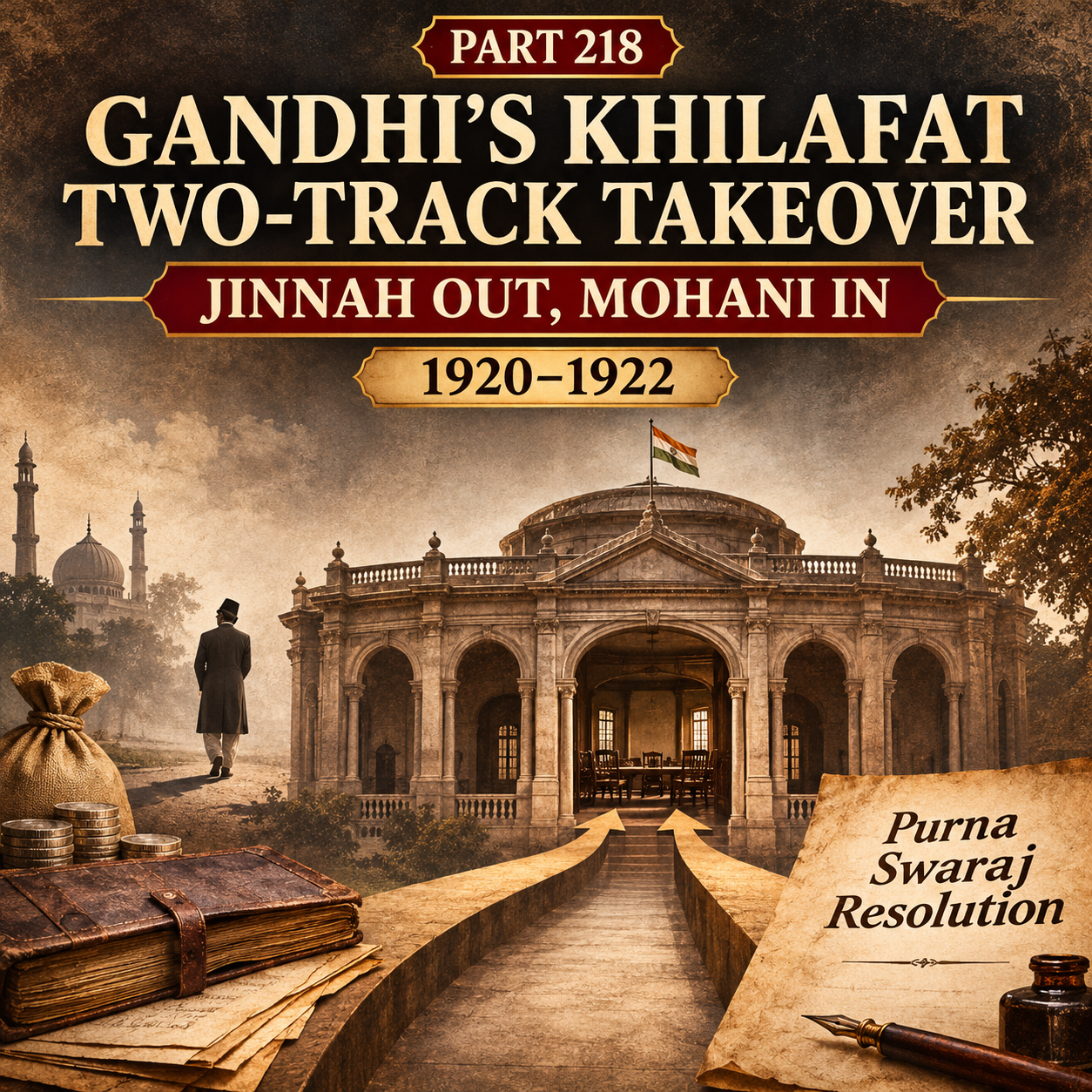
Feature Image: Click here to view the image.
Videos
Glossary of Terms
1. Gandhi’s Khilafat Two-Track Takeover: An analytical framework used in this blog to describe two simultaneous mechanisms through which the Khilafat movement influenced Congress operations between 1920 and 1922: external extraction of Congress resources and internal subordination of Congress policy.
2. External Extraction: The first track of the framework, describing how Khilafat organisations and leaders obtained access to Congress funds, cadres, public platforms and institutional legitimacy while retaining their independent organisational and clerical authority.
3. Internal Subordination: The second track, describing the influence exercised by Khilafat-aligned leaders operating within Congress institutions to direct Congress policy towards Khilafat priorities.
4. Nagpur Transaction: A term used in this blog to describe the political developments at the December 1920 Nagpur Congress session, particularly Jinnah’s displacement and the resulting organisational conditions for the Congress–Khilafat alliance.
5. Constitutional Muslim Politics: A form of political participation based on constitutional methods, civic rights and representative institutions, as distinguished in the blog from politics subordinated to religious mobilisation.
6. Dominion Status: A constitutional arrangement under which India would enjoy substantial self-government while retaining a formal constitutional connection with the British Empire.
7. Purna Swaraj: Complete independence from British rule, without retaining a constitutional connection with Britain. Hasrat Mohani moved a resolution advocating this position at the Ahmedabad Congress session in December 1921.
8. Tilak Swaraj Fund: A fund established in 1920 in the name of Bal Gangadhar Tilak to finance the Non-Cooperation Movement. The blog examines its role as a financial resource accessed by Khilafat formations.
9. Jamiat Ulema-e-Hind: An organisation of Islamic religious scholars formally constituted at the November 1919 Delhi Khilafat Conference, which provided clerical networks and organisational infrastructure for Khilafat mobilisation.
10. Congress Working Committee: The principal governing body within the Congress organisation, responsible for important organisational and political decisions. Hasrat Mohani held membership while also participating in Khilafat leadership.
11. Clerical Authority: Religious leadership exercised through scholars, religious institutions, theological interpretations and associated networks. The blog examines its relationship with political mobilisation and Congress discipline.
12. Hijrat: Migration undertaken for religious reasons. In the context of the blog series, it refers particularly to the 1920 migration movement encouraged through Khilafat-related religious and political mobilisation.
13. Nagpur Congress Session: The December 1920 Congress session at which Muhammad Ali Jinnah opposed Gandhi’s Non-Cooperation programme and the mixing of mass agitation with clerical religious authority.
14. No Third Category: A central analytical argument of this blog suggesting that the Congress–Khilafat alliance lacked an organisationally independent category of constitutional Muslim participation after Jinnah’s departure, between the external and internal mechanisms described.
15. Structural Proof: The method of examining organisational records, institutional authority, financial resources and political accountability to establish how the two-track arrangement operated, rather than relying exclusively on ideological interpretations.
#Gandhi #Khilafat #Jinnah #Mohani #Congress #IndianHistory #FreedomMovement #NonCooperation #PoliticalHistory #HinduinfoPedia
Scan Through The Entire Series at