
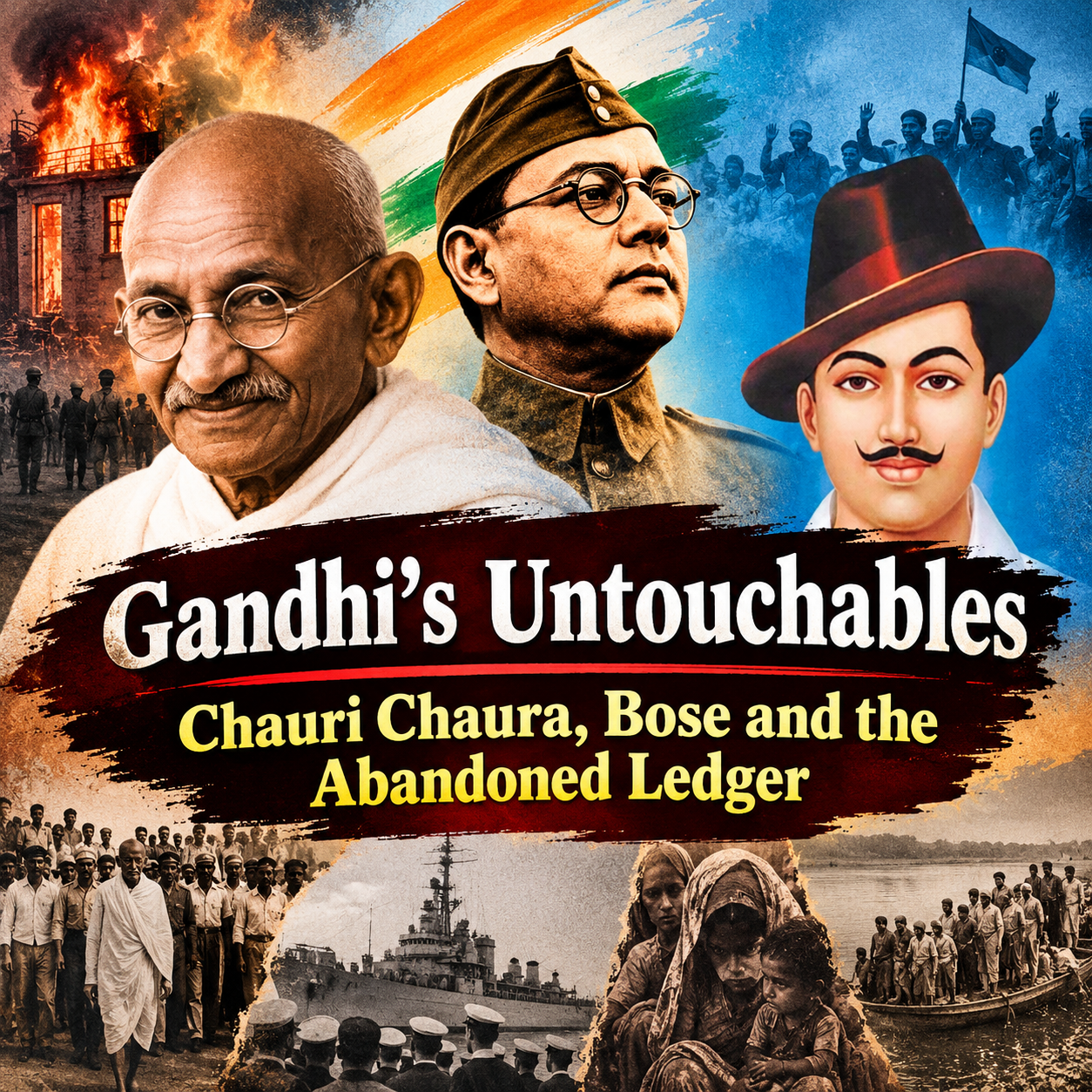
Gandhi’s Untouchables Abandoned Ledger: The Abandoned Ledger from Bose to Sandeshkhali (175)
भारत / GB
Part 175: Mahatma Gandhi’s Peace Efforts | Series Index
Blog 174 placed before the reader Gandhi’s living flood — the two keys turned between 1919 and 1947, and what is still running seventy-six years after his death. This post turns to a question the macro record does not answer: who paid for the experiments? The prosecution’s name for the answer is Gandhi’s untouchables abandoned ledger — the functional political category of persons whose suffering, sacrifice, or inconvenient stance could not be acknowledged without destroying the myth of the bloodless, morally infallible Mahatma. Gandhi spent his public life campaigning against untouchability. The prosecution places the record of what he created alongside that campaign.
Thank you for reading this post, don't forget to subscribe!THE HISTORICAL RECORD — THE ABANDONED LEDGER
The Pattern: The myth of bloodless, morally sovereign non-violence was sustained by externalising all human, physical, and financial cost onto the common Indian citizen. When an experiment collapsed or turned bloody, the leadership walked away morally pure. The foot soldiers went to the gallows. The targeted communities were told to suffer non-violently. The rivals who demanded accountability were hounded out. The prosecution’s name for those left in each category is Gandhi’s untouchables abandoned ledger — not a caste classification but a functional political one: anyone whose suffering or sacrifice could not be touched without cracking the myth.
The Lethal Exhibit: When Gandhi’s Non-Cooperation Movement produced Chauri Chaura, Gandhi suspended the national movement and walked away from 172 peasant volunteers facing the colonial gallows. It was Pandit Madan Mohan Malaviya who appeared before the Allahabad High Court and saved over 150 of them from execution. Not Gandhi. Not the Congress high command. The man who had organised those peasants into a national movement treated their legal defence as morally contaminated. The prosecution places that sequence before the reader.
Why it matters: Gandhi campaigned against untouchability as a caste evil throughout his public life. The prosecution does not dispute that campaign. It places alongside it the functional political category Gandhi’s choices created: the condemned foot soldiers, the inconvenient rivals, the communal sacrifices, the downstream remnants — each rendered untouchable by the same mechanism. The reader will place the two records side by side.
The Semantic Inversion
Gandhi’s public campaign against caste untouchability is in the documented record. He renamed the untouchables Harijans — children of God. He made their uplift a stated objective of the Congress programme. The prosecution does not dispute the record of that campaign.
The prosecution places alongside it a second record. In the functional political vocabulary of the independence movement Gandhi led, “untouchable” acquired a second meaning. An untouchable was anyone whose suffering, sacrifice, or political position could not be acknowledged — could not be touched — without threatening the narrative of non-violent moral sovereignty that Gandhi’s authority rested on.
The condemned peasant whose violence Gandhi had organised but now disowned: untouchable. The revolutionary whose armed resistance Gandhi’s doctrine could not accommodate: untouchable. The Hindu community whose massacre by Gandhi’s own Khilafat allies would have destroyed the alliance if named directly: untouchable. The elected Congress President who refused passive submission and was popular enough to threaten Gandhi’s monopoly: untouchable. The displaced families in Bengal whose plight cannot be named without disrupting the appeasement calculus that is the Khilafat alliance’s living heir: untouchable.
The prosecution places the accumulated record of these categories before the reader in sequence.

The Rival Who Could Not Be Controlled
Subhas Chandra Bose was elected President of the Indian National Congress at the Haripura session in 1938. He was re-elected at the Tripuri session in February 1939 — defeating Pattabhi Sitaramayya, Gandhi’s preferred candidate, by 1,580 votes to 1,377 in a direct democratic contest among Congress delegates.
Gandhi’s response to the result is on the documented record. He declared that Sitaramayya’s defeat was “more mine than his.” The Congress Working Committee — whose members owed their positions to Gandhi’s backing — resigned collectively, leaving Bose with a presidency he could not administer. No formal resolution removed Bose. No constitutional mechanism was invoked. Gandhi’s declared personal stake in the rival candidate’s loss was sufficient to make the Working Committee’s cooperation unavailable. Bose resigned in April 1939 and left the Congress.
The prosecution places the Tripuri sequence alongside the Khilafat alliance. In 1920, Gandhi chose the ulema over Jinnah’s constitutional framework — the man who had built the Congress-League Lucknow Pact of 1916 was sidelined in favour of a foreign-backed religious mobilisation. The prosecution placed that record before the reader in Blog 82. In 1939, Gandhi chose Sitaramayya over Bose — the man who would have pressed for a harder settlement, who had the democratic mandate of the Congress electorate, and who was made politically untouchable because his popularity threatened the moral-authority monopoly the series has documented across seven arcs.
Bose formed the Forward Bloc. When the Second World War came, he concluded — correctly, as events proved — that the British were militarily vulnerable and that armed pressure from outside could accelerate the transfer. He raised the Indian National Army. He died in August 1945. The settlement he might have negotiated — from a position of demonstrated military capacity, without the eleven-week compression, without Dominion status — is not in the record. Gandhi’s untouchables abandoned ledger places the question before the reader.
The Foot Soldiers Thrown to the Gallows
The Chauri Chaura incident of February 4, 1922 is in the documented record. A crowd of Non-Cooperation Movement protesters, fired upon by police, retaliated by burning the Chauri Chaura police station. Twenty-two constables were killed. Gandhi suspended the entire Non-Cooperation Movement within days, citing a Himalayan miscalculation. The Bardoli Resolution of February 11–12, 1922, passed by the Congress Working Committee, formally ended the movement.
One hundred and seventy-two peasant volunteers — men who had organised, marched, and demonstrated under the banner Gandhi had raised — were tried for the incident. They faced hanging. The Congress high command that had mobilised them treated their defence as the wrong kind of problem. It was Pandit Madan Mohan Malaviya who entered the Allahabad High Court and fought their cases. Over 150 of the 172 were saved from the gallows by Malaviya’s legal intervention, not by the movement that had recruited them.
The prosecution places the arithmetic alongside the suspension. Gandhi called off a national movement to protect his moral authority. The cost of that decision — the gallows facing 172 peasants — was paid by those peasants, not by Gandhi.
The Civil Disobedience Movement produced a second accounting. Across the 1930–1932 period, more than 60,000 Indians were imprisoned. The 1942 Quit India Movement produced upwards of 100,000 detentions. Families lost land, livelihoods, and ancestral property to colonial seizures. The names of those who were beaten and killed across the salt marches — in Dharasana, in Peshawar, across the country — are not consolidated in any official record the movement produced. They are the unnamed entry in Gandhi’s untouchables abandoned ledger.
The Gandhi-Irwin Pact of March 5, 1931 is the terminal exhibit in this category. Gandhi negotiated the release of Congress civil disobedience prisoners. He negotiated salt manufacture permissions on the coast. He did not make the commutation of Bhagat Singh’s death sentence a condition of the Pact — a condition he had the standing to demand and the British had reason to consider. Bhagat Singh, Sukhdev, and Rajguru were hanged on March 23, 1931, eighteen days after the Pact was signed. The prosecution placed that sequence before the reader in Blog 173.
The moral absolutism Gandhi applied was not applied symmetrically. It was applied against Indian patriots whose methods his doctrine could not accommodate. It was not applied against the colonial authority that held those patriots’ lives in its administrative power and could have been pressed.
The Communal Outcasts: Malabar to Murshidabad
The Moplah uprising of August 1921 is the founding exhibit of a template the prosecution has documented across six blogs. The record was placed before the reader beginning at Blog 54. The Khilafat movement Gandhi had built and led produced, in its first year of operation, documented forced conversions, displacement, and killing of Malabar Hindus. Gandhi’s response established three moves that are now in the institutional record: deny or dilute the communal and ideological motivation; frame the perpetrators as reactive to structural conditions; preach non-violence exclusively to the victims.
Gandhi called the Moplah perpetrators “brave God-fearing men.” The Malabar Hindus who were killed, converted, and displaced were rendered untouchable in the political vocabulary of the movement: to name their suffering directly would have required naming the Khilafat alliance as the cause, which would have ended the alliance. The alliance was worth more to Gandhi’s programme than the accounting.
The prosecution traces that template forward without a break in the institutional record.
Marichjhapi, 1979. Dalit Bengali Hindu refugees — Namasudras who had fled East Pakistan — settled on Marichjhapi island in the Sundarbans. The Left Front government under Jyoti Basu blockaded food, water, and medicine. Police fired on them. Bodies were thrown into the rivers. The count of dead has never been officially established. The political machinery that inherited Gandhi’s appeasement template treated those refugees as untouchable: to account for their deaths would have required naming the administrative choice that produced them.
Sandeshkhali, 2024. Systematic land-grabbing, sexual violence, and intimidation of rural Hindu communities occurred under documented state patronage. The administrative response was silence. The media ecosystem that executes the Moplah template at institutional scale — documented in the prosecution’s record at Blog 176 — treated the victims as untouchable: their plight could not be named without disrupting the vote-bank calculus the appeasement template now serves.
Murshidabad, 2024. During protests against the Waqf Amendment Act, arson, targeted attacks, and the displacement of Hindu families across district borders were met with administrative silence and selective reporting. Dozens of families left their homes. The Bengal government’s response confirmed the template: the perpetrators were framed as reacting to a provocation; the victims were told — implicitly, through the silence — to absorb the cost.
The prosecution places the sequence before the reader: 1921 Malabar → 1979 Marichjhapi → 2024 Sandeshkhali → 2024 Murshidabad. The template has three moves. It has been executed without modification across 103 years. Gandhi’s untouchables abandoned ledger is the name for everyone in that sequence whose suffering the template required to be left unaccounted.
The East Timor counter-exhibit belongs here. East Timor was separated from Indonesia in 1999 through a self-determination referendum. It lives today without a Line of Control, without four wars, without organisations sheltered in Indonesia’s territory whose stated objective is East Timor’s destruction. The reason is structural: the separation did not require the creation of a state whose founding logic is the theological and civilisational negation of its neighbour. Pakistan was not carved out as an administrative boundary. It was founded on the proposition that the subcontinent’s Muslims and Hindus constituted two nations that could not coexist — a proposition that required two decades of unilateral concession and identity consolidation to manufacture, and that Gandhi’s Khilafat alliance was the first and most consequential instrument of. Because Pakistan’s state logic is India’s negation, it cannot resolve into a peaceful neighbour. The Line of Control does not move. East Timor’s border with Indonesia is not a line of control. The creation process is the difference.

The Prosecution’s Position
Gandhi’s untouchables abandoned ledger places three questions before the reader.
- Does the sequence — 172 Chauri Chaura peasants abandoned to the gallows while Gandhi suspended the movement that recruited them; Bhagat Singh’s death sentence not made a condition of the Gandhi-Irwin Pact; 60,000 and 100,000 prisoners in 1930 and 1942 whose family losses are unrecorded; Bose hounded from the Congress presidency by the withdrawal of Working Committee cooperation after a democratic election — constitute an exhibit the reader places alongside the claim that the cost of Gandhi’s experiments was shared equitably between the leadership and the common Indian?
- Does the template — Moplah 1921, three moves, perpetrators framed as reactive, victims told to absorb — constitute an exhibit the reader places alongside its unbroken replication at Marichjhapi 1979, Sandeshkhali 2024, and Murshidabad 2024, and alongside the claim that Gandhi’s appeasement choices and their contemporary institutional heirs are unconnected?
- Does the East Timor counter-exhibit — a separation achieved without a founding charter of civilisational negation, without a Line of Control, without four wars — constitute an exhibit the reader places alongside the claim that the India-Pakistan configuration was the only possible outcome of the subcontinent’s partition, rather than the predictable result of two decades of identity consolidation that Gandhi’s Khilafat alliance initiated and Gandhi’s choices sustained?
The series does not answer. Gandhi’s untouchables abandoned ledger places the categories before the reader — the condemned foot soldiers, the hounded rival, the communal sacrifices, the downstream remnants — and asks the reader to place them alongside the campaign against caste untouchability that the same man conducted, with the same moral authority, in the same decades. The reader will complete the sentence.
Invitation To Defence
The floor belongs to the defense. We now invite them to present their exhibits and challenge the narrative established by the prosecution.
One hundred and seventy-two peasants faced the gallows at Chauri Chaura. Malaviya saved them. Gandhi suspended the movement and walked away. Bhagat Singh was hanged eighteen days after the Gandhi-Irwin Pact. Bose won the Tripuri election and was made politically untouchable by the withdrawal of Working Committee cooperation. The Moplah perpetrators were called brave God-fearing men. The Malabar Hindu victims were told to absorb the cost. The template ran at Marichjhapi, at Sandeshkhali, at Murshidabad. East Timor separated from Indonesia without a Line of Control and without four wars. Gandhi’s untouchables abandoned ledger places the categories before the reader. The reader will complete the sentence.
← Part 174 | Series Index | Exhibits Table | Forensic Archive
Feature Image: Click here to view the image.
Videos
Glossary of Terms
2. Semantic Inversion: The shift in the meaning of untouchable from a caste-based social category to a political metaphor for people whose suffering or sacrifice could not be acknowledged without challenging an established political narrative.
3. Non-Cooperation Movement: A mass political movement led by Mahatma Gandhi against British colonial rule. Its suspension following the Chauri Chaura incident in February 1922 is central to this blog’s argument.
4. Chauri Chaura Incident: An incident on 4 February 1922 in which protesters burned a police station, killing 22 policemen. Gandhi subsequently suspended the Non-Cooperation Movement, while 172 peasant volunteers faced prosecution.
5. Bardoli Resolution: The Congress Working Committee resolution of 11–12 February 1922 that formally ended the Non-Cooperation Movement following the Chauri Chaura incident.
6. Khilafat Alliance: The political alliance formed around the Khilafat movement, supported by Gandhi and the Congress leadership. The blog presents it as a consequential instrument in Gandhi’s political strategy and examines its alleged communal consequences.
7. Tripuri Sequence: The events surrounding Subhas Chandra Bose’s re-election as Congress President in 1939, Gandhi’s opposition to his leadership, the collective resignation of the Congress Working Committee, and Bose’s eventual resignation.
8. Gandhi-Irwin Pact: An agreement signed on 5 March 1931 between Mahatma Gandhi and Viceroy Lord Irwin. The blog examines Gandhi’s negotiations and his failure to make the commutation of Bhagat Singh’s death sentence a condition of the agreement.
9. Moral Absolutism: The application of uncompromising moral principles to political decisions. In this blog, the term describes the alleged unequal application of Gandhi’s principles to Indian revolutionaries and British colonial authorities.
10. Appeasement Template: A recurring political pattern identified by the author: denying or diluting communal motives, portraying perpetrators as reacting to circumstances, and placing the burden of non-violence on victims.
11. Moplah Uprising: The 1921 uprising in Malabar associated with violence, forced conversions, displacement, and killings affecting Hindu communities. The blog presents Gandhi’s response as an early example of the political pattern examined throughout the series.
12. Marichjhapi: An island in the Sundarbans where Bengali Hindu refugees, including members of the Namasudra community, settled in 1979. The blog discusses the blockade, police violence, displacement, and unresolved death toll associated with the episode.
13. Sandeshkhali: An area in West Bengal associated with allegations of land-grabbing, sexual violence, and intimidation affecting rural communities. The blog uses the 2024 events as a contemporary example of its proposed appeasement template.
14. East Timor Counter-Exhibit: The blog’s comparative example of East Timor’s separation from Indonesia through a 1999 self-determination referendum. It contrasts this separation with the India–Pakistan partition and their differing political and territorial consequences.
15. Vote-Bank Calculus: The political calculation of retaining electoral support from particular communities. The blog uses this term to explain its argument that political considerations can influence whether victims’ suffering is publicly acknowledged.
#Gandhi #MahatmaGandhi #SubhasChandraBose #IndianHistory #IndianFreedomStruggle #ChauriChaura #BhagatSingh #Partition #KhilafatMovement #Congress #Bengal #HinduinfoPedia
Scan Through The Entire Series at
Gandhi’s Peace Efforts: The Questions Before the Mahatma (0)